 |
| ||||||||||||||||||||||||||||||||||||||||
|
| ||||||||||||||||||||||||||||||||||||||||
Institut f�r berufliche Entwicklung e.V.
Berlin
Original title:
Lehrbeispiele f�r die berufspraktische Ausbildung
"Herstellen
von Dachausbauten"
Author: Rolf Becher
First Edition © IBE
Institut f�r berufliche Entwicklung e.V.
Parkstra�e
21-23
13187 Berlin
Order No.: 93-33-3602/2
|
| ||||||||||||||||||||||||||||||||||||||||
Preliminary Remarks
The present booklet contains 7 selected instruction examples to show the manual skills a carpenter must have and logical considerations he must make to meet the requirements of this trade.
The individual instruction examples have been selected so that they can be separately practised and carried out.
The Instruction Examples 2.3. to 2.7. are successively based on each other with the whole complex representing the entire technological flow for joining an upright window roofed with lean-to dormer.
The working drawings show the cross sections and lengths of timbers to be used by the trainees for the relevant steps of work.
Instruction Example 2.7. clearly explains how to calculate the real timber lengths and the recess sizes in the event of different roof pitches.
The logical sequence of the necessary steps of work is given in each instruction example and shown in the respective working drawings.
The hand tools, measuring and testing means, auxiliary accessories, as well as previous knowledge required are also mentioned.
|
| ||||||||||||||||||||||||||||||||||||||||
Instruction Example 2.1.: Making Openings for Roof Superstructures in Existing Roofing
This instruction example explains how to saw out the openings for the roof window to be built in the existing roofing.
Constructional details
- Gable roof as purlin roof with triple upright truss.
- Eaves angle: 45 degrees.
- Rafter distance: 800 mm.
- Roofing consisting of 24 mm thick boards with slating.
- Scaffolding is available at the facade.

Figure
Hand tools
Hammer, hand saw, compass saw, pad saw, bit brace, insert bit of 20 mm diameter, carpenter's pincers
Measuring and testing means
Folding rule
Auxiliary accessories
Marking pencil, roofers' scaffolding, facade scaffolding, safety belt with catch rope
Necessary previous knowledge
Measuring, scribing, boring, sawing, functions of angles, reading of tabular values, reading of drawings
Explanations to the working drawing
1 = area where the roofing is to be removed
|
Sequence of operations |
Comments |
|
1. Determine the sizes for the openings to be saw out and draw a hand sketch. |
See working drawing! |
|
2. Check facade scaffolding for completeness and stability. |
Check covering of uprights for support. |
|
3. Measure-in and scribe on the existing roof face the lower horizontal limitation for removing the roof slates. |
Take the sizes from the hand sketch. Scribe with the marking
pencil at one window only, starting from the centre of the roof window. |
|
4. Measure-in and scribe the lateral limitation of the roof window opening. |
Measure from the centre of the roof window. Start scribing about 100 mm below the lower horizontal limitation and continue until about 300 mm upwards. |
|
5. Remove the roof slates above the lower limitation line. |
Remove the roof slates so that they can be used again. |
|
6. Mount the roofer's scaffolding on the slate roof surface. |
Use scaffolding trestles with brushes. |
|
7. Measure-in and scribe the upper horizontal limitation for removing the roof slates. |
Work on the roofer's scaffolding with safety belt only. |
|
8. Remove the slates up to the upper horizontal limitation of the opening. |
Laterally the opening is limited by the trimmer rafters. |
|
9. Produce a borehole at the inside of the trimmer rafters below the upper limitation line. |
Use a 20 mm diameter bit to enable the compass saw to start. If possible, bore near a roof board joint. |
|
10. Saw out the first board with the compass saw. |
Guide the compass saw blade along the inside face of the trimmer
rafter. |
|
11. Saw out the roof boards up to the lower horizontal limitation using a pad saw and then a hand saw. |
Guide the saw blade along the inside face of the trimmer rafter. |
|
12. Remove the roofers' scaffolding. | |
|
13. Measure-in and scribe the limitation for the next opening. |
Measure from the centre of the first roof window. |

Roof
Superstructures
|
| ||||||||||||||||||||||||||||||||||||||||
Instruction Example 2.2.: Making a Rafter Trimming
This example teaches how to saw out the rafters of the main roof and build in the parapet trimmings in the area of the existing openings for upright roof windows to be built in, in order to make use of the attic.
Constructional details
- Gable roof as purlin roof.- Eaves angle: 45 degrees.
- Rafter distance: 800 mm.
- Parapet trimming to be joined with steel squares and hexagon-head wood screws. Tail rafter to be joined with mortise-and-tenon joint.
- Steel squares and hexagon-head wood screws to be supplied.

Figure
Hand tools
Hammer, hatchet, bit brace, insert bits of 6.2 mm and 3 mm, wrench with 10 mm opening, mortise chisel 24 mm, planing chisel 35 mm, beating wood
Measuring and testing means
Folding rule, engineer's square, water-level
Auxiliary accessories
Pencil, trestles, batten of 2200 mm length, cover strap of 700 mm length, 40 mm thickness and 120 mm width, cover strap of 700 mm length, 24 mm thickness and 120 mm width, 3.1/70 nails, 10/40 hexagon-head wood screws of diameter 6, clamp iron
Necessary previous knowledge
Measuring, plumbing, scribing, boring, mortising, planing (smoothing), reading of drawings
Explanations to the working drawing
The identification figures allocated to the arrows correspond to the numbers of the working steps in the working drawing.
|
Sequence of operations |
Comments |
|
1. Store the tools, auxiliary accessories and parapet trimmings in the attic. |
Do not store them in the immediate working area - danger of accidents! |
|
2. Erect the trestless and put on the rafter trimmings. |
Ensure stability of the trestles! |
|
3. Check the parapet trimmings, decide on the joining side and mark with marking-out mark. |
The joining side is the surface of the roof rafters. |
|
4. Measure the clearance between the trimmer rafters. | |
|
5. Measure the clearance between the trimmer rafters and tail rafters to be produced. | |
|
6. Scribe section at left end of parapet trimming and mark with marking-out mark. |
Use a sharp pencil and the engineer's square. |
|
7. Measure-in, scribe and mark clearance between trimmer rafters, starting from the scribed section line towards the right. |
Place folding rule in parallel with parapet trimming and let folding rule tongues engage properly. |
|
8. Measure-in and scribe measured size between trimmer rafters and tail rafters, starting from the left scribed section line towards the right. |
Scribe a thin line and place the engineer's square! |
|
9. Measure-in and scribe mortise length from scribed line 8. towards the right. | |
|
10. Measure-in and scribe mortise width. |
Measure from the joining side! |
|
11. Transfer the scribed section lines at both ends of parapet transom onto all timber faces. |
The scribed section lines must be congruent! |
|
12. Place parapet transom on trestles so that face "1" is on top and then make the mortise. |
Ensure firm support on the trestles! |
|
13. Saw parapet trimming to length. |
Saw exactly along the scribed pencil line! |
|
14. Place steel square on both sawn ends of parapet transom, scribe borehole of square and take off square. |
Scribe one side first and then the other one. |
|
15. Pre-bore holes of 3 mm diameter for screwing in the hexagon-head wood screws. |
Place bit on centre of scribed holes! |
|
16. Put on steel square, place hexagon-head wood screw and screw it in by wrench. |
Do not overturn the hexagon-head wood screw when tightening it,
otherwise the steel square will not fit snugly. |
|
17. Place folding rule perpendicularly on tail rafter to be produced and scribe 600 mm size. |
Scribe-mark exactly on bottom side of rafter! |
|
18. Scribe section. |
Use engineer's square and scribe thin line! |
|
19. Scribe tenon length and mark with marking-out mark. |
Tenon length - engineer's square width, measure towards roof ridge! |
|
20. Measure-in and scribe tenon thickness. |
Measure from surface of rafter downwards! |
|
21. Nail cleat for stiffening of rafter to bottom side. |
Saw off cleat of approx. 200 mm length from cover strap (24 mm
thick)! |
|
22. Determine and scribe inclination of cover strap (50 mm thick) for stiffening of rafter and tack cover strap (24 mm thick) with its end face. |
Inclination of about 55 degrees is equal to a ratio of 1
(horizontal) : 1.33 (vertical). |
|
23. Place cover strap for stiffening, scribe face and length and prepare cover strap. | |
|
24. Place the prepared cover strap (50 mm thick) under the rafter with one end to contact the cleat and the faced end on the floor. Loosen the tacked cover strap (24 mm thick), shift it to the faced end, drive it towards the eaves angle and nail it on. |
Do not pull out the tack-nail off the cover strap! |
|
25. Nail 24 mm cover strap firmly. |
Drive in three 3.1 mm diameter nails, 70 mm shank length (nails 3.1/70). |
|
26. Place the 2200 mm batten perpendicularly on the floor contacting the rafter on top. Plumb the batten and scribe the height line on the rafter. |
Use a water-level! |
|
27. Continue the height-line scribing horizontally up to the lower edge of the rafter. | |
|
28. Scribe the section line and mark it with marking-out mark. |
Use the engineer's square for scribing! |
|
29. Saw out the rafter. |
Saw through on top at first strictly following the scribed line! When the lower end is being sawn through, it is absolutely necessary that a second worker secures the rafter piece to be sawn out against turning off, otherwise there is a great danger of accidents. |
|
30. Produce tenon on tail rafter. | |
|
31. Plug on parapet trimming with mortise on tenon of tail rafter, hammer and secure it against turning off. |
Secure by means of clamp iron. Do not fully drive in clamp iron jaws into the wood to avoid splitting of wood! |
|
32. Align parapet trimming and bore holes through boreholes in screwed-on steel square into one of the two trimmer rafters for screwing-in of hexagon-head wood screws. |
Use 3 mm diameter bits! |
|
33. Place hexagon-head wood screws and screw them in by means of wrench. |
Do not overturn hexagon-head wood screws when tightening |
|
34. Bore holes in the other trimmer rafter, place hexagon-head wood screws and screw them in by means of wrench. |
Before boring, press parapet trimming again towards eaves angle and keep pressing when boring. |
|
35. Complete stiffening of roof rafter, nail cover straps completely, clear working place and prepare for next roof superstructure, place hexagon-head wood screws and screw them in by means of wrench. |
Repeat steps 2. through 34! |

Rafter trimming for upright roof
window with lean-to dormer
roof
|
| ||||||||||||||||||||||||||||||||||||||||
Instruction Example 2.3.: Making the Opening for the Roof Window to be Built in
This instruction example teaches how to make the opening in the existing roofing for the upright roof window with lean-to dormer roof to be built in.
Constructional details
- Gable roof as valley-beam (collar-beam) roof.
- Eaves angle: 45 degrees.
- Rafter distance: 820 mm.
- Upper edge of head rail: 2200 mm.
- Roofing consisting of 24 mm thick roof boards and two layers of roofing felt.
- Scaffolding is available at the facade.

Figure
Hand tools
Hammer, hand saw, compass saw, pad saw, bit brace, insert bit of 20 mm diameter, carpenter's pincers, knife
Measuring and testing means
Folding rule, water-level
Auxiliary accessories
Marking pencil, battens of about 800 mm and 2300 mm length, straight-edge, safety belt with catch rope, 3.1/70 nails, ladder battens - 10 pcs.
Necessary previous knowledge
Measuring, plumbing, scribing, boring, sawing, reading of drawings
|
Sequence of operations |
Comments |
|
1. Make available the necessary tools and materials. |
Secure tools and materials against falling down from the roof. |
|
2. Saw to length short batten to 750 mm and long batten to 2200 mm. |
Saw the two battens at right angles! |
|
3. Find out in the attic the rafters where to build in the roof superstructure. |
Take size from the drawing! |
|
4. Place short batten perpendicularly on the floor leaning to the rafter on top and shift it towards the eaves angle. |
Use water-level! Place water-level to ensure perpendicularity when shifting the batten towards the eaves angle! Shift batten up to the roof bearding! |
|
5. Scribe marking-out line on roof boarding. | |
|
6. Scribe height line on opposite rafter. |
Repeat steps 4. and 5! |
|
7. Place nail on scribed line and drive it through the roofing from the inside to the outside. |
Make sure that the nail is long enough to penetrate at the
outside roofing! |
|
8. Place long batten perpendicularly on the floor and scribe upper limitation of the opening. |
Similarly to steps 4. through 7. |
|
9. Check facade scaffolding including safety measures for completeness and stability. |
Check anchoring or bracing and upright covering
support. |
|
10. Locate straight-edge at driven-through nails and scribe lower limitation of opening. |
Locate the straight-edge so as to scribe the limitation of the opening greater by the straightedge width. Use marking pencil. |
|
11. Locate straight-edge for lateral limitation at the driven-through nails and drive in tack-nail. |
Drive in tack-nail to prevent the straight-edge from slipping off! Do not drive in the nail completely because it has to be pulled out again! |
|
12. Nail ladder battens onto roofing at a distance of about 500 mm. |
Nail on ladder battens outside the opening to be made at a distance of about 100 mm from the |
| |
tacked straight-edge! |
|
13. Scribe lateral limitation of the opening. |
Scribe greater by the straight-edge width! |
|
14. Loosen and remove straight-edge. |
Pull out nail with hammer pane! |
|
15. Locate straight-edge at opposite side and scribe lateral limitation. |
Proceed similarly to steps 11. through 14. |
|
16. Drive nails for opening limitation back. |
Just drive back nails, do not pull them out! |
|
17. Loosen and remove roofing felt between the scribed marking-out lines. |
Guide the knife along the scribed lines and cut the roofing felt
through! |
|
18. Bore a hole at the inside of the roof rafter below the upper limitation nail. |
Use 20 mm diameter bit to enable the compass saw to
start! |
|
19. Bore a hole at the neighbouring roof rafter. |
Repeat step 18.! |
|
20. Saw out the first board using the compass saw. |
Guide compass saw blade along the inside face of the
rafter! |
|
21. Saw out the roof boards up to the lower horizontal limitation of the opening using a pad saw and hand saw. |
Guide the saw blade along the inside face of the rafter! |
|
22. Clear the working place. |
Store the sawn-out boards in the attic. Pull out driven-in or
left roofing felt nails! |

Opening in roof window to be built
in
|
| ||||||||||||||||||||||||||||||||||||||||
Instruction Example 2.4.: Joining of the Parapet Transom
This instruction example teaches how to join the parapet transom for an upright roof window with lean-to dormer roof.
Constructional details
- The opening in the roofing has already been made.
- Window posts are to be joined with a corner tenon.
- Cross sections of timbers are shown in the workshop drawing on page 7.
- Parapet transom is just cut to the length of 950 mm.
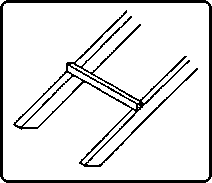
Figure
Hand tools
Hammer, engineer's square
Measuring and testing means
Folding rule
Auxiliary accessories
Trestles (one ell), pencil, marking gauge, workshop drawing
Necessary previous knowledge
Measuring, scribing, angling, use of marking-out marks, reading of drawings
Explanations to the working drawing
(D sectional view A-A, (2) upright roof window - front
view.
The figures 1 to 12 represent the steps as per sequence of operations.
|
Sequence of operations |
Comments |
|
1. Manufacture a marking gauge. |
See working drawing point VII. |
|
2. Erect the trestles and prepare the working place. |
Ensure firm standing and stability of the trestles! |
|
3. Put the parapet transom on the trestles, decide on the joining side and mark it. |
Joining side III shall have a flat face! |
|
4. Scribe the section line at the left end of the parapet transom and mark with marking-out mark. |
Go only as far to the right as to permit a right-angle section
to be produced! |
|
5. Measure-in and scribe parapet transom length, starting from the section line and measuring to the right, mark with marking-out mark. |
Use engineer's square and scribe a thin line! |
|
6. Measure-in and scribe at left and right section the window post width towards the centre. |
Use engineer's square. |
|
7. Measure-in and scribe the comer tenon width from the two scribed lines towards the two ends of the parapet transom. |
Use engineer's square and don't scribe over the total timber width! |
|
8. Scribe the tenon thickness. |
Use marking gauge and scribe with sharp pencil exactly at
marking gauge end face (VIII)! |
|
9. Scribe section line on all four sides at the two ends of the parapet transom and mark with marking-out mark. |
Use engineer's square. The scribed section lines of all timber
sides must be congruent! |
|
10. Scribe roof rafter inclination of main roof and mark with marking-out mark. |
Place square legs for scribing and exactly scribe the diagonal. |
|
11. Measure-in, scribe and mark with marking-out mark the rafter width of the main roof on the side (V) opposite the joining side. |
Use engineer's square and place it exactly! |
|
12. Transfer rafter width line to bottom side (IV) and mark with marking-out mark. |
Place engineer's square exactly. |
|
13. Work parapet transom accordingly, take it off the trestles and store it outside the working area. | |
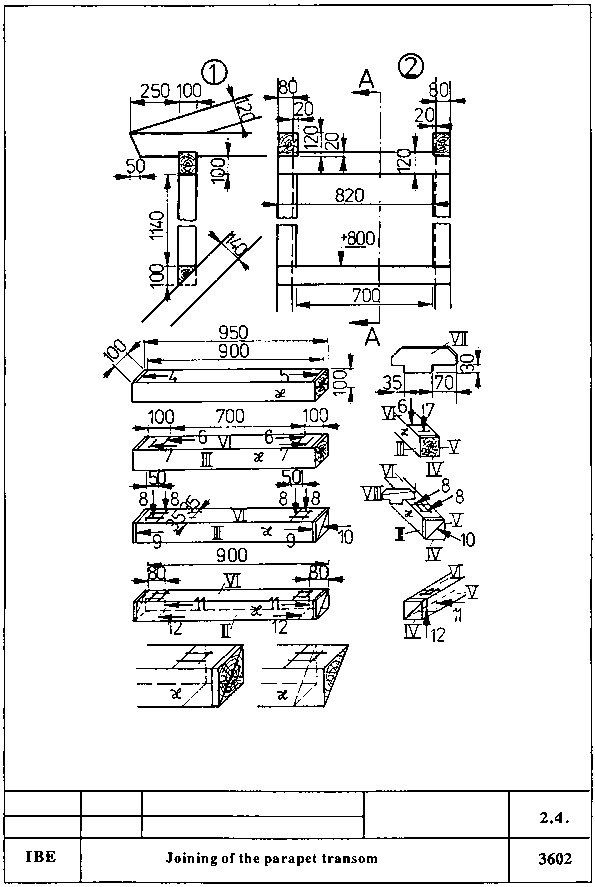
Joining of the parapet
transom
|
| ||||||||||||||||||||||||||||||||||||||||
Instruction Example 2.5.: Joining of the Window Posts
This instruction example teaches how to join the window posts for an upright roof window with lean-to dormer roof.
Constructional details
- The opening in the roofing has already been made.
- Window posts are to be joined with corner tenons.
- Cross sections of timbers are shown in the workshop drawing on page 7.
- Window posts are cut to a length of 1250 mm.
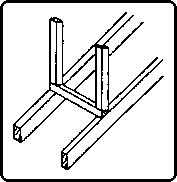
Figure
Hand tools
Hammer, engineer's square
Measuring and testing means
Folding rule
Auxiliary accessories
Trestles (one ell), pencil, marking gauge, workshop drawing
Necessary previous knowledge
Measuring, scribing, angling, use of marking-out marks, reading of drawings
Explanations to the working drawing
The figures 2 to 14 represent the steps as per sequence of operations
|
Sequence of operations |
Comments |
|
1. Prepare the working place, erect the trestles with the correct distance. |
Check the trestles for firm standing and stability! |
|
2. Inspect the window posts, decide on the joining side and mark with marking-out mark. |
Joining side "I" shall have an even face! |
|
3. Put the window posts closely together on the trestles. |
Put them so that the face marked with "II"" is visible from
above! |
|
4. Scribe section lines at left ends of window posts and mark with marking-out mark. |
Go only as far to the right as to permit a right-angle section to be produced! |
|
5. Angle the section line at both joining sides, scribe and mark-out. |
Use engineer's square! |
|
6. Measure-in and scribe window post length, starting from the section line and measuring to the right, and mark with the marking-out mark. |
Window post length = clear window height plus two tenon
lengths! |
|
7. Angle the section line at right ends of window posts at the joining sides, scribe and mark-out. |
Use engineer's square! |
|
8. Measure-in and scribe the corner tenon length at both section ends on timber face "II", measuring towards the centre. |
Scribed line must be in parallel with scribed line of steps 4. and 6. above! |
|
9. Angle and scribe corner tenon length at the two joining sides. |
Place engineer's square exactly and scribe thin line! |
|
10. Move the window posts apart because now each of them is to be separately scribed. |
Select the distance so that scribing between the timber faces marked with "III" is possible without hindrance! |
|
11. Scribe the comer tenon thickness at the left ends of the window posts. |
Place sharp pencil exactly at marking gauge end face and scribe from the joining side! Do not cant the marking gauge when scribing! |
|
12. Scribe the comer tenon thickness at the right ends of the window posts. |
See step 11. above! |
|
13. Measure-in and scribe corner tenon width. |
Scribed line must be in parallel with timber face "II"! |
|
14. Mark wood to be sawn out at all four comer tenons. |
Scribe crossing diagonal lines! |
|
15. Angle the section lines at both ends of the window posts onto the timber faces "III" and "IV", scribe and mark with marking-out mark. | |
|
16. Work the window posts. | |
|
17. Take the worked window posts off the trestles and store them outside the working area. | |
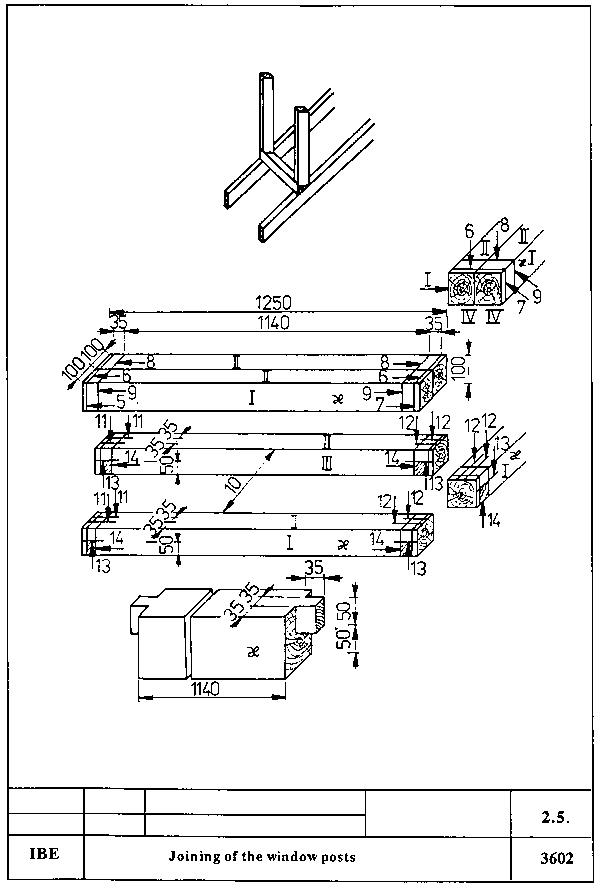
Joining of the window
post
|
| ||||||||||||||||||||||||||||||||||||||||
Instruction Example 2.6.: Joining of the Lintel Transom
This instruction example teaches how to join the lintel transom for an upright roof window with lean-to dormer roof.
Constructional details
- The opening in the roofing has already been made.
- Window posts are to be joined with a corner tenon.
- Cross sections of timbers are shown in the workshop drawing on page 7.
- Lintel transom is cut to a length of 950 mm.

Figure
Hand tools
Hammer
Measuring and testing means
Folding rule
Auxiliary accessories
Trestles (one ell), pencil, marking gauge, workshop drawing, engineer's square
Necessary previous knowledge
Measuring, scribing, angling, use of marking-out marks, reading of drawings
Explanations to the working drawing
The figures 2 to 7 represent the steps as per sequence of
operations.
I joining side, II bottom side of lintel transom. III side
opposite to joining side, IV top side of lintel transom
|
Sequence of operations |
Comments |
|
1. Prepare the working place, erect the trestles with the correct distance. |
Check the trestles for firm standing and stability! |
|
2. Put lintel transom on trestles, decide on joining side and mark with marking-out mark. |
Joining side "I" shall have an even face! |
|
3. Scribe section line at left end of lintel transom, angle onto all four faces and mark with marking-out mark. |
Go only as far to the right as to permit a right-angle section to be produced! Use engineer's square for scribing! Place lintel transom so that face marked "II" is on top again! |
|
4. Measure-in length of lintel transom from section line towards the right, angle onto all four faces and mark with marking-out mark. |
Place folding rule exactly and in parallel! Use engineer's square for scribing! |
|
5. Measure-in and scribe window post width, starting from left and right section line and measuring towards the centre. |
For window post widths see Instruction Example 2.4.! |
|
6. Measure-in and scribe the comer tenon width from the two scribed lines towards the ends of the lintel transom. |
Scribed line must be in parallel with scribed line of step 5. above! |
|
7. Scribe corner tenon. |
Use marking gauge and place sharp pencil exactly at marking
gauge end face! Do not cant marking gauge when scribing! |
|
8. Chisel out the mortise, cut lintel transom to length, take it off the trestles and store it outside the working area. | |

Joining of the lintel
transom
|
| ||||||||||||||||||||||||||||||||||||||||
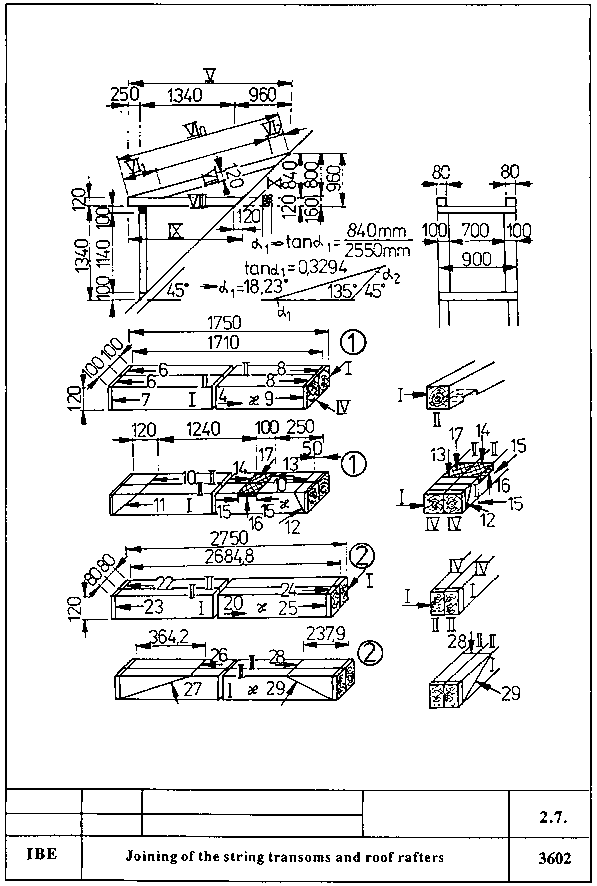
Instruction Example 2.7.: Joining of the String Transoms and Roof Rafters
This instruction example teaches how to join the string transoms and roof rafters for an upright roof window with lean-to dormer roof to be built in.
Constructional details
- String transoms are to be supported on main roof rafters and cogged in the lintel transom.
- Roof rafters are to be supported on rafters of the main roof and on the string transoms.
- Cross sections of timbers are shown in the working drawing of Instruction Example 2.4.
- String transoms are cut to a length of 1750 mm and roof rafters are cut to a length of 2750 mm.
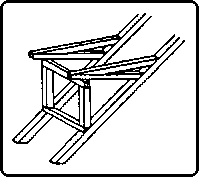
Figure
Hand tools
Hammer
Measuring and testing means
Folding rule
Auxiliary accessories
Workshop and detail drawings, trestles (one ell), pencil, hand sketch, engineer's square
Necessary previous knowledge
Measuring, scribing, angling, use of marking-out marks, reading of drawings, reading of tabular values
|
Sequence of operations |
Comments |
|
1. Study workshop and detail drawings and draw hand sketch for determination of timber lengths. |
See working drawings 3 and 7 and calculation method below! |
|
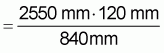
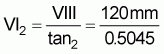
2. Calculate the timber lengths for string transoms and roof rafters and the recess sizes for scribing. Calculation method: VI0 = X2 + V2 VI0 = 2684.8 mm, chosen = 2750 mm Recess sizes (VI1, VI2) VI1 : V = X : VII
alpha2 = 180 degrees - (135 degrees + 18.23 degrees) alpha2 = 26.77 degrees tan alpha = tan 26.77 degrees = 0.5045 |
VI2 = 237.9 mm |
|
3. Prepare working place, erect trestles with correct distance. |
Check trestles for firm standing and stability! |
|
4. Put string transoms on trestles, decide on joining side and mark with marking-out mark. |
Joining side "I" shall have an even face! |
|
5. Put string transoms closely together on trestles. |
Place string transoms so that face marked with "II" is visible
from above! |
|
6. Scribe section line at left ends of string transoms and mark with marking-out mark. |
Go only as far to the right as to permit a right-angle section to be produced! |
|
7. Angle section line at both joining sides, scribe and mark with marking-out mark. |
Place engineer's square exactly! |
|
8. Measure-in maximum length at right ends of string transoms, scribe section line and mark with marking-out mark. |
For maximum length of string transoms see calculation
method! |
|
9. Angle section line at the joining sides at the right ends of string transoms, scribe and mark with marking-out mark. |
Place engineer's square exactly! |
|
10. Measure-in recess sizes from the section lines of the left and right ends of string transoms towards the centre, scribe and mark with marking-out marks. |
Do not mix up the recess sizes! |
|
11. Measure-in the inclination of the rafters of the main roof at the left ends of the string transoms, scribe and mark with marking-out mark. |
Use leg of square for scribing, place it exactly! |
|
12. Measure-in inclination of cornice at the right ends of the string transoms, scribe and mark with marking-out mark. |
Use leg of square for scribing, place it exactly! |
|
13. Measuring-in and scribe the front edge of the lintel transom from the right section line of the string transoms towards the left. |
Scribe thin line and use engineer's square. |
|
14. Measure-in to the left and scribe the lintel transom width. |
For width see working drawing 4! |
|
15. Angle scribed lines of 13. and 14. at the joining sides and scribe. |
Do not scribe the lines over the total timber width! |
|
16. Measure-in and scribe cog depth. |
For cog depth see working drawing 4! |
|
17. Mark wood to be removed for cog recess. |
Mark with diagonal lines! |
|
18. Put string transoms apart, scribe on inner faces and mark. |
Scribe all lines as on the joining side! |
|
19. Work string transoms, take them off the trestles and store them outside the working area. |
Use supports when storing them! |
|
20. Put roof rafters on trestles, decide on joining side and mark with marking-out mark. |
Joining side "I" to have an even face! |
|
21. Put roof rafters closely together on trestles. |
Shown on page 12 but not identified by figures. |
|
22. Scribe section line at left ends of roof rafters and mark with marking-out mark. |
Go only as far to the right as necessary to produce a right-angle section! |
|
23. Angle section lines at the joining sides, scribe and mark with marking-out mark. |
Use engineer's square, place it exactly and scribe thin line! |
|
24. Measure-in, scribe and mark with marking-out mark the roof rafter length. | |
|
25. Angle right-end section line of roof rafter length, scribe and mark with marking-out mark. |
|
|
26. Measure-in the recess size (VI1) at the left ends of the roof rafters, scribe and mark with marking-out mark. |
Place folding rule exactly at section line and scribe exact size VI1, otherwise the roof rafter of the lean-to dormer roof will not be supported on the rafter of the main roof! |
|
27. Scribe roof pitch (inclination) of main roof on joining sides and mark with marking-out marks. |
Use leg of square for scribing and place it exactly at the lines! |
|
28. Measure-in the recess size at the right ends of the roof rafters, scribe and mark with marking-out mark. |
Place folding rule exactly, otherwise the foot bevel will not fit on the string transom! |
|
29. Scribe rafter foot bevels and mark with marking-out mark. |
Use leg of square for scribing and scribe exactly! |
|
30. Put roof rafters apart and scribe on inner faces (III). |
Scribe all lines as on the joining sides! |
|
31. Work the roof rafters, take them off the trestles and store them outside the working area. |
Use supports for storing them! |
|
32. Clear the working place. | |

Joining of the string transoms and
roof
rafters