 |
| ||||||||||||||||||||||||||||||||||||||||||||||||||||||||||||||||||||||||||||||||||||||||||
Edited by D. E. N. Dickson
|
INTERNATIONAL |
|

This edition copyright © International Labour Organisation
1986
First published 1986
Third impression 1991
Publications of the International Labour Office enjoy copyright under Protocol 2 of the Universal Copyright Convention. Nevertheless, short excerpts from them may be reproduced without authorisation, on condition that the source is indicated. For rights of reproduction or translation, application should be made to the Publications Branch (Rights and Permissions), International Labour Office, CH-1211 Geneva 22, Switzerland. The International Labour Office welcomes such applications.
This publication was developed by the Improve Your Business project of the Management Development Branch of the International Labour Office, with financial assistance from the Swedish International Development Authority (SIDA), from an original idea conceived by the Swedish Employers' Confederation and published in Se Om Ditt F�retag (Stockholm, 1974). A preliminary test edition was published by the ILO in 1981.
|
Dickson, D. E. N. /Textbook/, /Management/, /Small enterprise/s. 12.04.1 Also published in Spanish: Mejore su negocio. Cuaderno de
trabajo ILO Cataloguing in Publication Data |
The designations employed in ILO publications, which are in conformity with United Nations practice, and the presentation of material therein do not imply the expression of any opinion whatsoever on the part of the International Labour Office concerning the legal status of any country, area or territory or of its authorities, or concerning the delimitation of its frontiers.
The responsibility for opinions expressed in signed articles, studies and other contributions rests solely with their authors, and publication does not constitute an endorsement by the International Labour Office of the opinions expressed in them.
Reference to names of firms and commercial products and processes does not imply their endorsement by the International Labour Office, and any failure to mention a particular firm, commercial product or process is not a sign of disapproval.
ILO publications can be obtained through major booksellers or ILO local offices in many countries, or direct from ILO Publications, International Labour Office, CH-1211 Geneva 22, Switzerland. A catalogue or list of new publications will be sent free of charge from the above address.
Printed in
Switzerland
ROT
|
| ||||||||||||||||||||||||||||||||||||||||||||||||||||||||||||||||||||||||||||||||||||||||||
FOREWORD
In recent years there has been an upsurge of interest in the role of small-scale enterprises as providers of employment and contributors to gross national product, and as a key component in economic development. This has been accompanied by the corresponding appearance of numerous publications on how to run small businesses. Given this, what is the justification for another book on the subject?
There are few publications which are simple enough to be understood easily by people with limited formal education but which can still communicate all the basic management knowledge required by entrepreneurs if they are to run small businesses successfully. This book is an attempt to fill this gap.
The underlying idea of the book is that improvements can best come from active and creative thinking by entrepreneurs about their own businesses. The purpose of this material is therefore to encourage such creative thinking and motivate entrepreneurs to take action to improve their businesses.
The material can be used equally well by individual business people or by trainers giving small business seminars and workshops.
The writing and publication of this book, as well as field testing of earlier versions in eastern Africa, was made possible by financial assistance from the Swedish International Development Authority (SIDA). The main author and editor of this edition of Improve your business is D. E. N. Dickson, ILO Chief Technical Adviser in Nairobi. He was assisted by Henny Romijn and Per Linden. Many of the ideas in the Handbook and Workbook owe their origin to the earlier work of the late Rhys Wynne-Roberts, who devoted so much time and effort to adapting the original idea conceived by the Swedish Employers' Confederation. Acknowledgement is also due to many other colleagues in the ILO Management Development Branch, the Kenya Industrial Estates and other organisations, for the comments and suggestions on how to focus and present this material.
|
| ||||||||||||||||||||||||||||||||||||||||||||||||||||||||||||||||||||||||||||||||||||||||||
WHAT IS IMPROVE YOUR BUSINESS?
IMPROVE YOUR BUSINESS IS FOR:
· RETAILERS
· WHOLESALERS
· MANUFACTURERS
· OPERATORS OF SERVICES
Improve your business is about running small businesses. It has been written for retailers, wholesalers, manufacturers and operators of services such as repair services, laundries, dry cleaners and restaurants. Although in a small book like this we cannot hope to deal with the special conditions of each different trade, most of what we say can be used in many different trades or branches of industry. We have given examples from trade, manufacturing and service industries.
Improve your business is material for you to work with. It comes in two parts: a Workbook, which you are reading now, and a Handbook. They are best read together but they can each be useful if read separately. We recommend that you start using the Workbook and when needed turn to the Handbook for assistance.
Both the Handbook and the Workbook consist of eight sections, each of which deals with an important part of the management of your business. Each section of the Handbook has a corresponding section in the Workbook. The sections stand on their own and can be read separately.
THE WORKBOOK
The Workbook will make you think hard about your business; it will do this by asking you a number of questions about your business and the way you are running it. In each section of the Workbook there is a list of simple questions to which you answer “yes” or “no”. The answers you write will tell you how much you know about the strengths and weaknesses of your business.
The Workbook will also give you the possibility of learning more about the financial and practical sides of the business by means of simple exercises in business practice.

TELLS YOU YOUR STRENGTHS AND
WEAKNESSES
THE HANDBOOK
The Handbook talks very simply about some of the important things that you must know and understand if you are to make your business work well over a long time. It is not a textbook, but you can get some interesting and useful ideas from the Handbook. The sections are set out in the same order as the sections in the Workbook, so that you can easily go from Workbook to Handbook or from Handbook to Workbook.

GIVES YOU MANAGEMENT IDEAS
WHERE TO START
We recommend that you start by going through the section which deals with that part of management which you think is weakest in your business.
If you do not know the strong and weak points in the management of your business, you can find this out by filling in the sheet called “ Finding out your strengths and weaknesses” which is placed behind the introductory section, “For you in business”. We advise you to fill in this sheet before you start using Improve your business.
|
Note: Since this book is intended for use in many different countries, we have used the term “NU” in the examples to represent an imaginary “national unit of currency”. |
|
| ||||||||||||||||||||||||||||||||||||||||||
Improve Your Business: Workbook (ILO, 1986, 96 p.)
FOR YOU IN BUSINESS
It is for you in business that we have written Improve your business. Why? Because one of the difficulties of business owners or managers who have been running their businesses for some time is that they become “blind” to what is happening. They have done things in the same way for so long that they cannot see where they are going wrong or where money is being lost because they are doing things badly.

Figure
Have you ever invited a friend into your business, and he or she looks round and says: “Why do you still do things like that? You are wasting money.” And you say: “You are quite right. We have been doing things this way for a long time and I never thought about changing.”
This Workbook is trying to be your “business friend” and to make you see some of the things going on in your business with new eyes. Then it tries to help you do something about putting things right.
How to use this Workbook
You can use the material yourself or together with others. You should use it regularly, especially if you feel that something is wrong in the business or needs improvement.

YOUR WORKBOOK, YOUR BUSINESS
FRIEND
PART 1 - QUESTIONS
HOW TO USE THIS WORKBOOK

FIRST ANSWER THE QUESTIONS
In the first part of each section of the Workbook you will find a number of questions. These questions are related to the corresponding section in the Handbook. You can answer the questions with “yes” or “no”. The questions have been chosen so that the answers will show the strong and weak points of your business. Think carefully about each question and see whether you can do something to make things better. Do not try to go through the Workbook quickly. Take one section at a time.
PART 2 - BUSINESS PRACTICE

NEXT COMPLETE THE EXERCISES
Use this part of the Workbook to understand the financial and practical sides of your business better. You do this by completing simple exercises in business practice. If you have any difficulties in completing the exercises or if you want to learn more, read the corresponding section in the Handbook. Then you will be able to do all the exercises easily.
PART 3 - ACTION PROGRAMME
FINALLY TAKE ACTION TO SOLVE YOUR PROBLEMS
When you have worked through the questions and business practice, you will have found some things in your business which could be done better. The final step is to take action. Use the action programme part of the Workbook for this.
Part 1 - Questions
START HERE!
|
|
Yes |
No |
|
1. Do you sell goods to others? |
|
|
|
2. Do you sell services to others? |
|
|
|
3. Are you a retailer? |
|
|
|
4. Are you a wholesaler? |
|
|
|
5. Are you a manufacturer? |
|
|
|
6. Do you operate a service business? |
|
|
|
If one or more of your answers is “yes”, then you are in business and it is for you that we have written Improve your business. | | |
|
7. Do you know what assets are? |
|
|
|
8. Do you know the difference between your private assets and your business assets? |
|
|
|
9. Do you know the difference between money in and profit? |
|
|
|
10. Write down what you think is the difference between money in and profit in the space below. |
|
|

Part 2 - Business practice
1. Put a tick (Ö) against those items in the list below which you think belong to a business and not to the owner or his or her family:
a cutting machine
the contents of a cash register
a cousin of the owner
raw materials like wood and nails
a bill for school fees to be paid
a two-ton lorry
hens in a hen-run

Figure
2. Complete these statements about how profit is made.

Figure
If you had any difficulties in answering the questions, study the section of the Handbook entitled “For you in business”.
Now that you have completed the business practice exercises, turn to the page which follows the action programme. There you will find the answers. Check your answers against the answer solutions which are given on that page. How many correct answers did you get?
CHECK YOUR ANSWERS!
THEN GO TO THE HANDBOOK FOR MANAGEMENT
IDEAS
Now go to the Handbook and read thoroughly the management ideas in the same section there. You will then find that all the business practice exercises become easier to answer.
Part 3 - Action programme
HOW TO CONSTRUCT YOUR ACTION PROGRAMME
Count the number of times you answered “yes” or “no” for questions 7-10 above. How many times did you answer “yes”? The more “yes” answers, the better you are in business management. Now look again at those questions you answered with “no”. Those are possible problem areas in your business. Choose the one which you think is the most important for your business. Take the most urgent problem first. Don't try to solve everything at once.
Now write the problem into the action programme opposite, as we have done with the example. Then write in What must be done, By whom and By when in order to solve your problem.
Finally, go back to your business and carry out the action programme.

Figure
|
Problem |
What must be done? |
By whom? |
By when? |
|
Example: | | | |
|
Need to know how to improve my business. |
Look at the section called “for you in business” in the Handbook and read the management ideas there. |
Myself |
After work TODAY |
ANSWERS TO BUSINESS PRACTICE
|
1. |
a cutting machine Ö |
| |
the contents of a cash register Ö |
| |
a cousin of the owner |
| |
raw materials like wood and nails Ö |
| |
a bill for school fees to be paid |
| |
a two-ton lorry Ö |
| |
hens in a hen-run |
Of course the answer will depend on the kind of business you have. For example, if you raise poultry, the hens in the hen-run will be a part of your business.
|
2. |
Money in - Money out = Profit |
| |
More money in - Money out = More profit |
| |
Sales up and Costs down = Profit up |
FINDING OUT YOUR STRENGTHS AND WEAKNESSES
Before you start using Improve your business, you may wish to find out about your business performance. You can get a rough idea about your strengths and weaknesses by answering the questions below. Each question concerns one area of management and corresponds to one particular section of Improve your business. For example, question 1 corresponds to section 1, question 2 to section 2 and so forth. Find out from your answers in which area(s) of management you are weakest and start reading the corresponding sections of Improve your business.
|
How good are you at... |
Good |
Average |
Bad |
|
1. Buying, selling and stock control? |
|
|
|
|
2. Production management and production technology? |
|
|
|
|
3. Bookkeeping? |
|
|
|
|
4. Costing and pricing your products or services? |
|
|
|
|
5. Marketing? |
|
|
|
|
6. Management accounting? |
|
|
|
|
7. Organising your office? |
|
|
|
|
8. Planning your business activities? |
|
|
|
|
| ||||||||||||||||||||||||||||||||||||||||||||||||||||||||||||||||||
Improve Your Business: Workbook (ILO, 1986, 96 p.)
1. BUYING AND SELLING
Part 1 - Questions
Selling
|
|
Yes |
No |
|
1. Can you find out quickly the total sales of your business during the last month? |
|
|
|
2. Do you know the names of your competitors? |
|
|
|
3. Do you know how much your most important competitors sell? |
|
|
|
4. Can you always offer the goods or services when your customers ask for them? |
|
|
|
5. Are your customers generally satisfied about the price and the quality you offer? |
|
|
|
6. Do customers know the range of different products or services which you offer? |
|
|
|
7. When you have goods or services that are selling badly, do you use special ways of promoting them ? |
|
|
|
8. Do you keep records of sales by both quantity and value? |
|
|
|
9. Do you regularly check what products competitors offer for sale? |
|
|
|
10. With regard to your competitors, do you know the special goods or services which they have that you do not have? |
|
|
Buying to sell
|
|
Yes |
No |
|
1. Compare your buying with other businesses in your trade. Do suppliers give you at least the same conditions on prices and discount and credit? |
|
|
|
2. And do they give you the same quality? |
|
|
|
3. Do you ask for competitive quotations from at least three suppliers each time you make a major purchase? |
|
|
|
4. Are you happy with your present supplier? |
|
|
|
5. Are you free to change suppliers if you are not happy with your present supplier? |
|
|
|
6. Have you tried to find out about possible new suppliers? |
|
|
|
7. Have you asked other possible suppliers to give you quotations? |
|
|
|
8. Are you able to pay cash for what you buy if you want to? |
|
|
|
9. Can you find out quickly how much of each type of product or material you have bought during the previous six months? |
|
|
|
10. Can you think of three ways in which you could improve your buying? |
|
|
Stock control
|
|
Yes |
No |
|
1. Do you check your stock regularly? |
|
|
|
2. Do you always have enough stock to satisfy the needs of your business? |
|
|
|
3. Have you ever tried to reduce the average number of items held in stock? |
|
|
|
4. Do you know how many of each kind of goods are in stock? |
|
|
|
5. Can you see and count all your stocks easily? |
|
|
|
6. Do you write down in a book details of what stock is received and what stock is used? |
|
|
|
7. When you check your stocks, do you usually have the same number of items in stock as shown in your records? |
|
|
|
8. Do you know how long you may have to wait for delivery of different items after you have ordered? |
|
|
|
9. Do you know how much old, damaged and useless stock you have in your store? |
|
|
|
10. Do you try to get rid of old, damaged and useless stock by extra promotion? |
|
|
Handling cash
|
|
Yes |
No |
|
1. Can you quickly calculate how much money has come into your business during the past month? |
|
|
|
2. Do you or does a reliable employee handle all the cash? |
|
|
|
3. Have you instructed all members of your family and your staff never to take money out of the cash box? |
|
|
|
4. Does the way you are now taking care of the cash keep it safe and prevent losses? |
|
|
|
5. Do you pay yourself and family members working in the business fixed wages? |
|
|
|
6. Do you record all the cash you take in and pay out each day either in a cash register or a cash book? |
|
|
|
7. Is the cash kept in a locked drawer? |
|
|
|
8. Do you write a receipt for every cash sale? |
|
|
|
9. Do you write out a voucher each time you pay out cash? |
|
|
|
10. Do you ask your bank to send you a statement every month showing the balance in your business account? |
|
|
Part 2 - Business practice

Figure
1. Assuming that you sell 100 products of a certain kind in one year, calculate what the gross profit will be if:
· you buy them at 70 NU each;
· you sell them at 100 NU each.

Figure
2. If you lower your selling price to 80 NU, you estimate that you will sell 200 in one year. Since you are buying more from your supplier, you will also have a discount. You pay only 55 NU each if you buy 200.
Calculate what the gross profit will be if you sell the 200 products.

Figure
3. Understanding steps (a)-(g) below can help you to improve your buying. Write down what you would do at each of the steps:
Step (a): Examine your needs
What I would do:
(i) ___________
(ii) ___________
(iii) ___________
Step (b): Find the supplier
What I would do:
(i) ________
(ii) ________
(iii) ________
Step (c): Ask for quotations from several suppliers
What I would do:
(i) ___________
(ii) ___________
(iii) ___________
Step (d): Negotiate terms and then buy
What I would do:
(i) _________
(ii) _________
(iii) _________
Step (e): On the day the goods arrive, check quantity, quality and price against delivery note
What I would do:
(i) ____________
(ii) ____________
(iii) ____________
Step (f): If you have any complaints, complain to the supplier immediately
What I would do:
(i) ____________
(ii) ____________
(iii) ____________
Step (g): Check your invoices against the delivery note when it arrives
What I would do:
(i) __________
(ii) __________
(iii) __________
4. Suggest four ways in which you could do simple market research:
(a) ___________
(b) ___________
(c) ___________
(d) ___________
5. Filling in and using a stock card
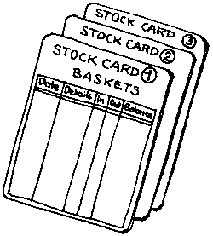
Figure
Jane has a small retail shop. She sells items like handicrafts and shopping baskets. She maintains a stock card for each different item that she deals in. Can you help Jane to fill in her stock card for baskets? Use the following information:
|
1 January 1986 |
83 baskets in store |
|
1-15 January 1986 |
26 baskets sold |
|
16-31 January 1986 |
23 baskets sold |
|
15 January 1986 |
Jane places an order for 100 baskets |
|
2 February 1986 |
Jane receives the order of 100 baskets. |
Her cost price is 30 NU and her selling price 45 NU.
After you have completed the stock card over the page, try to answer the following questions:
(a) How many baskets did Jane have in store according to the stock card at the end of January 1986?_____________________________________________________________
(b) And how many did she have in store on 2 February 1986?
_____________________________________________________________
(c) What was the value of her total sales during January 1986?
_____________________________________________________________
|
STOCK CARD | |||||
|
Item: ____________ |
Reorder level: _______ | ||||
|
Date |
Particulars |
Stock in |
Stock out |
Balance | |
|
| | | | | |
6. Keeping a cash book

Figure
Francis has a small retail shop. He sells basic items such as tea, soap, milk, bread and so on. He has never kept a cash book before, but he has now decided that he should start one, because he finds it difficult to keep check on where his cash is going. Can you help him to start the cash book? Use the cash book sheet opposite to make the following entries:
(a) Francis starts his cash book at the opening of business on 8 March 1986. He counts the cash in the cash box before opening his shop. There are 50 NU in the cash box.(b) Francis thinks that this 50 NU is not enough to meet his expenses of the day. He therefore sends his shop assistant to the bank to withdraw 200 NU. He puts this amount into the cash box.
(c) During the day he sells six loaves of bread at 3.10 NU each, 15 packets of milk at 2.45 NU each, two bars of soap at 2.50 NU each and one tin of coffee at 30 NU.
(d) In the afternoon he is visited by one of his suppliers who collects his dues. Francis pays him the bills outstanding: 50 NU for toilet rolls, 120 NU for toothpaste and 76 NU for tea.
(e) His mother comes into the shop and takes away a tin of beans, without paying! Francis pays for the tin from his own pocket and puts the money into the cash drawer: 25 NU.
Have you made all the entries in the cash book?
(f) Now total up all the columns. What is the total amount of cash in on 8 March 1986? _______(g) Now subtract cash at start of day from total cash in. What is the total money from sales ? ________
(h) Finally, subtract total cash out from total money from sales. This gives you the net cash in for the day. How much is it? _______________

WRITE THESE AMOUNTS INTO THE CASH BOOK
|
CASH BOOK | |||||
|
Date |
Details |
Cash in |
Cash out |
Bank in |
Bank out |
|
8/3/86 |
Cash at start of day | |
| | |
|
|
Total | | | | |
|
Gives: |
Total money from sales | |
| | |
|
Gives: |
Net cash in |
| | | |
Now that you have completed the business practice exercises, turn to the pages which follow the action programme. There you will find the answers. Check your answers against the answer solutions which are given. How many correct answers did you get?
CHECK YOUR ANSWERS!

THEN GO TO THE HANDBOOK FOR
MANAGEMENT IDEAS
Now go to the Handbook and read thoroughly the management ideas in the same section there. You will then find that all the business practice exercises become easier to answer.
Part 3 - Action programme
How to construct your action programme
Count the number of times you answered “yes” or “no” for each set of ten questions. How many times did you answer “yes”? The more “yes” answers, the better you are in business management. Now look again at those questions you answered with “no”. Those are possible problem areas in your business. Choose the one which you think is the most important for your business. Take the most urgent problem first. Don't try to solve everything at once.
Now write the problem into the action programme opposite, as we have done with the example. Then write in What must be done, By whom and By when in order to solve your problem.

Figure
Finally, go back to your business and carry out the action programme.
|
Problem |
What must be done? |
By whom? |
By when? |
|
Example: | | | |
|
I am tied to one supplier. I could buy more cheaply if I
could buy for cash from another dealer. |
Save up enough money so that I can pay what I owe my present supplier. Then I will be free to choose another supplier. |
Myself |
Start today. Finish in two months. |
Answers to business practice

Figure

Figure
3. Step (a): Examine your needs

Figure
What I would do:
(i) Think how much I need.
(ii) Think what quality I need.
(iii) Think what price I pay.
Step (b): Find the supplier
What I would do:
(i) Look in telephone book.
(ii) Ask friends in trade.
(iii) Look in trade directory.
Figure
Step (c): Ask for quotations from several suppliers
What I would do:
(i) Telephone them.
(ii) Write to them.
(iii) Get written quotations.
Step (d): Negotiate terms and then buy
What I would do:
(i) Talk with each supplier.
(ii) Compare their prices.
(iii) Ask for a discount.

Figure
Step (e): On the day the goods arrive, check quantity, quality and price against delivery note
What I would do:
(i) Check all deliveries.
(ii) Examine their condition.
(iii) Check delivery note details.

Figure
Step (f): If you have any complaints, complain to the supplier immediately
What I would do:
(i) Contact the supplier himself.
(ii) Explain the problem.
(iii) Get the answer in writing.

Figure
Step (g): Check your invoices against the delivery note when it arrives
What I would do:
(i) Check the prices.
(ii) Check the quantities.
(iii) Check the additions.
4. Suggest four ways in which you could do simple market research:
(a) Talk to customers.
(b) Ask customers what they like.
(c) Look at competitors.
(d) Look at what people buy.
5. Filling in and using a stock card
|
STOCK CARD | |||||
|
Item: Baskets |
Reorder level: 57 | ||||
|
Date |
Particulars |
Stock in |
Stock out |
Balance | |
|
1/1/86 |
In store |
83 | |
| |
|
1/1-15/1/86 |
Sold |
|
26 |
57 | |
|
16/1-31/1/86 |
Sold |
|
23 |
34 | |
|
2/2/86 |
Bought |
100 |
|
134 | |
(a) There were 34 baskets in store at the end of January 1986.
(b) There were 134 baskets in store on 2 February 1986.
(c) Total sales over January 1986:
26 + 23 = 49 baskets.
Total sales: 49 × 45 NU = 2,205 NU.
6. Keeping a cash book
|
CASH BOOK | |||||
|
Date |
Details |
Cash in |
Cash out |
Bank in |
Bank out |
|
8/3/86 |
Cash at start of day |
50 | | | |
|
8/3/86 |
From bank |
200 | | |
200 |
|
8/3/86 |
Bread |
18,60 | | | |
|
8/3/86 |
Milk |
36,75 | | | |
|
8/3/86 |
Soap |
5 | | | |
|
8/3/86 |
Coffee |
30 | | | |
|
8/3/86 |
Toilet rolls |
|
50 | | |
|
8/3/86 |
Toothpaste | |
120 | | |
|
8/3/86 |
Tea | |
76 | | |
|
8/3/86 |
Beans |
25 | | | |
|
|
Total |
365,35 |
246 | |
200 |
|
Gives: |
Total money from sales |
315,35 |
| | |
|
Gives: |
Net cash in |
69,35 | | | |
|
| ||||||||||||||||||||||||||||||||||||||||||||||||||||||
Improve Your Business: Workbook (ILO, 1986, 96 p.)
2. MANUFACTURING AND SERVICE OPERATING
Part 1 - Questions
Manufacturing
|
|
Yes |
No |
|
1. Do you know how the total costs of making your products are divided between materials, labour and other expenses? |
|
|
|
2. Do you know how much of your raw materials are wasted from bad cutting or processing and from bad workmanship? |
|
|
|
3. Do you know what working capital is? |
|
|
|
4. Can you think of two things you could do to cut the costs of manufacturing? |
|
|
|
5. Have you ever stood and watched the movement of your workers between stores, machines and workplaces? |
|
|
|
6. Have you ever looked closely at how the workplaces are laid out and how the workers work at them? |
|
|
|
7. Is your work and the supply of material planned so that one job follows another without delay? |
|
|
|
8. Can you think of three ways in which machine working time can be lost in your factory during a normal day's work? |
|
|
|
9. Are the machines regularly oiled, greased and checked to see that they are working properly? |
|
|
|
10. Can you think of three ways in which you could reduce the amount of money tied up in working capital? |
|
|
Service operating
|
|
Yes |
No |
|
1. Do you know how the costs of your operation are divided between labour, material and other expenses? |
|
|
|
2. Do you know what the biggest item of cost is? |
|
|
|
3. Do you know how much of the total working time of your employees is wasted through tea-breaks, smoking, coming in late and leaving work early? |
|
|
|
4. If your equipment and personnel are not well used, do you know why? |
|
|
|
5. Do you know what is meant by the word “productivity”? |
|
|
|
6. Can you think of two things you could do to increase the productivity of your service operation? |
|
|
|
7. Are the machines and equipment used in your operation serviced regularly? |
|
|
|
8. Do you keep written records which give you details of the dates and times when machines and equipment used in your operation are stopped by breakdowns? |
|
|
|
9. Can you think of two ways in which the costs of your operation could be reduced? |
|
|
|
10. Do you know what is meant by the words “planned maintenance”? |
|
|
Part 2 - Business practice
1. Write down two things which you could do to cut the costs of your manufacturing or service operation:
(a)__________
(b)__________
2. Write down two things which you could do to reduce the amount of money tied up in working capital in your business:
(a)__________
(b)__________
3. Below you see the working capital that was tied up in a business before and after a carpenter studied the manufacturing section of the Handbook.
How much extra cash in hand had the carpenter after the improvement?
|
Working capital tied up in: |
Before improvement |
After improvement |
Released |
|
Raw material store |
8,000 |
6,000 |
2,000 |
|
Processing |
4,000 |
3,000 |
_____ |
|
Assembly |
2,000 |
1,000 |
_____ |
|
Finishing |
2,000 |
1,000 |
_____ |
|
Inspection |
3,000 |
1,000 |
_____ |
|
Finished goods store |
6,000 |
3,000 |
_____ |
|
Cash released after improvement |
_____ | ||
Now that you have completed the business practice exercises, turn to the page which follows the action programme. There you will find the answers. Check your answers against the answer solutions which are given on that page. How many correct answers did you get?
CHECK YOUR ANSWERS!
THEN GO TO THE HANDBOOK FOR MANAGEMENT
IDEAS
Now go to the Handbook and read thoroughly the management ideas in the same section there. You will then find that all the business practice exercises become easier to answer.
Part 3 - Action programme
How to construct your action programme
Count the number of times you answered “yes” or “no” for each set of ten questions. How many times did you answer “yes”? The more “yes” answers, the better you are in business management. Now look again at those questions you answered “no”. Those are possible problem areas in your business. Choose the one which you think is the most important for your business. Take the most urgent problem first. Don't try to solve everything at once.
Now write the problem into the action programme opposite, as we have done with the example. Then write in What must be done, By whom and By when in order to solve your problem.
Finally, go back to your business and carry out the action programme.

Figure
|
Problem |
What must be done? |
By whom? |
By when? |
|
Example: | | | |
|
Drilling machine breaks down too often. |
Take it out of use. Have it repaired properly at Machine Repair Ltd. |
Joseph and Bill. |
Friday afternoon. |
Answers to business practice
1. Write down two things which you could do to cut the costs of your manufacturing or service operation:
(a) reduce the cost of materials by good buying or cut down on wasted or spoiled materials;(b) reduce time wasted by workers and cut the cost of labour or improve the layout of your workshop.
2. Write down two things which you could do to reduce the amount of money tied up in working capital in your business:
(a) hold less stocks;
(b) send out invoices fast and get your cash in fast.
|
3. Working capital tied up in: |
Before improvement |
After improvement |
Released |
|
Raw material store |
8,000 |
6,000 |
2,000 |
|
Processing |
4,000 |
3,000 |
1,000 |
|
Assembly |
2,000 |
1,000 |
1,000 |
|
Finishing |
2,000 |
1,000 |
1,000 |
|
Inspection |
3,000 |
1,000 |
2,000 |
|
Finished goods store |
6,000 |
3,000 |
3,000 |
|
Cash released after improvement |
10,000 | ||

Figure

Figure
|
| ||||||||||||||||||||||||||||||||||||||||||
Improve Your Business: Workbook (ILO, 1986, 96 p.)
3. BOOKKEEPING
Part 1 - Questions
|
|
Yes |
No | |
|
1. Do you have a bookkeeping system? |
|
| |
|
2. Do you understand the bookkeeping system yourself? |
|
| |
|
3. Do you check your bank statement with your cheque counterfoils and paying-in slips? |
|
| |
|
4. Can you get all the information you want quickly, and is it correct? |
|
| |
|
5. Do you file all vouchers (receipts, invoices, etc.) in such a way that they are easily found when needed? |
|
| |
|
6. Do you have a set of books that gives you information about: | | | |
| |
(a) How much your customers owe you? |
|
|
| |
(b) How much you owe your suppliers? |
|
|
| |
(c) Your employees, their wages and so on? |
|
|
| |
(d) The present value of your machines and equipment? |
|
|
|
7. Do you write out vouchers when people get cash from you and make them sign their names on the voucher? |
|
| |

Figure
Part 2 - Business practice
Use the sheet called “ Ledger”, below, to enter the following business transactions:
|
Transaction |
Date |
Item |
|
1. |
8 July |
A carpenter sells a sofa and receives 600 NU cash from the customer. |
|
2. |
10 July |
The carpenter receives a loan amounting to 8,000 NU from the local bank. The money is put into the carpenter's loan account. |
|
3. |
15 July |
A turning lathe is bought. It costs 7,000 NU. It is paid with the money from the bank. |
|
4. |
15 July |
Wages are paid to four employees. In total 400 NU is paid out. |
|
5. |
16 July |
The carpenter sells four chairs and receives 600 NU cash. |
|
6. |
18 July |
Raw material is bought: 60 m of timber 5 × 2.5 cm. The cost is 240 NU. It is paid in cash. |
|
7. |
19 July |
Interest on the loan is paid. 100 NU is taken from the bank to pay the interest which is due. |
|
8. |
19 July |
A water bill amounting to 300 NU is paid in cash. |
|
9. |
20 July |
The customer who bought four chairs returns one, owing to bad quality. The customer receives 150 NU in return. |
|
10. |
22 July |
The carpenter takes 500 NU from the bank and pays school fees for his son. |
Transactions no. 1 and 4 are already entered in the ledger to show you how it is done. Now try to enter the rest of the transactions.
Now that you have completed the business practice exercises, turn to the pages which follow the action programme. There you will find the answers. Check your answers against the answer solutions which are given. How many correct answers did you get?
CHECK YOUR ANSWERS!
THEN GO TO THE HANDBOOK FOR MANAGEMENT
IDEAS
Now go to the Handbook and read thoroughly the management ideas in the same section there. You will then find that all the business practice exercises become easier to answer.
Ledger
|
DATE |
PARTICULARS |
ID. NO. |
CASH |
BANK |
SALES |
RAW MAT.* |
WAGES |
LOANS |
EQUIPMENT |
INTEREST |
DRAWINGS |
OTHERS | ||||||||||||
|
July |
| |
In |
Out |
Bal. |
In |
Out |
Bal. |
In |
Out |
In |
Out |
In |
Out |
In |
Out |
In |
Out |
In |
Out |
In |
Out |
In |
Out |
|
8 |
One sofa |
1 |
600 | |
600 | |
| | |
600 | |
| | | | | | | | | | | | |
| | | | | | | | | | | | | | | | | | | | | | | | | |
| | | | | | | | | | | | | | | | | | | | | | | | | |
|
15 |
Wages |
4 | |
400 |
200 | |
| | | | | |
400 | |
| | | | | | | | | |
| | | | | | | | | | | | | | | | | | | | | | | | | |
| | | | | | | | | | | | | | | | | | | | | | | | | |
| | | | | | | | | | | | | | | | | | | | | | | | | |
| | | | | | | | | | | | | | | | | | | | | | | | | |
| | | | | | | | | | | | | | | | | | | | | | | | | |
| | | | | | | | | | | | | | | | | | | | | | | | | |
| | | | | | | | | | | | | | | | | | | | | | | | | |
| | | | | | | | | | | | | | | | | | | | | | | | | |
* RAW MAT. = raw materials
Part 3 - Action programme
How to construct your action programme
Count the number of times you answered “yes” or “no” for the set of questions. How many times did you answer “yes”? The more “yes” answers, the better you are in business management. Now look again at those questions you answered with “no”. Those are possible problem areas in your business. Choose the one which you think is the most important for your business. Take the most urgent problem first. Don't try to solve everything at once.
Now write the problem into the action programme opposite, as we have done with the example. Then write in What must be done, By whom and By when in order to solve your problem.
Finally, go back to your business and carry out the action programme.

Figure
|
Problem |
What must be done? |
By whom? |
By when? |
|
Example: | | | |
|
We do not have a proper bookkeeping system for the business. |
1. Buy a suitable ledger and some notebooks and journals. |
Myself |
Friday 5/6/86 |
| |
2. Begin to enter details of all money in and money out of
the business. |
Myself |
Next monday 8/6/86 |
Answer to business practice
|
DATE |
PARTICULARS |
ID. NO. |
CASH |
BANK |
SALES |
RAW MAT. |
WAGES |
LOANS |
EQUIPMENT |
INTEREST |
DRAWINGS |
OTHERS | ||||||||||||
| | | |
In |
Out |
Bal. |
In |
Out |
Bal. |
In |
Out |
In |
Out |
In |
Out |
In |
Out |
In |
Out |
In |
Out |
In |
Out |
In |
Out |
|
July | | | | | | | | | | | | | | | | | | | | | | | | |
|
8 |
One sofa |
1 |
600 | |
600 | | | | |
600 | | | | | | | | | | | | | | |
|
10 |
Loan |
2 | | | |
8,000 | |
8,000 | | | | | | | |
8,000 | | | | | | | | |
|
15 |
Turning lathe |
3 | | | | |
7,000 |
1,000 | | | | | | | | |
7,000 | | | | | | | |
|
15 |
Wages |
4 | |
400 |
200 | | | | | | | |
400 | | | | | | | | | | | |
|
16 |
4 Chairs |
5 |
600 | |
800 | | | | |
600 | | | | | | | | | | | | | | |
|
18 |
Timber 5 × 2.5 cm 60m |
6 | |
240 |
560 | | | | | |
240 | | | | | | | | | | | | | |
|
19 |
Interest on loan |
7 | | | | |
100 |
900 | | | | | | | | | | |
100 | | | | | |
|
19 |
Water |
8 | |
300 |
260 | | | | | | | | | | | | | | | | | |
300 | |
|
20 |
1 Chair returned |
9 | |
150 |
110 | | | |
150 | | | | | | | | | | | | | | | |
|
22 |
Private expenses |
10 | | | | |
500 |
400 | | | | | | | | | | | | |
500 | | | |

Figure
|
| ||||||||||||||||||||||||||||||||||||||||||||||||||||||||||||||||||||||||
Improve Your Business: Workbook (ILO, 1986, 96 p.)
4. COSTING AND PRICING
Part 1 - Questions
Costing one product
|
|
Yes |
No |
|
1. Do you know what is meant by direct costs? |
|
|
|
2. Do you know the difference between direct costs and indirect costs? |
|
|
|
3. Is the following statement correct: “Indirect costs are the same as overheads”? |
|
|
|
4. When you must quote a price to a customer before he buys, do you have all the information from past costs at hand so that you can make an estimate quickly? |
|
|
|
5. Do you have written records which tell you how much you have spent so far this year on each of the following: salaries; insurance; rent; electricity; interest on a loan? |
|
|
|
6. Is the following statement correct: “ Direct costs are not the same as overheads”? |
|
|
|
7. Can you tell from your records exactly how much your wage bill was for the past six months? |
|
|
|
8. Do you know what is meant by inflation? |
|
|
|
9. Do you keep written records giving the costs of materials and labour? |
|
|
|
10. Do your workers work at their jobs 100 per cent of the time they are at the workplace? |
|
|
Costing many products
|
|
Yes |
No |
|
1. Do you know the total number of hours which your employees worked during last year? |
|
|
|
2. If a competitor begins to sell goods at lower prices than yours, do you know how much you can afford to lower your price to compete with him? |
|
|
|
3. Do you think that your prices are generally right and give you the profits you expect? |
|
|
|
4. Is the following statement correct: “The different products made by a carpenter normally use different quantities of material and different amounts of labour”? |
|
|
|
5. Is the following statement correct: “An easy way of calculating indirect costs when there are many different products is to show them as a percentage of direct labour costs”? |
|
|
|
6. Do you agree with the following statement: “The total costs of making a product consist of the total direct costs plus the total indirect costs”? |
|
|
|
7. If the cost of your raw materials rises, do you increase the price of your product? |
|
|
|
8. Is the following statement true: “Some costs are fixed but most costs are variable”? |
|
|
|
9. Can you give a rough estimate of the current rate of inflation in your country? |
|
|
|
10. Do you know the total cost of running your business during the last year? |
|
|
Pricing for a manufacturer
|
|
Yes |
No | |
|
1. Do you agree with the following statement: “If you do not know your costs, you cannot know whether the prices you charge give you a profit or a loss”? |
|
| |
|
2. Do you know what it costs you for labour, raw materials and overheads every month? |
|
| |
|
3. Is the following statement true: “It is important to know costs, but there are many other factors that you have to take into account when setting your prices”? |
|
| |
|
4. Consider the way you are working out your prices. Do they enable you to sell well against your competitors? |
|
| |
|
5. However you work your prices, do you find that they give you a fair profit? | | | |
|
6. Do you set your prices on the basis of: |
|
| |
| |
(a) The highest you think the customers will pay? |
|
|
| |
(b) Your competitors' prices? |
|
|
| |
(c) Your total costs plus a reasonable profit? |
|
|
|
7. Do you know how to calculate the total costs for each product you make? |
|
| |
Pricing for a trader
|
|
Yes |
No | |
|
1. Do you agree with the following statement: “ If you do not know your costs, you cannot know whether the prices you charge give you a profit or a loss”? |
|
| |
|
2. Do you know your labour costs, the cost price of your goods and your overheads every month? |
|
| |
|
3. Is the following statement true: “ It is important to know costs, but there are many other factors that you have to take into account when setting your prices”? |
|
| |
|
4. Consider the way you are working out your prices. Do they enable you to sell well against your competitors? |
|
| |
|
5. However you work out your prices, do you find that they give you a fair profit? |
|
| |
|
6. Do you set your prices on the basis of: | |
| |
|
|
(a) The highest you think the customers will pay? |
|
|
| |
(b) Your competitors' prices? |
|
|
| |
(c) Your total costs plus a mark-up? |
|
|
|
7. Do you understand the difference between a trade margin and a mark-up? |
|
| |
Pricing for a service operator
|
|
Yes |
No | |
|
1. Do you agree with the following statement: “ If you do not know your costs, you cannot know whether the prices you charge give you a profit or a loss”? |
|
| |
|
2. Do you know what it costs you for labour, materials and overheads every month? |
|
| |
|
3. Is the following statement true: “It is important to know costs, but there are many other factors that you have to take into account when setting your prices”? |
|
| |
|
4. Consider the way you are working out your prices. Do they enable you to sell well against your competitors? |
|
| |
|
5. However you work out your prices, do you find that they give you a fair profit? |
|
| |
|
6. Have you heard the expression “charge per service hour”? |
|
| |
|
7. Do you set your prices on the basis of: | |
| |
|
|
(a) Your competitors' prices? |
|
|
| |
(b) The highest you think the customers will pay? |
|
|
| |
(c) Your direct costs per hour plus a percentage for gross profit per hour? |
|
|
Part 2 - Business practice
1. Complete these statements about the types of costs in a business.

Figure
2. Complete the following calculations:

Figure
3. The total costs of a table are 528 NU and you want to add on 30 per cent for your profit. Calculate the selling price.
_________________________________________________________________
_________________________________________________________________
4. A carpenter estimates the total costs of producing a table to be 720 NU. He decides to add on 30 per cent for his profit as follows:

Figure
Calculate in the space below his percentage of profit on the selling price.
_________________________________________________________________
_________________________________________________________________
5. Are the following costs direct costs or indirect costs ?
Fill in the boxes on the right-hand side.

Figure
|
|
Direct costs |
Indirect costs |
|
(a) The wages of your workers in the workshop |
|
|
|
(b) The cost of your telephone |
|
|
|
(c) The salary of your secretary |
|
|
|
(d) The cost of electricity |
|
|
|
(e) The cost of using a dry-cleaning machine |
|
|
|
(f) The rent of a factory building |
|
|
|
(g) The cost of petrol for your car |
|
|
|
(h) The cost of replacing a worn-out tool |
|
|
|
(i) The cost of stationery |
|
|
|
(j) The cost of your raw materials |
|
|
Now that you have completed the business practice exercises, turn to the pages which follow the action programme. There you will find the answers. Check your answers against the answer solutions which are given. How many correct answers did you get?
CHECK YOUR ANSWERS!

THEN GO TO THE HANDBOOK FOR
MANAGEMENT IDEAS
Now go to the Handbook and read thoroughly the management ideas in the same section there. You will then find that all the business practice exercises become easier to answer.
Part 3 - Action programme
How to construct your action programme
Count the number of times you answered “yes” or “no” for each set of questions. How many times did you answer “yes”? The more “yes” answers, the better you are in business management. Now look again at those questions you answered with “no”. Those are possible problem areas in your business. Choose the one which you think is the most important for your business. Take the most urgent problem first. Don't try to solve everything at once.
Now write the problem into the action programme opposite, as we have done with the example. Then write in What must be done, By whom and By when in order to solve your problem.
Finally, go back to your business and carry out the action programme.

Figure
|
Problem |
What must be done? |
By whom? |
By when? |
|
Example: | | | |
|
I do not know if the price I charge for my products covers
the costs and gives me a profit. |
Set up a simple costing system which will show me the indirect costs and the direct costs for each product. |
Myself and Joshua, my accountant friend. |
Start: |
Answers to business practice

Figure

Figure
3. The selling price for the table is:
528 NU + 30 per cent of 528 NU = 686 NU

Figure
The percentage of profit on the selling price is:

5. Are the following costs direct costs or indirect costs?
|
|
Direct costs |
Indirect costs |
|
(a) The wages of your workers in the workshop |
|
|
|
(b) The cost of your telephone |
|
|
|
(c) The salary of your secretary |
|
|
|
(d) The cost of electricity |
|
|
|
(e) The cost of using a dry-cleaning machine |
|
|
|
(f) The rent of a factory building |
|
|
|
(g) The cost of petrol for your car |
|
|
|
(h) The cost of replacing a worn-out tool |
|
|
|
(i) The cost of stationery |
|
|
|
(j) The cost of your raw materials |
|
|

* Usually indirect costs. For some types of businesses such as laundries they could be viewed as direct costs.** To be considered as direct costs for a transport business.
|
| ||||||||||||||||||||||||||||||||||||||||||||||||||||||||||||||||||||||||||||||
Improve Your Business: Workbook (ILO, 1986, 96 p.)
5. MARKETING
Part 1 - Questions
Choosing the goods to be made and sold
|
|
Yes |
No | |
|
1. Do you know what is meant by “market research”? |
|
| |
|
2. Have you done any market research for your business or your product(s)? |
|
| |
|
3. Do you keep any sales records so that you can see which products sell well and which sell less well? |
|
| |
|
4. Do you try to specialise in producing or selling a few items in a way that makes your firm a specialist in its field? |
|
| |
|
5. Before you bring out a new product or service, do you: |
| | |
| |
(a) Look at the market and see if there is a place for a new product or service like the one you are considering? |
|
|
| |
(b) Study your competitors' products and try to make and/or sell something different? |
|
|
| |
(c) Try it out in a few places or on a few customers before selling it to everyone? |
|
|
|
6. When you produce or sell a new product, do you highlight the specific things that make it different? |
|
| |
|
7. Do you sell different sizes and/or qualities of the same product? |
|
| |
|
8. Do you know who your competitors are and where they are? |
|
| |
|
9. Do you know how much your competitors sell each month? |
|
| |
Promotion and advertising
|
|
Yes |
No |
|
1. Do you know what is meant by the expression “promotion of your products”? |
|
|
|
2. A letter which has an attractive heading and is well typed makes a good impression on those who receive it. Do you think your letters make a good enough impression? |
|
|
|
3. Have you at any time advertised the sale of your products in a newspaper or magazine? |
|
|
|
4. Have you ever sent special letters to customers telling them about a new product which you are selling? |
|
|
|
5. Do you think it is wrong to tell a customer that your goods or services are better than they really are? |
|
|
|
6. Have you ever used special posters or leaflets to inform customers what you have for sale? |
|
|
|
7. Have you ever asked new customers how they first heard of your name and what made them come to your business? |
|
|
|
8. Do you know what is meant by the expression “point-of-sale advertising”? |
|
|
|
9. Have you ever given your customers materials such as calenders, diaries, pencils or notepads which have the name of your business printed on them ? |
|
|
|
10. Have you ever produced a printed list of special offers of stock which you want to sell off at very low prices? |
|
|
Distributing
|
|
Yes |
No |
|
1. Are you sure that your present method of transporting and distributing your goods is the best and cheapest |
|
|
|
2. Have you tried other ways? |
|
|
|
3. Have you really thought about who and where your customers are, and how many of them there are? |
|
|
|
4. Have you thought about whether it is cheaper to use a wholesaler or your own sales representative for distribution of your products? |
|
|
|
5. Is it only seldom that customers complain about the way they receive their purchases? |
|
|
|
6. Do you visit the people and businesses who buy from you and find out what they think about your products? |
|
|
|
7. Do you ever deliver your products to customers yourself? |
|
|
|
8. Have you considered introducing a very quick delivery service to customers who will buy a large quantity of your goods and pay cash? |
|
|
|
9. Is it possible for you to introduce a different and better method of distributing your goods to your big customers? |
|
|
|
10. Do you personally go out and talk to all the customers who buy from you in large quantities? |
|
|
Managing sales representatives
|
|
Yes |
No |
|
1. Have you compared the advantages of doing your own selling (either yourself or by sales representatives) with the advantages of using wholesalers and/or agents? |
|
|
|
2. Are you sure that the person who sells on behalf of your business understands your products or services and is able to talk about them to customers in the best possible way? |
|
|
|
3. Do you deal with customers' complaints the same day they are received in your office? |
|
|
|
4. Is the person selling your product strained to explain their uses and benefits to the prospective customer? |
|
|
|
5. Do you give additional incentives to the people who sell your products when they make a sale? |
|
|
|
6. Does someone from your business go out and visit customers and try to find out how satisfied they are with your products? |
|
|
|
7. To promote your sales, do you have a leaflet or small catalogue you can give to potential customers which describes the products or services which you sell ? |
|
|
|
8. Do you make sure to tell your staff that everyone who works in the business should think of himself or herself as a sales representative for the business? |
|
|
|
9. Do you make sure that letters about sales, orders from customers and requests for quotations are dealt with at once? |
|
|
|
10. Do you keep written sales records which tell you how much of each product or service is being sold every month and by whom? |
|
|
Sales records
|
|
Yes |
No | |
|
1. Can you tell from your sales records: | |
| |
|
|
(a) Whether your sales are going up or down each month? |
|
|
| |
(b) Which goods or services are selling well or badly? |
|
|
| |
(c) In which parts of the city or parts of the country your product sells best? |
|
|
| |
(d) If there have been large increases or reductions in the sales of different products during the last year? |
|
|
| |
(e) How many orders you have received from each of your individual customers during the last 12 months? |
|
|
|
2. Do you know the total number of orders or sales which you achieve during a year? |
|
| |
|
3. Do you know whether each sale you make is bringing you a profit or a loss? |
|
| |
|
4. Can you tell when one of your products is going out of date? |
|
| |
|
5. Can you find out quickly which products bring in most of your sales? |
|
| |
|
6. Do you sit down quietly every month to study the sales figures and make comparisons with the sales obtained in the past? |
|
| |
Payment and credit
|
|
Yes |
No |
|
1. Do you have rules about payment and credit which you print clearly on your quotations and invoices and display in your business premises? |
|
|
|
2. Do your prices allow for discounts to people who buy big quantities? |
|
|
|
3. When you sell on credit, do you send out your invoices within a week of delivery of the goods? |
|
|
|
4. Do you check the credit reputation of a new customer by asking your bank to contact the new customer's bank manager for a reference? |
|
|
|
5. Do you try to find out about customers' ability to pay by talking to others who have done business with them? |
|
|
|
6. Do you tell customers that you will give them a discount if they pay you cash? |
|
|
|
7. Do you write down every month the names of the customers who owe you money and for how long they have owed you the money? |
|
|
|
8. Do you ever make slow payers pay you something extra for being late with their payment? |
|
|
|
9. Do you personally go and talk to all the people who have owed you money for more than two months? |
|
|
|
10. Do you have a definite policy in regard to the collection of debts? If “yes”, write your policy below: |
|
|
_________________________________________________________________
_________________________________________________________________
Part 2 - Business practice
1. Which of the following activities would you include in market research? Tick them (Ö):
Asking customers about your goods.
Asking your husband's or wife's opinion.
Going through business catalogues.
Checking your own order books.
The bus to the nearest big city.
Asking your sales representative's opinion.
2. State four things which you should consider when choosing the goods which you will make and sell:
(a) _____________________________
(b)_____________________________
(c) _____________________________
(d)_____________________________
3. Write below four things which you could do to promote your products or services so that customers will be more likely to buy from you:
(a) _____________________________
(b)_____________________________
(c) _____________________________
(d)_____________________________
4. Which factors would you consider important when selecting a sales representative?
(a) _____________________________
(b)_____________________________
(c) _____________________________
5. Write below three things which you can find out more easily about your products if you keep good sales records:
(a)_____________________________
(b)_____________________________
(c) _____________________________
6. The table below shows the monthly sales (in quantity) of a company, Soap Ltd., which manufactures different brands of soap.
|
Item Month |
Jan. |
Feb. |
Mar. |
Apr. |
May |
June |
July |
Aug. |
Sep. |
Oct. |
Nov. |
Dec. |
|
Soap brand X |
- |
- |
- |
4* |
5 |
7 |
9 |
12 |
11 |
10 |
11 |
11 |
|
Soap brand Y |
20 |
19 |
19 |
12 |
12 |
11 |
10 |
7 |
5 |
3 |
2 |
- |
|
Soap brand Z |
22 |
24 |
21 |
21 |
20 |
19 |
10 |
19 |
20 |
6 |
4 |
3 |
|
Total |
44 |
43 |
40 |
37 |
37 |
37 |
29 |
38 |
36 |
19 |
17 |
14 |
* Manufacturing of brand X started in April only.
Now answer the following questions:
(a) Which information about the sales of the different brands of soap can you find in the above table?(b) Can you give a possible reason for the falling sales of brand Y?
(c) Can you suggest two ways in which Soap Ltd. could try to increase sales next year?
(i) ___________________________
(ii) ___________________________
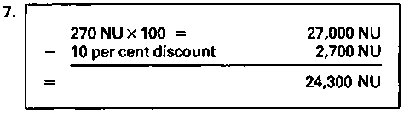
7. Peter is in the business of selling timing machines. His usual selling price is 270 NU per timing machine. However, he is in a very competitive market so he has decided that he must offer discount to people who buy many timing machines at the same time. He offers a 5 per cent discount to those who buy quantities between 10 and 50; and a 10 per cent discount to those who buy quantities between 50 and 100. One day he has the possibility of selling 100 timing machines to a customer. Calculate the total amount that he asks for the 100 timing machines.
Now that you have completed the business practice exercises, turn to the pages which follow the action programme. There you will find the answers. Check your answers against the answer solutions which are given. How many correct answers did you get?
CHECK YOUR ANSWERS!
THEN GO TO THE HANDBOOK FOR
MANAGEMENT IDEAS
Now go to the Handbook and read thoroughly the management ideas in the same section there. You will then find that all the business practice exercises become easier to answer.
Part 3 - Action programme
How to construct your action programme
Count the number of times you answered “yes” or “no” for each set of questions. How many times did you answer “yes”? The more “yes” answers, the better you are in business management. Now look again at those questions you answered with “no”. Those are possible problem areas in your business. Choose the one which you think is the most important for your business. Take the most urgent problem first. Don't try to solve everything at once.
Now write the problem into the action programme on the next page, as we have done with the example. Then write in What must be done, By whom and By when in order to solve your problem.
Finally, go back to your business and carry out the action programme.
Figure
|
Problem |
What must be done? |
By whom? |
By when? |
|
Example: | | | |
|
Too many people to whom I have given credit. They do not pay me. |
1. Set a credit limit of 100 NU to customers who have bought from me regularly for at least 3 months. 2. Strictly cash terms for casual customers. |
Myself and all my staff |
From today onwards. |
Answers to business practice
|
1. |
Asking customers about your goods. Ö |
| |
Asking your husband's or wife's opinion. |
| |
Going through business catalogues. Ö |
| |
Checking your own order books. Ö |
| |
The bus to the nearest big city. |
| |
Asking your sales representative's opinion. Ö |
Figure
|
2. |
(a) The kind of products my customers want. |
| |
(b) The quality and prices. |
| |
(c) The design. |
| |
(d) The sizes or dimensions. |
|
3. |
(a) Advertising in newspapers and magazines. |
| |
(b) Using signboards on main roads. |
| |
(c) Placing posters on buildings. |
| |
(d) Sending special promotional letters to selected customers. |
|
4. |
(a) The ability to learn about the technical aspects of your products. |
| |
(b) The ability to fit in with the kind of customers that he or she has to deal with. |
| |
(c) Politeness, patience and smart appearance. |
|
5. |
(a) Whether your sales are rising or falling. |
| |
(b) Which goods or products are selling well and which are selling badly. |
| |
(c) How your sales representatives are doing. |
Figure
|
6. |
(a) The sales of brand X are steady as from August. It is not an extremely successful product in terms of sales volume. | |
| |
Brand Y is competing with brand X. The sales of brand Y go down steeply in April when brand X is introduced into the market. Ultimately brand Y loses its market share altogether. | |
| |
The sales of brand Z drop suddenly in October. |
|
| |
(b) Brand Y cannot compete with brand X. | |
| |
(c) (i) Launch a marketing campaign to promote brand X. | |
| |
|
(ii) Start a new brand to replace brand Y; stop manufacturing brand Y. |
Figure
The business will ask 24,300 NU for 100 timing machines.
Figure
|
| ||||||||||||||||||||||||||||||||||||||||||||||||||||||||||||
Improve Your Business: Workbook (ILO, 1986, 96 p.)
6. MANAGEMENT ACCOUNTING
Part 1 - Questions
The profit and loss account
|
|
Yes |
No |
|
1. Do you know the difference between cash and profit? |
|
|
|
2. Do you try to calculate every month whether you have made a profit? |
|
|
|
3. Can you think of two things which you could try to do in your business to increase your profits? |
|
|
|
4. Do you know what is meant by depreciation? |
|
|
|
5. Could you explain to another business person what the expression “value added” means? |
|
|
|
6. Do you understand the connection between sales, costs and profits? |
|
|
|
7. Do you know which items to include in a profit and loss account? |
|
|
|
8. Is it important to study the profit and or loss figures for the last ten years if you want to get ideas on how to improve your business quickly? |
|
|
|
9. Do you have a profit and loss account prepared once a year? |
|
|
|
10. Are you sure that you understand how you can use the profit and loss account to improve your business? |
|
|
The balance sheet
|
|
Yes |
No |
|
1. Do you know what an asset is? |
|
|
|
2. Do you know the difference between assets and liabilities? |
|
|
|
3. Can you think of three liabilities which your business has? |
|
|
|
4. Do you know the difference between your private assets and your business assets? |
|
|
|
5. Do you regularly check your insurance policies and the valuations put on your assets? |
|
|
|
6. Are your premises suitable for your operations and is there the possibility of expansion if your business grows? |
|
|
|
7. Is a balance sheet prepared for your business once a year? |
|
|
|
8. Are you sure you understand how you can use the balance sheet to make your business better? |
|
|
|
9. Do you, the owner, sit down and talk to your accountant about the state of the business once the balance sheet and profit and loss account have been prepared? |
|
|
|
10. Have you ever considered paying a fee to a business consultant to examine your business and give you a report about its strengths and weaknesses? |
|
|
The cash flow budget
|
|
Yes |
No |
|
1. Do you try to plan how money will flow in and out of your business month by month over a future period? |
|
|
|
2. Do you know what is meant by working capital? |
|
|
|
3. Do you prepare a cash flow budget at least twice a year? |
|
|
|
4. Do you obtain a monthly bank statement from your bank so that you know how much money you have in the bank? |
|
|
|
5. Can you tell how many months your debtors are taking to pay you the money they owe to you? |
|
|
|
6. Is it true to say that if you find a big difference between the estimated cash position and the actual cash position, then you have a possible management problem? |
|
|
|
7. Do you know how you can use the cash flow budget to improve your business performance? |
|
|
|
8. Are you able to calculate your total estimated monthly wage bill for all your workers for each of the next six months? |
|
|
|
9. Can you estimate how much you will spend on business travel and car expenses in each of the next six months? |
|
|
|
You can ? Then write your estimate below and say briefly how you arrived at it: | | |
_________________________________________________________________
_________________________________________________________________
Part 2 - Business practice
1. THE PROFIT AND LOSS ACCOUNT AND THE BALANCE SHEET
Tin Smith Works Ltd. is just about to produce a profit and loss account for the period 1 January 1986 -31 December 1986 and a balance sheet for the year ending 31 December 1986.
In order to draw up the profit and loss account and the balance sheet, they have collected the following information from their bookkeeping system :
Information needed for the profit and loss account:
|
|
(NU) | |
|
Sales |
100,000 | |
|
Payments for: |
| |
|
|
Raw materials |
30,000 |
| |
Wages |
15,000 |
| |
Interest on loan |
5,000 |
| |
Drawings |
20,000 |
| |
Others |
10,000 |
|
The value of the stock for raw materials and goods has increased by: |
2,000 | |
|
The amount of money due from customers (debtors) has increased by: |
4,000 | |
|
The amount of money due to suppliers (creditors) has increased by: |
6,000 | |
|
The reduction in value of machines and equipment (depreciation) during 1986 is: |
8,000 | |
Information needed for the balance sheet:
|
As at 31 Dec. 1986 | |
| |
(NU) |
|
Money in cash box |
8,000 |
|
Money in bank |
10,000 |
|
Money due from customers (debtors) |
6,000 |
|
Value of stocks |
40,000 |
|
Value of machines and equipment |
30,000 |
|
Money owing to suppliers (creditors) |
4,000 |
|
Loans |
35,000 |
|
Owner's capital |
40,000 |
Using the above information, try to complete the profit and loss account and the balance sheet which are given below.
After completion, try to answer the following questions:
(a) What was the profit in the business in 1986?_________________________________________________________________
(b) How much profit was made and left in the business up to 31 December 1986?
_________________________________________________________________
|
Profit and loss account | ||
| |
Money in |
Money out |
|
Sales | | |
|
Raw materials |
| |
|
Wages | | |
|
Interest | |
|
|
Drawings | |
|
|
Others | | |
|
Change in stock |
| |
|
Change in creditors |
| |
|
Change in debtors |
| |
|
Depreciation |
_______ |
_______ |
|
Profit |
_______ |
_______ |
|
Balance sheet | |
|
Assets |
Liabilities |
|
Cash |
Creditors |
|
Bank |
Loans |
|
Debtors |
Owner's capital _______ |
|
Stocks | |
|
Equipment |
Profit made and left in the business _______ |
|
_______ |
_______ |
2. THE CASH FLOW BUDGET
The information needed to draw up a cash flow budget is given below. Turn to the sheet called “ Cash flow budget, Tin Smith Works Ltd.”, over the page, and try to enter the following items:
· Period of forecast: 1 January 1987-30 June 1987 (ENTER IT)· Money in the cash box and in the bank account on 1 January 1987: 20,000 NU (ENTER IT IN “MONEY PRESENT AT START OF MONTH”)
Now enter the RECEIPTS
· The average sales for the particular months as recorded in the last two years are as follows:
|
January |
February |
March |
April |
May |
June |
|
10,000 |
8,000 |
8,000 |
8,000 |
8,000 |
10,000 |
During 1987 sales will be approximately the same as the above for each month from January to June.
· Three-quarters of the sales each month are cash sales. (ENTER THEM)
· One-quarter of total sales each month are on credit. These are entered in the small triangle for each month under “Cash from credit sales”.
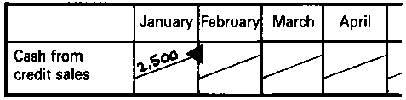
CREDIT SALES
· When credit is given by Tin Smith Works Ltd. it is for one month only. Customers usually pay in one month's time. Enter the cash from credit sales.
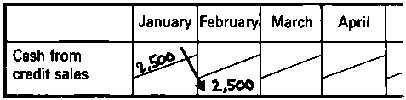
ENTER THEM
· The Tin Smith Works Ltd. will sell an old welding machine in March 1987. This will add 8,000 NU to “Other money in”. (ENTER IT)
Now enter the PAYMENTS
· Tin Smith have found out that when they buy raw materials each month, the value of the purchases is always half of the sales amount for that month. (WORK OUT THE PURCHASES)
Work out the purchases and enter them in the box below.
|
January |
February |
March |
April |
May |
June |
| | | | | | |
(ENTER THEM)
· Four-fifths of the purchases are cash purchases.
· One-fifth of the purchases are on credit. These are entered in the small triangle for each month under “cash paid for credit purchases”.
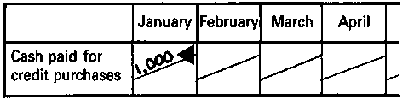
CREDIT PURCHASES
· Tin Smith always pay their creditors within one month. Enter the cash paid for credit purchases.
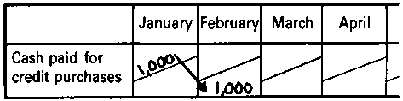
Figure
· Wages amount to 2,000 NU each month. (ENTER THEM)· Drawings by Tin Smith amount to 1,000 NU each month. (ENTER THEM)
· Tin Smith have a 40,000 NU loan. They pay 100 NU as interest each month and make a repayment of the loan in March and June amounting to 1,000 NU in each of these months. (ENTER THEM)
· The item “Others” amounts to 1,500 NU each month. (ENTER IT)
· Tin Smith will buy an electronic calculator in March for 500 NU. (ENTER IT UNDER “PLANNED INVESTMENTS”)
(a) With the information you have been given, try to calculate how much money will be present in the business at the end of January. Write your answer below.________________________________________________
(b) Now try to fill in each month and work out how much money will be present in the business at the end of June. Write your answer below.
________________________________________________
Cash flow budget, Tin Smith Works Ltd.
Period of forecast: ______________
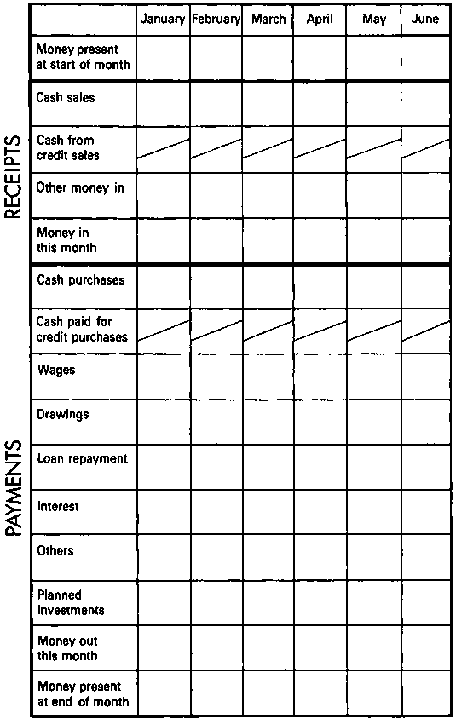
Figure
Now that you have completed the business practice exercises, turn to the pages which follow the action programme. There you will find the answers. Check your answers against the answer solutions which are given. How many correct answers did you get?
CHECK YOUR ANSWERS!

THEN GO TO THE HANDBOOK FOR
MANAGEMENT IDEAS
Now go to the Handbook and read thoroughly the management ideas in the same section there. You will then find that all the business practice exercises become easier to answer.
Part 3 - Action programme
How to construct your action programme
Count the number of times you answered “yes” or “no” for each set of questions. How many times did you answer “yes”? The more “yes” answers, the better you are in business management. Now look again at those questions you answered with “no”. Those are possible problem areas in your business. Choose the one which you think is the most important for your business. Take the most urgent problem first. Don't try to solve everything at once.
Now write the problem into the action programme opposite, as we have done with the example. Then write in What must be done, By whom and By when in order to solve your problem.
Finally, go back to your business and carry out the action programme.
Figure
|
Problem |
What must be done? |
By whom? |
By when? |
|
Example: | | | |
|
How to make sure there will be enough cash in the business by
the end of August to buy a cash-register. |
Draw up a six-month cash budget. |
Myself |
One week from now i.e. by 9/8/86. |
Answers to business practice
|
Profit and loss account | ||
| |
Money in |
Money out |
|
Sales |
100,000 | |
|
Raw materials |
|
30,000 |
|
Wages | |
15,000 |
|
Interest | |
5,000 |
|
Drawings | |
20,000 |
|
Others | |
10,000 |
|
Change in stock |
2,000 | |
|
Change in creditors |
4,000 | |
|
Change in debtors |
|
6,000 |
|
Depreciation |
|
8,000 |
| | |
94,000 |
|
Profit | |
12,000 |
| |
106,000 |
106,000 |
|
Balance sheet | |||
|
Assets |
Liabilities | ||
|
Cash |
8,000 |
Creditors |
4,000 |
|
Bank |
10,600 |
Loans |
35,000 |
|
Debtors |
6,000 |
Owner's capital |
40,000 |
|
Stocks |
40,000 | |
79,000 |
|
Equipment |
30,000 |
Profit carried over from 1985 |
3,000 |
| |
______ |
Profit made in 1986 |
12,000 |
| |
94,600 | |
94,000 |
Cash flow budget, Tin Smith Works Ltd.
Period of forecast: 1.1.1987 - 30.6.1987
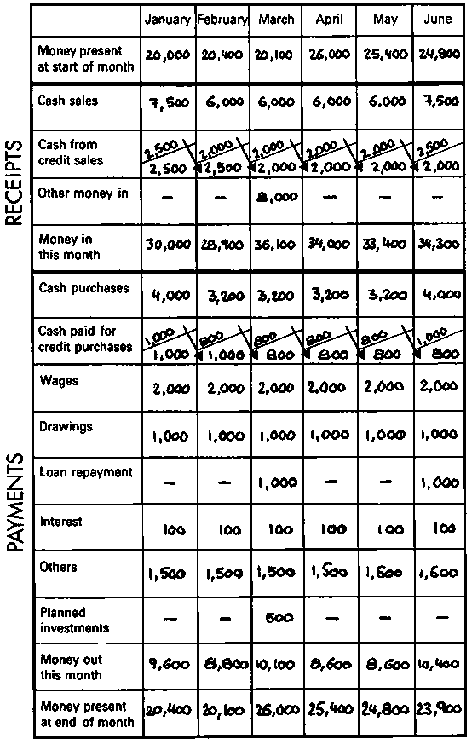
Figure
|
| ||||||||||||||||||||||||||||||||||||||||||
Improve Your Business: Workbook (ILO, 1986, 96 p.)
7. OFFICE WORK
Part 1 - Questions
|
|
Yes |
No |
|
1. Do you have a room or a separate place which is used for the office work in your business? |
|
|
|
2. When someone telephones you in your office asking for information which must be on the files, can you generally find it while the caller holds the line? |
|
|
|
3. Do you think the filing of your business documents is as good as it could be? |
|
|
|
4. In your office, do you have one person responsible for ail filing of records? (If it is yourself - write “myself”.) |
|
|
|
5. Do you keep a separate file or binder for business documents relating to the way your business is run such as annual reports, insurance policies and so on? |
|
|
|
6. Do you have a typewriter to type your business letters? |
|
|
|
7. If you look at the letterhead and typing of the business letters you recently sent, do you think they create a good impression of your business? |
|
|
|
8. Do you think the appearance and layout of your office would give a good impression of your business to a visitor? |
|
|
|
9. Do you use a stamp marked “Paid” to cancel all invoices and vouchers when you have paid them? |
|
|
|
10. Do you use a simple calculator for calculating prices and checking on the additions and multiplications on invoices, ledgers, payrolls and so on? |
|
|
Part 2 - Business practice
1. Given below is a list of things that you might find in a business office. Choose from the list the twelve which you think are essential for you to have in your office. Write them down against the letters below in the order of priority in which you would introduce them.
· a safe
· a calculator
· a photocopying machine
· a telephone
· a typewriter
· a desk and chair
· a desk diary
· a waste paper basket
· a calendar
· a file for important business matters
· business cards to give to people
· printed letter-head stationery
· an easy chair for visitors
· a wages file
· an expenses claims file
· a tax file
· data for invoicing
· copies of your own invoices
· a file for suppliers' invoices
· a general voucher file or paid invoice file
· an alphabetical letter file
· shelves for the files
· a wall chart showing your sales targets
Figure
(a) ______________________________
(b) ______________________________
(c) ______________________________
(d) ______________________________
(e) ______________________________
(f) ______________________________
(g) ______________________________
(h) ______________________________
(i) ______________________________
(j) ______________________________
(k) ______________________________
(l) ______________________________
2. Write down the names of three documents which you would put in a file called “The business”:
(a) ____________________________
(b) ____________________________
(c) ____________________________
Now that you completed the business practice exercises, turn to the page which follows the action programme. There you will find the answers. Check your answers against the answer solutions which are given. How many correct answers did you get?
CHECK YOUR ANSWERS!
THEN GO TO THE HANDBOOK FOR
MANAGEMENT IDEAS
Now go to the Handbook and read thoroughly the management ideas in the same section there. You will then find that all the business practice exercises become easier to answer.
Part 3 - Action programme
How to construct your action programme
Count the number of times you answered “yes” or “no” to the set of ten questions. How many times did you answer “yes”? The more “yes” answers, the better you are in business management. Now look again at those questions you answered with “no”. Those are possible problem areas in your business. Choose the one which you think is the most important for your business. Take the most urgent problem first. Don't try to solve everything at once.
Now write the problem into the action programme opposite, as we have done with the example. Then write in What must be done, By whom and By when in order to solve your problem.
Finally, go back to your business and carry out the action programme.
Figure
|
Problem |
What must be done? |
By whom? |
By when? |
|
Example: | | | |
|
The place where we do the office work is too noisy and
dirty. |
Must organise a better place for the office work. |
Myself and one worker. |
Start on Monday next week, 5/8/86 |
Answers to business practice
1. This is only one suggestion about the important things in a small business office. Discuss your list of ideas with another business person.
(a) a desk and chair
(b) a telephone
(c) a typewriter
(d) a calculator
(e) printed letter-head stationery
(f) a waste paper basket
(g) a desk diary
(h) a file for important business matters
(i) data for invoicing
(j) copies of your own invoices
(k) a file for suppliers' invoices
(l) a general voucher file or paid invoice file
|
2. |
(a) The partnership agreement, if any, or the memorandum and the articles of association, if a limited company. |
| |
(b) Balance sheets and profit and loss accounts; bank statements. |
|
|
(c) Loan documents and insurance policies. |

Figure
|
| ||||||||||||||||||||||||||||||||||||||||||||||||||||||
Improve Your Business: Workbook (ILO, 1986, 96 p.)
8. PLANNING
Part 1 - Questions
Planning sales and costs
|
|
Yes |
No | |
|
1. Do you plan your business at least one year ahead ? |
|
| |
|
2. Do you plan your business one or more months ahead? |
|
| |
|
3. Do you write your plans down on paper? |
|
| |
|
4. Do you usually set a target in terms of a certain value of sales or profit which you hope to achieve during the next year? |
|
| |
|
5. Do you know what a budget is? |
|
| |
|
6. If you plan ahead, do you make your plans by using : |
| | |
| |
(a) Records of your past activities? |
|
|
| |
(b) Information you can get from official publications and talks with other business people? |
|
|
|
7. When planning, do you talk with your own staff and get their ideas? |
|
| |
|
8. Once you have drawn up the plan, do you check regularly that everything is going in accordance with that plan? |
|
| |
|
9. Do you prepare a written budget of what your various business costs are likely to be during the next year? |
|
| |
New investments
|
|
Yes |
No | |
|
1. Do you know which information about your machines and equipment you need in order to be able to decide when they must be replaced? |
|
| |
|
2. Do you keep written records about output, breakdowns and costs on all your machines and equipment? |
|
| |
|
3. When thinking about buying new machines or equipment: |
| | |
| |
(a) Do you first make an estimate of your sales for the next few years? |
|
|
| |
(b) Do you contact several dealers and suppliers for information on new techniques and processes? |
|
|
| |
(c) Do you visit other businesses which are already using the equipment you want to buy, or similar equipment? |
|
|
| |
(d) Do you obtain and compare detailed specifications and quotations from several manufacturers, either through local agents or direct? |
|
|
| |
(e) Do you check in advance whether your new equipment can operate with the materials you are currently using and, if not, do you find out if the new materials you need are easily obtainable, and at what cost? |
|
|
| |
(f) Do you ensure that spare parts for the new equipment can be easily and quickly obtained? |
|
|
| |
(g) Do you find out whether your workers will need new skills to operate the new equipment? |
|
|
|
4. Do you make sure that the contract spells out clearly the exact payment conditions, delivery dates, capacity, fuel consumption and so on, of the equipment, as well as the obligations of the supplier (guarantee conditions, etc.)? |
|
| |
Part 2 - Business practice
1. THE BUSINESS PLAN
A business plan is an estimate of the sales you think you can achieve with the resources you have in the business, i.e. with the machines, workers, cash and your own business skills or ability.
The business plan helps you to control the operation of your business. The plan is made up for the period of time ahead (e.g. for one year or for three years). It is then broken down into shorter periods (e.g. months). If it is done in this way, it is easier for you to check whether your business is running according to the plan. If necessary you can take action to correct any deviation from the plan.
In addition to the estimated sales figures which you have to calculate for your business plan, you also have to estimate the direct and indirect costs. Once you have made estimates of these costs you can get an idea of how much profit you will make in total for the whole period, and also for each shorter period within the business plan.
To give you an idea of what you have to do to make a business plan, we will ask you to complete the business plan for one year for a carpentry business.

Figure
Read the following and try to complete the sheet called “Business plan” over the page by filling in the following:
(a) SalesLast year's sales in John's carpentry business were 2,500 chairs, at 45 NU a chair. As a result of improvements, the production capacity is now bigger. John has never had problems selling what he produces. His estimate for production and sales for the next 12 months (January-December) is 3,000 chairs at 50 NU a chair. Fill in the sales figure.
Figure
(b) LabourThe wages for his five employees (labour cost) will be 3,000 NU each month. Fill in the labour cost.

Figure
(c) MaterialsJohn estimates that the materials cost will be slightly less than half the selling price. If the sales each month total 12,500 NU the materials cost will be just under half that figure (half is 6,250 NU so you estimate, say, 6.000 NU for each month). Fill in the materials cost.
Figure
(d) Gross profitNow you can complete the estimated gross profit each month and for the whole year. Fill it in on the sheet.

Figure
(e) Indirect costsThe indirect costs (all other costs in John's business) were 15,000 NU last year. John knows that these costs increase every year. He must add an extra 20 per cent to his indirect costs (i.e. 20 per cent of 15,000, making 3,000). He adds 3,000 to 15,000 and gets 18,000 NU. This is the total indirect cost for the year to come. To get the monthly figure for indirect costs, 18,000 is divided by 12, giving 1,500 NU for each month. Fill in the indirect costs.
Figure
(f) Net profitNow you are in a position to calculate easily the monthly net profit and yearly net profit totals for John's business.
This example of a business plan shows you the basic principles which have to be followed. In the Handbook you will find more detailed instructions on how to make a business plan.
BUSINESS PLAN
|
Details |
Jan. |
Feb. |
Mar. |
Apr. |
May |
June |
July |
Aug. |
Sept. |
Oct. |
Nov. |
Dec. |
Total | |
|
Sales | | | | | | | | | | | | | | |
|
Less: Production costs of which: | | | | | | | | | | | | | | |
| |
Labour | | | | | | | | | | | | | |
| |
Materials | |
| | | | | | | | | | | |
|
Gives: Gross profit |
| | |
| | |
| | |
| | |
| |
|
Less: Indirect costs |
| | |
| | |
| | |
| | |
| |
|
Gives: Net profit |
| | |
| | |
| | |
| | |
| |

Figure
2. MARGARET'S TAILORING BUSINESS
Margaret has a small tailoring business. When she started her business two years ago, she did not have the capital to buy a suitable sewing-machine. Therefore she borrowed a hand-powered machine from her aunt, who was quite glad to receive 20 NU per month as a rent for the machine.
However, Margaret is not very satisfied with the machine. The fact that it is hand operated slows down the pace of her work as the right hand has to be on the wheel all the time, and only the left hand is available to hold the cloth. She has plans to invest her money in a new sewing-machine. She has made up her mind that, to solve her present problem, the new sewing-machine should be either foot powered or electrical.
Margaret has never been in a situation like this before in her life. She does not know how to choose between the two types of machine. Can you help her by giving her some factors which she should consider before making the decision?
(a) ______________________________
(b) ______________________________
(c) ______________________________
(d) ______________________________
(e) ______________________________
(f) ______________________________
Now that you have completed the business practice exercises, turn to the pages which follow the action programme. There you will find the answers. Check your answers against the answer solutions which are given. How many correct answers did you get?
CHECK YOUR ANSWERS!
THEN GO TO THE HANDBOOK FOR MANAGEMENT
IDEAS
Now go to the Handbook and read thoroughly the management ideas in the same section there. You will then find that all the business practice exercises become easier to answer.
Part 3 - Action programme
How to construct your action programme
Count the number of times you answered “yes” or “no” for each set of questions. How many times did you answer “yes”? The more “yes” answers, the better you are in business management. Now look again at those questions you answered with “no”. Those are possible problem areas in your business. Choose the one which you think is the most important for your business. Take the most urgent problem first. Don't try to solve everything at once.
Now write the problem into the action programme opposite, as we have done with the example. Then write in What must be done, By whom and By when in order to solve your problem.
Finally, go back to your business and carry out the action programme.
Figure
|
Problem |
What must be done? |
By whom? |
By when? |
|
Example: | | | |
|
Must set up targets for my business activities for the next
12 months. |
Make up a Business Plan. |
Myself |
Next Saturday 4/7/86 |
Answers to business practice
1. THE BUSINESS PLAN
|
Details |
Jan. |
Feb. |
Mar. |
Apr. |
May |
June |
July |
Aug. |
Sept. |
Oct. |
Nov. |
Dec. |
Total | |
|
Sales |
12,500 |
12,500 |
12,500 |
12,500 |
12,500 |
12,500 |
12,500 |
12,500 |
12,500 |
12,500 |
12,500 |
12,500 |
150,000 | |
|
Less: Production costs of which: | | | | | | | | | | | | | | |
| |
Labour |
3,000 |
3,000 |
3,000 |
3,000 |
3,000 |
3,000 |
3,000 |
3,000 |
3,000 |
3,000 |
3,000 |
3,000 |
36,000 |
| |
Materials |
6,000 |
6,000 |
6,000 |
6,000 |
6,000 |
6,000 |
6,000 |
6,000 |
6,000 |
6,000 |
6,000 |
6,000 |
72,000 |
|
Gives: Gross profit |
3,500 |
3,500 |
3,500 |
3,500 |
3,500 |
3,500 |
3,500 |
3,500 |
3,500 |
3,500 |
3,500 |
3,500 |
42,000 | |
|
Less: Indirect costs |
1,500 |
1,500 |
1,500 |
1,500 |
1,500 |
1,500 |
1,500 |
1,500 |
1,500 |
1,500 |
1,500 |
1,500 |
18,000 | |
|
Gives: Net profit |
2,000 |
2,000 |
2,000 |
2,000 |
2,000 |
2,000 |
2,000 |
2,000 |
2,000 |
2,000 |
2,000 |
2,000 |
24,000 | |
Figure
2. MARGARET'S TAILORING BUSINESS
There are a number of factors which Margaret should consider:
(a) Afoot-operated machine is much cheaper than an electrical one. Will Margaret be able to make an investment in an electrical machine worthwhile?(b) Are spare parts for the electrical machine readily available? And for the foot-operated machine?
(c) Is there a mechanic available to repair the electrical machine when it breaks down?
(d) Are there frequent power cuts?
(e) An electrical machine gives a lot of possibilities for making more sophisticated clothing which a foot-powered machine may not have. Is there a market for more sophisticated, fashionable clothes in Margaret's town?
(f) Will Margaret need additional training to operate the electrical machine? At what cost will the training be available?
|
| ||||||||||||||||||||||||||||||||||||||||||||||||||||||||||||||||||||||||||||||||||||||||||
ENDPIECE
What we have advised in this Workbook is:
· Answer the questions by “yes” or “no” so that you will know the strong and weak points in your business knowledge.· Complete the exercises in business practice to improve your business knowledge. If you found that you had any difficulties in completing the exercises or if you want to learn more, always read again the corresponding section in the Handbook. Then you will be able to complete the exercises easily.
· Take action by using the action programme part of the Workbook to write down:
(a) Your business problems.
(b) What must be done?
(c) By whom?
(d) By when?
Lastly, remember that you should always ask yourself questions about your business as the Workbook does. This means that the best way to improve your business is to look at it in a critical way, ask yourself questions about it and then write down action programmes which do something about solving your problems.
|
| ||||||||||||||||||||||||||||||||||||||||||||||||||||||||||||||||||||||||||||||||||||||||||
BACK COVER
IMPROVE YOUR BUSINESS
WORKBOOK
Do you own and run a small business? Are you looking for ideas on how to improve sales, reduce costs, increase profits and use simple management techniques suitable for a small commercial, manufacturing or service business? If your answer is “yes”, Improve your business is for you!
Improve your business comes in two parts: a Handbook and a Workbook. You can use them separately, but they are best read together. Both consist of eight sections, each dealing with an important part of your business: buying and selling; manufacturing and service operating; bookkeeping; costing and pricing; marketing; management accounting; office work; and planning. Each section of the Handbook corresponds to a section in the Workbook, so that you can easily go from one to the other.
The Workbook, which you are holding now, makes you think hard about your business. Each section asks you a set of questions which will help you to see where your strengths and weaknesses lie. Next it sets you a number of business exercises, and finally it shows you how to set up an action programme to solve your problems. If you want to extend your knowledge of a particular aspect of your business, turn to the Handbook.
Improve your business can equally well be used by trainers, consultants and extension workers.
Price: 7.50 Swiss francs
ISBN for Workbook: 92-2-105340-7
ISBN for complete set
of two volumes:
92-2-105342-3