 |
| ||||||||||||||||||||||||||||||||||||||||||||
|
| ||||||||||||||||||||||||||||||||||||||||||||
Institut f�r berufliche Entwicklung e.V.
Berlin
Original title:
Arbeitsmaterial f�r den
Lernenden
“Keilverbindungen”
Author: Frank Wengh�fer
First edition © IBE
Institut f�r berufliche Entwicklung e.V.
Parkstra�e
23
13187 Berlin
Order No.: 90-35-3135/2
|
| ||||||||||||||||||||||||||||||||||||||||||||
Preliminary Remarks
The present material is designed for the training in occupations which - in addition to knowledge in the field of manual and mechanical metal working - require mastership of assembly operations.
The material describes the various ways of joining component parts with the help of keys taking the function of the respective unit into consideration.
The making and undoing of keyed joints are explained by their main steps.
The questions at the end of each sections, are intended to help the trainees check their acquired knowledge.
|
| ||||||||||||||||||||||||||||||||||||||||||||
Hints on Labour Safety
On principle, the regulations on industrial safety apply which have to be observed with the techniques of filing, scraping, reaming, milling and slottering.
Special attention has to be paid to the following focal points:
- Use only clean, undamaged and sharp tools.- Clamp the workpieces safely and firmly but so that they are not damaged.
- Keep the measuring and testing instruments in a safe place, protect them against damages caused by shock and/or corrosion.
- Keep your workplace in order, keep fittings pieces always together with their matching parts.
|
| ||||||||||||||||||||||||||||||||||||||||||||
1. Intended Use of Keyed Joints
Keyed joints are detachable joints connecting machine parts by fasteners - keys - a non-positive way.
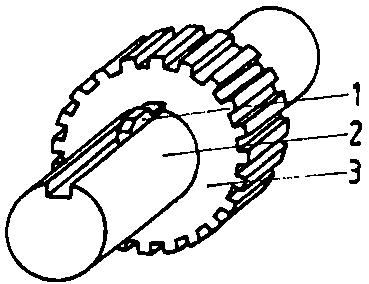
Figure 1 - Keyed Joints
1 key, 2 shaft, 3 hub
Keyed joints are made in order to
- connect machine parts that shall perform rotational movements transmitting little to great rotary powers;- connect machine parts that shall perform a to-and-fro movement where little to great axial force must be transmitted;
- connect machine parts in such a way that their exact position relative to one another can be adjusted.
If parts of machines are designed as keys or tapers, they can be connected immediately as a result of this shape. In this case, no additional wedges are required. Such machine parts must be adapted to one another very accurately. Advantage of keyed joints:
- Guarantee of function even with reciprocal stress in the form of shocks.
Disadvantage:
- With rotating machine parts, the accuracy of true running is not guaranteed in case of high peripheral speeds.
|
| ||||||||||||||||||||||||||||||||||||||||||||
2. Types of Keys
Keys are made from drawn steel with a tensile strength of approximately 700 MPa. They must have a greater strength and hardness than the machine parts to be connected, so that they are not deformed when they are driven in.
Taper sunk keys
These are long bodies with a rectangular cross-section, inclined back surface and with plane or rounded front surface.
The inclination has the proportion of 1:100, which means: the taper is 1 mm per 100 mm.
- Round-ended sunk keys are called laid-in keys - they are pressed (or inserted) into the snugly fitting groove of the shaft and the hub is subsequently driven on to the sunk key.
These keys are used if there is no space for driving the key in of out- Straight-ended sunk keys, also called tapered driving keys - in this case the shaft and the hub (or the machine parts in question) are mounted as in normal use and the sunk key driven in subsequently.
They are used if there is sufficient space to drive them in and out from either side.- Tapered driving keys the thicker ends of which feature a nose are called gib-head keys.
They are used if driving in or out can be done from one side only.- Woodruff keys can also assume the function of taper sunk keys because - due to their rotatable mounting in the keyway they are able to adapt themselves to the taper in a hub keyway.

Figure 2 - Taper sunk keys
1 laid-in sunk key, 2 tapered driving key, 3 gib-head key, 4 Woodruff key
Hollow and flat keys
These are long bodies with a rectangular cross-section with inclined back surface and small taper. They are only used for transmitting little rotary forces. For these no keyway must be made:
- The bottom of hollow keys is concave in longitudinal direction. The edges of these keys resemble cutting edges which contact the shaft.- A good adaption of the flat key to the shaft is achieved only, if the shaft is flattened corresponding to the width of the key in that place where the key shall be applied.

Figure 3 - Hollow and flat
keys
Tangential keys
These consist in a pair of mating bodies of a rectangular cross-section. Each of these bodies has one inclined side face, the inclination proportion (taper) is 1:60 up to 1:100. Tangential keys are used if very great rotational forces have to be transmitted in both directions of rotation.
With their inclined surface turned towards each other, they are driven into inclined keyslots and hub keyways. In doing so, always two pairs of keys are staggered around the shaft circumference at an angle of 120°.

Figure 4 - Tangential keys
Taper sleeves
These are bodies in the form of truncated cones with internal
and external tapers serving to connect machine parts directly. In general they
are used with machine spindles where tools with taper shanks are applied. For
undoing the connection, cotters are driven through lateral oblong holes into the
taper sleeves. A special type of taper sleeve is the clamping sleeve, which, as
an intermediate, is used in machine part joints. Clamping sleeves are placed on
shafts on which then antifriction bearings, toothed gears and similar elements
can be mounted. Their uniform circumferential stress which is the result of a
taper between 1 in 10 and 1 in 20 guarantees exact true running.
They are
fastened by nuts.

Figure 5 - Taper sleeves and
clamping sleeves
Taper pins
These are elongated bodies in the form of truncated cones with a taper of 1 in 50.
In keyed joints they are also called ‘cylindrical taper keys’. They are used if a joint shall be made very simply, shall be undone only seldom and has to transmit only little rotational force, for instance levers on axles.
The bore holes are reamed by reamers as it is done with taper pin joints.
For undoing the joint the taper pin must be bored out.

Figure 6 - Taper pin
Cotters
These are rectangular bodies with one or two inclined surfaces the edges of which are rounded.
They are used for fixing bolts and crankshafts in order to transmit longitudinal (to-and-fro) movements.
Cotters have a taper of 1 in 10 up to 1 in 40 and are often secured against loosening by additional means.
Since the manufacturing of the slots requires much time and labour, they are used only, if great axial forces have to be transmitted.
For the transmission of little force, taper pins can be used instead, because this facilitates the making of the joint.

Figure 7 - Cotter
1 with one inclined surface
2 with two inclined surfaces
Tightening keys
These are rectangular bodies with one or two inclined surfaces and a tapped through hole in longitudinal direction.
Tightening keys transmit no rotary forces; they are used for clearance adjustment in divided bearings and guideways. They are applied across the rod axis. In order to achieve a great tightening effect by a short path of positioning in longitudinal direction, the back surfaces are manufactured with a taper between 1: 5 and 1:10.

Figure 8 - Tightening key
What are keyed
joints?
_________________________________________________________________
_________________________________________________________________
_________________________________________________________________
What is the special advantage of keyed
joints?
_________________________________________________________________
_________________________________________________________________
_________________________________________________________________
What disadvantage has to be considered with keyed joints at
rotating machine
parts?
_________________________________________________________________
_________________________________________________________________
_________________________________________________________________
Which types of keys are used for joining machine parts that have
to carry out rotating
movements?
_________________________________________________________________
_________________________________________________________________
_________________________________________________________________
What are the tasks cotters have to
fulfill?
_________________________________________________________________
_________________________________________________________________
_________________________________________________________________
What are the tasks of tightening
keys?
_________________________________________________________________
_________________________________________________________________
_________________________________________________________________
Hints on manufacturing keys
- One’s own keys are made only, if no industrially prefabricated ones are available. Keys are manually worked by filing and scraping.- Since the bottom and back surfaces require reworking when the key is fitted in, they are made with an allowance of 0.3 to 0.5 mm.
- Often, the length of the key can be exactly determined only when the connection is just being made. Therefore, a sufficiently long key should be prepared.
- The side faces of taper sunk keys get the h 9 fit, so that they have enough play in the groove.

Figure 9 - Surfaces of a key
1 top of key, 2 key bottom, 3 front surfaces, 4 side faces
Sequence of operations for making a key for a shaft-and-hub joint:
- Putting the hub on the shaft- Determining the key heights according to the dimensions of the grooves (reckoning the taper over again)
- Marking the material for the wedge
- Rough-finishing the taper by filing, breaking the comers 0.5 x 45°
- Fitting the key, finding out the drag marks or the bearing contact pattern, scribing the length of the key
- Finishing the surfaces
- Sawing the key to length, breaking the comers, deburring
What allowances have to be made when manufacturing a wedge
oneself?
_________________________________________________________________
_________________________________________________________________
_________________________________________________________________
|
| ||||||||||||||||||||||||||||||||||||||||||||
3. Types of Keyed Joints
According to the task of the joint it is distinguished between fastening and tightening key joints. Keys used in fastening key joints are distinguished by their position to the longitudinal axis of the machine parts to be connected. Therefore, they are divided into keys and cotters.

Figure
|
| ||||||||||||||||||||||||||||||||||||||||||||
4. Kinds of Stress Acting on Keyed Joints
Keyed joints are non-positive connections - the back surface of the key is pressed against one part of a machine, its bottom surface against the other part of the machine. By this, the two machine parts are tightened with each other.
The tightening strength depends on the pressing-in force, on the angle of inclination of the surfaces and on the friction between the tightened surfaces.

Figure 10 - Stress acting on
keyed joints
1 tension between key and hub, 2 pressing-in force, 3 tension between key and shaft
Tightening becomes strong, if the pressing-in force is great The smaller the taper of the key used, the greater the tightening effect. If there is much friction between the surface to be tightened, a great pressing-in force must be applied.
Principle of action of the keyed joint
The effect of keyed joints is based on the principle of the inclined place.
It is known that heavy loads can be pulled up on an inclined plane with little force. Especially little force is required, if the plane has a narrow angle of inclination.
This means that keys of a small taper have a great tightening effect, although only little pressing-in force is required.
Therefore, it has to be considered with shaft and hub connections that too strong pressing into place of the key-may destroy the hub or, at least, may disturb the true running. Since, in this type of connection, only the back and bottom surfaces of the key are exposed to pressure, the side faces are normally free of pressure; they have play. However, with too strong rotary forces, the side faces of the wedge get in contact with the groove in shaft and hub.
Then, a shearing stress is generated in the cross section of the wedge on the level of the shaft diameter. As a result of this, the key might shear off.
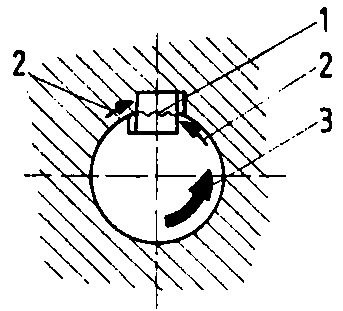
Figure 11 - Stress acting on a
keyed joint in case of overload
1 shearing stress, 2 acting forces, 3 rotary force
What types of keyed joints are
distinguished?
_________________________________________________________________
_________________________________________________________________
_________________________________________________________________
What stress is the key in the keyed joint exposed
to?
_________________________________________________________________
_________________________________________________________________
_________________________________________________________________
|
| ||||||||||||||||||||||||||||||||||||||||||||
5. Tools and Auxiliary Accessories
Shank cutter and cylindrical cutter
Shank cutters are used for making round-end grooves in shafts for laid-in keys as well as for drilling oblong holes for cotters.
Cylindrical cutters are used for making long, shallowing out grooves in shafts for receiving tapered driving keys as well as for making circular grooves for Woodruff keys.

Figure 12 - Making of shaft
keyways with the help of
1 end mill cutter, 2 cylindrical cutter
Broaches and grooving tools
Broaches or grooving planer tools are used for making hub key-ways on the respective machines according to the required technique of “broaching” or “shaping”.

Figure 13 - Making of hub
keyways with the help of
1 end mill cutter, 2 cylindrical cutter
Lathe tools and taper reamers
Lathe tools are used for making external tapers with taper sleeves and clamping sleeves. Taper reamers are used for making internal tapers with taper sleeves and taper pin joints.

Figure 14 - Lathe tool and
taper reamer
Files and scrapers
Finishing files as well as triangular flat scrapers are used for deburring grooves and keys as well as for reworking and fitting of the keys in the grooves.

Figure 15 - Files and scrapers
Hammers
Locksmith’s hammers are used for pressing the keys in the machine parts and light-metal hammers for pressing in cotters and taper pins.

Figure 16 - Hammers
Cotter drivers and key extractors
Cotter drivers are used for forcing in and loosening of keys/cotters with the help of locksmith’s hammers.
Non-ferrous metal arbors drifts serve the same purpose.
Key extractors are cotters which are used especially for drawing gib-head keys out of the joint

Figure 17 - Cotter driver and
cotter extractor
Pullers
Pullers are used for pulling the hub from the shaft, if these parts cohere to each other very firmly and must be loosened.

Figure 18 - Pulling
device
|
| ||||||||||||||||||||||||||||||||||||||||||||
6. Selected Technological Operations for Making Keyed Joints
The sequence of operations for making keyed joints are different according to the respective type of key that shall be put in.
6.1. Taper Sunk Key Joints
Prefabrication of the slots
If keyed joints shall be made with the help of taper sunk keys, grooves must be prepared in the parts to be joined, in order to receive the key. These parts are machined by “milling”, “broaching” and “shaping”. Mostly, the grooves are given the D 10 fit and must have the taper of 1 in 100 in the hub.

Figure 19 - Individual parts
with prepared grooves
Testing the individual parts
The external condition and accuracy to size of the hub and shaft have to be checked. In doing so, make sure that
- the shaft has a clean surface quality without embossments;- the bore of the hub is free of shoulders or ridges;
- length, width, depth and alignment of the shaft keyway as well as the taper of the hub keyway (1:100) are true to size;
- the accuracy of fit of shaft and hub have been exactly observed (check by external limit gauge or plug limit gauge).

Figure 20 - Checking of the
individual parts
1 length of shaft keyway, 2 depth of shaft keyway, 3 fit of shaft, 4 alignment of shaft keyway, 5 width of shaft keyway, 6 width of hub keyway, 7 depth of hub keyway, 8 fit of hub, 9 inclination taper of hub keyway
The clearance between shaft and hub must be kept very small, otherwise the hub moves off the centre by as much as the size of play and cants when the wedge is pressed in.
With high rotational speeds it may therefore come to great balance errors. In order to prevent this it is recommended to joint shaft and hub by a slight interference fit.

Figure 21 - Canting of hub and
shaft due to too much play
Deburring of the individual parts
The keys as well as the keyways in shaft and hub are checked for burrs. Deburring is done by using a file or triangular scraper.
Fitting the key in the keyways
By slight driving-in of the tapered driving key in the keyway of the joined machine parts by way of trial it is found out whether the back surface carries well. For this purpose, one searches for drag marks or rubs the back surface with chalk; in order to find out the bearing contact pattern. Reworking is done by filling or scraping.

Figure 22 - Bearing contact
pattern
1 surface areas required reworking
A similar procedure is followed with laid-in keys. As distinguished from the tapered driving key, the laid-in key is inserted into the shaft keyway and then the hub is driven on to the key.
Hints on the length of tapered driving keys
- After the test fitting, the respective key is sawn to the required length, so that it does not project from the hub.- The length of gib-head keys is fixed in such a way that after the wedge is driven in the nose projects from the hub by the measure of the key width.

Figure 23 - Gib-head key put
in place
1 width of gib-head key
Projecting gib-head keys must be protected by suitable protective caps. Freely rotating machine parts with gib-head keys may easily be the cause of an accident.
Assembling the individual parts
The shaft journal, the hub bore and the key are slightly greased.
Laid-in keys and Woodruff keys are put in the shaft keyway; then the hub is driven on to the shaft by press.

Figure 24 - Pressing-in of the
hub using laid-in keys
1 pressing-in force
Tapered driving keys are driven into the previously joined individual parts with the help of a locksmith’s hammer and a cotter driver.

Figure 25 - Pressing-in of the
tapered driving key by means of cotter driver
1 pressing-in force
Long and big tapered driving keys are forced in by about sledges and with the help of light metal backings. Neither the wedge nor the shaft and hub must be damaged when the wedge is forced in.
Testing the joint
After the key is driven in it has to be made sure that
- the key fits tightly
- the hub is in the right place on the shaft
- the hub rotates in truth on the shaft.
By what techniques are the grooves made in the
shafts?
_________________________________________________________________
_________________________________________________________________
_________________________________________________________________
By what techniques are the grooves made in the
hubs?
_________________________________________________________________
_________________________________________________________________
_________________________________________________________________
What qualities of the individual parts have to be examined if a
taper sunk key joint shall be
made?
_________________________________________________________________
_________________________________________________________________
_________________________________________________________________
What kind of fit is required between shaft and hub in case of
taper sunk key
joints?
_________________________________________________________________
_________________________________________________________________
_________________________________________________________________
6.2. Hollow Key and Flat Key Joints
- Preparation of the keyways:
Only hub keyways have to be made.
- Checking of the individual parts:
The external condition and accuracy to size of shaft and hub as well as of the hub keyway have to be inspected.
- Deburring of the individual parts:
Key and hub keyway have to be deburred.
- Fitting the key into the keyway:
By way of trial it is found out whether the key fits in the joined machine parts.
When using flat keys, the shaft has to be flattened corresponding to the bottom surface of the wedge.

Figure 26 - Fitted in hollow
and flat keys
1 hollow key, 2 flat key
- Assembling the individual parts:
Shaft and hub are slightly greased and put together. The key is driven in by a locksmith’s hammer and a cotter driver.
- Testing of the joint:
After assembly, the firm fit of key and hub as well as the true running are tested.
6.3. Tangential Key Joint
- Preparation of the keyways:
In each shaft and hub two oblique (tangential) keyways have to be made which are staggered by 120°.
- Checking of the individual parts:
The external condition and accuracy to size of shaft and hub as well as of the keyways have to be checked.
- Deburring of the individual parts:
Wedges and keyways have to be deburred.
- Fitting the keys into the keyway:
At first, keys 2 and 4 are put in, then keys 1 and 3; they are slightly forced in and reworked after their bearing contact pattern has been inspected.
The inclined surfaces of keys 1 and 2 as well as 3 and 4 must be placed against one another for assembly.

Figure 27 - Fitted in
tangential keys
- Assembling the individual parts:
Shaft and hub are slightly greased and put together.
After that, keys 2 and 4 are inserted and then keys 1 and 3 beaten in alternately.
- Testing of the joint:
After assembly, the firm fit of the keys and the hub as well as the true running have to be tested.
How is the fit of the keys
examined?
_________________________________________________________________
_________________________________________________________________
_________________________________________________________________
What is tested after a shaft and hub joint is
made?
_________________________________________________________________
_________________________________________________________________
_________________________________________________________________
6.4. Particularities when Making Conical Connections
- Taper sleeves are adapted to conical shaft butts attaining full bearing capacity by ink-marking and subsequent grinding and scraping.
- Taper pins as longitudinal keys are fitted in shaft and hub joints by the tecique of reaming. For this purpose, shaft and hub are clamped and bored and then reamed by taper reamers. Attention has to be paid that the front ends of shaft and hub level with each other so that they are bored accurately on the line of the shaft circumference.

Figure 28 - Conical joints
1 taper shank in taper sleeve, 2 taper pin as key
6.5. Joining by Using Cotters
- Making of elongated holes:
By the techniques of milling or mechanical filing elongated holes with the required taper of the side faces are made in both machine parts.
- Assembling the individual parts:
The individual parts are deburred and cleaned and put together with the oblong holes being aligned.
- Fitting in the key:
The key is beaten in slightly (on trial) in order to find out the bearing capacity of the inclined surfaces.
- After having been reworked the key is forced into the elongated hole by systematic hammer blows.
- Shall the key stand heavy and changing loads it must be secured against coming loose.

Figure 29 - Fitted in cotter
6.6. Joint Made by Using Tightening Keys
- Mounting the premanufactured individual parts:
The bearing shells are put into the mechanically made through hole. Thin sheet metal insets are placed between the two bearing shells.The tightening key is put in such a way that a displacement of the key would cause also a displacement of one of the bearing shells.

Figure 30 - Mounted adjusting
key
1 adjusting screw, 2 casing, 3 tightening key, 4 plate insets, 5 bearing shell I, 6 bearing shell II
- Coarse adjustment of the tightening key:
The adjusting screw is screwed in and tightened till the bearing shells are pressed together. The locking screw is loosely screwed in - if tightened, it secures the tightening key against coming loose.
- Fine adjustment of the tightening key:
The shaft journal is put between the bearing shells. By tightening the adjusting screw the bearing shells are pressed together, but only to such an extent that a fine clearance remains between shaft and bearing shells.If the shaft journal rattles, parts of the sheet metal insets have to be removed and the tightening key has to be retighten. Then, the tightening key is secured with the help of the locking screw.
|
| ||||||||||||||||||||||||||||||||||||||||||||
7. Undoing of Keyed Joints
Machine parts which shall be dismounted and - after maintenance - shall be reassembled have to be marked before dismantling.
By this, they will be put in their right places after repair or maintenance.
Tapered driving keys, hollow keys, flat keys
These keys are removed by blows on a cotter driver or non-ferrous metal arbor (drift) opposite the driving-in direction.
Gib-head keys
Between hub and nose of the key the key extractor is driven and beaten through by hammer blows.
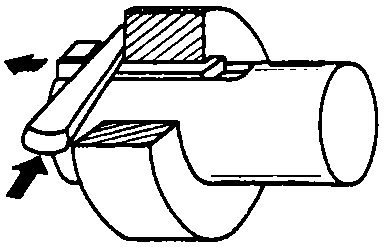
Figure 31 - Driving out of the
gib-head key by cotter extractor
Laid-in keys, Woodruff key, tangential key
By means of puller shaft and hub are drawn apart, so that the joining elements can be taken out.
Taper sleeves
A cotter is inserted into the oblong hole of the taper sleeve and driven in by hammer blows.
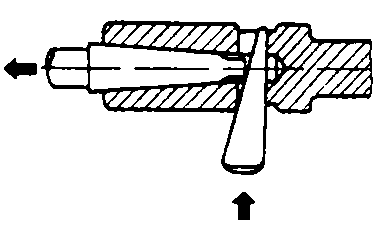
Figure 32 - Driving out of a
taper shank by cotter
Taper pin used as a key
The joint is undone by drilling the taper pin out or by pulling the hub off by a puller.
Cotter and taper pin as a cotter
It is driven out with the help of a hammer and suitable non-ferrous metal arbor (drift) by blows opposite the driving-in direction.
Tightening key
The locking screw is loosened then, the tightening key can be loosened by the adjusting screw.
If the keyed joints appear to be too difficult to undo, the hub should be carefully heated up by a gas burner - make sure that the shaft does not become hot.
Then it is tried to drive or pull the key out.
If this is not possible, the shaft keyway, too, is heated up with the help of a second gas burner. Then the key can be driven out.
By heating up the hub, even very firm shaft and hub joints can be slackened so that they can be separated by a puller.
How is a tightening key
fine-adjusted?
_________________________________________________________________
_________________________________________________________________
_________________________________________________________________
How are tapered driving keys
loosened?
_________________________________________________________________
_________________________________________________________________
_________________________________________________________________
How are laid-in keys
loosened?
_________________________________________________________________
_________________________________________________________________
_________________________________________________________________