 |
| ||||||||||||||||||||||||||||||||||||||||
|
| ||||||||||||||||||||||||||||||||||||||||
Institut f�r berufliche Entwicklung e.V.
Berlin
Original title:
Arbeitsmaterial f�r den
Lernenden
“Reiben”
Author: Detlev Krechlok
First edition © IBE
Institut f�r berufliche Entwicklung e.V.
Parkstra�e
23
13187 Berlin
Order No.: 90-35-3206/2
|
| ||||||||||||||||||||||||||||||||||||||||
1. Purpose of reaming
Reaming is a cutting operation with a multi-edged cutting tool which is constantly in action. Reaming is applied to finish drilled holes accurately to size and with a good surface finish. Reaming offers the advantage that a greater number of holes can be produced with consistently good quality. This requires a cutting tool (the reamer) which
- has exactly the diameter required,
- has an adequate edge profile (lead, straight/helical-fluted and taper reamers) and
- is well sharpened.
Reaming calls for a hole that has been exactly pre-machined (good true-running accuracy and sufficient machining allowance). The use of lubricants will prolong the life of the tool.
Reaming is applied for fitting holes and taper holes.
Which requirements roust be met by the
reamer?
__________________________________________________________________________
__________________________________________________________________________
__________________________________________________________________________
When is the reaming technique
applied?
__________________________________________________________________________
__________________________________________________________________________
__________________________________________________________________________
|
| ||||||||||||||||||||||||||||||||||||||||
2. Design and types of reamers
There are hand reamers and machine reamers. They mainly differ with respect to the shank (hand reamer: square, machine reamer: taper) and to the cutting portion (machine reamers have a shorter lead).

Figure 1 Hand reamer, straight
1 lead, 2 finishing cut

Figure 2 Machine reamer, straight
1 lead, 2 finishing cut, 3 cutting portion reducing in diameter
Hand reamers are primarily used for assembly work to make parts fit better. Their main feature is a long taper lead. This ensures good guidance in the hole and prevents canting. The reamer is inserted into the hole by means of the milled square and a tap wrench with clockwise rotation and slight pressure.

Figure 3 Hand reamer in operation
1 feed movement, 2 cutting movement, 3 workpiece, 4 clamping tool (vice)
Dimensional inspection of reamers must be made at the transition to the straight portion (Fig. 1).
Hand reamers are non-adjustable (Fig. 1) or adjustable (Fig. 4).

Figure 4 Adjustable hand reamer
1 conical adjusting screw, 2 slot for expanding the diameter
Taper hand reamers are also in use (Fig. 5).

Figure 5 Hand reamers, tapered
What are the main differences between hand reamers and machine
reamers?
__________________________________________________________________________
__________________________________________________________________________
__________________________________________________________________________
Machine reamers used on lathes are: non-adjustable reamers (Fig. 2), arbor-mounted reamers (Fig. 6), adjustable reamers (Fig. 7), spiral-fluted reamers (Fig. 8) and taper reamers (Fig. 9)

Figure 6 Arbor-mounted reamer (shell
reamer)
1 cutting portion, 2 mounting arbor
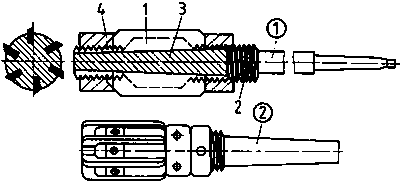
Figure 7 Adjustable machine reamer
(1) for through holes; (2) for blind holes
1 blades in angular position, 2 adjusting thread, 3 adjusting cone, 4 re-adjusting nut
Figure 8 Spiral-fluted reamer

Figure 9 Machine reamer, tapered
Arbor-mounted reamers (20 mm diameter and more) and adjustable reamers are mainly used for reaming of several holes in a single set-up and for bigger quantities (easily interchangeable and adjustable). Spiral-fluted reamers are used for grooved holes and taper reamers for taper holes.
Adjustable reamers are to be checked for dimensional accuracy by means of the setting collar as per Fig. 10.

Figure 10 Setting (checking) of reamer
by setting collar
1 reamer blades, 2 setting collar (ring gauge)
Machine reamers are used for reaming on drilling machines and lathes. They are guided by the work spindle. Therefore, the lead need not be as long as that of hand reamers. With reaming, cutting is by the lead while the straight portion serves for smoothing the hole.
In order to avoid vibration patterns on the surface of the work-piece (chatter marks), reamers have non-uniform tooth pitches. This avoids vibrations and results in exactly round holes. The even number of cutting edges permits dimensional inspection (by outside micrometer) over opposite sides.
What types of machine reamers are used for
reaming?
__________________________________________________________________________
__________________________________________________________________________
__________________________________________________________________________
__________________________________________________________________________
__________________________________________________________________________
When are spiral-fluted reamers
used?
__________________________________________________________________________
__________________________________________________________________________
|
| ||||||||||||||||||||||||||||||||||||||||
3. Preparation for reaming
The reaming process is to be prepared so that all working tools and materials are readily available.
For the determination of the cutting values it is important to know that reamers are made of tool steel or high-speed steel.
Therefore, reaming is done with low cutting speed (v) and high feed rate. As a guideline, v can be taken as m/min.
The necessary rotational speed (n) is calculated by conversion of

The feed is manually effected and to be selected so as to ensure the surface finish required (no scoring). Prior to reaming the surface must have been finished (admissible height of roughness Rz 20) since otherwise the machining allowance would not be sufficient to remove the tool marks completely.
A fitting hole of 32 mm dia. is to be produced by reaming. What rotational speed is to be selected for reaming?
|
n = | |
|
Given: | |
|
Required: | |
|
Calculation: |
|
|
|
================= r.p.m. |
The direction of rotation of the work spindle is of special importance for reaming. When reaming, the workpiece must always rotate in opposite direction to the cutting edges (clockwise rotation), also when the tool is retracted, since otherwise the cutting edges would chip.
The reaming technique always requires prior machining of the hole to be reamed.
Within the technological sequence, reaming is included as follows:
1. Centring
2. Drilling
3. Boring/Counterboring with spiral-fluted counterbore
4. Reaming
5. Final inspection.
Why is the direction of rotation of the work spindle important
for
reaming?
__________________________________________________________________________
__________________________________________________________________________
__________________________________________________________________________
What are the operations connected with reaming within the
technological sequence of operations for the production of a fitting
hole?
__________________________________________________________________________
__________________________________________________________________________
__________________________________________________________________________
__________________________________________________________________________
__________________________________________________________________________
With the boring/counterboring operation the hole is to be provided with a machining allowance for the subsequent reaming operation. The surface must have been finished (no major tool marks).
The recommended values for machining allowances can be taken from the respective table.
Example:
A fitting hole of dia. 16 F8 to be produced by reaming shall have a machining allowance of 0.2 - 0.3 mm. The boring/counter-boring tolerance, consequently, is 15.8 (upper deviation) and 15.7 (lower deviation).
The final size of a reamed hole does not only depend on the correct diameter of the reamer but also on the type of the material to be reamed, the clamping facilities of the reamer, the position of the tailstock and the type of the coolant and lubricant. The same reamer, for example, may produce different diameters into tough steel and brittle grey cast iron.
Therefore, a test hole must always be produced.
In the event of dimensional variations, the tool is to be changed.
What is the machining allowance for a dia. 24 H7
hole?
__________________________________________________________________________
__________________________________________________________________________
What factors are influencing the accuracy to size of a
hole?
__________________________________________________________________________
__________________________________________________________________________
__________________________________________________________________________
__________________________________________________________________________
__________________________________________________________________________
__________________________________________________________________________
For the selection of the coolant and lubricant it is essential that
- reaming of grey cast iron is dry reaming,
- addition of spirit is recommended for reaming of aluminium,
- steel should be reamed using cutting oil,
- the use of a water-in-oil emulsion (diluted soluble oil) permits closer reaming of the hole.
The following main tools and accessories are to be made available for machining (centring, drilling, boring, reaming):
- Chuck with internally turned, soft chuck jaws for clamping of the workpiece.- Centre drill with drill chuck for centring the workpiece.
- Twist drill for rough-machining of the hole.
- Internal side-cutting tool (boring tool) or spiral-fluted counterbore (three-lipped twist drill) to produce the hole with machining allowance for reaming.
- Reamer for finishing the hole (see Fig. 2).
- Taper sleeves for location in the tailstock.
- Coolant/lubricant.
- Vernier caliper for dimensional checks in the 0,1 mm range.
- Depth gauge (for stepped holes or blind holes).
- Dial gauge for radial and axial run-out checks.
- Limit plug gauge for initial and final inspections.

Figure 11 Limit plug gauge
1 go end, 2 not-go end, 3 nominal size marking

Figure 12 Taper plug gauge
1 testing area, 2 fitting marking, 3 nominal size marking
The size of the reamer and of the limit plug gauge must be determined on the basis of the working drawing and must correspond with each other. Reamers with a smaller quality index (e.g. dia. 30 H7 required, dia. 30 H6 available) may be used.
Machine reamers are clamped in the tailstock. Prior to reaming it is to be made sure that the tailstock is in central position, i.e. that the axis of rotation of the workpiece and the centre line of the tool are in line. If necessary, the tailstock is to be laterally re-aligned as per Fig. 13 since otherwise the nominal diameter cannot be maintained because the tool will cut at one side of the hole only.

Figure 13 Tailstock adjustment
1 workpiece held in chuck, 2 reamer, 3 tailstock sleeve, 4 centre offset, 5 adjustability
Minor centre offset between the workpiece and tool can be compensated for by the use of a floating head as per Fig. 14.

Figure 14 Floating holder (floating
head)
1 floating sleeve, 2 holder, 3 locking bolt
Labour safety recommendations:
- For transportation cover the cutting portion of the reamer to prevent injuries.- When checking the hole by means of the limit plug gauge make sure that the cutting portion is sufficiently off the work area or is covered.
- Don’t do any measuring or testing unless the work spindle is at standstill 1
- Centre with high rotational speed rates!
Firm clamping of workpiece and tool are essential.
- Wear safety goggles to protect against flying chips (boring).
- When working with spirit (to be used for aluminium) take precautions against fire - easily inflammable!
What can be done if a centre offset between the workpiece and
tool is found when
reaming?
__________________________________________________________________________
__________________________________________________________________________
__________________________________________________________________________
|
| ||||||||||||||||||||||||||||||||||||||||
4. Reaming with solid reamer
“Reaming with solid reamer” means machining of close-tolerance holes (fitting holes) by means of a reamer which is fixed in the tailstock of the lathe. The cutting is done on the inner surface of the part in its centre of rotation.
A pre-machined hole is a pre-condition.
- All types of machine reamers can be used depending on the type of hole (through hole, stepped hole, blind hole).- The machine taper must be all-supporting and thoroughly fitting in the sleeve of the tailstock (no impurities between the locating surfaces).
- If necessary, taper sleeves are to be used.
- The axis of rotation and axis of the tailstock must be in line. In case of deviations, re-alignment is to be made as per Fig. 13.
- The supporting surfaces of the tailstock are to be lubricated. The tailstock must be lockable since otherwise it might be displaced during the operation.
- The working feed is manually effected by means of the tail-stock sleeve. It is to be guided smoothly.
- The true-running accuracy of the workpiece must be ensured. If necessary, the jaws have to be internally turned.
|
| ||||||||||||||||||||||||||||||||||||||||
5. Reaming with floating reamer
“Reaming with floating reamer” is also a method of finishing close-tolerance holes by means of a reamer. Unlike reaming with solid reamer, however, the tool is not directly held in the tail-stock sleeve of the lathe but through a floating holder (see Fig. 14) connecting the reamer with the tailstock sleeve. The cutting is done on the inner surface of the part in its centre of rotation.
A pre-machined hole is a pre-condition.
- Here, too, all types of machine reamers can be used. For the selection of the actual reamer to be used it is important to know whether the hole is a stepped hole or blind hole (short lead of reamer; use as per Fig. 7) or a through hole.- The use of the floating holder allows for compensation of minor offset between the axes of the workpiece and of the tool. Greater differences are to be corrected as per Fig. 13.
- The demand on the part’s true-running accuracy is relatively low, however the runout must not be greater than the floating movement of the floating holder.
- The floating sleeve must be retained by the locking bolt during reaming.
- The use of the floating holder permits quick change of reamers for holes of different sizes in one part.
- The working feed is manually effected and is to be guided smoothly.
|
| ||||||||||||||||||||||||||||||||||||||||
6. Reaming of taper holes
Tapers can also be produced by the reaming technique by means of the reamer. Here, too, the holes are close-tolerance holes. The cutting is also done on the inner surface of the workpiece in its centre of rotation by means of a solid or floating reamer. Because of the intricacy of pre-machining the hole, the following rules are to be observed.
- The taper hole may be pre-machined as straight stepped hole (Fig. 15) but also by top slide adjustment (Fig. 16) or by means of the taper guide bar (Fig. 17).

Figure 15 Straight stepped hole
1 diameter 1, 2 diameter 2, 3 diameter 3
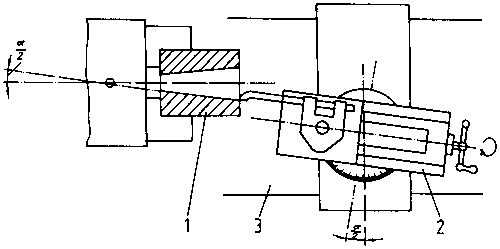
Figure 16 Taper turning by top slide
adjustment
1 workpiece held in chuck, 2 top slide, 3 carriage, setting angle
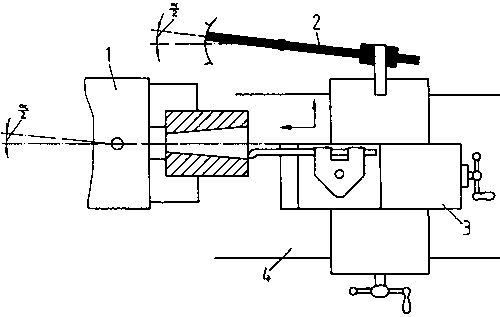
Figure 17 Taper turning by means of
taper guide bar
1 chuck and workpiece, 2 taper guide bar, 3 top slide, 4 carriage, a/2 setting angle
In any case it is to be ensured that the diameter after pre-machining does not fall below the minimum taper diameter (see Fig. 19) but is provided with a machining allowance for reaming.
- Roughing reamers can also be used for taper reaming of holes pre-machined as straight stepped holes (Fig. 18).
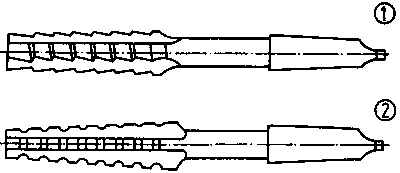
Figure 18 Pre-machining reamers (1)
roughing reamer (2) semi-finishing reamer
- Top slide adjustment is the method mostly used for pre- machining of taper holes. The taper guide bar is normally used where the taper length (see Fig. 19) exceeds the working travel (crank length) of the top slide.
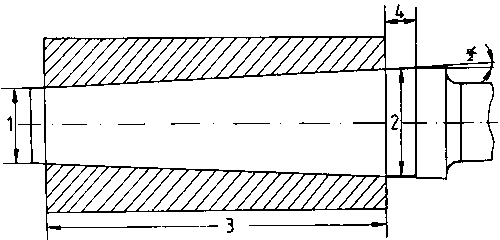
Figure 19 Pre-fitting check with
taper plug gauge
1 = d minimum taper diameter, 2 = D maximum taper diameter, 3 = 1 taper length, 4 = a pre-fitting length, a/2 setting angle
- The hole is properly pre-machined when the taper plug gauge is supporting over its entire length. The entire length of the taper plug gauge is marked by means of try-out paste, chalk or similar material. When turning the taper plug gauge in the hole the chalk, for instance, must be equally distributed over the length and diameter.
The pre-fitting length (see Fig. 19) can be calculated by the formula

The actual taper reaming is performed as per sections 4 and 5 above.
In taper reaming the cutting is not done by the lead of the reamer but by the entire length of the taper reamer. The cutting forces, therefore, are considerably higher and, consequently, the cutting values are to be reduced to 50%.
The taper plug gauge (Fig. 12) is used for testing.
When is a taper hole considered prepared for
reaming?
__________________________________________________________________________
__________________________________________________________________________
The reaming technique shall be applied to produce a taper hole M.T. 4 (Morse taper size 4); a/2 = 1° (degree) 29’ (minutes) 15” (seconds); d = 25.71 mm; D = 31.5 mm.
Calculate the machining allowance and the pre-fitting length a!
|
Formula: |
a = | |
|
Given: | | |
|
Required: | |
|
|
Calculation: |
| |
| | |
|
|
| | |
| |
| |
| | |
================== mm |
|
| ||||||||||||||||||||||||||||||||||||||||
Table 1 - Recommended values for machining allowances
|
Final size in mm |
Machining allowance (reaming allowance) in mm |
|
less than 5 |
0.1 - 0.2 |
|
5 to 20 |
0.2 - 0.3 |
|
21 to 32 |
0.3 |
|
33 to 50 |
0.5 |
|
51 to 70 |
0.8 |
|
71 to 120 |
1.0 - 1.2 |
|
121 to 150 |
1.3 - 1.5 |
|
| ||||||||||||||||||||||||||||||||||||||||
Table 2 - Usual kinds of fits
(extract from ISO system of fits standard holes)
|
Tolerance zone |
E8 |
F7 |
H6 |
H7 |
H8 |
H11 | |
|
Range of nominal size |
Maximum variation in mm | ||||||
|
exceeding |
1 |
+ 28 |
+ 16 |
+ 7 |
+ 9 |
+ 14 |
+ 60 |
|
up to |
3 |
+ 14 |
+ 7 |
0 |
0 |
0 |
0 |
|
exceeding |
3 |
+ 38 |
+ 22 |
+ 8 |
+ 12 |
+ 18 |
+ 75 |
|
up to |
6 |
+ 20 |
+ 10 |
0 |
0 |
0 |
0 |
|
exceeding |
6 |
+ 47 |
+ 26 |
+ 9 |
+ 15 |
+ 22 |
+ 90 |
|
up to |
10 |
+ 25 |
+ 13 |
0 |
0 |
0 |
0 |
|
exceeding |
10 |
+ 59 |
+ 34 |
+ 11 |
+ 18 |
+ 27 |
+ 110 |
|
up to |
18 |
+ 32 |
+ 16 |
0 |
0 |
0 |
0 |
|
exceeding |
18 |
+ 73 |
+ 41 |
+ 13 |
+ 21 |
+ 33 |
+ 130 |
|
up to |
30 |
+ 40 |
+ 20 |
0 |
0 |
0 |
0 |
|
exceeding |
30 |
+ 89 |
+ 50 |
+ 16 |
+ 25 |
+ 39 |
+ 160 |
|
up to |
50 |
+ 50 |
+ 25 |
0 |
0 |
0 |
0 |
|
exceeding |
50 |
+ 106 |
+ 60 |
+ 19 |
+ 30 |
+ 46 |
+ 190 |
|
up to |
80 |
+ 60 |
+ 30 |
0 |
0 |
0 |
0 |
|
exceeding |
80 |
+ 126 |
+ 71 |
+ 22 |
+ 35 |
+ 54 |
+ 220 |
|
up to |
120 |
+ 72 |
+ 36 |
0 |
0 |
0 |
0 |
|
exceeding |
120 |
+ 148 |
+ 83 |
+ 25 |
+ 40 |
+ 63 |
+ 250 |
|
up to |
180 |
+ 85 |
+ 43 |
0 |
0 |
0 |
0 |
|
exceeding |
180 |
+ 172 |
+ 96 |
+ 29 |
+ 46 |
+ 72 |
+ 290 |
|
up to |
250 |
+ 100 |
+ 50 |
0 |
0 |
0 |
0 |
|
exceeding |
250 |
+ 191 |
+ 108 |
+ 32 |
+ 52 |
+ 81 |
+ 320 |
|
up to |
315 |
+ 110 |
+ 56 |
0 |
0 |
0 |
0 |
|
exceeding |
315 |
+ 214 |
+ 119 |
+ 36 |
+ 57 |
+ 89 |
+ 360 |
|
up to |
400 |
+ 125 |
+ 62 |
0 |
0 |
0 |
0 |
|
exceeding |
400 |
+ 232 |
+ 131 |
+ 40 |
+ 63 |
+ 97 |
+ 400 |
|
up to |
500 |
+ 135 |
+ 68 |
0 |
0 |
0 |
0 |