 |
| ||||||||||||||||||||||||||||||||||||||||||||||||||||||||||||
Institut f�r berufliche Entwicklung e.
V.
Berlin
Original title:
Arbeitsmaterial f�r den
Lernenden
"Gl�hen, H�rten, Anlassen"
Author: Frank Wengh�fer
First edition © IBE
Institut f�r berufliche Entwicklung e.V.
Parkstra�e
23
13187 Berlin
Order No.: 90-35-3116/2
|
| ||||||||||||||||||||||||||||||||||||||||||||||||||||||||||||
Introductory Remarks
The present material has been elaborated for the training in professions which, apart from knowledge in the field of metal working, require command of the usual heat treatment processes. The material includes the description of various heat treatment processes on principle and the necessary devices and auxiliary means with their specific features of application. All working steps have been described by the material group of plain carbon steels (tool steels); given temperature data are not applicable for alloy steels; with regard to that, tables elaborated by the steel manufacturer must be consulted.
In order to promote the learning process, control questions follow the individual sections, the trainees can check their knowledge by answering those questions.
|
| ||||||||||||||||||||||||||||||||||||||||||||||||||||||||||||
Hints on Labour Safety
- Wear work clothes, aprons and gloves
- Protect your eyes by wearing protective glasses
- Do not remove safety devices at appliances
- Do not touch salts for melting baths with bare hands
- Cover up melting baths after use
- Use only pre-dried and cleaned workpieces for heat treatment
- Take care for fire protection
- Immediately remove oil sticks from the floor
- Lay down hot workpieces only on marked places
- Keep clean tools, devices and auxiliary means and clear them away after finishing of work.
|
| ||||||||||||||||||||||||||||||||||||||||||||||||||||||||||||
1. Objectives of Heat Treatment of Steel
In practice, heat treatment is a systematic sequence of various processes of "heating" and "cooling".
In this way, special properties of unalloyed and alloy steels can be changed.
Such properties are:
Hardness - Strength - Toughness - Elasticity.

Figure 1 - Principle of heat
treatment - 1 heating, 2 cooling
The appropriate heat treatment process is selected either to increase or to decrease the properties.
Therefore, temperatures to be set during heating, the period of heating and the cooling speed are of special importance. Cooling can be effected either quickly or slowly or in individual stages.
Properties of steels are changed because the crystal structure of steels having a latticed configuration is changed in its internal structure due to temperature factors.
According to the selection of the process, a structural change of the entire workpiece or of certain parts on the surface only can be effected.
Examples:
Tools must be hard and robust so that they are suitable for working other materials. In general, they must, however, only be hard at points by which working is effected:
Chisel:
- cutting edge is hard and wear-resistant
- tang is tough and elastic
If the chisel would be hard throughout, it could break when the hammer is striked onto it!

Figure 2 - Cut through a
hardened chisel - 1 cutting edge (hard), 2 twig
(tough)
Measuring and testing means must not be worn out even when they are used frequently. They must especially be wear-resistant on their surfaces.
Moving machine parts (ball bearing, shafts, spur wheels) must not be worn out or only to a little extent. They must be hard and wear-resistant, but also tough at the same time.
Alloy steels containing apart from iron also other alloying elements have in general especially distinct properties.
Therefore, an exact heat treatment can only be carried out when the conditions given by the steel manufacturer are strictly adhered to. Precise temperature data for heat treatment processes are therefore supplied with by the steel manufacturer.
|
| ||||||||||||||||||||||||||||||||||||||||||||||||||||||||||||
2. Kinds of Heat Treatment Processes
According to the purpose of application and the kind of material of the workpiece to be treated, different heat treatment processes are applied. The most common processes are given in the following chart:

Figure
Apart from these processes, "surface hardening" and "hardening with subesequent tempering" are used among others when special properties shall be changed.
Hint:
In practice, hardening is directly related to tempering since it follows the hardening process as subsequent method.
What is heat
treatment?
____________________________________________________________________________
____________________________________________________________________________
____________________________________________________________________________
What is the purpose of heat treatment
processes?
____________________________________________________________________________
____________________________________________________________________________
____________________________________________________________________________
|
| ||||||||||||||||||||||||||||||
Annealing, Hardening, Tempering - Course: Working techniques of heat treatment of steel. Trainees' handbook of lessons (Institut f�r Berufliche Entwicklung, 27 p.)
3. Devices and Auxiliary Means
The following requirements are made on devices designed to heat the workpieces:
- Temperature must be reached in the shortest possible time
- Temperature has to be controlled as easy as possible
- Temperature has to be kept constant at the required figure
- The workpiece must evenly be heated in all spheres.
3.1. As to Heating
Smith's hearth (open fire):
It is used for heating small parts and tools; in most cases, it is heated by means of charcoal. Pit coal is not suitable due to its sulphur content, fresh timber does not generate enough heat and it bums unevenly. Temperature must be estimated by the temper colours of the workpiece; thus, it is unsafe to assess.
Therefore, assessment can only be made perfectly in darkened rooms (windows are coated with blue paint).
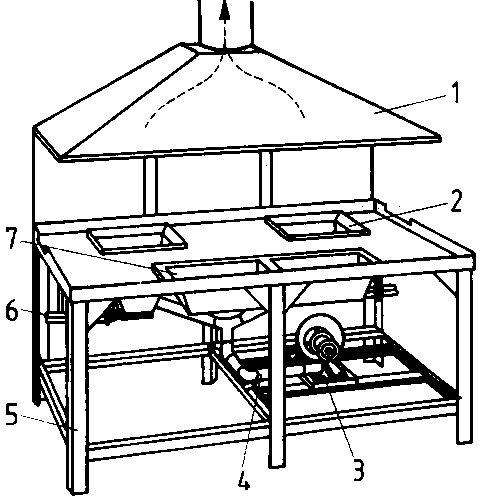
Figure 3 - Smith's hearth -
1 flue, 2 fire case, 3 blower, 4 air supply, 5 frame, 6 nozzles and
slag lever, 7 explosion chamber
Smith's hearth is equipped with firing appliances: coal shovel, swatter and fire rake.
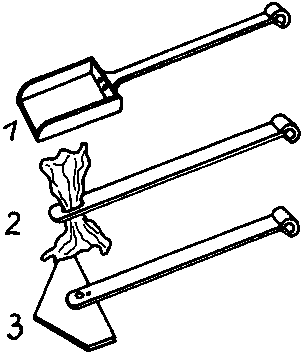
Figure 4 - Firing appliances -
1 coal shovel, 2 swatter, 3 fire rake
Gas burner:
When tempering small parts and tools, gas burners of the Bunsen type (fuel gas: e.g. propane) are used. In case of flame hardening, special burners designed for gas/oxygen mixtures and, in most cases, equipped with mechanical feeders onto which water sprinklers are mounted subsequently, are applied.

Figure 5 - Gas burner - 1
gas and oxygen burner, 2 Bunsen burner
Furnaces:
They are used for evenly heating any workpieces; gas, oil or electric power are used as fuel. In furnaces equipped with temperature controllers there is no danger that the workpieces are overheated or changed in their chemical composition. In order to contact the workpieces not directly with the heat source they may be arranged in inserts
(muffles) made of fire clay, graphite or heat-resistant cast iron. Thus, the workpieces are evenly heated as a whole.

Figure 6 - Muffle furnace -
1 chimney flue, 2 insert (muffle), 3 work-piece, 4 air supply,
5 fuel gas supply, 6 combustion chamber
Apart from the simple muffle furnace operating at nominal temperatures around 1200°C, the double-chamber furnace equipped with two differently heated chambers (nominal temperatures in the chambers: 1300°C and 900°C, ensuring timesaving hardening and tempering, are applied. Hardening temperature can be controlled by means of electrical or optical measuring instruments. Modern furnaces used in industrial large-series production are designed in such a way that they guarantee an uninterrupted heat treatment. For that purpose, they may be equipped with multi-purpose chambers for annealing, tempering and quenching, ace, to type. They have chambers with certain gas atmospheres and different transport mechanisms.
Melting baths (hot baths):
They are used to evenly heat sensitive workpieces (measuring and testing means, cutting tools). By applying fuels such as gas, oil or electric power, metals, metal alloys or salt mixtures are heated, which melt within a limited temperature range; the workpieces are entirely or partly suspended into the melting baths.
Overheating is avoided by means of automatic temperature controllers. In a short time, the workpieces are heated up to bath temperature, scaling of surfaces cannot be affected in the bath.
Whereas lead melting baths can be heated up to 800°C, melting baths can be heated up to 1400°C.
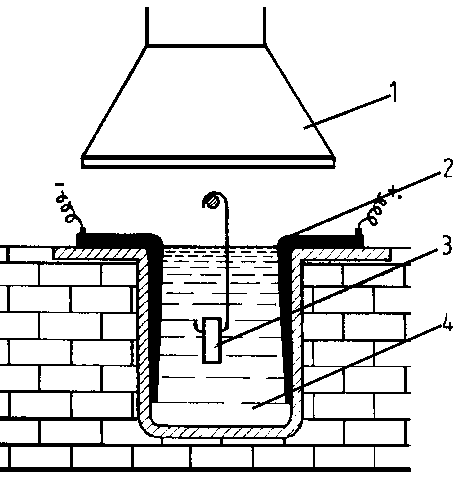
Figure 7 - Melting bath - 1
hood, 2 electrode, 3 workpiece, 4 melt
Other possibilities for heating:
- When tempering, heated steel plates, heated sand baths or hot oil baths are especially used which ensure a slow and even heating of the work-pieces.
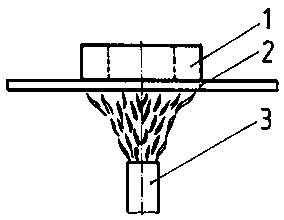
Figure 8 - Heat steel plate -
1 workpiece, 2 heated steel plate, 3 gas burner
- In case of casehardening, sheet-metal boxes filled with sand and carbon-containing powder and equipped with cover are required. They are sealed by means of clay.
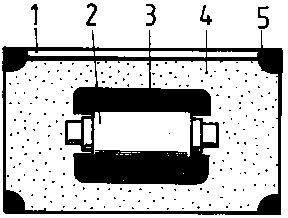
Figure 9 - Box for
casehardening - 1 fireproof box with cover, 2 workpiece, 3 carbon-containing
powder, 4 sand, 5 clay
Which requirements have to be made on the devices designed to
beat the
workpieces?
_________________________________________________________________________
_________________________________________________________________________
_________________________________________________________________________
What are the advantages of melting baths compared to the smith's
hearth?
_________________________________________________________________________
_________________________________________________________________________
_________________________________________________________________________
3.2. As to Transport
Hooks and spears:
They are used for operating the smith's hearth and the furnaces, in order to turn and displace the workpieces.
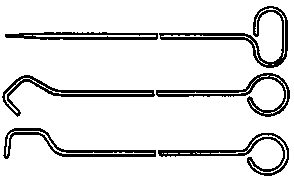
Figure 10 - Hooks and spears
Tongs:
They grip the workpieces when being inserted into the furnaces and when being removed as well as when being suspended into the quenching baths. Their bit-type shape can be formed variously in order to use them properly according to the shapes of workpieces.
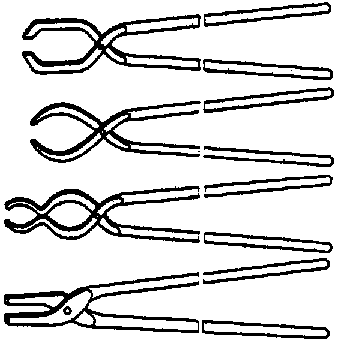
Figure 11 - Tongs
Self-tightening claws:
Large and heavy workpieces can be lifted beyond a lifting device, the clamping jaws are clamped due to workpiece's weight.

Figure 12 - Self-tightening
claw
Hangers:
Heavy workpieces which cannot be gripped by means of claws are inserted into the hangers and moved by means of a lifting device.

Figure 13 - Hanger
Sieves:
Small workpieces may be placed onto the sieve and moved for being heated in melting baths and for being quenched in quenching tanks, in large quantities.
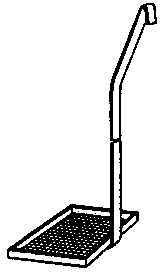
Figure 14 - Sieves
Baskets:
Very small workpieces may be poured into baskets in large quantities and moved for being heated in melting baths and for being quenched in quenching tanks.

Figure 15 -
Baskets
3.3. As to Cooling
Quenching tank:
In order to quickly cool down the workpieces, the tank is filled with water or oil, for example, and it must constantly be kept cool. That is ensured by means of cooling coils, but also by the regular feed of coolant (with simultaneous discharge). Workpieces have to be moved in quenching tanks so that cooling down is effected as quick as possible; thus, steam bubbles quickly come off the workpiece.
|
The quicker cooling is effected, the higher is the degree of hardness! |
As to mild cooling processes, heated quenching media can also be applied in heated tanks (hot baths).

Figure 16 - Quenching tank
Quenching media:
According to the desired properties of the workpieces, rough or mild quenching media are used.
|
Rough quenching media |
- |
great strength and little elasticity of the workpiece to be treated |
|
Mild quenching media |
- |
little strength and higher elasticity of the workpiece to be treated |
|
Quenching media |
Effect |
|
Acidified water |
very rough |
|
Salt-containing water (10% salt) |
rough |
|
Ice-cold water (2° C) |
very powerful |
|
Pure water (20° C) |
powerful |
|
Soluble oil emulsion or hot water (40° C) |
less powerful |
|
Petroleum, oil, train oil |
mild |
|
Compressed air |
very mild |
|
Air |
very mild |
|
The rougher the quenching medium, the harder is especially the case of the workpiece! |
Temperature data may be given in various units. Apart from the units "degree centigrade" used herein, the units "Kelvin" or "Fahrenheit" may be used.
Conversion table for temperature data
|
Centigrade |
Kelvin |
Fahrenheit |
|
0°C = |
273 K = |
32 F |
|
100°C = |
373 K = |
212 F |
Which requirements are made on quenching
tanks?
_____________________________________________________________________________________
_____________________________________________________________________________________
_____________________________________________________________________________________
What are the effects of the use of a rough quenching medium onto
the
workpiece?
_____________________________________________________________________________________
_____________________________________________________________________________________
_____________________________________________________________________________________
|
| ||||||||||||||||||||||||||||||
Annealing, Hardening, Tempering - Course: Working techniques of heat treatment of steel. Trainees' handbook of lessons (Institut f�r Berufliche Entwicklung, 27 p.)
4. Annealing
Any processes of heat treatment resulting in a heating of the workpiece up to a certain temperature with subsequent, in most cases slow, cooling, are called annealing.
Since heating must be effected slowly, evenly and drastically, furnaces are granted special favours to be the heat source which are equipped with temperature measuring devices. If there is no possibility to exactly gauge the temperature, it must be estimated by means of the decoloration of the workpiece effected during heating.
Standard values of colours for plain carbon steels:
|
Temper colour |
Temperature |
Temperature |
|
Brownish black |
520 to 580 |
793 to 853 |
|
Brownish red |
580 to 650 |
853 to 923 |
|
Dark-red |
650 to 750 |
923 to 1023 |
|
Dark cherry red |
750 to 780 |
1023 to 1053 |
|
Cherry red |
780 to 800 |
1053 to 1073 |
|
Light cherry red |
800 to 830 |
1073 to 1103 |
|
Light-red |
830 to 880 |
1103 to 1153 |
|
Yellowish red |
880 to 1050 |
1153 to 1323 |
|
Dark-green |
1050 to 1150 |
1323 to 1423 |
|
Light-yellow |
1150 to 250 |
1423 to 1523 |
|
White |
1250 to 1350 |
1523 to 1623 |
|
The identification of colour differences requires a darkened
background and experience in estimating! |
4.1. Principle and Kinds of Annealing Processes
Annealing is effected in three working steps:
1st - Heating of the workpiece to annealing temperature
2nd -
Keeping the temperature constant over a certain period of time
3rd - Slow
cooling down of the workpiece
|
Workpieces have to be prepared very carefully, rust and scale have to be removed prior to annealing! |
According to the required properties of the workpiece, different annealing processes are used:
Stress-free annealing:
Stresses which may result in distortion of the workpiece are caused by different cooling processes for forged or rolled steel or by cold forming.
Hose stresses can largely be removed by the annealing process.
Proceedings:
- Heating to temperatures between 550°C and 650°C;
- Keeping the temperature constant for 30 to 120 minutes in dependence on material thickness;
- Slow and even cooling down in warmed ash or in a furnace.
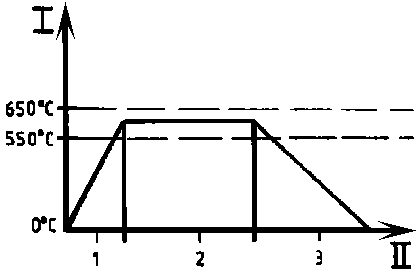
Figure 17 - Temperature/time
diagram of stress-free annealing - 1 heating, 2 keeping constant. 3 cooling
down - I Temperature, II Time
Soft annealing:
Hardened materials or materials rich in carbon (above 0.9%) have a bad free-cutting machinability and cannot easily be cold-formed. In order to make those materials better for being machined, they are soft-annealed.
Proceedings:
- Heating to temperatures between 650°C and 750°C; it is also possible to work with changing heating and slight cooling-down processes around 723°C;
- Keeping the temperature range constant for 3 to 4 hours in dependence on the type of material and material thickness;
- Slow cooling down.
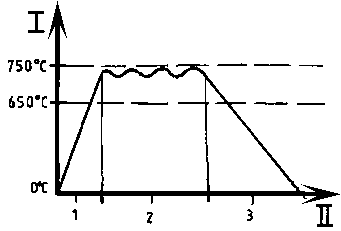
Figure 18 - Temperature/time
diagram of soft annealing - 1 heating, 2 keeping constant
(shuttle), 3 slow cooling down - I Temperature, II Time
Normalizing:
When dressing, bending, hammer forging and forging, the material is cold or hot-worked and the structure of the workpiece is distorted and partly solidified, the same goes for areas near welding seams.
The working properties of heavily-stressed workpieces and parts of constructional engineering are therefore unfavourable. By means of normalizing, the structural irregularities will be balanced and a fine-grained structure will be reached.
Proceedings:
- Heating to temperatures between 750°C and 980°C according to the carbon content of the material;
- Keeping the temperature constant according to material thickness;
- Slow cooling down in air.
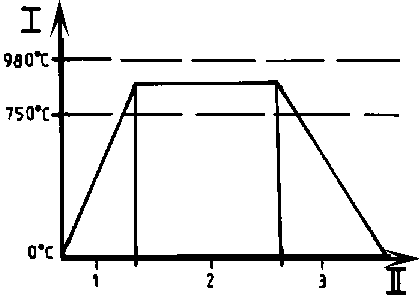
Figure 19 - Temperature/time
diagram of normalizing - 1 heating, 2 keeping constant, 3 slow cooling down -
I Temperature, II
Time
4.2. Working recommendations
- In case of a high carbon content, choose low temperatures within the range!
- Holding time for massive workpieces is adjusted ace, to the rule: 20 minutes plus half of material thick ness.
Example for determining the holding time:
A workpiece of 60 mm thickness has to be annealed.
|
Rule: |
Holding time = 20 minutes + D/2(without unit) |
| |
Holding time = 20 minutes + 60/2 |
| |
Holding time = 20 minutes + 30 |
| |
Holding time = 50 minutes |
The workpiece has to be annealed for 50 minutes before it is cooled down.
What demands have to be made on workpieces being prepared for
the annealing
process?
_____________________________________________________________________________
_____________________________________________________________________________
_____________________________________________________________________________
What principle is the annealing process based
on?
_____________________________________________________________________________
_____________________________________________________________________________
_____________________________________________________________________________
What is the purpose of stress-free
annealing?
_____________________________________________________________________________
_____________________________________________________________________________
_____________________________________________________________________________
What is the purpose of soft
annealing?
_____________________________________________________________________________
_____________________________________________________________________________
_____________________________________________________________________________
What is the purpose of
normalizing?
_____________________________________________________________________________
_____________________________________________________________________________
_____________________________________________________________________________
What holding time has to be considered when a shaft of 84 mm
diameter must be
annealed?
_____________________________________________________________________________
_____________________________________________________________________________
_____________________________________________________________________________
4.3. Control of the Annealing Result
Annealing defects can be identified by means of the appearance of the broken workpiece. That is why the test workpiece has to be notched after being annealed and broken across to the rolling direction by a short blow of a hammer.
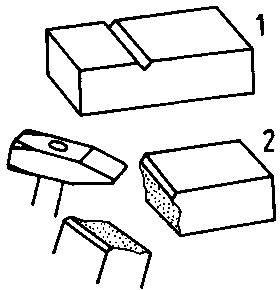
Figure 20 - Control of the
annealing result - 1 notching, 2 breaking
|
Appearance of break |
Kind of material and treatment |
Improvement |
|
criystalline fracture, glistening |
steel of low carbon content, "structural steel" |
no |
|
fine-grained, dead grey, smooth |
steel of higher carbon contents, "tool steel" |
no |
|
coarse-grained |
steel kept too long at annealing temperature or heated too much |
normalizing |
|
coarse-grained, very glistening over the entire cross-section |
steel heated too much so that carbon is burned out, "burned steel" |
waste because structure is destroyed |
|
large- to coarse-grained, glistening edge |
steel heated too long and too much, carbon removed from surface, "decarburized surface" |
decarburized edge zone to be removed or recarburized by inserting -normalizing |
A change of the mechanical properties can first be determined when the workpieces will be worked further.
After what can annealing defects be
determined?
_____________________________________________________________________________
_____________________________________________________________________________
_____________________________________________________________________________
Which defects do suggest a coarse-grained
structure?
_____________________________________________________________________________
_____________________________________________________________________________
_____________________________________________________________________________
|
| ||||||||||||||||||||||||||||||||||||||||||||||||||
Annealing, Hardening, Tempering - Course: Working techniques of heat treatment of steel. Trainees' handbook of lessons (Institut f�r Berufliche Entwicklung, 27 p.)
5. Hardening
By hammering, bending and cold rolling of iron materials and nonferrous metals a strengthening of the metal structure is already reached, this is called "cold straining". Another kind is the "age-hardening" of light metals which is carried out after the finished heat treatment by storing the materials of several days' duration.
The most important kind is the "hardening by means of heat treatment" by which the structure of steels is changed systematically. This kind of heat treatment is used for making the steels hard and wear-resistant for certain purposes.
5.1. Material-related Preconditions for the Hardening by Means of Heat Treatment
Unalloyed steel is an iron material which can be formed in hot or cold state without special after treatment Unalloyed steel contains, apart from other chemical elements, the element "carbon" in portions of 0.02 to 2.1 per cent, which especially influences the properties "hardness" and "strength".
|
High carbon content: |
- great hardness and strength |
|
|
- low toughness and elasticity |
|
Low carbon content: |
- low hardness and strength |
|
|
- great toughness and elasticity |
When the steel is heated, the properties of the steel are changed in dependence on the carbon content
|
That is why the carbon content of the steel must be known prior to the heat treatment! |
Conditions for hardenability:
|
Carbon content: |
above 0.35 per cent - hardenable |
|
|
below 0.35 per cent - not hardenable |
Steels of a carbon content below 0.35 per cent can be hardened at their surfaces when carbon is added to the steel from outside by means of a special process (casehardening).
What is the purpose of hardening by means of heat treatment?
What minimum carbon content must a steel have for being hardenable?
What influence on the mechanical properties does a high carbon content have?
5.2. Principle of Hardening by Means of Heat Treatment
Three working steps are required for hardening:
- Heating of the workpiece up to hardening temperature (over 723°C) in dependence on the carbon content of the steel;- Holding the temperature according to the grade of steel and the size of the workpiece;
- Sudden cooling down (quenching) of the workpiece still being at hardening temperature.
In order to reach the correct hardness for the respective steel, the required hardening temperature must be met
Selection of hardening temperatures for unalloyed steels:
|
Carbon content in percent |
0.5 |
0.6 |
0.7 |
0.8 |
1.0 |
1.5 |
|
Hardening temperature in degree centigrade |
830 |
815 |
800 |
780 |
770 |
770 |
|
The lower the carbon content, the higher must be the hardening temperature! |
The holding time up to hardening temperature is dependent on the grade of steel and the size of the workpiece. Small and difficult-to-form parts only require short holding times of a few minutes duration. With increasing size of the parts and a high carbon content, a longer holding time is required.
5.3. Kinds of Hardening by Means of Heat Treatment
Quenching:
Steels which can be hardened without special preparations are hardened by this process. In this case, the steel is heated to hardening temperature and quickly cooled down once a time. As a result, the material is very hard and brittle and it can show serious internal stresses; in case of unfavourable conditions, the workpiece can distort or break.

Figure 21 - Temperature/time
diagram of quenching - 1 heating, 2 keeping constant. 3 quick cooling down -
I Temperature, II Time
Interrupted hardening:
By this process, steels are treated which are especially sensitive to break and distortion. The material is quenched only for a short time in a powerful quenching medium (water) until hissing is finished, after having been heated up to hardening temperature; subsequently, it is kept in a mild quenching medium (heated oil) until temperature balance. Only then it is further cooled down in air. A favourable variant is therefore the method where the material powerfully quenched is suspended into a hot bath of 200°C until temperature balance; by this, stresses occuring during the cooling-down process and the danger of break formation are effectively avoided.

Figure 22 - Temperature/time
diagram of interrupted hardening - 1 heating, 2 keeping constant, 3 quick
cooling down, 4 slow cooling down - I Temperature, II Time
Hot quenching:
By this process, workpieces of complicated shapes are treated. After having been heated to hardening temperature, the workpiece is cooled down in a hot bath at temperatures between 180°C and 500°C until temperature balance according to the grade of steel. Then it is cooled down (for any length of time) to ambient temperature by means of which the workpiece subsequently shows minor internal stresses only. Salt melting baths are preferably used as hot baths, the temperature of the bath must be derived from the grade of steel.

Figure 23 - Temperature/time
diagram of hot quenching - 1 heating, 2 keeping constant, 3 retarded cooling
down, 4 residual cooling down - I Temperature, II Time
Within this mild hardening process the holding time for the workpiece in the melting bath has to be considered for the cooling-down process. The following rule is valid:
|
For every 10 mm in diameter or thickness, the workpiece must be held in the melting bath for 60 seconds! |
Example:
A heated shaft of 75 mm diameter has to be cooled down in a melting bath. What holding time has to be met in the melting bath?

The shaft has to be kept in the melting bath for 450 seconds or 7.5 minutes, respectively.
Which working steps are required for the hardening
process?
________________________________________________________________________
________________________________________________________________________
________________________________________________________________________
What feature determines the interrupted
hardening?
________________________________________________________________________
________________________________________________________________________
________________________________________________________________________
5.4. Hardness-related Shaping of the Workpieces
As to small workpieces, hardening is effected in the entire structure; as to greater workpieces, the degree of hardness decreases internally.
Unfavourable shapes of workpieces or working imperfections can cause crack formation after hardening.
The following problematic points can cause defects:
- irregular breakthroughs
- sharp edges
- boreholes directly made into outer surfaces
- abrupt transitions between thick and thin parts
Measures:
Sharp edges have always to be rounded; in case of abrupt transitions, a separated individual-part-hardening with subsequent joining of the individual parts is more favourable.

Figure 24 - Workpieces
compared to hardness - I Favourable shape of workpiece, II Unfavourable shape of
workpiece - 1 shaping of opening, 2 shaping of internal edges, 3 boreholes, 4
transition points in cross-sektion
Hints:
Quenching cracks can be determined when a dilute colour paint is coated over the hardened surfaces - existing cracks ink and become visible!
Particularities for hardening in melting baths:
- When suspending into melting baths it has to considered that the workpieces are correctly emerged according to their shape.- The workpieces must evenly be wetted; air cushions must not be produced! Air cushions slow down the quenching process and cause soft spots in the hardness layer!

Figure 25 - Correct dipping of
various workpieces into a melting bath
- Before being suspended into the melting bath, the workpieces must be predried. Minor amounts of moisture cause, at those great temperature differences, explosive evaporation of water. The vapour throws off the heated bath fluid from the melting tank.
- Vapours produced in the melting baths must be sucked off the hardening room by means of effective suction devices.
5.5. Hardening Defects
|
Feature |
Causes of defect by |
| |
|
|
heating |
quenching |
tempering |
|
Steel to soft |
hardening temperature too low, too little heated, workpiece too much cooled prior to quenching |
quenching bath too hot, quenching bath too small, wrong quenching medium, quenching speed too slow, quenching time too short |
tempering temperature too high, wrong temper colour, when tempering from inside, too slowly cooled down |
|
Steel irregularly hard |
irregular heating, sulphur taking in from fuel gas, scaled workpiece, sticking melting bath when using melting baths |
too big tongs' bit, unclean quenching bath, pieces to be hardened lie too crowded, unsuitable covering, wrong move in the bath (vapour bulbs), annealing skin and scale |
irregularly heated |
|
Steel too hard |
too high hardening temperature |
quenching medium too coarse |
tempering temperature too low |
|
Distorted work-pieces |
due to great cross-section differences heated wrong, unfavourable position in annealing furnace, heated too quickly and unevenly, workpiece partly superheated, covered inadequately or even not, too long kept onto hardening temperature |
cooled down too coarsely, emerged wrong |
- |
|
Workpieces with cracks |
irregularly and too much heated, sharp screwings not covered, not preheated |
irregularly quenched |
|
5.6. Specific Working Hints for Practical Execution of Work
- Finished parts which have to be protected from scaling or carbon loss are favourably heated in a salt bath or hardened in a packing.
Packing material can be, for low hardening temperature, peashaped-screened and roasted charcoal; in case of higher hardening temperatures, it can be burnt coke grit. It is practicable to wrap the parts into paper, additionally.
- As to the heating of workpieces of great cross-section differences or sensitive points, protective covers made of sheet metal, asbestos or clay must be laid onto the weaker or more sensitive points in order to protect them from being overheated.- Prior to hardening, it is practicable to preheat the workpieces to about 500°C and to hold them at that temperature. At the beginning of hardening, the workpieces are quickly heated to hardening temperature and then, they are further machined.
Why is it favourable to harden the workpieces in a carbon
containing
packing?
________________________________________________________________________
________________________________________________________________________
________________________________________________________________________
5.7. Hardness Measurement
Hardness is the resistance a body puts up against the forcible entry of a harder body.
The easiest possibility to check this hardness is the use of a used fine file by means of which a file test is carried out If the file slips on the edge and does not penetrate, the material is harder than the file.
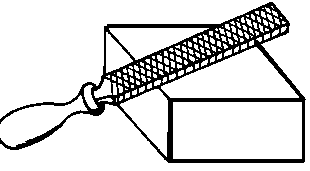
Figure 26 - File test
Frequently, the exact hardness is however required for the application of a workpiece. In those cases, the hardness must be determined by means of special testing devices.
According to the kind of power action onto the piece to be tested, we distinguish test procedures with statical or dynamical power action.
Principle of any hardness measurements:
A testing piece penetrates into the material to be tested - a value for the hardness of the material is derived from the deformation produced therefrom.
The produced hardness values are specified without measuring unit, only with a symbol according to the hardening process. Example for a hardness specification:

Figure
How can hardness be checked in a simple
way?
________________________________________________________________________
________________________________________________________________________
________________________________________________________________________
|
| ||||||||||||||||||||
Annealing, Hardening, Tempering - Course: Working techniques of heat treatment of steel. Trainees' handbook of lessons (Institut f�r Berufliche Entwicklung, 27 p.)
6. Tempering
The steel becomes hard an brittle by the quenching process after heating. So high stresses can occur in the structure of the material that cracks are produced and the material slivers to pieces like glass.
In order to eliminate those negative effects and give the material the "useful hardness", it is tempered after having been hardened, i.e. it is heated once again. The toughness of the material is increased again at a justifiable decrease of the hardness and strength.
Tempering temperatures relate to the purpose of use of the workpiece.
The higher the tempering temperature, the lower the hardness and the tougher the steel.
When a blank steel is heated, a 0.2 mm thick oxide layer is produced on the surface, this oxide layer becomes discoloured in dependence on the temperature.
Apart from temperature gauges, the temperature can also be estimated by the colour.
Tempering colours for plain carbon steels:
|
Tempering colours |
Temperature °C |
Temperature K |
Examples for use |
|
Pale yellow |
210 |
483 |
Steel scriber |
|
Light-yellow |
220 |
493 |
Measuring instruments |
|
Yellow |
230 |
503 |
Chisels of any kind |
|
Dark-yellow |
240 |
513 |
Twist drill, files |
|
Yellowish brown |
250 |
523 |
Milling cutter, reamers, |
|
Brownish red |
260 |
533 |
screw taps, metal saw blades |
|
Red/purple |
270 |
543 |
Screw drivers, woodworking tools |
|
Violet |
280 |
553 |
Hot-cross chisel, centrepunch, mandrils |
|
Dark-blue |
290 |
563 |
Springs, surgical instruments |
|
Cornflower blue |
300 |
573 | |
|
Light-blue |
310 |
583 |
Rivets, axes, hand saw blades, |
|
Greyish blue |
320 |
593 |
scynthes |
|
Grey/greyish green |
330 |
603 |
Household knives |
6.1. Types of Tempering
Tempering from outside:
The cold workpiece is slowly heated by means of appropriate heat sources and after having reached the tempering temperature (between 200°C and 500°C) it is cooled down.
Tempering from inside:
The workpiece is shortly quenched after having been hardened so that only outer layer is cold. The residual heat penetrates from inside, after having reached the tempering temperature it is cooled down.
The same effect can be reached when the workpiece is cooled down only on one side and the heat contained in the other part runs after again.
|
After hardening the point to be tempered must be finished quickly by means of polishing linen cloth in order to recognize the temper colours! |
The approximate value for the tempering time for compact workpieces:
|
1 to 1.5 hours for 20 mm thickness of workpiece |
Hints:
- The tempering effect is a combination of time and temperature. If the tune is enlarged, the temperature can be decreased.- For tools, longer tempering at lower temperature is better than shorter tempering at higher temperature.
- High-alloy steels require longer tempering times than unalloyed steels.
What is the purpose of
tempering?
_________________________________________________________________________
_________________________________________________________________________
_________________________________________________________________________
Which influence is exercised by the tempering temperature onto
the useful
hardness?
_________________________________________________________________________
_________________________________________________________________________
_________________________________________________________________________
Why it is possible to determine the temperature by means of
tempering
colours?
_________________________________________________________________________
_________________________________________________________________________
_________________________________________________________________________
|
| ||||||||||||||||||||
Annealing, Hardening, Tempering - Course: Working techniques of heat treatment of steel. Trainees' handbook of lessons (Institut f�r Berufliche Entwicklung, 27 p.)
7. Surface Hardening
When workpieces shall have a hard, wear-resistant surface, but the core must remain tough, they are only hardened on the surface. Those workpieces can resist to great shock and bending stresses.
7.1. Types of Surface Hardening
Flame hardening:
Unalloyed steels with 0.35 to 0.6% carbon content are quickly heated to hardening temperature and subsequently, they are immediately (without holding time) cooled down.
The thickness of the hardened surface is dependent on the heat supply:
The greater the supply and the smaller the burner speed, the stronger is the hardened layer!
Normal layer thicknesses are 1.0 to 1.5 mm, but they can also be greater.
The burner can be guided over the material surface by hand or by mechanical feeding devides. Tempering is effected at temperatures between 150°C and 200°C for materials which are sensitive to break and crack.

Figure 27 - Flame hardening -
1 gas burner, 2 sprinkler, 3 hardened surface, 4 red-hot surface, 5
workpiece
Casehardening:
Tough steels with a carbon content of less than 0.25% can be enriched with carbon (carburized) on their surfaces so that they contain 0.75 to 1.1 % carbon and can subsequently be hardened. As to the carburization process, the metallic clean workpieces are inserted in carbon-containing powder (charcoal or leather coal) or they are blown with carbon-containing gases and annealed without air for 4 to 10 hours at temperatures between 880°C and 920°C. Surfaces to be kept soft are covered by means of protective means (clay, refractories) or coppered.
The penetration depth of the carbon is dependent on the application time during carburization. After one hour the layer is about 0.4 mm thick, after 10 hours about 1.2 mm.
The following hardening process can be carried out at temperatures around 770°C by means of various processes.

Figure 28 - Casehardening -
1 fireproof case with cover, 2 workpiece, 3 carbon-containing powder, 4 sand,
5 clay
Which properties can have workpieces after surface
hardening?
_________________________________________________________________________
_________________________________________________________________________
_________________________________________________________________________
Which steels can be worked by means of flame
hardening?
_________________________________________________________________________
_________________________________________________________________________
_________________________________________________________________________
Which steels can be worked by means of
casehardening?
_________________________________________________________________________
_________________________________________________________________________
_________________________________________________________________________
|
| ||||||||||||||||||||||||||||||||||||||||||||||||||||||||||||
8. Hardening and Tempering
By this process, the strength of unalloyed steels with a carbon content of generally 0.2 to 0.6% in most cases can be changed in a wide range.
In spite of the low carbon content, those steels can reach higher strength values with higher toughness at the same time.
Proceedings:
1. Heating of the material according to the hardening temperature in furnaces or melting baths between 700 °C to 860° C.2. Quenching in water or oil to lukewarm.
3. Tempering according to the desired properties at temperatures between 360°C and 670°C and cooling down to lukewarm.
|
A high tempering temperature decreases the strength and increases the toughness! |
Which properties shall be reached by hardening and
tempering?
_________________________________________________________________________
_________________________________________________________________________
_________________________________________________________________________