 |
| ||||||||||||||||||||||||
|
| ||||||||||||||||||||||||
Institut f�r berufliche Entwicklung e.V.
Berlin
Original title:
Arbeitsmaterial f�r den Lernenden
"Messen
und Pr�fen"
Author: Frank Wengh�fer
First edition © IBE
Institut f�r berufliche Entwicklung e.V.
Parkstra�e
23
13187 Berlin
Order No.: 90-35-3101/2
|
| ||||||||||||||||||||||||
1. Purpose of Measuring and Testing
After each operation within the manufacturing process, workpieces must be checked for size, shape or surface finish, This is mostly based on the data of a manufacturing drawing. In addition to judgment by the eye, by the ear and tactile sense as possibilities of non-dimensional testing, dimensional testing methods using sensitive measuring and testing tools are predominantly applied in manufacturing processes.
Testing with measuring tools (measuring):
Lengths and angles of any object are determined (measured) by comparison with a measuring instrument where the exact value measured can be read on a scale.
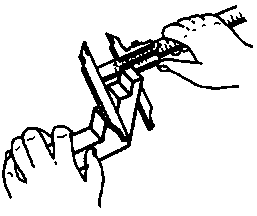
Figure 1 Measuring
Testing with testing tools (gauging):
Deviations in size or shape of any object are determined (tested) by comparison with a gauge.
This will answer the question as to whether the deviations are within or beyond admissible ranges (tolerance ranges) only. There is no need to know the exact value.
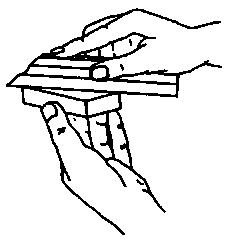
Figure 2 Testing
Which testing methods do you know?
__________________________________________________
What is the difference between measuring and gauging?
__________________________________________________
|
| ||||||||||||||||||||||||
2. Measuring Tools
Measuring tools are sensitive instruments of surface hardened steel provided with scales of different degree of accuracy. Simple measuring tools are mainly used in single-part production and maintenance work.
Steel rule and tape rule:
Measuring tools of 1 mm graduation mainly used for coarse measurements at easily accessible measuring points with the tool always to be placed at right angles to the locating edge.

Figure 3 Location of the steel rule

Figure 4 Location of the tape rule
Vernier caliper:
Predominantly used instrument, mostly of 1/10 mm graduation. Specially formed jaws permit outside, inside and depth measurements.

Figure 5 Measuring of inside
dimensions by means of the vernier caliper
Depth gauge:
Special instrument of 1/10 nun measuring accuracy for depth measurements of slots, shoulders and bore holes.
Depths of bore holes are always measured at the border (never in the centre!)!

Figure 6 Measuring of a slot depth by
means of the depth gauge
Outside micrometer:
Instrument of 1/100 mm measuring accuracy for precision measurement of outside measures in certain measuring ranges. For inside and depth measurements inside and depth micrometers are used.

Figure 7 Measuring by means of the
outside micrometer
Dial gauge:
Special instrument of 1/100 mm measuring accuracy for precision measurement in differential and concentricity measurements in batch production.

Figure 8 Use of the dial gauge in
differential measurements
Protractor:
Instrument for measurement of angles from 0 to 180 degrees with 1 degree graduation, suitable for coarse measurement only.

Figure 9 Protractor used for coarse
measurements
Universal bevel protractor:
Instrument for measurement of angles from 0 to 360 degrees with 1 degree graduation, with vernier providing for a reading accuracy of 1/12 degree - suitable for precision measurements.

Figure 10 Universal bevel protractor
In the use of measuring instruments faulty measurements may occur as a result of:
- Faults at the measuring instrument (damage):Check any measuring instrument for serviceability before use (slide vernier caliper into zero position and compare scale and vernier; check for external damage). Inaccuracies of measuring instruments may also be the result of too wide manufacturing tolerances or maladjustments!
- Faults caused by wrong use:
The measuring instrument is to be used for the proper purpose and range of accuracy. Too big measuring forces (deflections), oblique location or location on faces or edges not cleaned or deburred may result in wrong values measured. Moreover, reading errors may be a consequence of inadequate lighting or wrong conversion of the indicated values.
- Faults caused by environmental conditions:
Measuring instruments and workpieces are subject to heat expansion and low-temperature contraction. This may lead to different measuring results for the same object measured. To have a comparative value, measuring and testing tools are mostly adjusted at 20° Celsius.
Notes:- Avoid faulty measurements, if possible - measure twice at least I
- Use serviceable measuring tools only!
- Handle the measuring instrument properly!
- Ensure good conditions at the place of measurement - adequate lighting and cleanliness!
- Take the measurements at comparable temperatures, if possible I
Which measuring tools have a measuring accuracy of 1/10 mm?
__________________________________________________
Which measuring tools are used for precision measurements of 1/100 mm measuring accuracy?
__________________________________________________
What are the specific features of angle measuring instruments? How can measuring errors be avoided?
__________________________________________________
|
| ||||||||||||||||||||||||
3. Testing Tools
Testing tools (gauges) are sensitive instruments of surface hardened steel without any graduation. The measure is represented by their shape or size or setting.
Some testing tools have their type of measure engraved on them.
3.1. Size gauges
Size gauges are used to determine sizes or to check whether any dimensions of parts are within admissible limits.
The answer may be:
Yes - the size is within the admissible range.
No - the size is smaller than required.
No - the size is bigger than required.
If the answer is "no", it is to be decided whether (reworking) corrections of the part are possible.
Caliper:
Instrument with movable legs for outside and inside testing which are set to the size of the workpiece or setting of which is done by means of a measuring instrument before use.
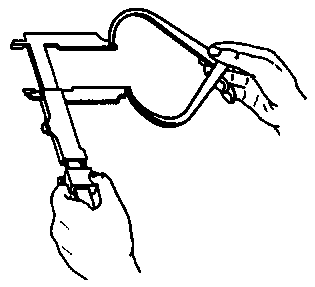
Figure 11 Outside calipering

Figure 12 Inside calipering
Thickness gauge:
Instrument which consists of several leaves of different thicknesses (0.05 to 0.1 mm increments) and is used to determine the size of narrow clearances by inserting a leaf into the clearance.
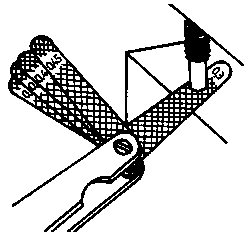
Figure 13 Clearance testing by means
of a thickness gauge
Drill and wire gauges:
Instruments with holes on a steel disk in 0.1 mm increments to quickly determine the diameter of drills or wires.

Figure 14 Testing of diameters by
means of the drill and wire gauge
Block gauges:
Square, standardized blocks, each representing a very precise measure of length (from 0.1 mm) .They are arranged in sets in boxes and are used for differential or comparative measurements.

Figure 15 Testing by means of block
gauges
Limit gauges:
Instruments representing the maximum and minimum limits of very small, standardized tolerance ranges (such as to the ISA system of tolerances and fits):
- Cylindrical limit plug gauge - for fitting inside diameters
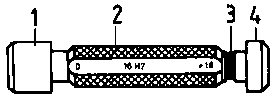
Figure 16 Cylindrical limit plug
gauge
1 "go" end (minimum size), 2 handle with designation of fit, 3 marking (red) of "not go" end, 4 "not go" end (maximum size)
- Limit screw plug gauge - for fitting female threads.

Figure 17 Limit screw plug gauge
Testing method:
The "go" end (minimum diameter) must easily go into the bore, the "not go" end (maximum diameter, marked with red colour) must not go into the bore.
- Limit snap gauge - for fitting outside diameters

Figure 18 Limit snap gauge
1 "go" end (maximum size), 2 gauge body with designation of fit, 3 marking (red) of "not go" end, 4 "not go" end (minimum size)
Testing method:
The "go" end (maximum diameter) must easily go over the work-piece, the "not go" end (minimum diameter, marked with red colour) must not slide over the workpiece,
- Ring thread gauge - for fitting male threads
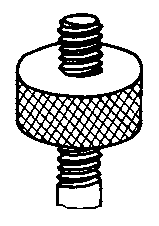
Figure 19 Ring thread gauge
Testing method:
When the ring can be screwed onto the thread, the thread is fitting!
(This does, however, not say whether the thread is possibly skew or dented).
What is the difference between measuring and testing tools?
__________________________________________________
What are the special features of limit gauges compared to simple size gauges?
__________________________________________________
What testing method is typical of the use of cylindrical limit plug gauges?
__________________________________________________
What are the results of testing by means of limit screw plug gauges and ring thread gauges?
__________________________________________________
3.2. Form gauges
Form gauges are used to determine whether the requirements as to flatness, squareness, roundness or other forms are met.
The light-gap testing method is applied:
Place the gauge against the workpiece and hold it against the light! The light gap between the gauge and workpiece must be evenly narrow!
(Form errors from 0.003 mm can be detected)

Figure 20 Light-gap testing
Levelling straightedge:
Instrument designed as steel straightedge (with straight reference faces) or as bevelled steel straightedge (with one knife edge) for flatness tests on finished surfaces.
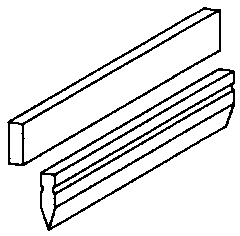
Figure 21 Levelling straightedges
Try square:
Instrument designed as millwrights' steel square (with straight reference faces), back square (with straight reference faces and one reference face designed as stock support) or bevelled edge square (with one knife edge) for flatness tests of faces and angularity tests (mostly 90° degrees) of two faces or edges to each other.
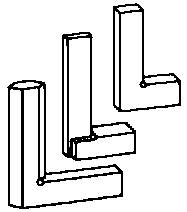
Figure 22 Try squares
Angle gauges:
Instruments for specific angles (60, 120, 55. 118 degrees).

Figure 23 Angle gauges
Radius gauges:
Instruments consisting of one or more specifically radiused leaves (increment of radii 1 mm) for convex or concave radii.

Figure 24 Radius gauge
Which testing method is typical of form gauges?
__________________________________________________
What is the difference between try squares and angle gauges?
__________________________________________________
|
| ||||||||||||||||||||||||
4. Recommendations for Handling Measuring and Testing Tools
- Store the instruments strictly separate from cutting or hand tools!
- Transport the instruments exclusively in the covers or containers intended for this purpose!
- Deposit the instruments during use on a piece of cloth or in special containers with padding!
- Handle the instruments with care - avoid any damage by shocks or by dropping them!
- Slightly grease the instruments after use with nonacid grease - protect them against rust!
- Have the instruments checked every 6 to 12 months depending on the degree of accuracy!