 |
| |||||||||||||||||||||||||||||||||||||||||||||||||||||||||||||||||||||||||||||||||||||
Copyrights
Training and information materials on Vector Biology and Control in the VBC Slide Set Series

Produced by
the WHO/FAO/UNEP/UNCHS Panel of Experts
on
Environmental Management for Vector Control
PEEM Secretariat, WHO, Geneva

© World Health Organization
1996
© World Health Organization 1996
This document is not a formal publication of the World Health Organization (WHO), and all the rights are reserved by the Organization. It may, however, be freely reviewed, abstracted, reproduced and translated, in part or in whole, but not for sale nor for use in conjunction with commercial purposes. The statements and views expressed in documents by named authors are solely the responsibility of those authors and do not reflect the policies of the four UN agencies participating in PEEM. The designations employed do not imply the expression of any opinion whatsoever on the part of the four agencies concerning the legal status of any country, territory, city or area or its authorities, or concerning the delimitation of its frontiers or boundaries.
Ordering information
Agricultural Development and Vector-borne Diseases
Training and Information Materials on Vector Biology and Control,
Slide Set Series
Prepared by WHO in collaboration with FAO, UNEP, and
UNCHS
1997, iii + 83 pages + 180 colour slides
Sw.fr. 250.-/US $225.00;
in developing countries: Sw.fr. 175.-
Order no.
1660013
|
| |||||||||||||||||||||||||||||||||||||||||||||||||||||||||||||||||||||||||||||||||||||
Preface - About PEEM - Acknowledgements
Preface
At its 7th meeting at FAO, Rome in 1987, the joint WHO/FAO/UNEP Panel of Experts on Environmental Management for Vector Control reviewed the effects of agricultural development in its broadest sense on vector-borne diseases. In addition to its traditional focus on water resources development for irrigation, the Panel focused its discussions on other aspects of agricultural development: cropping patterns, chemical inputs, the introduction of new varieties, mechanization and items pertaining to fisheries and forestry. A few years later, at its 1990 meeting, also in Rome, an in-depth review of the links between livestock management and human vector-borne diseases was carried out.
Several technical recommendations emerged from both meetings and, in particular, the collaboration with some of the CGIAR institutions was strengthened as a result. The WARDA/PEEM/IDRC Research Consortium Project on the association between rice production systems and vector-borne diseases in West Africa would not have taken shape so fast without this review, and progress towards the implementation of health research activities in the Environment and Health Programme of the International Irrigation Management Institute in Sri Lanka would have missed an important impulse.
The information collected for and generated by the 7th PEEM meeting was published in the FAO publication Effects of Agricultural Development on Vector-borne Diseases (AGL/MISC/12/87). The Panel recommended that, in addition, a set of visual training aids be developed for use in awareness creation, training and education activities. The production of this slide set was commissioned in 1992. After review and further refinement, a final, prototype set was ready by 1994, but it was not until 1996 that, thanks to the financial support of the United Nations Environment Programme, a first batch of slide sets could be produced for marketing.
The health dimensions of the extensive environmental change we are witnessing in the last decades of the 20th century are complex and probably only matched by the health dimensions of the extensive social change occurring at the same time. In all parts of the world, policy and decision makers are grappling with a transfer from a strictly economics-driven development to true sustainable development. This slide set aims to help them and future professionals to visualize specific agro-ecotypes, relate them to their local conditions and develop effective preventive solutions to equally specific local health problems.
Robert Bos
Executive Secretary
PEEM
About PEEM
The Panel of Experts on Environmental Management for Vector Control (PEEM) was established in 1981 as a joint activity of the World Health Organization, the Food and Agriculture Organization of the United Nations and the United Nations Environment Programme. The Panel’s objective is to create an institutional framework for effective interagency and intersectoral collaboration by bringing together various organizations and institutions involved in health, land and water development and the protection of the environment, with a view to promoting the extended use of environmental management measures for disease vector control in development projects. The PEEM Secretariat is located in the Division of Operational Support for Environmental Health of WHO in Geneva, Switzerland.
In 1991 the three agencies were joined by the United Nations Centre for Human Settlements (UNCHS/Habitat) and the Panel’s mandate was expanded to include health issues relating to human settlements in the context of development and the provision of drinking water supply and sanitation, and urban environmental management for disease vector control. At the time of publication of this slide set, the global PEEM network consists of 40 experts and fifteen collaborating centres representing a range of relevant disciplines.
The WHO Slide Set Series on vector Biology and Control contains twelve sets, eight of which concentrate on a single vector or group of vectors. Of the remaining four, the present set and the set on Environmental Management for Vector Control have been prepared under the auspices of PEEM.
Acknowledgements
The production of this slide set was commissioned from Mr Tom H. Mather, CEng MICE, who designed the set’s structure, collected the slides and drafted the captions and accompanying text. Within the limited resources available, Mr Mather was able to successfully carry out his assignment, drawing on his many contacts dating back to his position as Service Chief, Water Resources, Development and Management in FAO, Rome. The photo libraries of both FAO and WHO proved valuable sources of material, but many others contributed and these inputs are individually acknowledged at the start of each section, where the slides are listed. The accompanying text was further developed by Hans Verhoef, at the time Associate Professional Officer in the PEEM Secretariat and currently Research Associate of Wageningen University in the Netherlands. Jacob Williams, Associate Professional Officer in the PEEM Secretariat at the time of publication of this set, assisted in completing the text with disease profiles and in its assembly.
|
| ||||||||||||||||||||||||||||||
Agricultural Development and Vector-Borne Diseases (FAO - HABITAT - UNEP - WHO, 1996, 91 p.)
Introduction
1. Target audience, objectives, scope and structure
Target audience
The target audience of the present slide set is made up of those with technical, managerial or administrative responsibilities for planning, designing and implementing agricultural and natural resources development; for introducing changes in agricultural practices; and, for the settlement or resettlement of rural populations. It is also intended for teachers and students engaged in training for such responsibilities.
Secondly, it targets those working or preparing to work in public health to provide them with a clearer picture of the complexities of agriculture/health links
Objectives
The general objective of this slide set is to provide (future) professionals in the agricultural and natural resources sectors with relevant information so they become more willing to accept a joint responsibility with the health sector for solving health problems that are caused by land and water resources development for agricultural production.
More specifically, the set aims: a) to provide decision makers in the agriculture sector, at all levels, with a general understanding of the impact of agricultural development projects on vector-borne disease, b) to promote an awareness of the role of the agricultural sector in vector-borne disease prevention, and c) to give the target audience access to information, institutions and organizations that may assist in the incorporation of health safeguards into agricultural development and practices.
Scope
Agricultural development as used in this text refers not only to the development and management of crop production and cultivation, but also to irrigation, forestry and fisheries, land use and improvement and rural human settlements. The term vector-borne diseases is referred to in this slide set in its broad WHO definition, i.e. those diseases whose transmission vitally depends on primary and intermediate vertebrate and invertebrate hosts and animal reservoirs of pathogenic organisms. A summary description of each of the diseases is given in section 4.
Non-health professionals may easily be confused by clinical aspects and the epidemiological characteristics of the multitude of diseases that are covered in this slide set. Diseases have been grouped together as much as possible to avoid burdening the target audience with unnecessary details. Simplification has been unavoidable and it is recommended that in any case where professionals from the agricultural sector decide to work on human aspects of agricultural development, this is always done in close collaboration with health authorities and with the expert inputs of an epidemiologist.
Although the authors have tried to cover all major geographical areas of the world, there are admittedly gaps in the slide set due to the lack of available high quality slides. No attempt was made to illustrate all the topics that could possibly fit under the title of the set. Neither was it attempted to treat each discussed topic exhaustively, to discuss all vector-borne diseases or to prioritize vector-borne disease problems in relation to agricultural development.
The focus of this set is on health problems. Agricultural development, however, also provides many health benefits. The text accompanying the slides refers to these possible health benefits when appropriate.
Structure
Topic A (Vector-borne diseases of relevance to agriculture) provides a small reference slide collection showing the magnitude, distribution and symptoms of vector-borne diseases.
The development of environmental management measures should be systematically linked to specific vectors in particular agricultural environments and agroecosystems, in order to enhance the chance that they work effectively in a wide range of circumstances. This strategy is reflected in topics B (Relevant disease vectors) C (Vector habitats), a with exclusive reference to schistosomiasis
The remaining topics deal with the different components of agricultural development and their association with vector-borne diseases.
Topic E: Land use, vegetation and crops
Topic F: Water use in agriculture
Topic G: Cultivation practices
Topic H: Influence of livestock
Topic J: Plant protection, pest control and chemical inputs
Topic K: Rural settlements
In the WHO Vector Biology and Control Slide Set Series, there are volumes for each disease which cover the epidemiological, clinical, curative and public health sector issues. A slide set on environmental management for vector control focuses on physical interventions, particularly, environmental modification and manipulation in irrigation and drainage systems. All slide sets can be ordered from WHO Distribution and Sales, 1211 Geneva 27, Switzerland.
2. How to use this slide set
The integral set
The slide set gives a complete overview of issues related to the association of agricultural development and vector-borne diseases. While the set as such can be presented in its entirety, following the same sequence and using the captions provided with each slide, users are encouraged to make a more creative use of this material.
Target audience
First, consider your target audience: Is it a group of decision makers with serious time constraints? Is it a group of middle level managers with a lot of field experience already? Or, will the subject matter be presented to students in the context of courses on natural resources management? The answer will determine the length of presentation, the focus of the presentation and, consequently, the number and selection of slides from the set.
Objectives
It is important to have a clear view of what you want to achieve with the presentation. For instance, if it is general awareness creation exercise for policy makers as part of a debate on a new national water resources strategy, then slide materials should be selected highlighting locally important diseases and locally relevant situations. If the presentation is part of an environment and health risk appraisal by decision makers, then the organizers of the presentation may want to supplement the slide material with their own slides made in the project area.
The other important objective may be training and education. In that context, the material shown can address issues in much broader sense. At the same time, this objective implies an evaluation of the learning process, and ideas on that are further elaborated below.
Customize your presentation
Whatever the purpose of a presentation will be, it should be stressed that it will always be more convincing if the person preparing it will take the initiative to customize it to specific needs by (1) selecting the most appropriate slides of the set; (2) develop a narrative based on the information provided in this set and complemented by other relevant information, and (3) adding other visual training aids, i.e. slides from one’s own collection, overhead transparencies or videos.
Should it be decided to present the set integrally, then it is recommended to do so interspersed with course work on other relevant publications listed in this set. Nothing is as counterproductive in the learning process as slide presentation that lasts too long!
What should your students learn?
There are a number of key messages that professionals from the agricultural and water sector must assimilate to achieve he objectives of this slide set. These messages are contained in the set as six text slides, and they should be the most important topics for testing in examinations.
In addition, your audience must also have access to sources of information, institutions and organizations that may assist them further in the incorporation of health safeguards into agricultural development and practices. For this purpose, the set includes a short bibliography of selected publications and complementary training aids, and a list of addresses of organizations and institutions which can provide additional information and assistance. It is strongly recommended that you copy these two lists for distribution to your audience.
Use of slides
The psychology of learning has convincingly shown that students can remember subject matter more easily and use acquired knowledge better when they have the opportunity to elaborate on knowledge at the time of learning. Therefore, show a few slides at a time and discuss them thoroughly, rather than running through a large number of slides. Five or six slides may easily fill half an hour! Be selective, think ahead what you want to show and do not present slides for more than three quarters of an hour at a time.
Other didactic means
In mastering facts and concepts, it appears important that students learn and acquire the concepts while puzzling through a particular problem, rather than by ‘hammering’ it in through repetition. The task of the trainer is thus to present students with problems for which they have to find answers themselves (of course, with assistance of the trainer). Field trips, debates, discussions, essay writing all provide better opportunities to do so, and they are therefore more important learning forms than lectures, reading of literature or a slide show. Students benefit more if the use of the latter is embedded in an overall effort to solve a particular problem. For example, the slides may be used as an introduction to a learning exercise in which students will assess the health impact of a certain planned development project.
The multidisciplinary nature of the subject matter provides unique opportunities for discussions between professionals of different backgrounds, and this will significantly enrich the learning experience.
Handling slides and slide projectors
Store slides in a cool and dry place to prevent fungus growth, and away from chemicals.
Many presentations have been ruined by trainers who did not prepare themselves properly. As with other audio-visual material, get acquainted with your slide projector well before the actual session in which you present the slides, and check the following:
· Is there remote control of the projector? Does it have an auto-focus feature? If not, you may have to arrange for an assistant to switch slides and focus the slides.· Is the slide projector connected to an active power supply?
· Can the room where the presentation is to be held easily be darkened? Is it dark enough for students sitting at the last row?
· Do you know where the on/off switch of is located on the projector?
· Is there spare light bulb available? Remember that the life span of a light bulb can be prolonged if it is switched off a few minutes before switching off the cooling fan in the projector!
· Do the slide trays match your slide trays? The slide contained in this set are thin and should preferably be used in matching trays.
· Can you project the slide to a size that is adequate for viewing by the audience in the back of the room? The size of the picture depends on the distance between the projector and the screen, and on the focal length of the projector lens. If you bring your own projector, remember that, the size of the room may require a different projector lens!
· Very importantly, try out if you have put in your slides correctly in the tray! The top of the slide should be down in the tray, and the front of the slide should face the back of the slide projector (so check how the slide tray should fit into the projector before putting the slides into the tray!)
|
Immediately try to arrange to have backup copies made of all the slides upon receipt of the set. WHO cannot accept orders for copies of individual slides |
3. Introduction to the subject matter
Health impact of agricultural development
The increasing world population, the desire to achieve higher levels of food production and the changing nutritional patterns of growing urban populations, have led to an intensification of agricultural production in most developing countries. Agricultural development policies usually aim to improve food security, socio-economic conditions and the quality of life. Unfortunately, agricultural development may also have adverse health effects, notably through the spread and intensification of vector-borne diseases which may invade new areas, increase transmission rate and/or season with resulting higher numbers of cases, or cause more severe disease symptoms.
How agricultural development determines health
There are several driving forces that determine the nature and magnitude of the health risks associated with agricultural development. These may be broadly categorized as environmental, ecological, demographic and socio-economic changes.
Environmental and ecological changes
Environmental and ecological changes induced by agricultural development may lead to the creation of new building sites for disease vectors and snail intermediate hosts; they may create micro climatic conditions that favour vector longevity; they may result in habitat simplification with the loss of vital predator species that keep vector populations under control; or, they may lead to an increased frequency of human-vector contact.
Many vector species have very precise breeding site requirements. This is part of their ecology. A few vector species, such as the malaria vector species complex of Anopheles gambiae in sub-Saharan Africa, can adapt to a broader range of breeding sites.
All mosquito vectors have an aquatic larval stage. Some species prefer shaded pools, and others, sunlit ones. Anopheline vectors of malaria as a general rule prefer clean water, while the culicine vectors of filariasis breed in organically polluted water. Vectors depending on terrestrial ecosystems, such as tsetse flies (Glossina ssp.), are often associated with specific types of vegetation. In agro-ecosystems species succession may occur in relation to the cropping cycle.
Vector longevity, i.e. the life span of the adult insect, is a crucial determinant of vectorial capacity. The longer a mosquito lives, the more bloodmeals it will take and the greater the chance of transmitting pathogens.
Irrigation schemes may significantly increase relative humidity in a large area, favouring vector longevity. The impact of this phenomenon on malaria transmission was clearly demonstrated in the development of irrigated rice production systems in the Ruzizi plains of Burundi. The forest species of malaria vectors in South-East Asia and the archipelagos of Indonesia and part of the Philippines (Anopheles dirus and A. balabacensis) are excellent vectors in their natural environment and in reforested areas and plantations - but where vegetation density is reduced and the relative humidity drops, vector longevity and vectorial capacity diminish accordingly.
Agricultural practices are important determinants of vector-borne disease transmission. Water management in irrigation schemes, the choice of crops and crop varieties, cropping patterns, chemical inputs (pesticides, herbicides and fertilizer), and animal husbandry and mechanization all have the potential to affect one or more of the variables of vectorial capacity. The present slide set aims to provide ample illustrations of these links. Another slide set in the WHO/VBC series (Environmental Management for Vector control) focuses on risk factors in the design and management of irrigation schemes specifically and on modification or manipulation measures for risk reduction.
Changes in human behaviour may be directly related to agricultural activities, but they may also be brought about by modification of the physical environment. Night storage dams in irrigation schemes, for example, provide a suitable habitat for the aquatic snail intermediate hosts of schistosome parasites. In most cases these reservoirs are likely to become preferred sites for agricultural workers to wash themselves or for children to swim in, thus creating ideal conditions for the transmission of schistosomiasis.
The role of domestic animals that are part of the agricultural production system and that serve as a reservoir host for some of the vector-borne parasites deserves special mention, because, like vectors and intermediate hosts, they play an essential role in the life cycle of disease causing organisms. Examples are pigs, the amplifying hosts for the Japanese encephalitis virus and water buffaloes, a reservoir of Schistosoma japonicum in the Philippines.
Demographic changes
Agricultural development is often accompanied by demographic changes, which may lead to large concentrations of vulnerable people being exposed to infection at times of peak vector-borne disease transmission. This is particularly evident where agricultural development leads to intensive cultivation. Irrigation projects, for example, frequently sustain double or triple the number of people of traditional systems and usually have a re-settlement component for farmer families. The cultivation of certain crops creates a seasonal demand for temporary agricultural workers, often during, or just after the rainy season when disease transmission is most intense.
New settlers, temporary agricultural labourers and construction workers share one important characteristic: they may be more vulnerable to some diseases than the autochtonous population. Migration from low transmission areas (e.g. highland areas, as in the case of malaria) implies an influx of people with an inadequate protective disease immunity; thus, infections may easily lead to life-threatening conditions resulting in death.
The increased mobility to and from agricultural development areas, as in the case of temporary labourers and construction workers, also carry the risk of further spread of disease. Construction workers coming from overseas may introduce exotic pathogens. Seasonal labourers may carry parasite species back and forth between areas of intense agriculture and their home areas. A case in point is that of Madagascar, where malaria is much more common in the lowlands than in the highlands. Many seasonal workers engaged in rice cultivation in the irrigated lowlands carry malaria parasites back to the highlands from where they originate. When weather conditions in the highlands are favourable for transmission, this may occasionally lead to massive malaria epidemics in those areas. Because malaria does not occur with a high frequency in the highlands under normal circumstances, these epidemics hit highly vulnerable populations and usually result in many deaths. A similar phenomenon was observed in Ethiopia where schistosomiasis gradually spread from endemic areas in the provinces of Tigre and Wollo to new schemes in the Awash valley, mainly because of seasonal migration.
At the micro level, the siting of human settlements in relation to irrigation schemes can be of crucial importance in determining transmission risks: The distance between manmade mosquito breeding sites and human settlements may or may not be within the specific flight range. Easy access to irrigation canals may tempt villagers to have contact with unsafe water. On the other hand, siting of cattle between mosquito breeding places and human settlements may serve as a buffer and reduce human-vector contact. Studies in irrigated rice production zones in Philippines have shown that where long-term mass drug distribution to reduce the prevalence of schistosomiasis was carried out, each village reached a characteristic minimum level of prevalence rates, reflecting the specific environmental risks in its immediate surroundings.
Socio-economic changes
Socio-economic change, in the wake of agricultural development, will have a dramatic impact on the health of communities affected. Most of these are positive, as one would hope for any development project. Local infrastructure improvements mean a better access to and by the health services. At the household level, additional buying power may translate in the purchase of protective tools (mosquito nets, screening of windows) or medicine. Surplus money at the community level can be used to install or improve water supply and sanitation.
Unfortunately, there is no guarantee that these benefits are equitably distributed over all community members. Also, within each community, there will be vulnerable groups whose increased risks are not adequately compensated by socio-economic advances. And finally, large scale agricultural development projects will, because of increased economic activity, attract large groups of new people. These unplanned settlers may, to some extent, benefit from the opportunities on offer, but by and large will end up as marginalized, vulnerable communities with no access to public services such as health care, drinking water supply or education. They become risk foci for the other communities and may adversely affect the improved health status gained.
Particular attention should be given to gender issues. The risk of pesticide-poisoning following occupational exposure or suicide attempts, for example, is usually different for males and for females. Also, men and women may engage in different agricultural activities, and agricultural development which results in changes in gender roles is likely to result in shifts in sex-specific health risks.
Implications for the agricultural workforce
The phenomena described above have tremendous consequences for human well-being. They also affect the agricultural and economic productivity of the people who are afflicted by these diseases. Infectious diseases such as malaria, schistosomiasis and hookworm are major causes of anemia, a condition affecting almost half of young children, and more than half of pregnant women worldwide. The consequences of anemia during pregnancy include an increased risk of maternal and fetal morbidity and mortality, premature delivery and low birthweight. Anaemia is estimated to be a causative factor in at least 20% of maternal deaths. Anemia causes developmental deficits, growth retardation, decreased resistance to infectious diseases and decreased physical fitness in children. Growth retardation in a child increases morbidity and mortality risks, decreases physical work capacity throughout his/her life span, and increases the risk of future reproductive complications for girls.
In addition to these direct impacts on the quality of life of large groups of people, the consequences for on the health services is substantial. The hidden cost of inadequately planned agricultural development is seldom considered in feasibility studies or the calculation of the Internal Rate of Return. These costs nevertheless represent an often substantial drain on the national economy.
Health mitigation measures
Methods exist to counter-act the adverse impact of agricultural development projects on vector-borne diseases. Part of the capital investments and project revenue can be used to finance the recurrent costs of extra health care for the farmer families concerned. It should be noted, however, that vaccines are not (yet) available for operational use for such major diseases as malaria and schistosomiasis. Investments in improved access to drugs and improved health care delivery are the least desirable of all possible health interventions, because they cure rather than prevent disease, they require long-term and recurrent funding, and the increased drug use will eventually accelerate the selection of drug resistant parasites. Nevertheless, improved health care delivery has a complementary role if and when other methods fail or if their combined use is not sufficient (which is frequently the case).
The use of environmental management
The concept of sustainable development places human livings at the center of the environment and development framework. It implies risk assessment and management as much for natural resources as for human health.
The effective management of risks of vector-borne disease transmission is best achieved through chemical, biological and/or environmental methods of vector control. Wherever feasible, environmental management is the method of choice because of its long-term effects, environmental friendliness, consistency with good agricultural practices and favourable cost-effectiveness in comparison with other methods. The implementation of such measures in agricultural development requires the involvement and active participation of the agricultural sector. Environmental management includes modification or manipulation of the environment and measures aimed at a reduction of human-vector contact (Table 1). Environmental modifications consist of permanent or long-lasting physical transformations of land, water and vegetation, aimed at preventing, eliminating or reducing the habitats of vectors without causing undue adverse effects on the quality of the human environment. Environmental manipulation consists of any planned recurrent activities aimed at producing temporary conditions unfavourable to the breeding of vectors in their habitats.
Health safeguards can be built into agricultural development projects based on recommendations emerging from environmental assessments (see guidelines by Tiffen 1991, Birley 1991 and Phillips et al. 1993). Normally, the procedures include an initial health impact assessment, if necessary followed by an in-depth health impact assessment as part of the environmental assessment, an appraisal of the health impact assessment and an intersectoral action plan for health monitoring.
Formal procedures do, however, not normally exist for the use of such assessments in small-scale projects, nor will their use be economically realistic. For such projects, environmental management measures may be developed as a result of guidelines on procedures and standards of minimum requirements in the design, operation and maintenance of the project. Environmental management measures are only effective in specific ecological settings, for specific vectors and addressing specific epidemiological patterns. In the absence of a formal risk assessment, district level workers (health workers, agricultural extension workers and local engineers) will have to form a team to ensure the appropriate measures are designed and implemented.
Table 1: Examples of environmental management measures for vector control in irrigation schemes
|
Component |
Measure |
Class + |
|
Lay-out of irrigation scheme |
· design of the scheme aimed at proper field drainage and minimum surface areas of standing water |
MOD |
| |
· siting human settlements away from irrigated fields to reduce human-vector contact |
MOD |
|
|
· constructing latrines in the fields, layed out in a grid pattern, to provide farm workers with sanitary facilities while at work |
MOD |
|
Settlement design |
· Provision of water supply and sanitation (piped water supplies, washing and communal laundry facilities, safe children’s swimming pools, latrines) |
MOD |
|
|
· screening of houses and better house design |
MOD |
|
|
· domestic animal pens at strategic sites to avert mosquito vectors away from humans |
CON |
|
|
· (insecticide-impregnated) mosquito nets, particularly for use by high-risk groups |
CON |
|
Reservoir design and operation |
· avoid construction of night water storage reservoirs which may serve as vector breeding and disease transmission sites |
MOD |
| |
· periodic drawdown to achieve water level fluctuation |
MAN |
|
|
· vegetation clearance to reduce vector breeding |
MAN |
|
|
· fishing facilities that prevent unnecessary water contact |
MOD |
|
Irrigation canal design and operation |
· straight canals to eliminate standing pools suitable for vector breeding |
MOD |
| |
· canal lining of major or designated water contact points to inhibit vector breeding |
MOD |
|
|
· other design measures to increase water velocity, aimed at a reduction of vector breeding |
MOD |
|
|
· sluicing and flushing of snails |
MAN |
| |
· vegetation clearance against snail or mosquito breeding |
MAN |
| |
· mechanical screening of water intakes against the transport, via water, of snails |
MOD |
| |
· pathways and bridges across canals and drains, particularly in and around villages, to avoid unnecessary water contact |
MOD |
| |
· self-draining hydraulic structures to achieve water level fluctuation |
MOD |
|
|
· early (or late) working hours for canal maintenance crews to avoid schistosomiasis infection at peak transmission periods |
CON |
|
Irrigation method |
· alternate wetting and drying of rice fields to minimize vector breeding |
MAN |
| |
· sprinkler or trickle irrigation to reduce the amount of standing water |
MOD |
|
|
· scheduling of field irrigation that allows for periodic drying of canals and drains |
MAN |
|
Cropping system and other agricultural practices |
· use of upland crops, at least once per cropping cycle, to prevent the establishment of vector species that need permanent water bodies for survival |
MAN |
| |
· avoid double - or triple cropping to limit the vector breeding to the rainy season |
MAN |
| |
· use of varieties with a short growing season to reduce the period that standing water is available |
MAN |
| |
· Synchronization of cropping cycle in large areas of smallholder irrigated rice production, to ensure interruption of the availability of breeding sites |
MAN |
+ MOD: environmental modifications;
MAN: environmental manipulations;
CON: reduction of human-vector contact
Technical limitations to environmental management
Environmental modifications and manipulations share a number of technical limitations with other methods such as larviciding or biological control of snails and immature mosquito stages. These methods can only be useful when aiming at public health protection through a reduction of disease transmission. Actions by individuals have little impact, even for personal protection. Also, environmental management measures may not lead to an immediate reduction of disease morbidity and mortality. Their effectiveness is site- and time-specific, and more applied research is needed to develop measures that are appropriate for particular agricultural environments and ecosystems. Larviciding and bio-environmental control require meticulous searching out of all breeding sites within mosquito flight range of the communities to be protected, and the large investments in labour or costs that are needed to carry out recurrent measures are prohibitive in areas with low population densities. Environmental modifications or manipulations require intersectoral coordination, a top-down approach, a relatively high level of social organization and frequently high initial financial investments. The greatest chance of success in urban settings and in large, formal development projects, where a central management and farmer interest groups are present, and where a good level of control over the physical environment can be attained (e.g. irrigation projects). The chances of their sustainable use in poor rural communities, where most vector-borne diseases occur, are less.
Environmental management measures aiming at a reduction of human-vector contact, are usually cheaper, easier to apply and can be effectively used for personal protection of the individual or population groups at high risk. In certain conditions can also be used for the more ambitious goal of transmission control, for example by siting new villages away from breeding sites in the process of planning of irrigation schemes.
Constraints to the use of environmental management:
a) lack of intersectoral collaboration
Despite their obvious potential, environmental management measures remain insufficiently applied. We will briefly discuss a number of underlying reasons. The first is the lack of intersectoral collaboration (see guidelines by Tiffen, 1991). The agricultural and water sectors rarely consult the health sector in the planning of their projects. And even if they do, the health sector usually does not have the capacity to provide adequate inputs that can be readily taken up by the other sectors. The incorporation of engineering measures into the design, operation and maintenance of agricultural schemes is primarily a responsibility of the agricultural sector, but it requires close consultation with health experts to make a proper assessment of the possible health impact of a project, to get technical advice on appropriate measures, and to monitor the health status of temporary labourers and beneficiaries of the project. The health sector can only respond properly and timely when it is involved from the earliest stages of project planning.
b) financial constraints
The application of environmental management is furthermore hampered by financial constraints. Intersectoral collaboration should include sharing of resources. First, because sharing of resources avoids duplication of efforts and that are often initially required to apply environmental management measures. The health sector does not generate its own revenues, like some other sectors, and must therefore receive funds from other sectors, either at governmental level or at project level. In case agricultural projects create health risks, failure to share their revenues with the Ministry of Health is bound to result in inadequate provisions in health care and a poor health status of the agricultural labour force.
c) difficulties in economic analysis
The health sector often shows a reluctance and poor capacity to express health benefits economic terms. Health professionals often mistakenly assume that economic analysis requires the expression of health in monetary terms. Cost-effectiveness analysis, which is the type of economic analysis that is required to influence decision-making in agricultural projects, is based on a comparison of costs of different scenarios to contain disease vectors to a certain degree. Guidelines on cost-effectiveness analysis of vector control have been developed by Phillips et al. (1993).
d) difficulties in forecasting health impacts
Health professionals should not be deterred by the difficulties in accurately forecasting the health impacts of a development project; nor should non-health decision-makers use these difficulties a pretext for inaction. At the United Nation Conference on Environment and Development in Rio de Janeiro in June 1992, there was agreement on the need to adopt the precautionary principle; its definition was set out in principle of the Rio Declaration on Environment and Development - “Where there are threats of serious or irreversible damage, lack of full scientific certainty shall not be used as an reason for postponing cost-effective measures to prevent environmental degradation.” There are good reasons to apply this principle in view of the frequent and dramatic examples of adverse health effects of agricultural development that have occurred in the past.
Priority actions by the agricultural and water sectors
In view of what is discussed in the preceding paragraphs, the agricultural and water sectors should make a number of adjustments to safe health in agricultural development:
· become willing to accept joint responsibility with the health sector (including a willingness to share resources) for solving health problems that are caused by agricultural and water resources development,· become aware of the need to consult the health sector at the earliest stages of project planning in order to appraise the need for health impact assessment, either to be carried out independently or as part of environmental impact studies,
· develop a capacity for joint planning of health impact studies with the health sector, through the formulation of the terms of reference, to appraise the resulting reports, and to translate the recommendations of these studies into appropriate institutional arrangements and a plan of action for joint project monitoring,
· develop a joint strategy with the health sector for the development and promotion of guidelines and standards that should be maintained in small-scale agricultural projects.
Priority action by the health sector
The health sector should make the following adjustments:
· develop an understanding of the planning process that are used in agricultural projects, the actors involved and the critical times for health interventions in these processes.· develop a capacity to use rapid methodologies for forecasting the health effects of development projects, and to translate the cost of vector control disease containment in economic terms,
· foster and coordinate intersectoral collaboration by maintaining formal and informal links with the ministries and (semi-)governmental bodies covering the following sectors: agriculture, rural development, irrigation and rural water supply, economic planning, livestock development, and river basin management.
· develop the capacity to carry out health impact assessment and/or foster links with specialized consultancy firms who can do so.
For more information, the interested reader is referred to the list of PEEM technical papers and discussions, and the bibliography which contains a selection of technical papers, publications and complementary training aids.
4. Brief description of major vector-borne diseases
· Malaria
· Lymphatic filariasis
· Schistosomiasis
· African trypanosomiasis
· Japanese encephalitis
· Yellow fever
· Leishmaniasis
Malaria
Malaria is caused by four species of Plasmodium (protozoan): P. malariae, P. vivax, P. falciparum and P. ovale and is commonly characterized by intermittent high fevers, shivering chills, body pains, headaches, fatigue, nausea and vomiting, diarrhea and anaemia. Severe conditions, caused by P. Falciparum, can lead to liver and kidney failure, brain damage and spleen enlargement, among others, and may be fatal.
It has been estimated (WHO, 1990) that about two billion people are at risk and over 270 million people are affected by the disease. Malaria is thought to be one of the leading causes of mortality and morbidity in the world with approximately 110 million clinical cases and between one and two million fatalities each year, primarily among children and pregnant women. The disease is prevalent in the developing world where it exerts a serious economic strain on already frail economies. In sub-saharan Africa, the average direct cost of a case of malaria has been estimated at $3.40, which is equal to the per capita health budget of many African countries.
The vector of malaria is the Anopheles mosquito. Sixty of the approximated 400 species worldwide are known vectors of malaria. Of these, 30 are considered to be of major importance. The disease is transmitted through the bite of the female mosquito.
Transmission is dependent upon a number of factors relating to the parasite, the human host, the vector’s ecology and the social environment. The important role of environmental factors in sustaining malaria transmission is typified in the developing world where there has been dramatic changes in incidence patterns as a result of the intense economic activities brought about by rapid population pressure. The resultant deforestation, land exploitation, dam-building and irrigation has, in turn, led to the creation of vector habitats and movement of nonimmune people into malarious zones. The situation has led to the resurgence of the disease in many areas. The once primarily rural disease is now a growing problem in cities and peri-urban areas as a result of the trend towards urbanization.
Eradication measures have proved unsustainable and control measures have not yielded the expected goals, as prevalence has not changed in recent years. It has been estimated that about 474 million people now live in areas where no specific control measures are applied.
Options for malaria control include chemotherapy, vector control with chemical, biological and environmental management components. The development of drug and pesticide resistance by parasite and vector, respectively, have proved a severe impediment to the control of the disease. Other constraints to control measures include prohibitive costs and high trained manpower requirement. I spite of the progress made in vaccine research, an effective vaccine is still years away. Experience over the last two decades point to an integrated control approach as the best control strategy where a combination of all complimentary control methods are used.
The WHO Global Malaria Control Strategy advocates the following four points:
· to provide early diagnosis and prompt treatment· to plan and implement selective and sustainable preventive measures, including vector control;
· to detect early, contain or prevent epidemics; and
· to strengthen local capacities in basic and applied research to permit and promote the regular assessment of a country’s malaria situation, in particular the ecological, social and economic determinants of the disease.
Lymphatic filariasis
Lymphatic filariasis is caused by three nematode species, Wucheraria bancrofti, Brugia malayi and Brugia timori with W. bancrofti (bancrofian filariasis) being the most widespread. Humans are the only reservoir for W. bancrofti and B. timori, but B. malaya is also found in monkeys.
The disease is characterized by recurrent fevers, inflammation of the lymph nodes and vessels with transient swelling of the limbs as early clinical symptoms. Later symptoms include scrotal swelling and permanent swelling of the limbs (a condition commonly referred to as elephantiasis) as a result of the collections of fluid in cells, tissues, or body cavities brought about by adult worms residing in the nodes and vessels of the lymphatic system and restricting the flow of lymph. In hypersensitive individuals, immunological reactions may result in an asthma-like condition called tropical pulmonary eosinophilia (TPE), characterized by bouts of wheezing and coughing at night and shortness of breath.
Vectors of the disease include a number of mosquitoes of the genera Culex, Aedes, Mansonia and Anopheles: C. quinquefasciatus is the vector in urban and semi-urban areas worldwide, while species of the other genera have a more restricted geographic distribution. Strict ecological requirements by the vectors tend to make the distribution of the disease both patchy and focal. The parasite is transmitted an infected mosquito takes a blood meal.
Foci for the disease can be found in a number of countries in South-East Asia, Pacific island groups, several Carribean countries, most African countries and limited areas of Central America and northern South America. Conservative estimations put the number of people living in endemic areas at about 905 million, out of which about 91 million are actually infected by the parasite. Two-thirds of the infected people live in India, China and Indonesia. There is a strong correlation between infection and low socioeconomic status.
There has been an increasing incidence of bancroftian filariasis in Asian and African countries; poor sanitary conditions, i.e., polluted water, blocked open drains, roadside ditches, broken septic tanks and accumulation of sewerage effluents, which often accompany rapid urbanization have created conducive breeding habitats for the vector C. quinquefasciatus.
Disease control methods include vector control (reduction of breeding sites, control of vectors at breeding sources, and interruption of transmission by adult mosquitoes), reduction of infection in the human reservoir (chemotherapy) and personal protection. While some countries in the Western Pacific Region have more or less eliminated the disease, other countries, including the African countries, still have poorly developed control programmes.
Future priority areas for disease control include multidisciplinary research efforts, an intersectoral approach to vector control, strenghtening of primary health care and surveillance systems.
Schistosomiasis
Schistosomiasis is caused by five species of schistomes: Schistosoma mansoni, S. japonicum, S. haematobium, S. mekongi and S. intercalatum. It is a chronic debilitating disease affecting an estimated 200 to 300 million people in 79 countries. About 600 million are thought to live in endemic areas.
Schistosomiasis is primarily a rural disease associated with daily activities related to water use, such as farming, fishing, bathing, recreation, washing clothes and kitchen utensils, and personal hygiene. However, urban and peri-urban transmission of schistosomiasis is becoming a serious problem in some developing countries, due in part to the migration of infected persons from the countryside to areas of the cities or their suburbs that do not have adequate sanitary and health care facilities. Thus, the disease may have probably escaped detection in many localities where health services and disease surveillance are not well developed. Other factors contributing to the changing endemicity pattern of the disease include increasing irrigation projects, intensive water resources development activities and environmental destabilization.
Fresh water snails of the genus Biomphalaria, Bulinus and Oncomelania serve as species specific intermediary host of the parasites. The infective larvae penetrate the skin of humans who enter snail infested water. Thus infection does not require physical contact between man and snail.
The onset of the disease may be characterized by itching and rash, sometimes by shortness of breath and cough and on rare occasions by a fatal immunological reaction known as Katayama syndrome. The disease has two forms; urinary schistosomiasis caused by S. haematobium and intestinal schistosomiasis caused by the other four species. The former has a conspicuous early symptom of blood in the urine, and is as a result of major pathologic lesions in the walls of the urinary bladder often extending to the ureter, kidney, urethra and genitalia. It is accompanied by incontinence, and constant and increasing pain upon urination. There is also lower abdominal pain, bladder colic and weakness. Intestinal schistosomiasis is characterized by major pathological lesions of the intestine, particularly the colon, caecum and rectum as a result of worm-eggs passing through or calcifying in the tissues. Dysentery, accompanied by abdominal pain, enlargement of spleen and liver as well as arterial obliteration in the lungs are symptoms of severe cases.
Schistosomiasis control strategies have shifted away from the elimination of infection or interruption of transmission toward control of the human disease with chemotherapy. Snail host control should be a supportive part of an integrated control activities. The best strategies must be community-based and should include primary health care, especially as relating to health education, food and nutrition, water supply and sanitation, maternal and child health and drug distribution.
African trypanosomiasis
(Sleeping sickness)
Sleeping sickness is endemic in 36 countries in Africa. Estimates put about 50 million people at risk with at least 25,000 new cases yearly. The disease is caused by a protozoan parasite of the genus Trypanosoma. There are two forms of the disease recognized in man: an acute infection caused by the more virulent T. brucei rhodesiense (the Rhodesian sleeping sickness) found in the savannah areas of eastern and South-Central Africa, and the chronic T. b. gambiense (gambian sleeping sickness) found in the riverine, lake and humid, forested areas of West and Central Africa.
Infection is man is through the bite of an infective tsetse fly of the genus Glossina. G. mortisans and G. fuscipes transmit T. b. rhodesiense which is associated with occupations that expose humans to tsetse fly bites in areas with abundant game animal populations. The animals serve as parasite reservoir and source of infection to the tsetse fly during blood meals. The G. palpalis group of flies and their subspecies transmit T. b. gambiense. It is, however, believed that a peridomestic transmission cycle including pigs, dogs and cattle also exist.
The disease, in both its domestic animal and human forms, is a major deterrent to economic development in parts of Africa. The cost of disease treatment is very high - about $140 per patient for drugs and a long period of hospitalization.
Both forms of the sickness can be invariably fatal if untreated. It is characterized by intermittent fevers, headaches, swollen glands, intense itching and general malaise, drowsiness, somnolence and eventually a comatose state.
Disease control strategies are based on active or passive surveillance of infection in persons or populations, treatment and, if appropriate, vector control. The most promising and environmentally acceptable method of vector control is through the use of insecticide-impregnated fly traps.
Priorities for future actions for the control of trypanosomiasis will be on ecological studies for effective trap distribution and efficiency; the possible role for communities; the use of Geographical Information Systems and remote sensing data in the identification of high risk transmission areas and targeting of control afforts; serological and parasitological diagnostic techniques.
Japanese encephalitis
Japanese encephalitis (JE) is caused by a virus and occurs as epidemics in the rice growing areas of eastern and South Asia. The disease has a fatality rate of about 20 percent in children and up to about 50 percent in adults above the age of 50.
Disease symptoms include fever, headache, prostration, stiff neck and neurological disorders, including encephalitis. Some degree of mental impairment can be demonstrated in 30-40 percent of convalescent patients between the ages of 5 and 40.
The rice-field breeding mosquitoes, Culex tritaeniorhynchus, C. gelidus and C. fuscocephala are the most important vectors of the disease. Pigs are the major vertebrate amplifying hosts (they carry the virus without showing disease symptoms) in the northern areas of the disease distribution. While there has been marked reduction in disease incidence in Japan and Republic of Korea, countries such as Bangladesh, Burma, India, Nepal, Sri Lanka, Thailand and Viet Nam have recorded increases. Changes in the epidemiology of JE in many countries may be the result of increased rice paddy cultivation and pig rearing.
Disease control strategies include immunization of children and vaccination of all pigs in high-risk areas. In most countries immunization Campaigns are hampered by poor logistics and pig vaccination is economically not feasible. Therefore, vector control is an important disease control method. Since the vector is linked with rice production, water management in rice fields and changes in agricultural practices hold the key to the success of any vector control efforts. Chemical control of vectors has proved to be very expensive and not a very feasible method. Changes in pig-rearing practices form another important disease control tool.
Yellow fever
Yellow fever is a viral disease characterized in man by a sudden onset of fever, headache, backache, prostration, nausea and vomiting, and haemorrhagic symptoms and jaundice. The virus exists in two cycles: an urban cycle involving human-to-human transmission through Aedes aegypti and a jungle cycle involving forest primates and forest canopy mosquitoes, with accidental human infections.
Yellow fever is endemic in tropical Africa (15 degrees north - 15 degrees south) and in the northern and eastern South America and parts of central America. Worldwide incidence has been rising and the risk of the disease has increased in many parts. About 3,172 fatalities were reported worldwide out of 5,395 cases between 1986 and 1988.
Several species of Aedes mosquitoes are involved in the transmission of yellow fever. However A. aegypti is thought to be the main epidemic vector in the domestic form of the disease. Recent evidence suggests possible transmission from one mosquito generation to another via uterus as an additional mechanism responsible for maintaining the virus in circulation.
While vaccination seems to be the most important form of disease prevention, environmental management for the control of the disease vectors remains a cost-effective option in on overall integrated control strategy. This relates directly to efforts at reducing vector breeding sites, especially in the urban and peri-urban areas where inadequate sanitary conditions create favourable vector breeding sites.
Leishmaniasis
Human leishmaniasis is caused by a complex of protozoan parasites (at least 14 species and subspecies) of the genus Leismania and transmitted through the bite of female phlebotomine sand flies. There are about 600 known species serving as vectors of the disease. Leishmaniasis has a worldwide distribution although it occurs mainly in tropical and subtropical areas. Endemic regions include Latin America, the Mediterranean, Africa, India and China, and along the borders of Texas and Mexico. The disease is on the increase largely because forest clearing and cultivation projects, large water resources schemes, and colonization and resettlement programs are increasing contact between humans, vectors and reservoirs. About 12 million people are afflicted with the disease worldwide, with 400,000 new cases annually. Epidemic outbreaks in the Bihar region of India, is reported to have killed 75,000 people in a period of just three years.
There are many mammalian reservoirs of the disease, both wild and domestic. They include domestic dogs, wild canines such as foxes, and man. The primary reservoir sources, however, are rodents and other wild animals such as sloths.
There are three main forms of the disease: visceral, cutaneous and muco-cutaneous. Visceral leishmaniasis, also known as kala-azar, is an acute, often deadly form of the disease resulting from parasites multiplying in the spleen, liver and bone marrow. The disease is usually fatal if untreated. It is characterized by fever, enlarged spleen and liver and decreased white blood cell count. Visceral leishmaniasis a significant threat to child survival. Cutaneous leishmaniasis occurs in the form of one or more skin lesions that are usually self healing but can be seriously disfiguring. The mucosal form occurs when Leishmania invades the mouth, nose and throat, causing severe destruction and permanent disfiguring of the nose, lips and lyranx.
Disease control measures usually takes the form of an integrated program of chemotherapy, vector control, vaccination and elimination of reservoirs. House spraying with residual insecticides to reduce domestic transmission, the cutaneous form is probably the most effective vector control measure. Insecticides used include dieldrin, malathion and chlorophos. Where occupational exposure is a problem, education on avoidance of sand fly bites through protective clothing is useful.
|
| |||||||||||||||||||||||||||||||||||||||||||||||||||||||||||||||||||||||||||||||||||||
Glossary
Some of the explanations of medical terms in this glossary may not follow the precise wording of official WHO definitions. Wording has been chosen with a view to faciliting proper understanding by a non-expert audience
|
Aedes mosquitoes |
type of mosquito that may transmit diseases like yellow fever and dengue |
|
| |
|
agricultural environment |
environment which is defined by characteristics which have an important bearing on crop production or crop cultivation, e.g. water availability and soil characteristics (e.g. upland rice environment, seasonally flooded river banks) |
| | |
|
agroecosystem |
combination of ecosystem and cropping |
| | |
|
Anopheles mosquitoes |
type of mosquitoes that may transmit malaria and rural filariasis |
|
| |
|
arbovirus |
an arthropod-borne virus, i.e. a virus that is transmitted by insects, ticks or mites |
| | |
|
bilharziasis |
see: schistosomiasis |
| | |
|
cost-effectiveness analysis |
a form of economic evaluation where all the costs are expressed in monetary terms but where some of the effects are expressed in physical units (e.g. life-years gained, cases detected, etc.) - as opposed to cost-benefit analysis, where all effects are expressed in monetary terms only. |
| | |
|
cropping intensity |
land use as expressed in the number of crops that are cultivated on a particular surface area per year or season |
| | |
|
cropping system |
social, political and economic environment which determines crop cultivation practices. Compare with: ecosystem, agrosystem |
| | |
|
dengue |
a disease caused by viruses that are spread by Aedes mosquitoes; dengue haemorrhagic fever (DHF): potentially fatal complication of dengue characterized by bleeding from nose, mouth, skin wounds and internal organs. |
| | |
|
economic evaluation |
a process whereby costs of alternative actions are compared with the consequences in terms of improved health, savings in resources and opportunities lost. Compare with: financial evaluation |
| | |
|
ecosystem |
physical and ecological environment that determines crop production potential. Compare with: cropping systems, agrosystems |
| | |
|
ecotype |
see: ecosystem |
| | |
|
encephalitis |
inflammation of the brain |
| | |
|
endemic |
a term referring to the continuous presence of infection in a given community. Compare with: epidemic |
| | |
|
environmental assessment |
study to forecast the positive and negative effects of a particular project on the environment, and to recommend measures to mitigate possible negative effects. |
| | |
|
environmental management |
planning, organization, implementation and monitoring of activities for the modification and/or manipulation of environmental factors or their interaction with humans with a view to preventing or reducing vector propagation and reducing human-vector-pathogen contact. See also: environmental manipulation, environmental modification, human-vector contact |
|
| |
|
environmental manipulation |
a form of environmental management consisting of any planned recurrent activity aimed at producing temporary conditions unfavourable to the breeding of vectors in their habitat (e.g. weeding of irrigation canals for the control of snail vectors of schistosomiasis, regulation of water level in reservoirs, water salinity changes). See also: environmental management, environmental modification. |
| |
|
|
environmental modification |
a form of environmental management consisting of any physical transformation that is permanent or long-lasting of land, water and vegetation, aimed at preventing, eliminating or reducing the habitats of vectors without causing unduly adverse effects on the quality of the human environment (e.g. drainage, filling, land levelling). See also: environmental manipulation, environmental management |
| |
|
|
epidemic |
the occurrence of disease or illness that attacks greater numbers of people in one place at one time than expected on the basis of data from the past. Compare with: endemic |
| | |
|
filariasis |
a disease caused by parasitic worms which occur in the blood, lymph vessels and lymph nodes, and which may be transmitted by Anopheles, Culex, Mansonia and Aedes mosquitoes |
| | |
|
financial evaluation |
a process whereby costs or alternative actions are compared with the consequences in monetary terms. Compare with: economic evaluation |
| |
|
|
food security |
conditions whereby people have both physical and economic access to food at all times |
| | |
|
health impact assessment |
part of an environmental impact assessment dealing with health issues relating to beneficiaries and non-beneficiaries of the project. A health impact assessment should address both adverse effects as well as opportunities to further improve health. See also: health opportunities |
| | |
|
health monitoring |
part of project monitoring that evaluates the health impacts following project construction and implementation, the acceptability and the effectiveness of the mitigation measures that were carried out, as well as an assessment of the institutional, financial and legal arrangements in support of the implementation of these measures |
| |
|
|
health opportunities assessment |
study to evaluate how a particular development project can be used to promote health, either as part of the project, or through the concurrent implementation of a complementary health project |
| | |
|
health risk |
probability of an unhealthy state (e.g. infection, disease, death, disability) occurring within a certain time period |
| | |
|
health hazard |
a potential for causing harm to people’s health |
| | |
|
health sector |
the sector that includes government ministries and departments, social security and health insurance schemes, voluntary organizations and private individuals and groups providing health services |
| | |
|
human-vector contact |
direct contact between humans and vectors, which may therefore potentially lead to transmission of infection. Human-vector contact is determined by the distance between habitation and vector breeding sites, hygiene and personal protection measures, and provisions to divert humans and vectors from each other such as facilities for water supply and sanitation, mechanical barriers, zooprophylaxis, etc. The degree of human-vector contact is usually expressed as the number of vector mosquito bites per person per unit of time, the number or duration of contacts that a person has with snail-infected water per unit of time, etc. |
| | |
|
immunity |
all natural ability to prevent infection, reinfection or superinfection, or to destroy parasites or to limit their multiplication, or which reduce the clinical effects of infection |
| | |
|
infection |
the presence in the body of viruses or organisms such as bacteria, protozoa, fungi or helminths which multiply or develop, completing all or part of their life cycle within the tissues of an animal or human host (infection may or may not lead to a disease state); ~ rate: the number of infected individuals per total population (e.g. the proportion of infected mosquitoes) |
|
| |
|
institutional arrangements |
the administrative arrangements and procedures that formalize contacts between ministries and (semi-)governmental bodies involved in a project |
| |
|
|
intersectoral collaboration |
the process of joint planning, construction, implementation and monitoring by ministries and authorities belonging to different public sectors, including sharing of resources in order to enable each ministry or body to carry out their responsibilities that were mutually agreed upon |
| | |
|
Japanese encephalitis (JE) |
an zoonotic disease caused by an arbovirus and which, due to the breeding behaviour of the mosquito vector, is strongly associated with irrigated rice cultivation in Asia |
| | |
|
leishmaniasis |
a zoonotic disease, caused by parasitic protozoa of the genus Leishmania, which is transmitted by sandflies. Its potentially fatal visceral form is also called Kala-azar |
| | |
|
malaria |
a disease caused by parasitic protozoa that are transmitted by mosquitoes of the genus Anopheles |
| | |
|
morbidity |
the state of being diseased (also used in an epidemiological sense to indicate the effect of disease, as quantified by the frequency, duration and severity of disease); ~ rate: proportion of sick people in a particular area or population per unit of time |
| | |
|
mortality |
death or the effect of death on a population; ~ rate: number of deaths in a particular area or population per number of people and per unit of time |
|
| |
|
night storage water reservoir |
water reservoir constructed between a water source and irrigated fields to allow for the storage of water during the night time, so that the irrigating time is reduced and water can be saved by irrigating during the daytime only, when plants absorb water more efficiently |
| | |
|
onchocerciasis |
a disease caused by the parasitic worm Onchocerca volvulus that is transmitted by blackflies. See also: river blindness |
| |
|
|
parasite |
disease-causing organism that live in another organism termed the host, from which it draws nourishment; ~ rate: proportion of people who are found to be infected |
| |
|
|
project monitoring |
the continuous process of comparing the effects of a project with the predictions and plans that were made before project construction or implementation. See also: health monitoring |
| | |
|
resistance, insecticide ~ |
an inherited ability in a population of insects to tolerate doses of an insecticide which would prove lethal to the majority of individuals in a normal population of the same species; developed as a result of selection pressure by the insecticide |
| |
|
|
river blindness |
see: onchocerciasis |
| | |
|
sandflies |
tiny kind of flies that may transmit leishmaniasis |
| | |
|
schistosomiasis |
disease caused by the eggs of Schistosoma worms, which are transmitted by certain aquatic or amphibious snails. See also: bilharziasis |
| | |
|
sector |
distinct part of the economy e.g. health, agriculture, natural resources, economic planning, water resources, industry, private sector. Compare: health sector |
| |
|
|
severe disease |
acutely life-threatening disease |
| | |
|
transmission |
passing of infection from person to person; ~ rate: frequency of transmission, measured as the number of infections per person per unit of time (e.g. the number of infected mosquito bites per person-month) |
| | |
|
triatomine bugs |
certain type of crawling bugs that may transmit Chagas disease (American trypanosomiasis) |
| | |
|
tsetseflies |
blood-sucking flies that may transmit African trypanosomiasis (sleeping sickness) |
| | |
|
trypanosomiasis |
a disease of animals and humans caused by Trypanosoma parasites, which are transmitted by tsetse flies in Africa and by triatomine bugs in South and Central America. In Africa the disease is referred to as sleeping sickness, as it affects the central nervous system. The parasite species found in the Americas affects smooth muscle tissue and causes chagas disease |
|
| |
|
vector |
term used broadly here to refer to any animal that transmit human disease or plays an essential role in the parasite’s life cycle (e.g. anopheline mosquitoes of malaria, snail hosts of schistosomiasis, or rodent reservoirs of leshmaniasis) |
| |
|
|
zoonosis |
infectious disease that under normal conditions occurs in vertebrate animals only |
| | |
|
zooprophylaxis |
the use of livestock or domestic animals to divert vectors from humans |
|
| ||||||||||||||||||||||||||||||||||||||||||||||||||||||||||||||||||||||||||||||||||||||||||||||||||||||||||||||||||||||||||||||||||||||||||||||||||||||||||||||||
Agricultural Development and Vector-Borne Diseases (FAO - HABITAT - UNEP - WHO, 1996, 91 p.)
Topic A: Vector-borne diseases of relevance to agriculture
List of slides
I. About PEEM (Panel of Experts on Environmental Management for Vector Control)
A.1 Table of diseases
A.2 Global status of major vector-borne diseases
A.3 Global distribution of schistosomiasis: S. mansoni and S. intercalatum in Africa and the Americas
A.4 Global distribution of schistosomiasis: S. haematobium, S. japonicum and S. mekongi in Africa and Asia
A.5 Children infected with schistosomiasis
A.6 Global distribution of malaria
A.7 Number of malaria cases reported by WHO Region
A.8 Girl suffering from malaria, the Gambia
A.9 Distribution of yellow fever in Africa
A.10 Distribution of yellow fever in the Americas
A.11 Distribution of lymphatic filariasis in Africa and the Americas (WHO map 92353)
A.12 Distribution of lymphatic filariasis in Asia (WHO map 92354)
A.13 Distribution of onchocerciasis in Africa, with an indication of the area covered by OCP (WHO map 94910)
A.14 Distribution of onchocerciasis in the Americas (WHO map 94911)
A.15 A victim of river blindness (onchocerciasis)
A.16 Aerial view of an abandoned village in an area affected by onchocerciasis in West Africa
A.17 Distribution of Old World and New World visceral leishmaniasis (WHO map 89963)
A.18 Distribution of cutaneous and muco-cutaneous leishmaniasis in the New World (WHO map 891104)
A.19 Distribution of cutaneous leishmaniasis due to L. tropica and L. aethiopica in the Old World (WHO map 89962)
A.20 Distribution of cutaneous leishmaniasis due to L. major in the Old World (WHO map 891105)
A.21 A case of cutaneous leishmaniasis
A.22 A case of cutaneous leishmaniasis
A.23 Oriental sore (cutaneous leishmaniasis in the Eastern Mediterranean)
A.24 Distribution of Japanese encephalitis cases by endemic country over the period 1986-1990
A.25 Distribution of sleeping sickness foci in West and Central Africa
A.26 Distribution of sleeping sickness vectors Glossina morsitans and G. pallidipes in East and southern Africa
A.27 Distribution of sleeping sickness vectors G. palpalis, G. fuscipes and G. tachinoides in West Africa
A.28 An example of sleeping sickness vector ecology in southern Africa
Credit individual slides:
Agricultural University Wageningen, Netherlands
I, A.3, A.4, A.6, A.15, A.16, A.23
World Health Organization
A.1, A.2, A.5, A.7, A.9, A.10, A.11, A.12, A.13, A.14, A.17, A.18, A.19, A.20, A.21, A.22, A.24, A.25, A.26, A.27. A.28
Dr Steven Lindsay, Durham University, UK A.8
I. About PEEM (Panel of Experts on Environmental Management for Vector Control)

Slide I. About PEEM (Panel of
Experts on Environmental Management for Vector Control)
The joint WHO/FAO/UNEP/UNCHS Panel of Experts on Environmental Management for Vector Control (PEEM) was established in 1981 to create a framework for inter-agency and inter-institutional collaboration with a view to promoting the extensive use of environmental management for disease vector control as a health safeguard in the context of land and water resources development projects and for the promotion of health through agricultural, environmental, human settlement, urbanization and health programmes and projects. The collaboration originates from memoranda of understanding between three agencies (WHO, FAO and UNEP) covering the areas of prevention and control of water-home and water-associated diseases in agricultural development, rural water supply and waste water use in agriculture, forestry and aquaculture. In 1991 the three agencies were joined by UNCHS and PEEM’s mandate was expanded accordingly to include human settlements, urbanization and urban environmental management including urban water supply, sanitation, drainage and solid waste disposal.
The PEEM programme covers three areas of activities: promotion, research and development and capacity building. Under promotion, PEEM has organized several national seminars on water resources development and vector-borne diseases (Kenya, Benin and Zambia), and it has published several technical documents, including those in the PEEM guidelines series and in the PEEM river basin series (see bibliography). In the area of research PEEM is a partner in the Consortium Research Project on the Association between Rice Production Systems and Vector-borne Diseases in West Africa, and is starting a health status assessment initiative with IUCN (the World Conservation Union) as part of the latter organization’s Zambezi wetlands conservation and resource utilization programme. PEEM’s capacity building efforts include the development and testing of the training course Health Opportunities in Water Resources Development and the organization of and follow-up to a series of workshops on the promotion of environmental management for disease vector control through agricultural extension programmes.
A.1 Table of diseases

Slide A.1 Table of diseases
The diseases listed in this table have one common denominator: they are all transmitted by vectors, insects that play an active role in picking up the disease-causing organism from an infected (not necessarily sick) human being and infecting another human being. This transmission occurs through blood meals which the female insects have to take in order to reproduce. In many, though not all cases, the disease causing organism (parasite) undergoes the changes pertaining to part of its life cycle in the insect vector.
The exception in this list is schistosomiasis, which is not actively transported by a vector from one human being to the other. Rather, the intermediate host aquatic or amphibious snails only harbour the larva of the Schistosoma parasite and provide the micro-environment for it to change from a non-infective to an infective larval stage.
This dependence of the transmission on other organisms links the transmission potential directly to the ecological requirements of the vectors. Water is a crucial element for the mosquito- and snail-borne diseases; others like Old World leishmaniasis and Chagas disease depend on more arid conditions.
Because of their common denominator, this group of diseases offers a method of control that is different from all others, since it does not interfere with the patients, nor with me disease causing organism: vector control aims to interrupt the transmission by attacking the vector, through environmental management, or by biological or chemical means.
On all the diseases listed, the World Health Organization regularly publishes up-dates through the Expert Committee reports (Technical Report Series) and through the annual World Health Report
A.2 Global status of major vector-borne diseases

Slide A.2 Global status of major
vector-borne diseases
The estimates of the prevalence and incidence of the diseases listed cannot be more accurate than the surveillance systems at the country level allow. Prevalence refers to the number of cases at a given moment in time and incidence describes the number of new cases over a determined period.
In many countries in sub-Saharan Africa the annual health budget does not allow proper monitoring and surveillance, and the real number of, for example, malaria cases is, therefore, a rough estimate or an extrapolation from small surveys. For more chronic infections, such as schistosomiasis, the use of effective sampling techniques provides a more accurate picture. Critics have noted in the past that WHO’S figures for this infection have not fluctuated over the years, but it should be remembered that they should be considered in the context of a growing world population, so that the situation has, in fact, improved.
For many of the viral infections, and particularly dengue, whose epidemics occur in the urban setting, the number of severe cases and the mortality rates can be easily documented, but the number of infected people without symptoms or with only light illness will be much greater. What counts here is the acute burden on the health services.
Finally, governments may have political or economic reasons to not report or under-report vector-borne diseases. This may be particularly the case when incidence increases in association with a possibly already controversial development project. This has contributed to the lack of well-documented descriptions of the magnitude of vector-borne disease problems associated with water resources development.
A.3 Global distribution of schistosomiasis: S. mansoni and S. intercalatum in Africa and the Americas
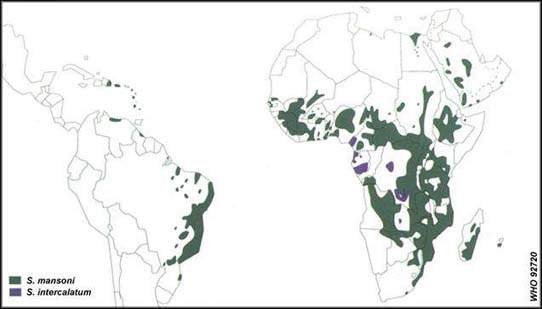
Slide A.3 Global distribution of
schistosomiasis: S. mansoni and S. intercalatum in Africa and the
Americas
Schistosoma mansoni is widely distributed in sub-Saharan Africa. It also occurs among populations of the South American Atlantic coast and on a number of Caribbean islands, where it was introduced through the slave trade. Other foci can be found in the Nile delta in Egypt and in Saudi Arabia.
A.4 Global distribution of schistosomiasis: S. haematobium, S. japonicum and S. mekongi in Africa and Asia

Slide A.4 Global distribution of
schistosomiasis: S. haematobium, S. japonicum and S. mekongi in
Africa and Asia
The distribution of Schistosoma haematobium is also mainly sub-Saharan, but there are important foci in the Nile Valley, in other North African countries and in the Middle East. Schistosoma japonicum is the parasite species occurring in eastern Asia, in China and the Philippines.
The example of Ethiopia clearly shows how environmental conditions determine the distribution of the snail intermediate hosts and of the infection: in the Awash Valley, Schistosoma mansoni is found at the higher altitudes (the upper valley) where the intermediate host, Biomphalaria pfeifferi profusely breeds in tertiary and drainage canals of the sugar estates. Intestinal schistosomiasis has been reported in these irrigated areas since the mid 1960s. Schistosoma haematobium, causing urinary schistosomiasis, occurs in the middle and lower valley (where average temperatures are higher) where the intermediate snail host Bulinus abyssinicus breeds in the clear marshy waters of swamps in undeveloped flood plains.
Human migration patterns have been of prime importance in the spread of schistosomiasis in Ethiopia and elsewhere. Health records show that before the development of sugar estates, prevalence was limited to the provinces of Harar, Tigray and the Lake Tana Basins of Gojjan and Gondar. Agricultural development attracted people from these areas, including people infected with the parasite. The newly created snail habitats in the irrigation schemes provided fertile grounds for the local transmission of the disease to take off. The droughts of the early 1980s caused further demographic change, including a massive move of people from the endemic areas in Wello and Tigray to the irrigation schemes of the Middle Awash Valley.
References:
Kloos, H. 1985. Water resources development and schistosomiasis ecology in the Awash Valley, Ethiopia. Soc. Sci. Med. 20: 609-625
Meskal, F.H., Woldemichael, T., and Lakew, M. 1985. Endemicity of urinary schistosomiasis in Entadoyta village, Gewane flood plain, Eastern Ethiopia. Ethiop. Med. J.23: 107-115
Roundy, R.W. 1978. A model for combining human behavior and disease ecology to assess disease hazard in a community: rural Ethiopia as a model. Soc. Sci. Med. 12D: 121-130
A.5 Children infected with schistosomiasis

Slide A.5 Children infected with
schistosomiasis
Among the clinical symptoms of intestinal schistosomiasis is severe enlargement of the liver and spleen. This and intestinal involvement are the main public health impacts due to chronic infection. In areas of low prevalence severe clinical features are seen in a relatively small proportion of patients. Symptoms such as abdominal pain, bloody diarrhoea and fatigue are reported by infected people in high-prevalence localities.
Fibrosis of the liver and portal hypertension may be life threatening and are irreversible in advanced disease. The enlargement of the liver in childhood has been correlated with the intensity of the infection.
Reference:
WHO, 1993. The control of schistosomiasis. Second Report of the WHO Expert Committee, World Health Organization, Geneva
A.6 Global distribution of malaria

Slide A.6 Global distribution of
malaria
A.7 Number of malaria cases reported by WHO Region
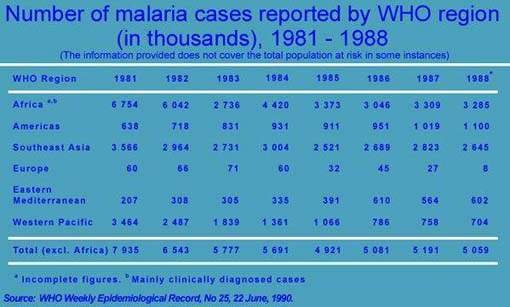
Slide A.7 Number of malaria cases
reported by WHO Region
With respect to the global distribution of malaria, several issues should be borne in mind:
· the distribution map indicates risk and does not indicate intensity of transmission. Malaria has a patchiness in time and location, except in the so-called holo-endemic and hyper-endemic areas (epidemiological terms relating transmission intensity to clinical patterns) of sub-Saharan Africa.· the majority of malaria cases in the world (90%) occur in sub-Saharan Africa
· the map does not distinguish between the various parasite species, the most important of which are the virulent Plasmodium falciparum and the more benign P. vivax. The latter predominates in the Eastern Mediterranean and in South Asia, even though the proportion of P. falciparum cases in the latter area is increasing.
· the map does not indicate the problems of drug resistant Plasmodium falciparum, spreading in South East Asia and in Africa
· malaria was successfully eradicated from Europe, parts of the Eastern Mediterranean, parts of North, Central and South America, and parts of the Western Pacific, mainly through the spraying of residual insecticides. These were without exception areas of unstable vivax malaria.
· current important malaria foci are associated with areas of rapid economic development, with demographic and environmental change, and areas characterized by civil strife or refugee problems. Urban malaria is gaining importance.
A.8 Girl suffering from malaria, the Gambia

Slide A.8 Girl suffering from
malaria, the Gambia
The clinical symptoms of malaria are reasonably clear, but the underlying pathology complex. The traditional fever and headache syndrome is related to the breakdown of parasitized red blood cells and the release of the parasites waste products in the blood stream are accompanied by liver and spleen enlargement and anemia. With a high concentration of parasites in the circulation, the P. falciparum feature of parasites clumping together in the small blood vessels of brain may cause severe cerebral malaria, which can be fatal in a matter of 24 hours.
The great majority of fatalities caused by malaria is among under five year olds in sub-Saharan Africa (rough estimates come to the figure of 1 million deaths a year); pregnant women are another vulnerable group; and migrants from non-malarious (usually high-altitude) areas moving into new development schemes (particularly irrigation schemes) make up a third important group.
Attribution of malaria transmission to a single environmental or behavioural factor is impossible. Moreover, malaria being a disease of poverty, it is usually part of a conglomerate of illnesses, including diarrhoeal diseases, malnutrition and other parasitic infections.
A.9 Distribution of yellow fever in Africa

Slide A.9 Distribution of yellow
fever in
Africa
A.10 Distribution of yellow fever in the Americas

Slide A.10 Distribution of yellow
fever in the Americas
The incidence of yellow fever is highest in parts of western Africa, including Ghana, Nigeria and adjacent countries, and in northern South America, especially Peru, Bolivia and Brazil. Rural populations are at greatest risk, with most cases occurring among young adult males who enter the forests as part of their work.
Reference:
WHO, 1996. The world health report. Fighting disease, fostering development, World Health Organization, Geneva
A.11 Distribution of lymphatic filariasis in Africa and the Americas (WHO map 92353)

Slide A.11 Distribution of
lymphatic filariasis in Africa and the Americas (WHO map
92353)
A.12 Distribution of lymphatic filariasis in Asia (WHO map 92354)

Slide A.12 Distribution of
lymphatic filariasis in Asia (WHO map 92354)
The group of filariases includes all those infections caused by parasitic filarial worms belonging to the species Wuchereria bancrofti, Brugia malayi and Onchocerca volvulus. Distribution of the disease caused by the infection with the latter, river blindness, is covered in slide A.13. The other two infections will both lead to the well-known clinical picture called elephantiasis.
In urban areas and in some of the rural areas of Asia the distribution of W. bancrofti is linked to the distribution of Culex quinquefasciatus, which breeds in organically polluted water. In Sri Lanka, in addition to the conventional breeding in open sewers and other stagnant water bodies with organic waste, the practice of obtaining coconut fiber by letting the coconut husks rot in water collections (so-called coconut husk pits) contributes importantly to the distribution of the disease along the coastal belt of the island south of Colombo. In rural Africa, anophelines are responsible for the transmission of this parasite. On the islands of the South Pacific a special form of W. bancrofti occurs which has a life cycle adapted to the biting pattern of its vector, Aedes polynesiensis. This vector takes its blood meal during the day-time (as opposed to dusk or night-time biting by the other vector mentioned). This Aedes species breeds profusely in standing water in open coconut shells.
Brugia malayi is transmitted by Mansonia mosquitoes, which have the peculiarity that their larval stage lives under water, taking oxygen from the roots of aquatic weeds. The distribution of the disease is therefore partly related to man-made reservoirs where such weeds have taken over.
A.13 Distribution of onchocerciasis in Africa, with an indication of the area covered by OCP (WHO map 94910)

Slide A.13 Distribution of
onchocerciasis in Africa, with an indication of the area covered by OCP (WHO map
94910)
A.14 Distribution of onchocerciasis in the Americas (WHO map 94911)
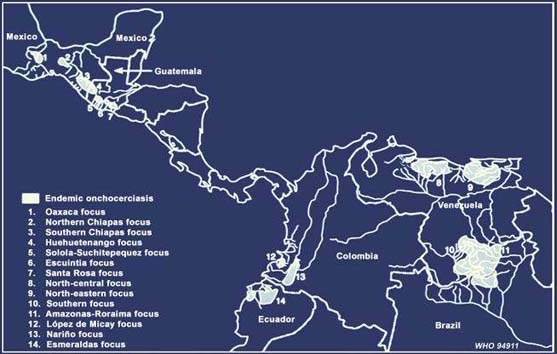
Slide A.14 Distribution of
onchocerciasis in the Americas (WHO map 94911)
Onchocerciasis or river blindness has a distribution both in Africa and Central and South America that is immediately linked to the preferred breeding conditions of the Simulium blackfly vector. The blackfly larvae develop attached to rocks in fast running parts of rivers, including rapids, where water is highly oxygenated. Intense disease transmission therefore occurs among communities in the river valleys. The adult fly can, however, migrate over large distances (hundreds of kilometers) using favourable winds.
The Onchocerciasis Control Programme, at its onset in 1974 WHO’S single largest vector control operation, has eliminated the disease from a large part of West Africa (11 countries), as indicated in the map. Initially strictly a vector control operation, using insecticide release upstream from breeding places, in recent years these efforts have been backed up by the distribution of the drug Ivermectin. In January 1996 the African Programme for Onchocerciasis control became operational, aimed to expand the OCP operations to cover the entire distribution area of the disease in Africa. Elimination of the disease as a public health hazard is targeted by 2002. The World Bank and a consortium of bilateral donors continue to support these efforts.
A.15 A victim of river blindness (onchocerciasis)

Slide A.15 A victim of river
blindness (onchocerciasis)
Long-term exposure to the infected bites of blackflies causes blindness. In the most endemic areas in Africa, where OCP started its work, it was a common phenomenon to have the majority of community members being guided by the younger members who could still see. Blindness is a result of the microfilaria load, affecting the skin and the eyes. Microfilaria are the larvae of Onchocerca volvulus living in the bloodstream of the victims.
A.16 Aerial view of an abandoned village in an area affected by onchocerciasis in West Africa

Slide A.16 Aerial view of an
abandoned village in an area affected by onchocerciasis in West Africa
The socioeconomic impact of onchocerciasis has been devastating for the endemic countries. The transmission intensity was highest in the fertile river valleys where many villages were abandoned by their inhabitants. The prospect of blindness on the long-term contributed as much to this migration as the acute nuisance of clouds of blackflies in search for a blood meal. The potential for agricultural development in these valleys is enormous and FAO, in collaboration with the World Bank, is monitoring the re-migration of people and the expansion of agricultural production. Remote sensing is applied to carry out this monitoring over large areas.
A.17 Distribution of Old World and New World visceral leishmaniasis (WHO map 89963)

Slide A.17 Distribution of Old
World and New World visceral leishmaniasis (WHO map
89963)
A.18 Distribution of cutaneous and muco-cutaneous leishmaniasis in the New World (WHO map 891104)

Slide A.18 Distribution of
cutaneous and muco-cutaneous leishmaniasis in the New World (WHO map
891104)
A.19 Distribution of cutaneous leishmaniasis due to L. tropica and L. aethiopica in the Old World (WHO map 89962)
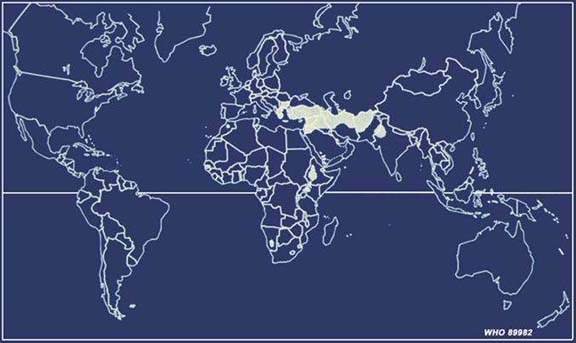
Slide A.19 Distribution of
cutaneous leishmaniasis due to L. tropica and L. aethiopica in the
Old World (WHO map
89962)
A.20 Distribution of cutaneous leishmaniasis due to L. major in the Old World (WHO map 891105)

Slide A.20 Distribution of
cutaneous leishmaniasis due to L. major in the Old World (WHO map
891105)
Both vectors and animal reservoirs determine the distribution of the range of leishmaniases in the world. Even for specialists in this field the picture is complex. A first distinction that clarifies the epidemiology is that between the visceral and the cutaneous forms of the disease. In the visceral disease form (known as Kala-azar) the Leishmania parasite affects the internal organs and the disease is very likely to have a fatal ending if not treated. An arid, warm environment provides the ideal ecological conditions for the breeding of many species of sandflies. In the Old World these are sandflies of the genus Plebotomus, in the New World of the genus Lutzomyia.
Kala-azar is commonly associated with dry, rocky hill country. In Kenya, sandflies live and breed near large termite hills, where they become infected biting rodents living in the holes of these hills. Dogs, wild carnivores and various species of rodents are commonly infected, and this zoonosis (a human disease with an animal reservoir) is therefore linked to certain types of vegetation or certain agricultural practices that affect especially the rodent populations.
Old world cutaneous leishmaniasis is also a zoonosis occurring in scattered foci throughout the tropical and sub-tropical belts. It is known by different local names: Oriental sore, Aleppo button, Baghdad boil or Delhi sore. Arid or even semi-desert terrain provides ideal habitats for the vector sandflies which spend the days in cool deep crevices in the ground, between rocks, in caves, cellars and house walls.
The association with the ecology of reservoir animals holds a key to the control of the disease. In Uzbekistan, large scale land-levelling works destroyed the burrow of the local reservoir rodents species (the great gerbil, Rhombomys opimus), thus interrupting the transmission. On the other hand, in one country in North Africa, a policy to settle nomadic tribes caused a chain reaction leading to an outbreak of the disease: the nomadic lifestyle ensured that a large camel population kept a desert type vegetation under control - when this stopped, the rodent population also living on this vegetation exploded and with it the sandfly population, creating a situation where conditions for disease transmission to humans were optimal. In Ethiopia, rock hyraxes are the main reservoir of the parasite.
In the New World, cutaneous and mucocutaneous forms of the disease exist, again known by various local names: espundia in the Amazon region, papalomoyo in Central America and pian bois in the Guyanas. The Lutzomyia vectors live in the forests, feeding on forest rodents such as Proechimys guyanensis, and also on monkeys and sloths, all of which serve as reservoirs. Those working in the forests such as gum-tappers (chicleros) are readily exposed to infection. The conditions in some plantations such as coffee, are conducive to vector breeding and people working in these agro-ecosystems are equally at risk. In 1995 the UNDP/World Bank/WHO Special Programme on Research and Training in Tropical Diseases funded research in Colombia to investigate the risk levels associated with different coffee varieties creating different ecological conditions.
A.21 A case of cutaneous leishmaniasis

Slide A.21 A case of cutaneous
leishmaniasis
A.22 A case of cutaneous leishmaniasis

Slide A.22 A case of cutaneous
leishmaniasis
A.23 Oriental sore (cutaneous leishmaniasis in the Eastern Mediterranean)

Slide A.23 Oriental sore
(cutaneous leishmaniasis in the Eastern Mediterranean)
The lesions caused by cutaneous leishmaniasis are frequently on the face, but sometimes also reveal other areas of the body exposed, for instance, in agricultural work. In terms of direct impact on production, the cost of visceral leishmaniasis is considerable. However, the social cost of the skin lesions caused by cutaneous leishmaniasis may also be considerable, certainly so in cultural settings where marriage has a strong economic component (dowries etc.). In the Americas, mucocutanous infections are a risk for those who go into the forest for their livelihood.
A.24 Distribution of Japanese encephalitis cases by endemic country over the period 1986-1990
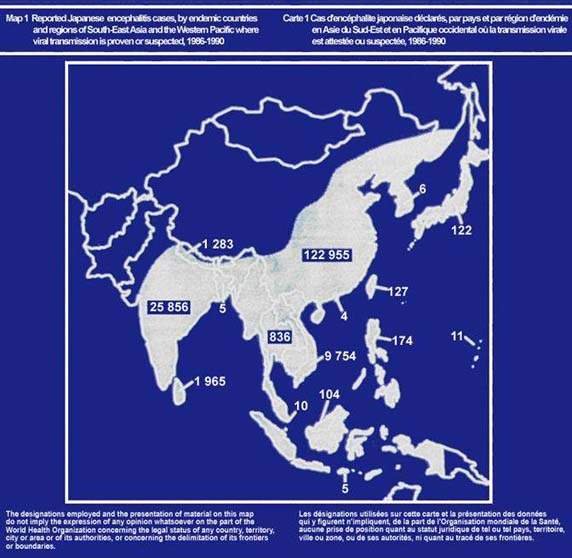
Slide A.24 Distribution of
Japanese encephalitis cases by endemic country over the period 1986-1990
The distribution of Japanese encephalitis provides an interesting example of “landscape epidemiology”. The virus causing the disease (referred to as brain fever in some of the endemic areas) normally circulates among certain domestic animals and birds such as egrets and herons, in the rice producing parts of South, South-East and East Asia. The culicine vectors are all species breeding in irrigated rice fields (especially at the early stages of flooding, before the rice plants have developed into a canopy).
Pigs are the key amplifying host of the virus, hence the disease is not found in muslim countries like Bangladesh, or in Malaysia, where pig rearing by the Chinese population and rice production by the Malays are geographically separated.
The migratory birds play a role in distributing the virus over larger distances. Recent changes in rice production (expansion of areas under irrigation, introduction of rice varieties allowing double or triple cropping) have been conducive to outbreaks of the disease.
Under favourable conditions, the rapid build-up of the vector population causes the virus to “spill over” into the human population - under stable conditions the mosquito species involved are zoophilic, i.e. they prefer taking their blood meals from animals.
The distribution of the disease has spread westwards in recent years, and it now borders with the distribution of West-Nile virus. The immunity to these two viruses show cross-reactivity so a further expansion westward of JE is not expected. In the industrialized countries of East Asia, the disease has been eliminated through extensive (and expensive!) vaccination campaigns of both humans and pigs.
A.25 Distribution of sleeping sickness foci in West and Central Africa

Slide A.25 Distribution of
sleeping sickness foci in West and Central
Africa
A.26 Distribution of sleeping sickness vectors Glossina morsitans and G. pallidipes in East and southern Africa

Slide A.26 Distribution of
sleeping sickness vectors Glossina morsitans and G. pallidipes in
East and southern
Africa
A.27 Distribution of sleeping sickness vectors G. palpalis, G. fuscipes and G. tachinoides in West Africa

Slide A.27 Distribution of
sleeping sickness vectors G. palpalis, G. fuscipes and G.
tachinoides in West Africa
Sleeping sickness occurs in the ecological setting where tsetse flies have their habitat. For the gambiense form of the disease, the Glossina species are riverine, requiring optimum shade and humidity. The contact between humans and flies is intimate when villagers congregate around pools or along rivers to collect water or to wash. In some areas, various Glossina species are sympatric, i.e. the distribution of different species largely overlaps. In such situations the control of one species often leads to the other species filling the ecological niches left by the eliminated population. Rhodesiense trypanosomiasis occurs in scrub savannah country because the Glossina vectors are less dependent on moisture. In this environment, wild and domestic animals provide good sources for blood meals.
A.28 An example of sleeping sickness vector ecology in southern Africa

Slide A.28 An example of sleeping
sickness vector ecology in southern Africa
Semi-arid areas with scrub vegetation, such as shown here, provide an excellent habitat for the vector of rhodesian sleeping sickness. In the past, control efforts in southern Africa aimed at destroying the tsetse fly habitat and killing game animals that serve as a reservoir for the trypanosomes. This approach can, however, no longer be reconciled with conservation interests and is certainly not a sustainable solution.
|
| ||||||||||||||||||||||||||||||||||||||||||||||||||||||||||||||||||||||
Agricultural Development and Vector-Borne Diseases (FAO - HABITAT - UNEP - WHO, 1996, 91 p.)
Topic B: Relevant disease vectors
List of slides
B.1 Principal genera of aquatic snails and the form of schistosomiasis they transmit
B.2 Shells of various snail intermediate hosts of schistosomiasis
B.3 The life cycle of schistosome parasites
B.4 Mosquitoes and the diseases they transmit
B.5 Mosquito life cycle
B.6 Anopheles gambiae, feeding
B.7 Sandfly, feeding
B.8 Blackfly, feeding
B.9 Blackfly larvae
B.10 Tsetse fly
B.11 Tsetse fly with its riverine ecology in West Africa
Credit individual slides:
World Health Organization
B.1, B.3, B.4, B.5, B.6, B.7, B.8, B.9
Danish Bilharziasis Laboratory
B.2
Agricultural University Wageningen, Netherlands
B.9, B.10
B.1 Principal genera of aquatic snails and the form of schistosomiasis they transmit
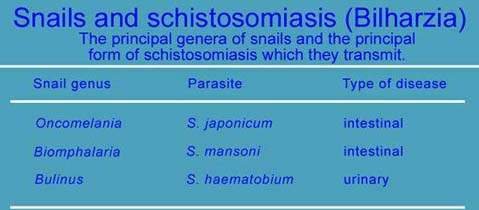
Slide B.1 Principal genera of
aquatic snails and the form of schistosomiasis they transmit
The three snail genera, Biomphalaria, Bulinus and Oncomelania each transmit a different species of Schistosoma. Apparently, within this system there is also a great deal of parasite strain specificity for snail species. Oncomelania snails are amphibious, and therefore environmental risk factors for japonicum schistosomiasis differ markedly from those of the other parasite species, whose intermediate hosts are strictly aquatic, even though they survive periods of drought for periods up to twelve months, a phenomenon known as aestivation.
Snail intermediate hosts of Schistosoma haematobium and S. mansoni are remarkably tolerant in terms of physical and chemical conditions. Sunlight and relatively high water temperatures put stress on the snail populations because bacterial decomposition processes may result in reduced oxygen tension.
In the context of irrigation schemes, stream velocities in canals are considered a crucial issue in relation to schistosomiasis transmission. Aquatic weeds slow down the stream velocity and they also provide a substrate for snail populations. Research by professor Martin Fritsch has given further insight into the hydraulic characteristics related to stream velocity. The impact of flushing canals on snail populations is not based on the drag force effect, but rather on turbulent and fleeting, short-lasting shear stresses along the transition zone of various embankment vegetation and river bed sediments.
Reference:
Fritsch, M., 1993. Environmental management for schistosomiasis control - river flushing, a case study in Namwawala, Kilombero District, Tanzania. Verlag der Fachvereine, Zurich, Switzerland
B.2 Shells of various snail intermediate hosts of schistosomiasis
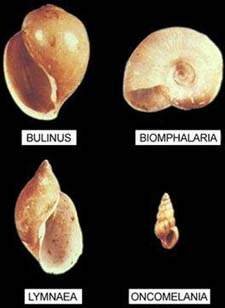
Slide B.2 Shells of various snail
intermediate hosts of schistosomiasis
Shells are important for the determination of snail species. This is the work of a malacologist. The Danish Bilharziasis Laboratory in Charlottenlund, Denmark, is the global authority for species identification. To many non-specialists the size of the snail intermediate hosts comes as a surprise. The maximum length of the elongated Bulinus shells is 20-22 mm, while the flat Biomphalaria shells have a maximum diameter of 13-17 mm. One snail can daily shed between 1000 and 1500 of cercariae (the infective larvae of the Schistosoma parasite) and snail colonies themselves can be very sizable. The snails serve as prey to certain fish and to other, predator snails. Such predators have been used as biological control agents, with different levels of success. Fish that live of aquatic weeds have been used for the same purpose, because the destruction of the snail habitat can also contribute significantly to a reduction of transmission risks under specific circumstances.
Danish Bilharziasis Laboratory, Jaegersborg Alle 1 D, 2920 Charlottenlund, Denmark
B.3 The life cycle of schistosome parasites

Slide B.3 The life cycle of
schistosome parasites
The life cycle of the Schistosoma parasite is complex, and involves various transformations, adapting the parasites to different micro-environments. The adult parasites, belonging to the group of trematodes (flukes), live as male/female pairs in the bloodstream of humans, either in the blood vessels of the mesenteric plexus surrounding the large intestine (S. mansoni and S. japonicum) or of the venous plexus of the bladder (S. haematobium and S. intercalatum).
The eggs they produce have to pass through the tissue to reach the intestinal tract or me bladder. In this process they cause damage, and many eggs get trapped and calcify - the accumulated effect is what causes the illness. Eggs leave the body of their host with either feces or urine.
In fresh water the eggs hatches and a free-living larval stage, called miracidium, starts its search for an appropriate intermediate snail host. In an internal organ of the snail (equivalent to the liver and pancreas combined) the miracidium transforms into a cercaria (the infective larval stage) in about a month.
The shedded cercariae will attach to and penetrate the skin of humans in touch with water and once in the human bloodstream the larva will reach its final destination (described above) via a complicated route, while undergoing a transformation into an adult worm.
While the details of the life cycle are the domain of parasitologists, the non-expert working in the area of agricultural development should remember the two crucial stages in the Life cycle where he/she can exert influence:
The sanitation aspect: if communities have adequate sanitation and permanent health education keeps them aware of the need to use this sanitation and to teach their children to use it, then contamination of water bodies can be minimized.
The water contact aspect: if communities have access to safe water (for drinking and for laundry) then (re-)infection can be avoided. Children and adolescents will always remain a vulnerable group and deserve special monitoring and treatment Men and women working in irrigated agricultural production are also at risk, depending on their water contact patterns, and need special attention, as well.
B.4 Mosquitoes and the diseases they transmit

Slide B.4 Mosquitoes and the
diseases they transmit
Mosquitoes are cosmopolitan, but only a few genera are medically important and within these genera not all species are vectors. The capacity to transmit human diseases depends first and foremost on specific physiological characteristics and feeding behaviour. Most parasites undergo a transformation inside the vector and require compatibility (in molecular terms: matching receptors) and the correct micro-environment for their development Female mosquitoes take blood meals in order to develop eggs. With each blood meal the chances of obtaining an infection from a human host and passing it on to another is increasing, and life span or longevity is, therefore, another important parameter of the vectorial capacity of a mosquito species.
The introduction of irrigation in large areas may lead to an increase in the relative humidity and this may result in a longer average life span of mosquitoes. As a result, the transmission of, for instance, malaria may intensify significantly.
B.5 Mosquito life cycle

Slide B.5 Mosquito life cycle
Some clear differences between Anopheles and Culex mosquitoes include the shape of the so-called egg-raft (all mosquitoes lay their eggs in water), the position of the larvae in relation to the water surface (dependent on the position of the siphons through which the larvae breath) and the position of the adult female when taking a blood meal. The difference between anophelines and culicines is particularly important to identify malaria vectors: malaria is only transmitted by anophelines.
B.6 Anopheles gambiae, feeding

Slide B.6 Anopheles
gambiae,
feeding
B.7 Sandfly, feeding

Slide B.7 Sandfly,
feeding
B.8 Blackfly, feeding

Slide B.8 Blackfly, feeding
Adult insects taking a blood meal: an Anopheles mosquito, a Phlebotomus sandfly and a Simulium blackfly, respectively.
At the start of the blood meal, the insect will inject an anticoagulant from its salivary glands into the host on which it feeds. If previously infected by another blood meal, the infective parasite larvae will be injected with the saliva into the hosts bloodstream. Not all parasites pass through a transformation inside the vector and remain in the salivary glands: filarial parasites are attached to the so-called proboscis (the mouth-part penetrating the skin) and are therefore transmitted mechanically.
B.9 Blackfly larvae
Slide B.9 Blackfly larvae
The larvae of the blackfly (Simulium damnosum spp.) live attached to a substrate in the fast flowing parts of rivers, where they filter out particles for their nutrition.
In addition to their natural habitat (rapids, water falls etc), they can also colonize spillways of dams, and there is one documented case where they colonized an irrigation canal with high velocity water running through it.
B.10 Tsetse fly

Slide B.10 Tsetse
fly
B.11 Tsetse fly with its riverine ecology in West Africa
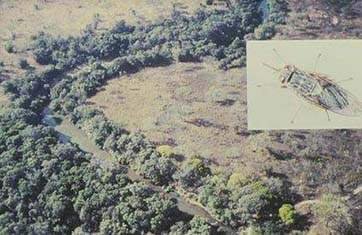
Slide B.11 Tsetse fly with its
riverine ecology in West Africa
Tsetse flies (genus Glossina) are relatively large, bloodsucking flies which are easily recognizable. Their reproduction requires a habitat of moist soil, where they produce one pupa at a time, which wriggles itself into the soil. The species transmitting gambian sleeping sickness live in the riverine forest zones and human-vector contact is associated with human water needs and uses.
|
| |||||||||||||||||||||||||||||||||||||||||||||||||||||||||||||||||||||||||||||||||||||||||||||||||||||||||||||||||||||||||||||||||||||||
Agricultural Development and Vector-Borne Diseases (FAO - HABITAT - UNEP - WHO, 1996, 91 p.)
Topic C: Vector habitats
List of slides
C.1 Principal vector-borne diseases in relation to principal vector habitats.
C.2 The association between vectors, diseases and water
C.3 Main animal reservoirs of vector-borne diseases in humans
C.4 Snail habitats
C.5 The environment of freshwater snails
C.6 Food of freshwater, pulmonate snails
C.7 Snail habitats: a shallow well in the Gizan area of Saudi Arabia
C.8 Snail habitats: a concrete irrigation basin, Gizan area of Saudi Arabia
C.9 Snail habitats: drainage canal, Nakambala Sugar Estate, Zambia
C.10 Snail habitats: a burrow pit in the Kisumu area of western Kenya
C.11 Malaria vector species and their ecological requirements; a transsect of the Malaysian peninsula
C.12 Malaria vector habitats: coastal lagoons with brackish water (Anopheles sundaicus) in Malaysia
C.13 Malaria vector habitats: Anopheles balabacensis breeding places in temporary forest pools in Indonesia
C.14 Malaria vector habitats: Anopheles maculatus breeding places in rice growing areas in Nepal
C.15 Malaria vector habitats: irrigated rice fields, Office du Niger, in Mali, where a succession of species breeds
C.16 Malaria vector habitats: Anopheles gambiae breeding in exposed pools
C.17 Malaria vector habitats: Anopheles gambiae breeding rooftop tanks, Mauritius
C.18 Malaria vector habitats: Anopheles arabiensis breeding sites in desert areas
C.19 Natural habitat suited to the breeding of simuliid black flies
C.20 Landscape typifying sandfly habitat in South-West France
C.21 Landscape typifying sandfly habitat in central Kenya
C.22 Landscape typifying sandfly habitat in the arid, northern Kenya (termite mound)
C.23 Rodent burrow system as a sandfly habitat in Uzbekistan (Rhombomys colony)
C.24 Sandfly vector habitat in the domestic environment, Colombia
Credit individual slides:
World Health Organization: all
C.1 Principal vector-borne diseases in relation to principal vector habitats.

Slide C.1 Principal vector-borne
diseases in relation to principal vector
habitats.
C.2 The association between vectors, diseases and water

Slide C.2 The association between
vectors, diseases and
water
C.3 Main animal reservoirs of vector-borne diseases in humans

Slide C.3 Main animal reservoirs
of vector-borne diseases in humans
These three matrices provide a complete picture of the associations between eco-zones, vectors and diseases. This is a general picture. The local situation will be defined by micro-habitats and micro-climates, and the intensity of associations will vary over time in relation to the weather and, for instance, the cropping cycle. An assessment of the local situation always requires an epidemiologist and a vector specialists knowledgeable of local disease patterns and the ecology and biology of local vectors.
The matrices are designed to facilitate a rapid health impact assessment of water resources development projects and are published in PEEM guidelines no. 2.
C.4 Snail habitats
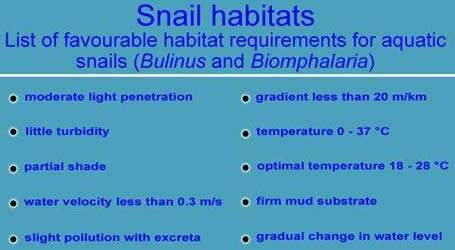
Slide C.4 Snail
habitats
C.5 The environment of freshwater snails
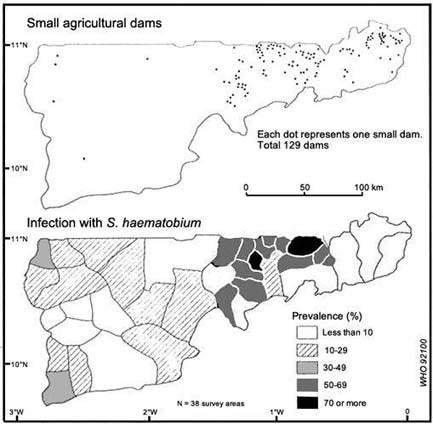
Slide C.5 The environment of
freshwater snails
Many large dams were constructed and reservoirs created in the 1960s and 1970s in Africa. They invariably created health problems, amongst which schistosomiasis scored high, particularly in communities of fishermen on the shores of the new man-made lakes. Perhaps more insidious, however, are the thousands of small dams that have been built all over the continent in the face of droughts, the need for increased food production through small scale irrigation and the water needs of expanding livestock populations. Their cumulative effect on health is likely to be substantial, but has not been documented.
Small reservoirs provide the habitat requirements for snails as presented in these slides. Temperature, availability of organic material and aquatic vegetation that serves as a refuge are crucial components of the snail habitat
C.6 Food of freshwater, pulmonate snails
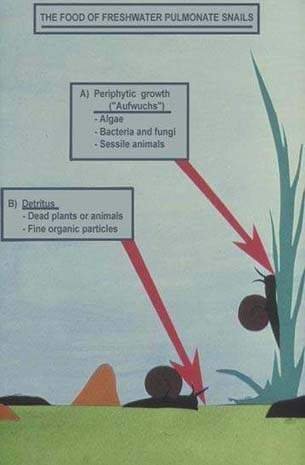
Slide C.6 Food of freshwater,
pulmonate snails
Snails need a substrate (soil or vegetation) from where to scrape of organic matter for their nutrition. For more detailed information on the feeding behaviour of snails, reference is made to specialist literature (see bibliography).
C.7 Snail habitats: a shallow well in the Gizan area of Saudi Arabia

Slide C.7 Snail habitats: a
shallow well in the Gizan area of Saudi
Arabia
C.8 Snail habitats: a concrete irrigation basin, Gizan area of Saudi Arabia

Slide C.8 Snail habitats: a
concrete irrigation basin, Gizan area of Saudi
Arabia
C.9 Snail habitats: drainage canal, Nakambala Sugar Estate, Zambia
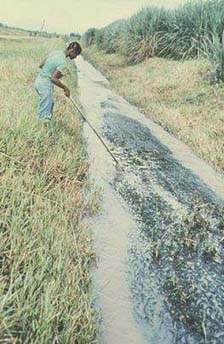
Slide C.9 Snail habitats: drainage
canal, Nakambala Sugar Estate,
Zambia
C.10 Snail habitats: a burrow pit in the Kisumu area of western Kenya
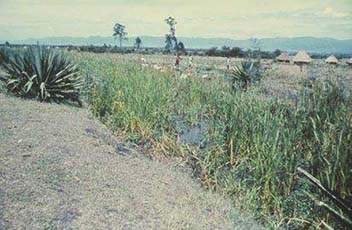
Slide C.10 Snail habitats: a
burrow pit in the Kisumu area of western Kenya
In all these locations snail species have been found that can serve as intermediate hosts for schistosomiasis. However, this only indicates the hazard or potential risk. Other elements need to be present to establish transmission: contamination of the aquatic environment with parasite eggs in either urine or feces of human origin; and, regular water contact by people with the contaminated water. Shallow wells are unlikely to be contaminated because local customs usually aim at protecting them. Irrigation basins and other concrete hydraulic structures, on the other hand, frequently become a site where children bathe and swim (and, possibly, urinate or defecate) and where transmission can be intense. They may, at the same time serve as laundry place, where women have intense water contact. Drainage canals in irrigation schemes tend to have more aquatic weed growth then irrigation canals. In the system’s run-off water natural minerals as well as excess fertilizer will provide more than sufficient nutrition for such vegetation. Burrow pits, places where soil is removed for construction purposes, become large aquaria where snail populations can thrive in stagnant water. Along new roads or near new settlements, such water collections can become important transmission sites as well as sources of nuisance or vector mosquitoes. On a larger scale, night storage dams in irrigation schemes can become important transmission sites for schistosomiasis.
C.11 Malaria vector species and their ecological requirements; a transsect of the Malaysian peninsula
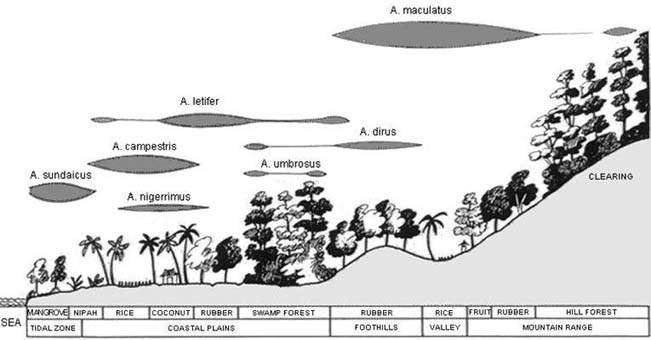
Slide C.11 Malaria vector species
and their ecological requirements; a transsect of the Malaysian peninsula
The situation in Malaysia proved ideal for the development of early environmental management approaches and the following section taken from the publication of Takken et al. (1991, see bibliography) gives a complete summary of this:
Species sanitationWhen in 1897 Ross published his findings on the development of Plasmodium inside the mosquito, and it was subsequently demonstrated that mosquitoes of the genus Anopheles were responsible for the transmission of malaria, it was soon realized that changing the aquatic habitat of the vectors would automatically lead to interruption of malaria transmission. The most well known example of this method is the drainage of the marshes near Rome, Italy. Malaria control through habitat modification was at that time also attempted in Indonesia by filling small water bodies with soil, especially dose to areas of human habitation. In Malaysia, Watson (1911) experimented with the selective elimination of one species, Anopheles umbrosus, which had been incriminated as the principal malaria vector in a lowland area. Watson had previously found that not all the anopheline species in the area were responsible for malaria transmission and ha had also found that these mosquitoes were often restricted to a specialized breeding habitat (the same would be discovered by Jennings in Central America in 1912). Through the selective clearing of wooded habitat, the shade loving A. umbrosus was being exposed to the sun and subsequently disappeared. The previously widely present malaria went with it. This proved to be an economical method of malaria control: by identifying the most important vector and the subsequent study of its biology and ecology, malaria control had been achieved without having to eliminate all anopheline species present.
Watson discussed his findings with Swellengrebel on Sumatra (Indonesia) in 1913. The latter became deeply interested in this method and called it species sanitation. This is the term with which we still identify the method today. It is defined as a naturalistic approach to vector control, directed against the main vectors, through modification of the habitat in such a way that the vectors avoid these areas. The method requires a study of the characteristic breeding habits of the main vectors and of the type of water in which they lay their eggs. Control is mostly directed against larval stages, but sometimes adults can be included as well. Species sanitation has the advantage over general sanitation that often only one of a complex of several Anopheles species needs to be attacked.
(From: Takken, W., et al., 1991. Environmental measures for malaria control in Indonesia, chapter 2, without quoting further references).
Regrettably, this situation with clearly identifiable micro-habitats for different vector species is not common. The vector species in Africa, for instance, are much more versatile and adaptable in terms of habitat requirements, and species sanitation has therefore only had a restricted application under very specific conditions.
C.12 Malaria vector habitats: coastal lagoons with brackish water (Anopheles sundaicus) in Malaysia
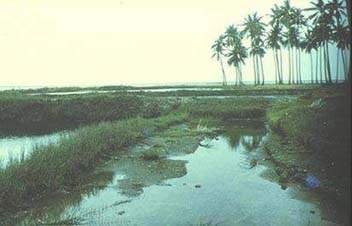
Slide C.12 Malaria vector
habitats: coastal lagoons with brackish water (Anopheles sundaicus) in
Malaysia
Some malaria vectors (Anopheles sundaicus with a distribution from the East coast of India to Viet Nam and the Indonesian islands; A. albimanus on the Pacific coast of Central America) require a brackish water environment for their larval stages. Managing the water flows in mangrove areas and estuaries to ensure that salt levels are maintained outside of the range needed by these species help to keep vector populations down. A lot of work was done in the Dutch East Indies, present-day Indonesia, in the 1930s, in connection with ponds for shrimp culture. Work in El Salvador (Ticuiziapa Estero) by Frederickson in 1986-1987 (as part of the USAID Vector Biology and Control Project) demonstrated that environmental management (removal of a sand bar, allowing the drainage of water from the estuary at low tide, and blocking the influx of sea water at high tide) can provide a lasting solution to malaria transmission.
Reports of the Vector Biology and Control Project, including the reports on the environmental management activities, belong to the grey literature. Information can, however, be obtained from the PEEM Secretariat, WHO, Geneva, Switzerland, where a full set of these reports is available.
C.13 Malaria vector habitats: Anopheles balabacensis breeding places in temporary forest pools in Indonesia
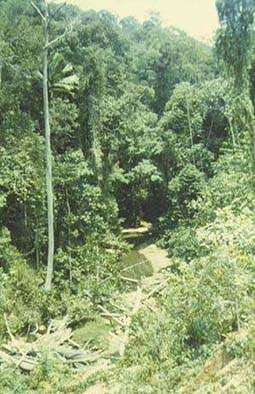
Slide C.13 Malaria vector
habitats: Anopheles balabacensis breeding places in temporary forest
pools in Indonesia
In South-East Asia and the archipelagos of Indonesia and part of the Philippines the most important vectors belong to the Anopheles dirus species complex or to the Anopheles balabacensis species. Tropical forests provide the essential habitat for these vectors, where they breed in small pools and other water collections in the vegetation, and where a high relative humidity creates favourable conditions for extended longevity. As a result, they are efficient vectors and maintain transmission amongst those workers who depend on the forest for their livelihood. Their role in the transmission of malaria in the forested border areas of Thailand with Myanmar and Cambodia is notorious.
Wherever deforestation occurs, transmission by these anophelines immediately declines. Re-afforestation and the introduction of plantations of rubber or fruit trees recreates the appropriate environment Moreover, the exploitation of plantations requires more humans to be exposed to the transmission risks or contributing to the transmission cycle. Often, the work in plantations requires people to be exposed to mosquito bites at the peak biting times.
In Indonesia, Anopheles balabacensis may be sympatric with other malaria vectors. In Central Java, for instance, a persistent focus of malaria was attributed to the rice field breeding A. aconitus. In this area of Banjarnegara residency, however, the local fruit salak is grown in plantations and fruit collectors work at night to get the fruit to the markets early morning. Research by the Vector Control Research Station in Salatiga (Director: Dr Sustriayu Nalim) indicated that malaria transmission occurs in the forested environment by A. balabacensis.
In resettlement projects, those communities living on the forest fringe are often at double risk. They will to some extent depend on forest products and will therefore be exposed to transmission risks by A. dirus, and at the same time they may be at risk of disease transmission associated with their agricultural activities or their settlements. Forest fringe rice growers in Thailand may therefore be at an increased risk of malaria and of Japanese encephalitis.
C.14 Malaria vector habitats: Anopheles maculatus breeding places in rice growing areas in Nepal

Slide C.14 Malaria vector
habitats: Anopheles maculatus breeding places in rice growing areas in
Nepal
C.15 Malaria vector habitats: irrigated rice fields, Office du Niger, in Mali, where a succession of species breeds

Slide C.15 Malaria vector
habitats: irrigated rice fields, Office du Niger, in Mali, where a succession of
species breeds
Irrigated rice fields make up the largest man-made wetlands environment in the world. Of the 150 million hectares of the global harvested rice area, about 77 million hectares are irrigated; of the total hectarage, 95% can be found in developing countries.
A flooded rice field is an agroecosystem that is frequently disturbed by farming practices, i.e. tillages, irrigation, fertilization, crop establishment and weeding, as well as by natural phenomena such as rainfall and flooding, which result in extreme instability on a short time scale during the crop cycle, but relative stability on a long time scale.
Flooded rice fields are eutrophic systems with exceedingly high recycling rates of nutrients and energy, as exemplified by the rapid succession of algae. The ecology of rice environments exhibits enormous spatial variation due to extremes in climatic, soil and hydrological conditions under which the crop is grown. The predominant role of water depth and dependability of the flooding regime in delineating rice environments is well recognized. Current terminology considers five dominant environments based on the maximum sustained depth of water in the field:
· irrigated with controlled shallow water depth (5-10 cm)
· rainfed lowland, with uncontrolled shallow water depth (1-50 cm)
· deep water, with maximum sustained depths from 50 to 100 cm
· very deep water, more than 100 cm deep, and
· upland, with no surface flooding
The association between irrigated rice production systems and vector-borne diseases is the subject of extensive literature. In general, Asian rice fields may breed very specific species in well defined areas. These include Anopheles culicifacies in India, A. aconitus in Indonesia and A. maculatus in Nepal. In terms of health impact, however, none of these vectors can compete with the forest breeding A. dirus group. Also, technically, a clear distinction should be made between those vectors that exclusively breed in rice fields and those that breed in irrigation schemes at large, including ancillary structures such as irrigation or drainage canals.
Slide C.14 shows ideal conditions for the breeding of A. maculatus in Nepal, where rice is grown on irrigated hillsides, providing many small pools and seepages. When the paddy is flooded, cattle may be taken to pasture elsewhere, thus reducing the availability of animals as a source of blood meals. This, in turn, may cause the so-called anthropophilic index to rise, i.e. higher proportions of mosquitoes will bite humans instead of cattle. These events will coincide with the time of the year when rainy and warm weather gives rise to higher densities of A. maculatus. Malaria transmission is likely to increase due to a combination of these conditions.
In Africa, the range of breeding habitats of the A. gambiae complex is so broad and transmission so intense that it is hard to determine to which proportion malaria can be attributed to irrigated rice production systems. Extensive research by Lindsay in the Gambia, by Carnevale in Burkina Faso and by Coosemans in Burundi has revealed more detailed information, but has also raised new questions. Unlike the Asian situation, in Africa mosquito density is not linearly correlated to transmission intensity - on the contrary, where irrigation development has led to an increase in the density of mosquito populations, transmission levels have frequently decreased.
In order to further clarify the various phenomena of irrigated rice associated malaria, the West Africa Rice Development Association, together with PEEM and IDRC/Canada, initiated, in 1995, a consortium research project on the association between irrigated rice production and vector-borne diseases in West Africa, with support from IDRC, DANIDA and the Government of Norway. The contact person is Dr Thomas Teuscher at WARDA in Bouak�, C�te d’Ivoire (see list of PEEM collaborating centres).
References
Amerasinghe, F.P., Amerasinghe, P.H., Malik Peiris, J.S. and Wirtz, R.A., 1991. Anopheline ecology and malaria infection during the irrigation development of an area of the Mahaweli Project, Sri Lanka. Am. J. Trop. Med. Hyg. 45(2):226-235
Carnevale, P., Robert, V., Snow, R., Curtis, C., Richard, A. Boudin, C., Pazart, L.-H., Halna, J.M., and Mouchet, J., 1991. L’impact des moustiquaires impr�gn�es sur la prevalence et la morbidit� li�e au paludisme en Afrique sub-Saharienne. Annales de la Soci�t� belge de M�decine tropicale 71 (suppl.): 127-150.
Coosemans, M., 1985. Comparaison de l’end�mie malarienne dans une zone de riziculture et dans une zone de culture de coton dans la Plaine de la Ruzizi (Burundi). Annales de la Soci�t� belge de M�decine tropicale 65 (suppl. 2.): 187-200.
Coosemans, M., and Barutwanayo, M., 1989. Malaria control by antivectorial measures in a rice growing area of the Rusizi Valley (Burundi). Transactions of the Royal Society of Tropical Medicine and Hygiene 83: suppl. 97-98
Lacey, L.A., and Lacey, C.M., 1990. The medical importance of riceland mosquitoes and their control using alternatives to chemical insecticides. Journal of the American Mosquito control association, supplement # 2, June 1990, pages 1-93.
Lindsay, S.W., Wilkins, H.A.. Zieler, H.A., Daley, R.J., Petrarca, V., and Byass, P., 1991. Ability of Anopheles gambiae mosquitoes to transmit malaria during dry and wet seasons in an area of irrigated rice cultivation in the Gambia. J. Trop. Med. Hyg. 94: 313-324
Smits, A. Coosemans, M., van Bortel, W., Barutwanayo, M. and Delacollette, Ch., 1995. Readjustment of the malaria vector control strategy in the Rusizi Valley, Burundi. Bulletin of Entomological research 85: 541-548
C.16 Malaria vector habitats: Anopheles gambiae breeding in exposed pools

Slide C.16 Malaria vector
habitats: Anopheles gambiae breeding in exposed
pools
C.17 Malaria vector habitats: Anopheles gambiae breeding rooftop tanks, Mauritius
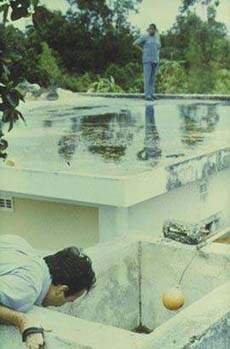
Slide C.17 Malaria vector
habitats: Anopheles gambiae breeding rooftop tanks,
Mauritius
C.18 Malaria vector habitats: Anopheles arabiensis breeding sites in desert areas
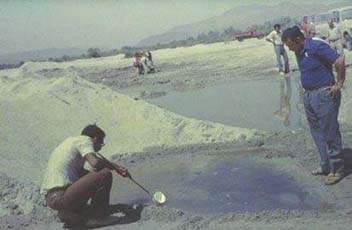
Slide C.18 Malaria vector
habitats: Anopheles arabiensis breeding sites in desert areas
Malaria vectors in Africa belonging to the Anopheles gambiae complex are among the most versatile in terms of breeding habitats. In slide C.15 the role of irrigated rice fields is already highlighted, where, as a rule, species succession takes place as the crop develops. But A. gambiae breeds in other, sunlit water collections as well. The crucial issue is the lifespan of pools after rainfall: do they last long enough for the almost two weeks needed for an Anopheles larva to complete its development? Water collections can be of many types: they can be pools near villages, but they can be as small as animal hoofprints. Collections for drinking water or for irrigation purposes can also contribute significantly to the mosquito population. Water collections in human settlements (for instance, roof tank) ensure that transmission takes place in villages, peri-urban areas and in urban areas. The importance of urban agriculture in this connection has not been the subject of detailed studies, but where this leads to clean, fresh water collections within the city boundaries, it will certainly play a significant role in urban malaria.
Perhaps for more than any of the other malaria vectors, the proper identification of A. gambiae and the design of control measures requires the involvement of a medical entomologist. Most ministries of health have a vector control department with the appropriate expertise.
The WHO Offset publication 66, Environmental Management for Mosquito Control (see bibliography) contains, in annex 1, a complete overview of malaria vector species and their ecological requirements is given. This overview is also presented in the VBC slide set Environmental Management for Vector Control.
C.19 Natural habitat suited to the breeding of simuliid black flies
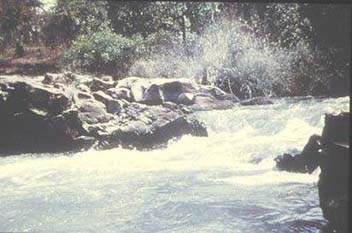
Slide C.19 Natural habitat suited
to the breeding of simuliid black flies
Natural or man-made cascades, such as weirs and spillways provide potential breeding sites for simuliid blackflies. Exposed rocks in rivers and streams with turbulent flow create a habitat suited to the breeding of simuliid black flies as well: aerated conditions that are essential for the development of larvae and pupae.
C.20 Landscape typifying sandfly habitat in South-West France

Slide C.20 Landscape typifying
sandfly habitat in South-West
France
C.21 Landscape typifying sandfly habitat in central Kenya

Slide C.21 Landscape typifying
sandfly habitat in central
Kenya
C.22 Landscape typifying sandfly habitat in the arid, northern Kenya (termite mound)

Slide C.22 Landscape typifying
sandfly habitat in the arid, northern Kenya (termite
mound)
C.23 Rodent burrow system as a sandfly habitat in Uzbekistan (Rhombomys colony)
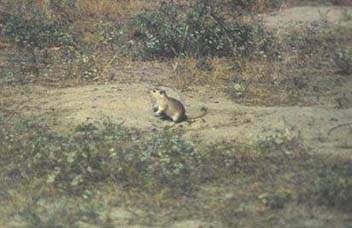
Slide C.23 Rodent burrow system as
a sandfly habitat in Uzbekistan (Rhombomys
colony)
C.24 Sandfly vector habitat in the domestic environment, Colombia

Slide C.24 Sandfly vector habitat
in the domestic environment, Colombia
The general type of ecology favouring sandflies is the arid shrubland shown on this series of slides. Around the Mediterranean, several Lesihmania vectors occur: Phlebotomus ariasi is important in the wooded hills of South West France, where infected hogs serve as the reservoir for this zoonosis (C.20). The phenomenon of aggravated leishmaniasis in AIDS patients has become of increased public health importance.
In Kenya, Kala-azar, the visceral form of leishmaniasis, is found in the northern, semi arid zones: slide C.21 shows the rich clopes with bands of cliffs where a close contact exists between the human populations, the sandflies and the local reservoir, rock hyraxes. In northern Kenya the vector P. martini is commonly found in large numbers in termite hills.
In the then Soviet Republic of Uzbekistan, land preparation with agricultural machinery was used to destroy the rodent habitat, eliminating both the habitats of the vector and of the reservoir host.
|
| |||||||||||||||||||||||||||||||||||||||||||||||||||||||||||||||||
Agricultural Development and Vector-Borne Diseases (FAO - HABITAT - UNEP - WHO, 1996, 91 p.)
Topic D: Disease transmission, with special reference to schistosomiasis
List of slides
D.1 Diagram: How development can affect health
D.2 Diagram: Pathways of disease transmission in water resources development projects
D.3 Table: Contact frequency related to disease transmission
D.4 Small holder irrigation in Mali, creating an increased risk for schistosomiasis transmission
D.5 Dense snail population in reservoir, Mali
D.6 Irrigated rice production, increased transmission risk because of water contact patterns, Mali
D.7 Transmission risk of schistosomiasis related to inland fisheries in Mali
D.8 Ford across stream, Puerto Rico, creating a potential transmission focus for schistosomiasis
D.9 Irrigation turn out (and bath), Yemen, a potential transmission focus for schistosomiasis
D.10 Collecting water from a canal, Sudan
Credit individual slides:
World Health Organization
D.1, D.2, D.3, D.8
Danish Bilharziasis Laboratory
D.4, D.5, D.6, D.7
Food and Agriculture Organization of the United Nations
D.9
Agricultural University Wageningen, Netherlands:
D.10
D.1 Diagram: How development can affect health

Slide D.1 Diagram: How development
can affect health
Disease and development are critically connected in many places where poverty, low environmental standards and lack of sufficient resources to ensure adequate environmental management and health care go hand in hand.
The two main pathways by which agricultural development will influence the human health status are the change in environmental receptivity and the change in community vulnerability.
Environmental receptivity covers vector ecology and biology: it may include changes in vector abundance, in the genetic composition of species complexes, in the longevity of vectors and in the resistance of vector (and the parasites they carry) to certain chemicals such as insecticides or drugs.
Community vulnerability may be affected by changes in economic activities, and in the settlement, re-settlement and migration of people with different levels of immune status or carrying different strains of parasites.
The health services will have to face the resulting new situation, and may or may not have the capacity to deal with it. Whatever the case may be, it is up to the sectors responsible for development to ensure that adverse health impacts are limited to a minimum and that health opportunities are used to a maximum benefit of local communities.
D.2 Diagram: Pathways of disease transmission in water resources development projects

Slide D.2 Diagram: Pathways of
disease transmission in water resources development projects
Agricultural development implies changes in the hydrology and the land use patterns in a large area. Thus, both terrestrial and aquatic breeding sites of disease vectors will be affected. The aquatic breeding sites produce vectors of malaria, arboviruses and the filariases (including onchocerciasis). Changes in man-vector contact are reflected in changed incidence rates. Snails and water fleas, also depending on aquatic habitats, will have an impact on the schistosomiasis and dracunculiasis (see below) situation. On the other hand, changes in the incidence of sleeping sickness and leishmaniasis are associated with modifications in terrestrial ecosystems. Vegetation cover is a crucial parameter for some malaria vectors, as it is a determinant of relative humidity.
Dracunculiasis or Guinea worm infection is a vector-borne disease transmitted by water fleas, aquatic copepods, which serve as intermediate hosts in the life cycle of the parasite Dracunculus medinensis. Some ten years ago, its distribution included most of tropical semi-arid Africa as well as parts of India and Pakistan. Thanks to the efforts coordinated by the World Health Organization, India and Pakistan will soon be certified as being free of the disease and its area of distribution in Africa has decreased considerably - global elimination of the disease as a public health problem is foreseen by the end of the century.
The transmission of Guinea worm infection exclusively depends on drinking contaminated water, i.e. water with infected water fleas. The disease is caused by a round worm about one meter in length which lives under the surface of the skin. Disability occurs when the female worm emerges, creating a painful blister usually on one of the lower limbs. Secondary infections may further aggravate the affliction. When a Guinea worm blister is immersed in water, the worm releases larvae, which infect the freshwater copepods. Water contact patterns may be related to routine household or agricultural use of water, but people often enter the water to relief the burning pain of the blister.
The disability prohibits walking, working and even routine household activities. The nature of the transmission allows inexpensive, community-based control methods, including health education, providing safe drinking water, applying filters when potentially infected water is used for drinking, and boiling water. The impact of the disease on economic productivity is estimated to be high: a World Bank study of the impact of dracunculiasis in the rice growing belt of Nigeria concluded that rice production may be doubled with the elimination of the disease.
D.3 Table: Contact frequency related to disease transmission

Slide D.3 Table: Contact frequency
related to disease transmission
Contact frequency related to disease transmission. For some diseases only one infective mosquito bite is sufficient to result in clinical illness. This is notably so in the case of malaria: not only do a large number of so-called sporozoites get injected into the bloodstream, but the parasites undergo further multiplication in the liver before developing into merozoites that infect red blood cells. For other diseases, such as schistosomiasis, only prolonged exposure leads to clinical illness. Such parasites do not multiply in their definitive host, but as the parasite load builds up over the years, clinical symptoms will gradually become apparent.
D.4 Small holder irrigation in Mali, creating an increased risk for schistosomiasis transmission

Slide D.4 Small holder irrigation
in Mali, creating an increased risk for schistosomiasis transmission
Small holder irrigation (in this slide in Mali) creates an increased risk for schistosomiasis transmission, particularly in connection with seepage, hydraulic structures that favour vector breeding and insufficient drainage.
Such increased risks depend on a number of factors:
· the creation of suitable habitats for snails (reservoirs, hydraulic structures, canals with slow-flowing water and with abundant aquatic weeds)· the spatial distribution of human settlements in the irrigation scheme in relation to various water contact points
· human behaviour in terms of agricultural practices and domestic water use, and with respect to sanitation
The risks can be off-set by proper environmental management measures. Disease situations that have arisen as a result of the introduction of small-holder irrigation need to be addressed by the health services with surveillance and drug distribution programmes.
Small-holder irrigation tends to be more prone to the creation of risk factors, mainly because it is usually less sophisticated than larger state or privately run schemes. This is, however, not necessarily true: in Zimbabwe small-holder farmers have been successfully set up to run a sprinkler irrigation system, which entails little or no health risks.
D.5 Dense snail population in reservoir, Mali

Slide D.5 Dense snail population
in reservoir, Mali
Reservoirs, in particular night storage reservoirs, provide the perfect habitat for intermediate host snails of schistosomiasis. Irrigation and drainage canals also contribute importantly, especially those where me flow is slow and where there is an abundance of aquatic weeds. Aquatic weed growth is usually more prominent in drainage canals, due to the run off of fertilizer.
Some hydraulic structures in irrigation schemes also mm into snail habitats and may become major transmission sites if children use them for swimming. Duckbill weirs are notorious as transmission sites.
Studies of the Blair Research Laboratory and the Overseas Development Unit of Hydraulics Research/Wallingford have tested designs for self draining structures in the Mushandike Small-holder Irrigation Scheme. Together with general land-leveling, lined canals with an optimal gradient and the provision of latrines in the fields, the introduction of these structures led to a substantial decrease in transmission risks. An example of a free-darining off-take design is presented on the next page.

Free draining off-take design for
Mushandike, from: Schistosomiasis control measures for small irrigation
schemes in Zimbabwe, by M. Chimbari, S.K. Chandiwana, B. Ndlela, P.D.
Ndhlovu, R.J. Chitsiko, A.J. Thomson and P. Bolton, Report OD 128, Hydraulics
Research, Wallingford, UK
(1993)
D.6 Irrigated rice production, increased transmission risk because of water contact patterns, Mali

Slide D.6 Irrigated rice
production, increased transmission risk because of water contact patterns,
Mali
The most important crops in terms of schistosomiasis transmission risks are rice and sugar cane. Contrary to popular belief, little or no transmission takes place in the irrigated rice fields, where water temperature tends to be to elevated for the snails. Also, in rice production systems there are periods in the cropping cycle when fields are left to dry and canals are drained. Sugar cane production requires larger quantities of water on a permanent basis, which reflects in high risk levels. The social structure of populations working in commercially run sugar cane plantations, and the use of seasonal labour, possibly coming in from infected areas and settling in temporary living quarters with little or no sanitary facilities, further adds to these risk levels.
D.7 Transmission risk of schistosomiasis related to inland fisheries in Mali

Slide D.7 Transmission risk of
schistosomiasis related to inland fisheries in Mali
Aquaculture is often cited as another source of schistosomiasis infection, and it may be when pisciculture of freshwater fish is concerned. Risks are usually reduced if the choice of fish ensures little or no aquatic weeds (for this purpose, the fish culture may have a mixture of marketable fish and fish that consume aquatic weeds), or, even better, if the fish species selected eats snails. In fish ponds with steep walls, water contact of fishermen may be negligible, but when the ponds have shallow shores fishermen may wade into the water to capture fish.
D.8 Ford across stream, Puerto Rico, creating a potential transmission focus for schistosomiasis

Slide D.8 Ford across stream,
Puerto Rico, creating a potential transmission focus for schistosomiasis
In addition to agricultural practices, peoples’ movements in rural areas may pose risks, for instance at places where they have to cross streams or creeks and where water contact may be unavoidable.
D.9 Irrigation turn out (and bath), Yemen, a potential transmission focus for schistosomiasis

Slide D.9 Irrigation turn out (and
bath), Yemen, a potential transmission focus for schistosomiasis
Many hydraulic structures designed for water management in the scheme become multipurpose structures when local communities start using them for bathing, washing laundry and dishes and watering cattle.
D.10 Collecting water from a canal, Sudan

Slide D.10 Collecting water from a
canal, Sudan
Rural communities involved in large scale irrigated agriculture (such as the area shown in this slide, in the Sudan) depend for their water supply on the irrigation and drainage canals. In these areas ground water is often saline, because of the percolation of nutrients and fertilizer, so wells are not an option. If they can avoid it, members of such communities (usually the women) will not take water from drainage canals, which may be bitter because of fertilizer run-off and pesticide and herbicide residues. As a result, they may have to carry their water over a distance of several kilometers or, in more affluent rural communities, they can buy it from a water trader at a price several times higher then the price their urban counterparts pay for piped water. The lack of adequate sanitation in these communities ensures that the life cycle of the Schistosoma parasite is effectively maintained.
|
| ||||||||||||||||||||||||||||||||||||||||||||||||||||||||||||||||||||||||||||||||||||||||||||||||||||||||||||||||||||||||||||||||||||||||||||||||||||||
Agricultural Development and Vector-Borne Diseases (FAO - HABITAT - UNEP - WHO, 1996, 91 p.)
Topic E: Land use, vegetation and crops
List of slides
E.1 View of a varied catchment topography and vegetation in the Philippines
E.2 Forest clearing in Thailand
E.3 Forest clearing and shifting cultivation in Thailand
E.4 Rice cultivation following deforestation
E.5 Shifting cultivation and upland rice in India
E.6 Shifting cultivation and upland rice in Thailand
E.7 Forest workers in South East Asia
E.8 Camp of collectors of Brazil nuts in the Amazon region
E.9 Cutting firewood near Penang, Malaysia
E.10 Collecting and transporting wood for the market, Ethiopia
E.11 Resin tapping in a pine forest, Viet Nam
E.12 Rubber plantation inter-cropped with pineapple, Thailand
E.13 Gum tapping in Indonesia
E.14 Coffee picking in Colombia
E.15 Coffee plantation shaded by figtrees, Ethiopia
E.16 Fodder collection in India
E.17 Coconuts and cattle in Western Samoa
E.18 Introducing forestry in areas in India with problems of waterlogging and salinity
E.19 Pioneer planting in a Brazilian forest with a risk of leishmaniasis transmission
E.20 A papaya plantation in Mauritania
E.21 Cassava production in Mozambique
E.22 Cassava production in Indonesia
E.23 Sugar cane field adjacent to rice paddy in Tamil Nadu, South India
E.24 Close up of sugar cane crop, Tamil Nadu, South India
E.25 Terraced rice fields in Nepal
E.26 Lowland irrigated rice in southern Asia
E.27 Rice field, bush and dwelling, Bali, Indonesia
Credit individual slides:
World Health Organization
E.7, E.8, E.15, E.19, E.26
Food and Agriculture Organization of the United Nations
E.1, E.2, E.3, E.4, E.5, E.6, E.9, E.10, E.11, E.12. E.13, E.14, E.16, E.17, E.18, E.20, E.21, E.22, E.25, E.27
Robert Bos, Geneva
E.23, E.24.
E.1 View of a varied catchment topography and vegetation in the Philippines

Slide E.1 View of a varied
catchment topography and vegetation in the
Philippines
E.2 Forest clearing in Thailand

Slide E.2 Forest clearing in
Thailand
E.3 Forest clearing and shifting cultivation in Thailand

Slide E.3 Forest clearing and
shifting cultivation in Thailand
The pristine environment of primary forests in tropical areas harbours a great deal of biodiversity. Among the insect species present there may be those of medical importance, but their densities are usually low. Research by Amerasinghe et al. in Sri Lanka (System C of the Mahaweli Development Project) has shown how habitat simplification, occurring when a forest area is developed for irrigated agriculture, can favour important vector species, in the Sri Lanka case Anopheles culicifacies.
The current trend to consider the development and management of catchment areas (slide E.1) and river basins in an integral manner, spearheaded by the World Bank, offers new opportunities to incorporate environmental management measures for disease vector control. Where dams are built in a river basin, reservoir fluctuation, down-stream artificial floods and salt water intrusion at the estuary may be employed to reduce vector-borne disease risks. In international river basins, such measures may be hampered by the difficulties of establishing effective institutional arrangements needed for this type of integrated management.
Those involved in forest clearing and shifting cultivation in Thailand are at a great risk of malaria infection. This type of cultivation is often practiced by hill tribes in northern Thailand to grow opium. In Colombia, a similar situation exists in the tropical forest areas where so-called informal agriculture (i.e. the cultivation of coca) occurs, closely associated with intense transmission foci.
The association between deforestation and malaria incidence varies in different parts of the world. Deforestation in West Africa led to a replacement of Anopheles funestus populations by Anopheles gambiae populations, and to a sharp increase in incidence. In Malaysia, deforestation favoured the principal malaria vector Anopheles maculatus, which prefers slow-moving, sunlit stream.
In the forested areas starting west at the Chittagong Hill Tracts in Bangladesh, throughout Myanmar, Thailand, Cambodia and Lao PR, as well as on some of the islands of Indonesia and the Philippines, mosquitoes of the Anopheles dirus group are the main malaria vectors. In man-made environments that mimick the forest ecology (rubber plantations) transmission by the same vector occurs.
E.4 Rice cultivation following deforestation

Slide E.4 Rice cultivation
following deforestation
Populations resettled in recently deforested areas suffer the double risks of the forest fringe. Rice cultivation as shown here in South East Asia carries the risk of Japanese encephalitis outbreaks that occur at intervals when favourable conditions prevail. Such resettled communities often also depend economically on the nearby forest, and will therefore be exposed to malaria transmission by Anopheles dirus.
E.5 Shifting cultivation and upland rice in India

Slide E.5 Shifting cultivation and
upland rice in
India
E.6 Shifting cultivation and upland rice in Thailand

Slide E.6 Shifting cultivation and
upland rice in Thailand
Forest clearing in upland areas of India (E.5) and Thailand (E.6) show the introduction of cultivation on slopes too steep to provide for sustained crop production. As top soil and fertility is lost, farmers will move on to new areas, to clear and destroy new land. A continuing cycle of population movement into potentially hazardous areas is thus propagated, without an opportunity to control either resource degradation and health risk.
Down stream in a catchment area where this cycle takes place, rivers carry excessive amounts of silt, which reduce the livespan of reservoirs and dams. In floodplains, the silt deposits may change the local ecology to the extent that breeding of mosquito vectors is significantly promoted.
E.7 Forest workers in South East Asia

Slide E.7 Forest workers in South
East
Asia
E.8 Camp of collectors of Brazil nuts in the Amazon region

Slide E.8 Camp of collectors of
Brazil nuts in the Amazon region
Forest workers often enter the hazardous environment at peak transmission times. The malaria risks of the workers in Thailand (E.7) have already been extensively covered. Their colleagues in Brazil (E.8: a camp of collectors of Brazil nuts in the Amazon region) do not only suffer the risk of malaria but also of muco-cutaneous leishmaniasis, transmitted by sandfly vectors belonging to the genus Lutzomyia.
E.9 Cutting firewood near Penang, Malaysia

Slide E.9 Cutting firewood near
Penang,
Malaysia
E.10 Collecting and transporting wood for the market, Ethiopia

Slide E.10 Collecting and
transporting wood for the market, Ethiopia
The collection of fuel wood is a daily occupancy for many people in parts of the world where they have no access to or cannot afford other types of fuel. Fuel wood collectors are another vulnerable group when it comes to forest related vector-borne disease risks.
E.11 Resin tapping in a pine forest, Viet Nam
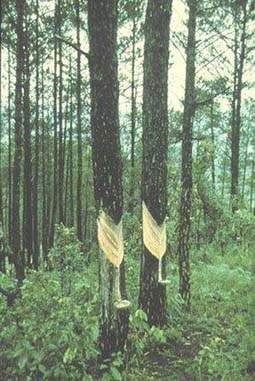
Slide E.11 Resin tapping in a pine
forest, Viet
Nam
E.12 Rubber plantation inter-cropped with pineapple, Thailand

Slide E.12 Rubber plantation
inter-cropped with pineapple,
Thailand
E.13 Gum tapping in Indonesia

Slide E.13 Gum tapping in
Indonesia
Various types of tree plantations will create the level of relative humidity required by some of the forest breeding malaria vectors. The plantation activities often coincide with peak biting times: gum and resin collection is preferably done at night when yields are highest Certain perishable fruits (such as the local salak fruit in Indonesia) are collected at night for marketing first thing in the morning.
Oil palm plantations are associated with malaria, scrub typhus and leptospirosis. The distribution of scrub typhus covers the Indian subcontinent, South East Asia and me Western Pacific. The pathogen, Rickettsia tsutsugamushi, is transmitted by trombiculid mites belonging to the genus Leptotrombidium. Rodents are important reservoirs, but transovarial transmission also keeps the pathogen in the vector population.
E.14 Coffee picking in Colombia

Slide E.14 Coffee picking in
Colombia
E.15 Coffee plantation shaded by figtrees, Ethiopia
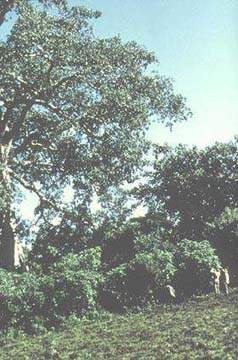
Slide E.15 Coffee plantation
shaded by figtrees, Ethiopia
Coffee plantations provide an environment which, depending on the local situation, may bring workers into close contact with disease vectors. The choice of the coffee variety and whether or not to have shade trees may have a bearing on the hazards, in particular the sandfly ecology and the epidemiology of leishmaniasis. An additional health hazard, beyond the scope of this slide set but nevertheless worth mentioning, arises from me processing of the berries. The resulting residues with their high organic content can cause serious pollution of local water resources, affecting drinking water supply.
E.16 Fodder collection in India

Slide E.16 Fodder collection in
India
Animal fodder collection in forested zones is another occupation which takes members of rural communities into risk areas for vector-borne diseases.
E.17 Coconuts and cattle in Western Samoa

Slide E.17 Coconuts and cattle in
Western Samoa
The Pacific island harbour a form of lymphatic filariasis whose transmission takes plays during daytime (as opposed to the nocturnal form transmitted by Culex quinquefasciatus elsewhere). The vector is Aedes polynesiensis. It breeds in small water collections, with open coconut shells and crab holes contributing significantly to populations densities. Several biological control methods (copepods, fungi) have been tested with initial but not lasting results.
In South India and Sri Lanka, coconut husks undergo a rotting process to release the fibre. Organic material in the coconut husk pits creates a suitable environment for Culex quinquefasciatus and this type of cultivation is therefore closely associated with Wuchereria bancrofti filariasis.
E.18 Introducing forestry in areas in India with problems of waterlogging and salinity

Slide E.18 Introducing forestry in
areas in India with problems of waterlogging and salinity
One way of dealing with water logging is to plant trees with a high water absorption capacity. This method has been used in various field trials of bio-environmental control of malaria by the Malaria Research Centre in Delhi. This integrated approach includes the use of larvivorous fish and physical improvements aimed to reduce seepage and standing water. Community participation is a hallmark of this approach.
Reference:
Sharma, V.P. (ed.), 1993. Community participation in malaria control. Malaria Research Centre, 22 Sham Nath Marg, Delhi 110 054, India
E.19 Pioneer planting in a Brazilian forest with a risk of leishmaniasis transmission

Slide E.19 Pioneer planting in a
Brazilian forest with a risk of leishmaniasis transmission
Settlers moving into the Brazilian rainforests come with many objectives. The health risks they are exposed to go beyond vector borne diseases such as malaria or leishmaniasis. They may range from malnutrition, to sexually transmitted diseases and trauma or death through violence.
Conventional control methods usually have little effect in this pioneer environment, and community based approaches fail in a context where there is frequently very little sense of community to begin with.
E.20 A papaya plantation in Mauritania

Slide E.20 A papaya plantation in
Mauritania
E.21 Cassava production in Mozambique

Slide E.21 Cassava production in
Mozambique
E.22 Cassava production in Indonesia

Slide E.22 Cassava production in
Indonesia
Fortunately there are also crops with little or no vector-borne disease risks such as the papaya and cassava plantations shown in these slides.
E.23 Sugar cane field adjacent to rice paddy in Tamil Nadu, South India

Slide E.23 Sugar cane field
adjacent to rice paddy in Tamil Nadu, South
India
E.24 Close up of sugar cane crop, Tamil Nadu, South India

Slide E.24 Close up of sugar cane
crop, Tamil Nadu, South India
Farmers’ decisions in crop selection are guided by the marketability of their produce. In this traditionally rice growing area of Tamil Nadu, South India, many farmers switch to sugar cane when the price of rice slumps on world markets. Such changes in the cropping system may have unexpected health repercussions. In this particular case, the longevity of rice field breeding mosquitoes may be extended because of the availability of relatively cool, moist resting places in the cane fields.
Cropping patterns can be influenced by governments through financial incentives (taxation or subsidies) or by imposing import tariffs. In West Africa, for instance, rice consumption by expanding urban populations is rapidly increasing. Governments want to encourage local rice cultivation to save their foreign currency reserves, but to do so they have to instate tariffs on the imports of much cheaper Asian rice to keep local farmers in business. Health implications are seldom considered in such policy decisions; the impact of development policies on health has been the subject of a WHO review (Cooper Weil D.E. et al., see bibliography)
E.25 Terraced rice fields in Nepal
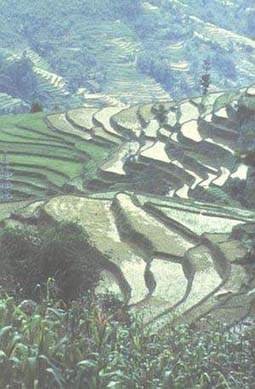
Slide E.25 Terraced rice fields in
Nepal
A high level of agricultural skills is needed in Nepal, where only 18% of the total land area is available to support 93% of the population. Vector-borne disease problems, which exist in Nepal, must inevitably be solved within the limitations to feasibility imposed by consideration of cultivation and production. Farming is mainly at subsistence level and per capita income is one of the world’s lowest.
On the positive side of things, transmission risks generally decrease at higher altitudes and the bulk of vector-borne disease problems in Nepal are found in the lowlands of the Terai area.
E.26 Lowland irrigated rice in southern Asia

Slide E.26 Lowland irrigated rice
in southern Asia
Lowland irrigated rice production in South Asia (Pakistan, India and Nepal) is associated with malaria and Japanese encephalitis. In the Terai area of Nepal, Anopheles annularis and A. culicifacies are responsible for malaria transmission.
In Pakistan, extensive irrigation in the Punjab suffers from high water tables and waterlogging. A massive water management and drainage programme is underway to correct this. Preliminary analysis, using remotely sensed data, indicated that there is a link between the severity of waterlogging and malaria transmission. The impact on health of the drainage projects is therefore expected to be positive.
In the tropics, irrigated, terraced rice cultivation in small plots is often a continuous process, where at any one time, all different stages of the cropping cycle occur. This creates conditions favourable to perennial malaria transmission. In an historic review of the environmental approaches to malaria control in Indonesia (Takken et al. see bibliography), the case of the Cihea Plains irrigation development on the island of Java is described After a short period of high productivity, yields went down and many fields remained uncultivated because of high malaria prevalence. After an investigation by malarialogists, improvements in water management and drainage were suggested. In addition, a less orthodox plan to synchronize the cropping cycle was proposed. Even though this met with initial resistance from both the irrigation authorities and the farmers themselves, it was eventually implemented with great success, reducing the transmission period and intensity substantially.
E.27 Rice field, bush and dwelling, Bali, Indonesia

Slide E.27 Rice field, bush and
dwelling, Bali, Indonesia
A diverse rice agro-ecosystem such as this scene from Bali harbours more health hazards than vector-borne diseases alone. Lack of adequate sanitation will promote the prevalence of intestinal helminths, such as Ascaris, hookworm and Trichuris. Damp conditions inside houses and indoor air pollution from stoves will contribute to respiratory diseases. If communities have no access to safe drinking water, risks of gastro-intestinal infection are high. Zoonoses and rodent-borne diseases may also take their toll and in some irrigated rice areas in Asia and Africa, snakebite as a cause of mortality cannot be neglected.
In a sufficiently balanced ecosystem, however, such disadvantages may gradually disappear as farmers improve their living conditions, invest surplus income partly into community services, and obtain a better access to health services. Health risk reduction and management can greatly accelerate the development process and improve quality of life.
|
| ||||||||||||||||||||||||||||||||||||||||||||||||||||||||||||||||||||||||||||||||||||||||||||||||||||||||||||||||||||||||||||||||||||||||||||||||||||||||||||||||
Agricultural Development and Vector-Borne Diseases (FAO - HABITAT - UNEP - WHO, 1996, 91 p.)
Topic F: Water use in agriculture
List of slides
F.1 Eighty percent of freshwater use is for agriculture
F.2 Water lifting for irrigation by human power, West Africa
F.3 Water lifting for irrigation by human power, India
F.4 Water lifting for irrigation by human power, China
F.5 Water lifting for irrigation by human power, China
F.6 Water lifting for irrigation by animal power, Egypt
F.7 Water lifting for irrigation by tractor, Tunisia
F.8 Lined canal and canaletti, Morocco
F.9 Hood irrigation, Egypt
F.10 Furrow irrigation with siphons, Tunisia
F.11 Sprinkler irrigation, India
F.12 Central pivot irrigation, Zambia
F.13 Trickle or drip irrigation, bananas, Egypt
F.14 Trickle or drip irrigation, tomatoes, Egypt
F.15 Irrigation canal and turn-outs, Pakistan
F.16 Effects of lack of infrastructure and poor irrigation management, Pakistan
F.17 Effects of lack of infrastructure and poor irrigation management, Pakistan
F.18 Waterlogged fields with crops
F.19 Waterlogged soybeans in the USA
F.20 Minor canal with aquatic weeds, Rahad, Sudan
F.21 An irrigation scheme in an arid area, Chad
F.22 Tank with dense Salvinia growth, Sri Lanka
F.23 Water storage for drinking water and livestock
F.24 Shallow well, Mozambique
F.25 Improved well, Keita, Niger
F.26 Village hand pump, Nepal
F.27 Aquaculture, India
F.28 Aquaculture in rice fields
F.29 Trimming and cleaning of a fishpond
Credit individual slides:
World Health Organization
F.23
Food and Agriculture Organization of the United Nations
F.1-F.18, F.21, F.22. F.24,-F.29
Professor Jim K. Olson, Texas A&M University
F.19, F.20
F.1 Eighty percent of freshwater use is for agriculture

Slide F.1 Eighty percent of
freshwater use is for agriculture
Eighty percent of freshwater use is for agriculture.
F.2 Water lifting for irrigation by human power, West Africa

Slide F.2 Water lifting for
irrigation by human power, West
Africa
F.3 Water lifting for irrigation by human power, India
Slide F.3 Water lifting for irrigation by human power, India
F.4 Water lifting for irrigation by human power, China
Slide F.4 Water lifting for irrigation by human power, China
F.5 Water lifting for irrigation by human power, China

Slide F.5 Water lifting for
irrigation by human power,
China
F.6 Water lifting for irrigation by animal power, Egypt

Slide F.6 Water lifting for
irrigation by animal power,
Egypt
F.7 Water lifting for irrigation by tractor, Tunisia

Slide F.7 Water lifting for
irrigation by tractor, Tunisia
Most agrarian societies in areas where water is a limiting factor have developed water lifting devices to irrigate their crops and boost production. In this way they can meet their needs in terms of food and fibres. Even the most primitive devices reveal human ingenuity. The introduction of animal power greatly enhanced the capacity. Motorized pumping requires major investments and operational costs. In areas where multi-purpose dams generate electricity, this source of energy may provide a cheap option for water lifting.
In terms of human health, water lifting devices preventing direct human-water contact in areas endemic for schistosomiasis are to be preferred, as are devices which remain without stagnant water when not in use, to avoid mosquito breeding. In those parts of the world where stagnant pools favour mosquito breeding, methods causing such pools are not appropriate. Where draught animal are introduced to lift water, they may become an important ecological factor in relation to human health - this is dealt with further in section H. Mechanized systems don’t carry any direct vector-borne disease risks.
F.8 Lined canal and canaletti, Morocco

Slide F.8 Lined canal and
canaletti, Morocco
Canaletti are elevated, concrete water conveyance systems. They are constructed of prefabricated units and are particularly functional in areas where extensive irrigation is introduced in highly permeable soils. Examples can be found in Morocco and in Turkey. Little water is lost to seepage in canaletti systems, and as a result mosquito vector breeding in relation to the irrigation system as such as minimum. Schistosomiasis risks are associated with ancillary hydraulic structures such as weirs.
Unfortunately, a good system of afferent canals does not necessarily imply proper drainage. In the 1970s, an outbreak of malaria in Turkey’s �ukurova Plain near Adana was caused by insufficient drainage of canaletti-fed cotton production schemes.
F.9 Hood irrigation, Egypt

Slide F.9 Hood irrigation,
Egypt
Flood irrigation involves a very low level of sophistication in water management and carries important vector-borne disease risks, both in terms of human-water contact and in terms of creating favourable mosquito breeding sites.
F.10 Furrow irrigation with siphons, Tunisia

Slide F.10 Furrow irrigation with
siphons, Tunisia
Water contact is inevitable when farmers install their siphons for furrow irrigation, but flow rates are usually high and hence schistosomiasis risks low. Furrow irrigation can give rise to unequal water distribution in the fields, with pool formation in some parts. An improved version, called surge irrigation, applies water intermittently, to allow from a gradual adaptation of soil permeability.
F.11 Sprinkler irrigation, India

Slide F.11 Sprinkler irrigation,
India
F.12 Central pivot irrigation, Zambia

Slide F.12 Central pivot
irrigation,
Zambia
F.13 Trickle or drip irrigation, bananas, Egypt

Slide F.13 Trickle or drip
irrigation, bananas,
Egypt
F.14 Trickle or drip irrigation, tomatoes, Egypt

Slide F.14 Trickle or drip
irrigation, tomatoes, Egypt
Sprinkler, central pivot and drip irrigation are sophisticated forms of water delivery with little or no health risks. They require, however, substantial investments and operate at a scale beyond the average smallholder schemes. Nevertheless, in some countries, such as Zimbabwe, smallholder cooperatives have successfully embarked on sprinkler schemes. Drip irrigation is almost exclusively used for very high value crops.
F.15 Irrigation canal and turn-outs, Pakistan

Slide F.15 Irrigation canal and
turn-outs, Pakistan
Well maintained canals and turnouts sustain a healthy environment. Local research in Pakistan on canal-lining technology aims to further improve the situation.
F.16 Effects of lack of infrastructure and poor irrigation management, Pakistan
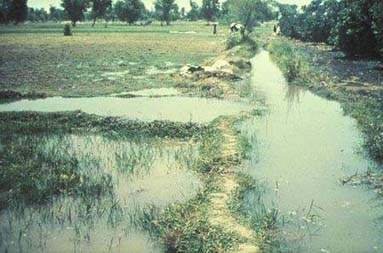
Slide F.16 Effects of lack of
infrastructure and poor irrigation management,
Pakistan
F.17 Effects of lack of infrastructure and poor irrigation management, Pakistan
Slide F.17 Effects of lack of infrastructure and poor irrigation management, Pakistan
Lack of infrastructure and poor irrigation management create environmental degradation with health risks that need no further comment. Devolution of water management responsibilities, and operation and maintenance of irrigation schemes to farmer groups is expected to improve the situation.
While collaboration between different ministries to address the environmental and health issues pertaining to inadequate irrigation water management is often hard to achieve at the central level, it is at the district level, where all sectors meet, that efforts should be made to obtain maximum benefits from rehabilitation projects. Health workers and agricultural extension workers should be mobilized to educate communities about the health risks of situations such as depicted in these slides.
F.18 Waterlogged fields with crops

Slide F.18 Waterlogged fields with
crops
F.19 Waterlogged soybeans in the USA

Slide F.19 Waterlogged soybeans in
the USA
Waterlogging is a problem in both industrialized and non-industrialized countries. In many irrigated areas it becomes a permanent problem. A high water table in hot climates also leads to salination, to which annually substantial amounts of cultivable land are lost.
F.20 Minor canal with aquatic weeds, Rahad, Sudan

Slide F.20 Minor canal with
aquatic weeds, Rahad, Sudan
The Blue Nile Health Project in Sudan proposed an integrated approach with drinking water supply and sanitation, environmental modification and manipulation (including the periodic removal of aquatic weeds from canals), health education and the strengthening of health services.
F.21 An irrigation scheme in an arid area, Chad

Slide F.21 An irrigation scheme in
an arid area, Chad
From the air, the dramatic impact of irrigation development in an arid area is clearly visible. The adverse health implications of such an ecological change may take some time to develop. Schemes are seldom abandoned because of acute health problems, even though the impact of malaria may be fierce. Ill-health does, however, contribute to maintaining the cycle of poverty and underdevelopment, and as a result the social structure of a newly developed irrigation scheme may drastically change. Resettled smallholder farmers may be unable to produce sufficiently to pay back their debts and sell their land to speculators from urban centres. It is difficult to determine to what extent ill-health contributes to such developments.
F.22 Tank with dense Salvinia growth, Sri Lanka

Slide F.22 Tank with dense
Salvinia growth, Sri Lanka
The growth of aquatic weeds, such as this tank with dense Salvinia growth in Sri Lanka, presents specific problems in South and South East Asia, where mosquitoes of the genus Mansonia breed. The larvae of these mosquitoes obtain their oxygen from the air roots of aquatic weeds. They transmit brugian filariasis. Weed control is the obvious solution, but may be hard to achieve on a sufficiently large scale once weeds have invaded a reservoir. In smaller reservoirs, community participation secures permanent weed clearing, provided there is an economic benefit (using the weeds as fodder or fertilizer, for example). Biological control methods have also been tested, using insect pests of weeds, or introducing fish or mammals that consume aquatic weeds.
F.23 Water storage for drinking water and livestock

Slide F.23 Water storage for
drinking water and livestock
Tanks or reservoirs for drinking water supply and for cattle are often close enough to human settlements to pose a vector-borne disease risk.
F.24 Shallow well, Mozambique

Slide F.24 Shallow well,
Mozambique
F.25 Improved well, Keita, Niger

Slide F.25 Improved well, Keita,
Niger
F.26 Village hand pump, Nepal

Slide F.26 Village hand pump,
Nepal
The supply of safe drinking water is crucial to community health in rural areas. Shallow or improved wells, or hand pumps all contribute to this, although the former carry more health risks in terms of contamination. For most rural communities, the daily collection of water for domestic use is a permanent chore, usually burdening the women. In many irrigation schemes, wells are not an option, because groundwater is brackish and polluted by residues of agrochemicals. Boreholes to greater depths may be a solution to this problem. While access to water in irrigation canals is obviously better than no water at all, and while it has been shown that water quantity rather than water quality is the crucial issue in diseases related to poor sanitation, the installation of a safe drinking water supply as part of irrigation development remains a very valid investment
F.27 Aquaculture, India

Slide F.27 Aquaculture,
India
F.28 Aquaculture in rice fields

Slide F.28 Aquaculture in rice
fields
F.29 Trimming and cleaning of a fishpond

Slide F.29 Trimming and cleaning
of a fishpond
The cultivation of fish in irrigated rice fields is an attractive option to reduce mosquito vector populations in this particular agro-ecosystem. In Indonesia, the method is referred to as mina-padi. There are a number of preconditions. In order to obtain farmers’ participation, the fish has to be marketable or at least attractive for consumption by me farmers themselves. The fish species selected has to belong to the group of so-called larvivorous fish, i.e. fish that eat insect larvae. Great care has to be taken with chemical inputs into these rice fields, to avoid wiping out the fish stock. And during the periods when rice fields are drained, there should be refuges (ponds or a plot reserved for this purpose) to maintain a minimum fish population.
|
| ||||||||||||||||||||||||||||||||||||||||||||||||||||||||||||
Agricultural Development and Vector-Borne Diseases (FAO - HABITAT - UNEP - WHO, 1996, 91 p.)
Topic G: Cultivation practices
List of slides
G.1 Riceland preparation with oxen, Africa
G.2 Riceland preparation with water buffaloes, Philippines
G.3 Deep ploughing by tractor, Malaysia
G.4 Aerial infrared photograph of a riceland system, Texas, USA
G.5 Rice harvesting equipment, Texas, USA
G.6 Equipment tire racks in rice field, Texas, USA
G.7 Aerial photograph of riceland study site, Texas, USA
G.8 Colour infrared photograph of levees and tire tracks, Texas USA
G.9 Oviposition features in ricelands, Texas, USA
Credit individual slides:
Food and Agriculture Organization of the United Nations
G.1, G.2, G.3
Professor Jim K. Olson. Texas A&M University
G.4, G.5, G.6, G.7, G.8, G.9
G.1 Riceland preparation with oxen, Africa

Slide G.1 Riceland preparation
with oxen,
Africa
G.2 Riceland preparation with water buffaloes, Philippines

Slide G.2 Riceland preparation
with water buffaloes, Philippines
Traditional methods of land preparation for irrigated lowland rice still employ animal power, such as the oxen in the African example (G.1) and the carabao - water buffalo - in the Philippines (G.2). Vector-borne disease issues include water bodies used by cattle, human-livestock-vector contact patterns, livestock in the domestic environment and the potential for zooprophylaxis (all covered in section H).
G.3 Deep ploughing by tractor, Malaysia
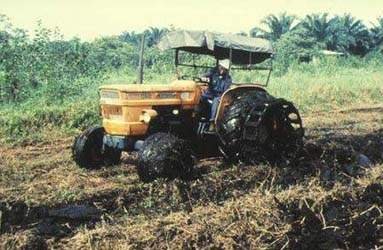
Slide G.3 Deep ploughing by
tractor, Malaysia
In many rice growing areas, the past two or three decades have seen a dramatic displacement of draught animals by tractors, as illustrated in this slide from Malaysia. Such mechanization makes it practical and economic to put marginal lands under cultivation. The ensuing ecological changes and the creation of monocultures (habitat simplification) can have far-reaching consequences for the health status of local communities. Farm mechanization will also change people’s lifestyles, possibly increasing the mobility of migrant and seasonal labour. In relation to rice cultivation, mechanization is likely to be associated with increased areas under flooding and more vector breeding opportunities. The introduction of upland or “dry” rice varieties will, on the other hand, reduce such risks. The recent trend of broadcasting rather than transplanting rice (in countries were manual labour is becoming too expensive) is also likely to have a beneficial effect with respect to vector-borne disease risks.
G.4 Aerial infrared photograph of a riceland system, Texas, USA

Slide G.4 Aerial infrared
photograph of a riceland system, Texas, USA
In a study to explore the potential of aerial colour infra-red photography to survey the oviposition sites of floodwater mosquitoes, a series of pictures was made, supported by ground truthing. This study was carried out by the Entomology department of Texas A&M University, as part of the USDA funded Riceland Mosquito Management Programme. The cropping pattern, and several natural and man-made features are clearly visible.
The remote sensing technique was also tested and proved effective in pinpointing rice fields in California that produce high numbers of Anopheles freeborni (a potential malaria vector; malaria is, however, not endemic in California). In extensive, uniform agro-ecosystems, this method would support a focused and, therefore, more efficient vector control effort.
G.5 Rice harvesting equipment, Texas, USA

Slide G.5 Rice harvesting
equipment, Texas,
USA
G.6 Equipment tire racks in rice field, Texas, USA

Slide G.6 Equipment tire racks in
rice field, Texas, USA
One of the important features of rice production systems in the southern USA is the impact of machinery, such as this harvesting equipment (G.5). The tire tracks left in the moist soil will provide ideal conditions for oviposition by Psorophora columbiae, the floodwater mosquito. It is estimated that these conditions account for between 1.7 and 2.9 million P. columbiae eggs per hectare in recently harvested rice fields.
P. columbiae transmits a number of viruses, most important of which is the Western Equine Encephalitis (WEE) virus.
G.7 Aerial photograph of riceland study site, Texas, USA

Slide G.7 Aerial photograph of
riceland study site, Texas, USA
This oblique aerial photograph of the riceland study site gives additional information concerning micro relief and vegetation.
G.8 Colour infrared photograph of levees and tire tracks, Texas USA

Slide G.8 Colour infrared
photograph of levees and tire tracks, Texas USA
This colour infrared photograph of levees and tire tracks in a recently harvested field is an impressive example of the density of features conducive to the breeding of Psorophora species under modern conditions of cultivation.
G.9 Oviposition features in ricelands, Texas, USA

Slide G.9 Oviposition features in
ricelands, Texas, USA
A list of oviposition features in ricelands, Texas, USA
|
| ||||||||||||||||||||||||||||||||||||||||
Agricultural Development and Vector-Borne Diseases (FAO - HABITAT - UNEP - WHO, 1996, 91 p.)
Topic H: Influence of livestock
List of slides
H.1 Water buffaloes in rice fields, Tamil Nadu, India
H.2 Household suffering from visceral leishmaniasis. North India
H.3 Use of rice fields as pasture land between cropping cycles, USA
H.4 Hoof prints in pasture lands providing breeding sites for floodwater mosquitoes, USA
H.5 Egrets in an irrigated rice field
Credit individual slides:
Robert Bos, Geneva
H.1
Food and Agriculture Organization of the United Nations
H.2
Professor Jim K. Olson. Texas A&M University
H.3, H.4
Danish Bilharziasis Laboratory
H.5
H.1 Water buffaloes in rice fields, Tamil Nadu, India

Slide H.1 Water buffaloes in rice
fields, Tamil Nadu, India
In most traditional agrarian societies, farm animals have an important role in the production process. They are a source of meat, milk products and energy. They also are an important factor in the local ecology, even a determining one in relation to endemic diseases.
First, they can serve as a reservoir host for certain disease causing organisms. The water buffaloes shown in these Indian rice fields could, were they working in the same environment in the Philippines, harbour Schistosoma japonicum, which causes the Asian form of schistosomiasis in humans. Its distribution is limited to the Philippines, parts of mainland China and a focus on the Indonesian island Sulawesi.
Pigs are amplifying hosts for the Japanese encephalitis virus and an essential ecological factor at the root of JE outbreaks. This explains the virtual absence of the disease from muslim countries such as Bangladesh, or from a country like Malaysia, where pig rearing by the Chinese population is spatially separated from the rice growing activities of the Malay.
Secondly, there is the more complicated role of cattle in the overall population dynamics of mosquito vectors and the transmission dynamics of diseases. Where mosquito species prevail with a preference to take blood meals from cattle (zoophilic species), the presence of cattle and its strategic location between breeding sites and human settlements will significantly reduce disease transmission risks. This approach is known as zooprophylaxis. If local mosquito species are less discriminate in the selection of their blood meal hosts, then the presence of cattle may in fact contribute to higher populations densities and higher transmission risks.
Where cattle plays an important role in diverting blood meal-seeking mosquitoes from human hosts, mechanization and the reduction of farm animals will have a dramatic impact on the human health status. A major malaria epidemic occurred in the Demerara River estuary in Guyana where after widespread mechanization of the agricultural sector, the local zoophilic vector, Anopheles aquasalis, found itself with only humans to trite.
PEEM reviewed the issue of livestock management and disease vector control at its tenth meeting in 1990; the technical discussion section of the meeting report can be obtained from the PEEM Secretariat, WHO, Geneva.
Reference:
PEEM Secretariat, 1991. Report of the tenth meeting of the joint WHO/FAO/UNEP Panel of Experts on Environmental Management for Vector Control (PEEM). Technical discussion: Livestock management and disease vector control. Document WHO/CWS/91.11, World Health Organization, Geneva
H.2 Household suffering from visceral leishmaniasis. North India
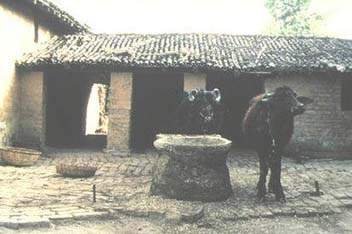
Slide H.2 Household suffering from
visceral leishmaniasis. North India
The proximity between humans and livestock is emphasized in this slide showing a kala-azar (visceral leishmaniasis) affected household in northern India. The local sandfly vector, Phlebotomus argentipes, is largely zoophilic, feeding on cattle. Locating cattle sheds away from human dwellings will lead to a significant decrease in health risks.
H.3 Use of rice fields as pasture land between cropping cycles, USA

Slide H.3 Use of rice fields as
pasture land between cropping cycles,
USA
H.4 Hoof prints in pasture lands providing breeding sites for floodwater mosquitoes, USA

Slide H.4 Hoof prints in pasture
lands providing breeding sites for floodwater mosquitoes, USA
Psorophora columbiae, the flood water mosquito in the rice agro-ecosystems of the southern United States of America is an important vector of local encephalitis viruses. The Riceland Mosquito Management Program sponsored by the US Department of Agriculture has carried out in-depth research on agricultural practices and their ecological consequences for P. columbiae production.
Giving out rice fields as pasture land after harvesting the crop results in large numbers of hoof prints in the moist soil that provide suitable oviposition sites for this mosquito species.
The main malaria vector in sub-Saharan Africa, Anopheles gambiae, is often cited as being so versatile that it can even breed and complete its aquatic life cycle in water collections in hoof prints.
References:
Meek, C.L. and Olson, J.K., 1977. The importance of cattle hoofprints and tire tracks as oviposition sites for Psorophora columbiae in Texas ricelands. Environ. Entomol. 6:161-166
Welch, J.B., Olson, J.K. and Yates, M.M., 1986. Occurrence of Psorophora columbiae eggs in different field types comprising a Texas riceland agroecosystem. J. Am. Mosq. Control Assoc. 2: 52-56
H.5 Egrets in an irrigated rice field

Slide H.5 Egrets in an irrigated
rice field
Egrets and other birds can be reservoirs of viruses and transport them over large distances. Some ecologists have speculated that with global climate change, migratory birds may change their routes and may introduce arboviral infection in areas where they now do not occur.
|
| ||||||||||||||||||||||||||||||||||||||||||||||||||||||||||||||||||||||||||||||||||||||||||||||||||||||||||||||||||||||||||||||||||||||||||||||||||||||
Agricultural Development and Vector-Borne Diseases (FAO - HABITAT - UNEP - WHO, 1996, 91 p.)
Topic J: Plant protection, pest control and chemical inputs
List of slides
J.1 Spraying rice for pest control, Lao People’s Republic
J.2 Spraying rice for pest control, Lao People’s Republic
J.3 Spraying rice for pest control, People’s Republic of China
J.4 Spraying rice for pest control, People’s Republic of China
J.5 Pest control and fertilizer spraying
J.6 Broadcasting fertilizer in paddy fields, Tamil Nadu, India
J.7 Traps for tsetse fly (human sleeping sickness, cattle nagana) control, Burkina Faso
J.8 Chemical control of tsetse flies, Burkina Faso
J.9 Chemical control of tsetse flies, Burkina Faso
J.10 Azolla use in rice fields, as joint weed control/fertilizer, Tamil Nadu, India
J.11 Azolla use in rice fields, as joint weed control/fertilizer, Tamil Nadu, India
J.12 Close up of Azolla
J.13 Laboratory studies: effect of Azolla coverage on anopheline mosquitoes
J.14 Laboratory studies: effect of Azolla coverage on culicine mosquitoes
J.15 Dragonfly on sugar cane, Tamil Nadu, India
J.16 Gambusia for rice field mosquito control, Afghanistan
J.17 Focal application of Bayluscide® in an irrigation canal, Egypt
J.18 Fish kill by Bayluscide®, Egypt
J.19 Mechanical weed clearance of canals
J.20 The Chinese grass carp
J.21 Lined canal with fast water flow, Zimbabwe
J.22 Drying out of canals
J.23 Control of Rhombomys colonies in the former USSR (now Uzbekistan)
J.24 Alternate wetting and drying in Chinese rice irrigation
J.25 Vector larvae populations in conventionally irrigated rice fields versus those with alternate wetting and drying
J.26 Effect of alternate wetting and drying on the rice yield
J.27 The International Code of Conduct
Credit individual slides:
World Health Organization
J.13, J.14, J.16, J.17. J.18, J.19, J.20, J.21, J.22, J.23
Food and Agriculture Organization of the United Nations
J.1, J.2. J.3, J.4, J.5, J.7, J.8, J.9, J.12, J.13, J.14, J.27
Robert Bos, Geneva
J.6, J.10, J.11, J.15
Agricultural University Wageningen, Netherlands
J.24, J.25, J.26
J.1 Spraying rice for pest control, Lao People’s Republic

Slide J.1 Spraying rice for pest
control, Lao People’s
Republic
J.2 Spraying rice for pest control, Lao People’s Republic

Slide J.2 Spraying rice for pest
control, Lao People’s
Republic
J.3 Spraying rice for pest control, People’s Republic of China

Slide J.3 Spraying rice for pest
control, People’s Republic of
China
J.4 Spraying rice for pest control, People’s Republic of China

Slide J.4 Spraying rice for pest
control, People’s Republic of China
An essential operation in farming is the control of crop pests, whether weeds, fungi or insects. The first two slides show a common form of control using a liquid pesticide in manually operated knapsack sprayers on rice seedlings. The third slide shows the individual application of powdered pesticide on rice, and the fourth one a primitive application method unlikely to achieve the necessary regularity of distribution.
The use of agrochemicals carries immediate health risks (acute poisoning), long-term direct health risks (chronic illness due to accumulation of pesticide residues) and health risks related to the impact of applying pesticides in the open environment, reducing populations of predator fauna, as well as inducing insecticide resistance in vector populations.
The examples from Lao (J.1 and J.2) and China (J.3 and J.4) illustrate the immediate risks of insecticide applications. Studies by the International Rice Research Institute (Pingali et al.) have helped to quantify the chronic health effects in rice farmers.
The immediate and chronic effects of exposure are not only linked to insufficient precautions at the time of insecticide handling and application. The inadequate storage of insecticides is also an important health hazard.
Studies in Central America (Georghiou et al.) and Sri Lanka (Herath et al.) have demonstrated the strong selection pressures exerted by agricultural pesticides against mosquito vector populations. As a result, the effectiveness of public health campaigns for disease vector control was substantially diminished.
There is ample anecdotal information about the application of insecticides, originally destined for use in anti-malaria campaigns (house spraying), in agriculture. At the village level, black market practices may result in part of the compound being sold to farmers. As a result, the dosage of the insecticide applied for malaria control may be too low, which will accelerate the induction of resistance, and a substantial volume of insecticide (over and above what may be applied as agricultural pesticides already) puts an additional burden on the ecosystem.
References:
Georghiou, G.P., Breeland, S.G. and Ariaratnam, V., 1973. Seasonal escalation of organophosphorous and carbamate resistance in Anopheles albimanus by agricultural sprays. Environm. Entomology 2: 369-374
Herath, P.R.J., and Joshi, G.P., (1989). Pesticide selection pressure on Anopheles subpictus in Sri Lanka: comparison with two other Sri Lankan anophelines. Trans. Roy. Soc. Trap. Med. 83: 565-567
J.5 Pest control and fertilizer spraying

Slide J.5 Pest control and
fertilizer
spraying
J.6 Broadcasting fertilizer in paddy fields, Tamil Nadu, India

Slide J.6 Broadcasting fertilizer
in paddy fields, Tamil Nadu, India
In industrialized countries combined mechanized pest control and fertilizer spraying provides the necessary efficiency in the agricultural production process. In less developed parts of the world (slide J.6 shows rice farmers in Tamil Nadu, near Madurai) fertilizer is applied by manual labour.
In this particular slide (J.6), the fertilizer that is being applied had been mixed with neem cake prior to the broadcasting. Neem is a botanical product with insecticidal properties. The seeds of the neem tree are pressed to obtain the oil, and the left-over pulp (neem cake) has been tested in a number of field trials for their possible effect on the populations of Culex tritaeniorhynchus. Product standardization remains a problem without purification and characterization of the active ingredient Joint studies by the Centre for Research in Medical Entomology and the Tamil Nadu Agricultural University, both in Madurai, India, nevertheless demonstrated its effectiveness in irrigated rice fields in reducing vector populations at the very start of the irrigation cycle, but the vector density peak was only delayed and not eliminated, as the neem was broken down more rapidly than expected. As a beneficial side effect, there was a notable reduction of damage to the crop by the rice brown planthopper; on the negative side, there have been reports that neem has a detrimental impact on non-target organisms, including fish.
An attempt to combine neem with Azolla (see below) failed because the two turned out not to be compatible.
J.7 Traps for tsetse fly (human sleeping sickness, cattle nagana) control, Burkina Faso

Slide J.7 Traps for tsetse fly
(human sleeping sickness, cattle nagana) control, Burkina
Faso
J.8 Chemical control of tsetse flies, Burkina Faso

Slide J.8 Chemical control of
tsetse flies, Burkina
Faso
J.9 Chemical control of tsetse flies, Burkina Faso

Slide J.9 Chemical control of
tsetse flies, Burkina Faso
Currently, the mainstay of the control of tsetse flies, vectors of trypanosomiasis (causing sleeping sickness in humans and nagana in cattle) is the use of traps (slide J.7). Previously, the application of insecticides and bush clearance were more important methods of control. Selective or partial bush clearance involves the removal of specific shade trees or undergrowth and the creation of clearings which the fly cannot cross, 0.5 to 4 km often proving an effective barrier. In affected areas, rural settlements and agricultural production are greatly dependent on tsetse control measures. Tsetse populations are often reduced by agricultural development, due to vegetation clearing, but sleeping sickness remains a problem where people venture into wooded areas nearby.
J.10 Azolla use in rice fields, as joint weed control/fertilizer, Tamil Nadu, India

Slide J.10 Azolla use in
rice fields, as joint weed control/fertilizer, Tamil Nadu,
India
J.11 Azolla use in rice fields, as joint weed control/fertilizer, Tamil Nadu, India
Slide J.11 Azolla use in rice fields, as joint weed control/fertilizer, Tamil Nadu, India
J.12 Close up of Azolla

Slide J.12 Close up of
Azolla
Azolla is an aquatic, floating fern that lives in symbiotic association with a blue alga, Anabaena azollae. It fixes nitrogen from the atmosphere and has therefore been promoted as cheap alternative for certain chemical fertilizers in irrigated rice fields. Farmers introduce Azolla into the rice fields, let it expand in rice fields, and at the end of the cropping cycle work the Azolla cover into the soil. An added advantage of Azolla is that it reduces weed growth. Still, Azolla has not lived up to its initial promise. Once large stretches of rice fields were covered with it, it turned out to be sensitive to its own specific pests. Also, farmers found that working the Azolla into the soil required considerably more effort than the application of chemical fertilizers, which in any case it could not entirely replace. The possibility of using Azolla as a method of controlling rice field bleeding mosquito vectors caught the attention of medical entomologists and was the subject of studies by Lu Bao Lin in China and F.P. Amerasinghe in Sri Lanka.
Reference:
Lu Bao Lin, 1988. Environmental management for the control of ricefield-breeding mosquitoes in China. In: Vector-borne disease control in humans through rice agro-ecosystem management. International Rice Research Institute, Los Ba�os, Philippines
J.13 Laboratory studies: effect of Azolla coverage on anopheline mosquitoes
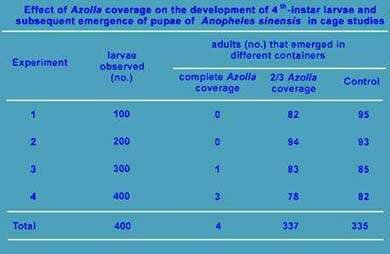
Slide J.13 Laboratory studies:
effect of Azolla coverage on anopheline
mosquitoes
J.14 Laboratory studies: effect of Azolla coverage on culicine mosquitoes

Slide J.14 Laboratory studies:
effect of Azolla coverage on culicine mosquitoes
Laboratory studies in China on the effect of Azolla coverage on mosquito oviposition and emergence showed that culicine mosquitoes can not lay there eggs at all in water that is completely covered with the fern. Under the same conditions, anophelines are not hampered in their oviposition, but larval development is retarded and successful emergence of the adult mosquito from the pupa is blocked.
Subsequent emergence studies in experimental rice fields showed that these observations have little practical value in real life conditions. The process of expanding the coverage of Azolla trails behind the vector breeding peak, and even starting of with a 70% coverage (which farmers are unlikely to apply), the coverage is never complete and sufficient surface water remains for mosquito population densities to build up.
J.15 Dragonfly on sugar cane, Tamil Nadu, India

Slide J.15 Dragonfly on sugar
cane, Tamil Nadu, India
FAO’s promotional efforts in the field of plant protection have led to the wide spread adoption of Integrated Pest Management (IPM) methods. In particular, the FAO Regional Rice IPM programme in South East Asia has been successful.
IPM aims to maintain an ecological balance in agricultural production systems as long as possible, with clear decision making criteria for farmers to switch to chemical control when crop damage is expected to pass an established economic threshold.
Predators, such as the dragonfly shown here on sugar cane, and parasites play a crucial role in keeping pest populations under control. Excessive applications of pesticide will have adverse effects on the medium term because the predator populations will take longer to restore than the populations of pest species.
The interface of IPM and Integrated Vector Control (IVC) in agro-ecosystems has been insufficiently explored and should be the subject of further research.
J.16 Gambusia for rice field mosquito control, Afghanistan

Slide J.16 Gambusia for
rice field mosquito control, Afghanistan
Gambusia is the most widely applied genus of larvivorous fish and can contribute importantly to keeping mosquito populations down. It is used in both rural and urban settings, and particularly effective in small water bodies.
J.17 Focal application of Bayluscide® in an irrigation canal, Egypt

Slide J.17 Focal application of
Bayluscide® in an irrigation canal, Egypt
Studies of snail distribution and human water contact patterns show that in most irrigation schemes transmission is focal rather than widespread. Consequently, chemical and manpower can be saved if snail control is effected at these transmission sites.
In Sudan this is done by applying one kilogram of Bayluscide® as 70% wettable powder mixed with 10 liters of water over a period of 40 minutes. The concentration achieved is 2-3 ppm of the active ingredient This application is done about 300 meters upstream from the village and will keep the target reach of the canal (i.e. the potential transmission sites at the village) free from snails for about 4-6 weeks, when the next application is carried out
J.18 Fish kill by Bayluscide®, Egypt

Slide J.18 Fish kill by
Bayluscide®, Egypt
Molluscicides can be biocidal at concentrations used to eliminate snail colonies, killing fish and amphibians. Often, dead fish are collected for consumption. Immediate harmful effects have not been reported, but the long term effects on human health of regular consumption of fish killed by these chemicals are not known.
J.19 Mechanical weed clearance of canals

Slide J.19 Mechanical weed
clearance of
canals
J.20 The Chinese grass carp

Slide J.20 The Chinese grass
carp
Regular weed clearance of canals will help reduce snail populations, but by itself is not sufficient to eliminate transmission. In irrigation canals weed clearance must be done to maintain water supply. Manual clearance may expose workers to the risk of schistosomiasis transmission. Mechanical clearance is only feasible economically as part of irrigation Canal maintenance, and not for the exclusive purpose of snail control. Herbivorous fish, such as the Chinese grass carp shown, have also been used in the battle against aquatic weeds.
J.21 Lined canal with fast water flow, Zimbabwe

Slide J.21 Lined canal with fast
water flow,
Zimbabwe
J.22 Drying out of canals
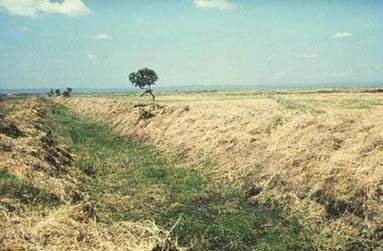
Slide J.22 Drying out of
canals
Concrete lining of canals (slide J.21, Hippo Valley Estate, a sugar estate in southern Zimbabwe) contributes to controlling snail populations, because higher flow speeds can be maintained and weed growth is minimized. Concrete lining also reduces seepage and the creation of pools where mosquitoes can breed. Observations have been made in studies in Pakistan that with time seepage re-occurs as cracks form in the lining; pools are, however, fewer in number and more clustered.
During the periods that irrigation water is not needed, canals can be left to dry: snail populations will diminish and aquatic weeds can be eliminated. In some parts of the world, small pools that may remain when canals are dried may be attractive breeding places for mosquito vectors (notably Anopheles culicifacies in Sri Lanka).
J.23 Control of Rhombomys colonies in the former USSR (now Uzbekistan)

Slide J.23 Control of
Rhombomys colonies in the former USSR (now Uzbekistan)
Colonial desert rodents create ideal habitats for sandflies in their relatively cool, moist burrows, across the entire Old World arid belt, from the northern edge of the Sahara to Mongolia and northern India. The animals also serve as a reservoir host to the Leishmania parasite. Agricultural development affects the sandflies in two main ways. Deep ploughing, shown in this slide, and other land disturbances eliminate Rhombomys and Psammomys species, two main reservoirs of cutaneous leishmaniasis, but often encourage Meriones species to increase in numbers. A second effect comes with changes in the water tables: depending on the location and vector species involved, either raising or lowering water tables may favour the breeding of sandflies. In the environmental impact assessment of the Flood Action Plan in Bangladesh, the possibility of increased risks of leishmaniasis transmission were distinctly identified in relation to a lower water table.
Reference:
Birley, M.H., 1993. An historical review of malaria, kala-azar and filariasis in Bangladesh in relation to the Flood Action Plan. Ann. Trop. Med. Paras. 87, 4: 319-334
J.24 Alternate wetting and drying in Chinese rice irrigation

Slide J.24 Alternate wetting and
drying in Chinese rice
irrigation
J.25 Vector larvae populations in conventionally irrigated rice fields versus those with alternate wetting and drying
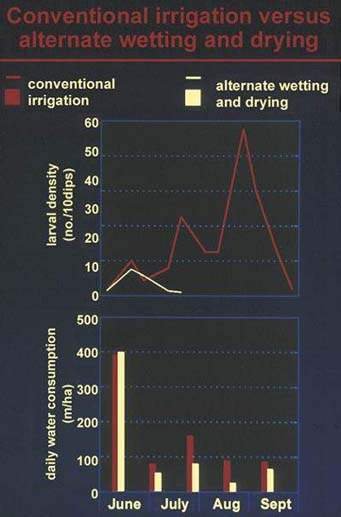
Slide J.25 Vector larvae
populations in conventionally irrigated rice fields versus those with alternate
wetting and
drying
J.26 Effect of alternate wetting and drying on the rice yield

Slide J.26 Effect of alternate
wetting and drying on the rice yield
Studies in China by Lu Bao Lin have demonstrated the effectiveness, under local conditions, of alternate wetting and drying of rice fields as opposed to permanently flooded fields, in controlling populations of Anopheles sinensis. Agronomic studies, run in parallel, showed a greater yield in the fields subject to the wetting and drying regime.
This approach, formerly incorrectly referred to as intermittent irrigation (a term which refers to the periodicity of the water influx into the system, but does not describe the actual water status in the fields) may be successful under specific conditions, but a first condition is the availability of sufficient water to irrigate the drained fields in time. Farmer communities are particularly sensitive to this issue and would strongly object to draining their fields without a guarantee of water availability. In areas with water scarcity, because of droughts, because of stretching the area under irrigation beyond capacity or both, a water management regime similar to alternate wetting and drying can be easily imposed. The impact of such a regime on Japanese encephalitis vector populations was tested in South India and proved very effective in reducing densities.
J.27 The International Code of Conduct

Slide J.27 The International Code
of Conduct
The International Code of Conduct on the Distribution and Use of Pesticides was developed by FAO in consultation with appropriate UN agencies and other organizations. The objectives of the code are to set forth responsibilities and establish voluntary standards of conduct for all public and private entities engaged in or affecting the distribution and use of pesticides, particularly where there is no or an inadequate national legislation to regulate pesticides. It focuses on the management, testing, regulation, distribution, trade, labeling, packaging, storage and disposal of pesticides. The Code of Conduct can be obtained from FAO, Via delle Terme di Caracalla, 00100 Rome, Italy.
The International Programme on Chemical Safety (IPCS, an interagency programme which is based at WHO, Geneva) addresses issues of safe use of pesticides, with special reference to pesticides used for public health purposes (insect and rodent control).
|
| ||||||||||||||||||||||||||||||||||||||||||||||||||||||||||||||||||||||||||||||||
Agricultural Development and Vector-Borne Diseases (FAO - HABITAT - UNEP - WHO, 1996, 91 p.)
Topic K: Rural settlements
List of slides
K.1 Overnight forest shelter, South East Asia
K.2 Forest workers camp, South East Asia
K.3 Forest family dwelling, Philippines
K.4 Lahu village, Thailand
K.5 Typical rice growing settlement, tropical lowlands of Bolivia
K.6 Typical rice growing settlement, tropical lowlands of Bolivia
K.7 Village scene, Myanmar
K.8 Village scene, Myanmar
K.9 Village ecology, rice growing area, Tamil Nadu, India
K.10 Village scene, Egypt
K.11 Displaced rural people in an urban slum, India
K.12 Integrated rural settlement development, Nepal
K.13 Use of impregnated mosquito nets in the Gambia
Credit individual slides:
World Health Organization
K.1, K.2,
Food and Agriculture Organization of the United Nations
K.3, K.4, K.5, K.6, K.7, K.8, K.10, K.11, K12
Robert Bos, Geneva
K.9
Danish Bilharziasis Laboratory
K.13
K.1 Overnight forest shelter, South East Asia

Slide K.1 Overnight forest
shelter, South East
Asia
K.2 Forest workers camp, South East Asia

Slide K.2 Forest workers camp,
South East Asia
The highly efficient malaria vectors in the forests of South East Asia, belonging to me Anopheles dirus complex, keep the transmission cycle going among forest workers, hunters and others who stay overnight in the jungle. Conventional chemical control methods (spraying house walls with residual insecticides) serve no purpose in the makeshift shelters as shown on slide K.1. Similar conditions prevail in the Amazon region of Brazil. In more permanent camps (slide K.2) chemical control can be used for endophilic vector species and the use of impregnated mosquito nets should be promoted for personal protection.
K.3 Forest family dwelling, Philippines

Slide K.3 Forest family dwelling,
Philippines
The typical housing conditions of this subsistence farming family in Quezon Province, Philippines illustrates a seemingly Arcadian setting where nevertheless vector-borne disease risks, in this case malaria, are a reality.
K.4 Lahu village, Thailand

Slide K.4 Lahu village,
Thailand
On-going deforestation around this village in northern Thailand will have reduced me immediate malaria risks. New developments may introduce new risks: rice cultivation combined with pig rearing will create conditions favourable to Japanese encephalitis, inadequate storage of drinking water (because of lack of drinking water or an unreliable supply) may lead to Aedes aegypti breeding and the risk of transmission of dengue and the establishment of commercial plantations may even bring back the malaria risks.
K.5 Typical rice growing settlement, tropical lowlands of Bolivia

Slide K.5 Typical rice growing
settlement, tropical lowlands of
Bolivia
K.6 Typical rice growing settlement, tropical lowlands of Bolivia

Slide K.6 Typical rice growing
settlement, tropical lowlands of Bolivia
The living conditions of this rice growing family in Bolivia’s lowlands are affected by the various endemic diseases they are exposed to: malaria, yellow fever and some of the more exotic or emerging arboviral haemorrhagic fevers. This type of dwellings offers little or no opportunity for personal protection measures to become part of the structure.
K.7 Village scene, Myanmar

Slide K.7 Village scene,
Myanmar
K.8 Village scene, Myanmar

Slide K.8 Village scene,
Myanmar
This settlement in a rice producing area in Myanmar appears to have all the features of a place where vector-borne disease problems are not a mere hazard, but a real risk. Myanmar is one of the countries where rodent-borne diseases are a serious public health problem. Clearly, agricultural areas with storage of grains and other produce, have large rodent populations. Depending on the region, leptospirosis, plague or scrub typhus may be important public health problems.
K.9 Village ecology, rice growing area, Tamil Nadu, India

Slide K.9 Village ecology, rice
growing area, Tamil Nadu, India
This slide shows several of the crucial elements of the ecology of a village in southern India (in this case: Vellikurichi, Tamil Nadu) in a rice growing area where Japanese encephalitis is endemic. There is a mix of human dwellings and cattle housing, both providing ample sources of blood meals for mosquitoes. On the fringes, vegetable gardens provide humid mosquito resting sites during the hottest period of the day, while the mosquitoes (of the Culex vishnui group) breed in the flooded rice fields beyond. Groups of trees serves as grooming places for birds: egrets and herons may transport the JE virus over great distances. The only element missing in this slide: pigs, which serve as the amplifying hosts for the virus.
K.10 Village scene, Egypt

Slide K.10 Village scene,
Egypt
In this peri-urban scene from Egypt, the surfaced roads and concrete building represent me urbanization process, but both physical aspects (the drainage canal) and behavioural aspects (women doing the laundry in the canal) remind one of rural settings. It is in these unplanned peri-urban extension, where the urbanization process proceeds unplanned and institutional arrangements are hopelessly inadequate to deal with even the minimum of services required, that growing populations live under conditions that are very hazardous to their health, usually with little or no access to health services. Even the minimum requirements in urban planning are not respected, such as taking into consideration the gradient in connection with proper drainage. Where urban zoning plans exist, separating areas for residential purposes, for small industry and businesses, and green zones, there are no mechanisms to enforce these plans once construction is underway. Construction and design standards, which could help reduce health risks (as demonstrated in the case of rooftop drinking water tanks in relation to A. stephensi breeding in Bombay) are often not observed.
Where fresh water canals turn into organically polluted drains, malaria risks are replaced by those of filariasis; small water collection in and around the house in urban and peri-urban areas create ideal conditions for the transmission of dengue by Aedes mosquitoes
K.11 Displaced rural people in an urban slum, India

Slide K.11 Displaced rural people
in an urban slum, India
When agriculture fails to support rural populations, there is an inevitable migration to urban centres. This community of landless poor lives in tents and shacks on the outskirts of Old Delhi, without access to safe drinking water or sanitary facilities. It can be questioned whether the health risks they left behind in their rural community are of a different magnitude from those they encounter in the new, urban setting.
K.12 Integrated rural settlement development, Nepal

Slide K.12 Integrated rural
settlement development, Nepal
The development of integrated rural settlements, such as here in Nepal, aim to take the various aspects of rural life into consideration. This includes the provision of safe drinking water, adequate sanitation, the screening of houses where nuisance or vector mosquitoes are a problem, and the promotion of vegetable gardens to offer people a healthy and varied diet.
K.13 Use of impregnated mosquito nets in the Gambia

Slide K.13 Use of impregnated
mosquito nets in the Gambia
With agricultural development, rural communities often improve their economic status to the extent where it becomes possible to purchase medicine, afford health services and buy personal protection devices against mosquito vectors, such as mosquito nets. The phenomenon observed in several irrigated rice schemes in West Africa of an increase in mosquito densities and a concomitant reduction in malaria transmission is, by some, explained by this economic progress.
Prices of mosquito nets vary, but in Senegal farmers in the St Louis area pay 6000 CFA francs for a two person net, which compares to an annual irrigation fee of 42 000 CFA francs for one hectare of land (1997 prices).
Mosquito nets can be used as a physical barrier, but they can also be impregnated with insecticide and help reduce vector populations. Social acceptability is a crucial factor for their success. In some cultures they are appreciated for the additional privacy they provide, but in hot climates they are experienced as uncomfortable.
|
| ||||||||||||||||||||
Agricultural Development and Vector-Borne Diseases (FAO - HABITAT - UNEP - WHO, 1996, 91 p.)
Bibliography
PEEM publications
Birley, M.H., 1991. Guidelines for the forecasting of vector-borne disease implications of water resources development. PEEM Guidelines series 2, document WHO/CWS/91.3, PEEM Secretariat, World Health Organization, Geneva
Mather, T.H., and Bos, R., 1990. Policies and programmes of governments, bilateral and multilateral agencies and development banks for environmental management in the context of natural resources, agriculture and health development. Document VBC/89.7. PEEM Secretariat, World Health Organization, Geneva
Phillips, M., Mills, A. and Dye, C., 1993. Guidelines for cost-effectiveness analysis of vector control. PEEM guidelines series 3, document WHO/CWS/91.2, PEEM Secretariat, World Health Organization, Geneva
Tiffen, M., 1991. Guidelines for the incorporation of health safeguards into irrigation projects through intersectoral cooperation. PEEM Guidelines series 1. Document WHO/CWS/91.2, World Health Organization, Geneva
IRRI/PEEM, 1988. Vector-borne disease control in humans through rice-agroecosystem management. International Rice Research Institute/WHO/FAO/UNEP Panel of Experts on Environmental Management for Vector Control, IRRI, Los Ba�os, Philippines
WHO, 1994. Incorporating a human health component into the integrated development and management of the Lower Mekong Basin. PEEM River Basin Series no. 1.
WHO, 1994. Incorporating a human health component into the integrated development and management of the Zambezi Basin. PEEM River Basin Series no. 2.
WHO, 1995. Promotion of environmental management for disease vector control through agricultural extension programmes. Report of the first inter-regional workshop (Alexandria, Egypt, 23-26 September 1991). PEEM Secretariat, World Health Organization, Geneva, Switzerland.
WHO, 1995. Promotion of environmental management for disease vector control through agricultural extension programmes. Report of the second inter-regional workshop (Bangkok, Thailand, 27 October 1991). PEEM Secretariat, World Health Organization, Geneva, Switzerland.
Other publications
AAAS, 1991. Malaria and development in Africa. A cross-sectoral approach. American Association for the Advancement of Science, Washington, D.C.
Birley, M.H., 1995. The health impact assessment of development projects. HMSO, London
Bunnag, T., and Sornmani, S., 1988. The impact of water resources development on the health of communities and preventive measures for adverse effects. Proceedings of the 30th SEAMEO-TROPMED seminar, Surat Thani, Thailand. Faculty of Tropical Medicine, Mahidol University, Bangkok
Cairncross, S. and Feachem, R., 1993. Environmental health engineering in the tropics. An introductory text. (2nd ed.). John Wiley and sons, Chichester
Cooper-Weil, D.E., Alicbusan, A.P., Wilson, J.F., Reich, M.R., and Bradley, D.J., 1990. The impact of development policies on health. A review of the literature. World Health Organization, Geneva
Curtis, C.F. (Ed.), 1990. Appropriate technology in vector control. CRC Press, Boca Raton, Florida
Hunter, J.M., Rey, L., Chu, K.Y., Adekolu-John, E.G., and Mott, K.E., 1993. Parasitic diseases in water resources development. The need for intersectoral negotiation. World Health Organization, Geneva
Jobin, W.R., 1992. Irrigation planning and prevention of bilharzia. Blue Nile handbook one. Blue Nile Associates, Box 218, Meeker, Colorado, USA
Jobin, W.R., 1992. Bilharzia prevention and hydro-electric reservoirs. Blue Nile handbook two. Blue Nile Associates, Box 218, Meeker, Colorado, USA
Lee, J.A., 1985. The environment, public health and human ecology. The International Bank for Reconstruction and Development/the World Bank, Washington DC
Lipton, M., and de Kadt, E., 1988. Agriculture-health linkages. World Health Organization, Geneva
Margraf, B. (Ed.), 1996. Effets sanitaires de l’irrigation et des am�nagements hydro-agricoles. Le cas de Madagascar. Heidelberg Studies in Applied Economics and Rural Institutions, Verlag f�r Entwicklungspolitik, Saarbr�cken, Germany
Oomen, J.M.V., de Wolf, J., and Jobin, W., 1988. Health and irrigation. Incorporation of disease control measures in irrigation, a multifaceted task in design, construction, operation. Volumes 1 and 2. ILRI Publication 45. International Institute for Land Reclamation and Improvement, Wageningen, the Netherlands
Pike, E.G., 1987. Engineering against schistosomiasis/bilharzia. Guidelines towards control of the disease. MacMillan Publishers, London
Takken, W., Snellen, W.B., Verhave, J.P., Knols, B.G.J., and Atmosoedjono, S., 1991. Environmental measures for malaria control in Indonesia: an historical review on species sanitation. Wageningen Agricultural University Papers 90.7, Agricultural University Wageningen, the Netherlands
Wooldridge, R. (Ed.), 1991. Techniques for environmentally sound water resources development, volumes 1 and 2. Report of the African Regional Symposium on techniques for environmentally sound water resources development, Alexandria, Egypt, 1991, Pentech Press Ltd, London
PEEM COLLABORATING CENTRES
Danish Bilharziasis Laboratory, Jaegersborg All� 1 D, DK-2920 Charlottenlund, Denmark. Focal point - Mr P. Furu.
Department of Medical Entomology, Health Impact Programme, Liverpool School of Tropical Medicine, Pembroke Place, Liverpool L3 5QA, U.K. Focal point - Dr Martin H. Birley.
Faculty of Tropical Medicine, Mahidol University, 420/6 Rajvithi Road, Bangkok, Thailand. Focal point - Prof. Sornchai Looareesuwan.
Instituto Oswaldo Cruz, CX Postal 926 - CEP 20000, Rio de Janeiro RJ, Br�sil. Focal point - Professor Fernando Dias de �vila Pires.
International Irrigation Management Institute, P.O. Box 2075, Colombo, Sri Lanka. Focal point - Mr. Flemming KoNradsen. (In 1997 a new health and irrigation programme coordinator will be appointed)
Institute for Land Improvement and Water Management, Swiss Federal Institute of Technology, EHT H�nggerberg, Zurich, Switzerland. Focal point - Professor Martin Fritsch
London School of Hygiene and Tropical Medicine, Keppel Street, London WC1E 7HT, United Kingdom. Focal point - Professor David Bradley
Malaria Research Centre, 22 Sham Nath Marg, Delhi 110054, India. Focal point - Dr V.P. Sharma
National Water Research Centre, Fum Ismalia Canal, P.O. Box 74, Shoubra El-Kheima, Cairo, Egypt. Focal point - Dr Mahmoud Adu-Zeid.
Tennessee Valley Authority, 400 West Summit Hill Drive, Knoxville, Tennessee 337902-1499, USA. Focal point - Dr J. Cooney.
The International Centre of Insect Physiology and Ecology, P.O. Box 30772, Nairobi, Kenya. Focal point - Dr Hans Herren.
The Queensland Institute of Medical Research, The Bancroft Centre, P.O. Royal Brisbane Hospital, Queensland 4029, Australia. Focal point - Dr Brian H. Kay.
West Africa Rice Development Association, 01 BP 2551, Bouak�, C�te d’Ivoire. Focal point - Dr P. Matlon
|
| |||||||||||||||||||||||||||||||||||||||||||||||||||||||||||||||||||||||||||||||||||||
Slide Set Series
The World Health Organization’s Slide Set Series on vector biology and control meets the need for visual training aids illustrating the fundamentals of vector biology, behaviour and control. Intended for use in seminars, briefing sessions and classroom lectures, the sets offer a rare opportunity to view different vectors in their favourite habitats, see the diseases and destruction they cause and observe the application of control measures under real conditions around the globe.
Each set consists of a series of colour slides accompanied by explanatory notes. Within each set, slides and notes are organized by topic to form a series of self-contained presentations. Eight of the twelve sets concentrate on a single vector or group of vectors, drawing upon WHO experience to present a global view of the related public health problems and recommended measures for control. Three sets provide training in environmental management and in the operation, maintenance and repair of equipment. The present set highlights the vector-borne disease aspects of agricultural development and aims to promote the human health dimension of the concept of sustainability.
Regardless of the topic, each set challenges students to understand the magnitude of problems posed by vectors and the difficulty of applying the theory of control to real conditions in the field. The sets can also be used to instruct operational staff in the correct use of insecticides, biological agents, sanitary measures and other methods of control.
Other sets in this series include
Aedes aegypti · Cockroaches · Environmental Management for Vector Control · The Guinea Worm · Hand-operated Compression Sprayers · The Housefly · The Intermediate Snail Hosts of African Schistosomiasis · Malaria Vectors · Motorized Pesticide Application Equipment · Rodents · Sandflies