 |
| ||||||||||||||||||||||||
|
| ||||||||||||||||||||||||
Three home-processing and preservation techniques
COPYRIGHT AND OTHER INTELLECTUAL PROPERTY RIGHTS, Food and Agriculture Organization of the United Nations (FAO) and the Informartion Network on Post-Harvest Operations (INPhO) 1998. All copyright and intellectual property rights reserved. No part of the procedures or programs used for the access to, or the display of, data contained in this database or software may be reproduced, altered, stored on a retrieval system or transmitted in any form or by any means without the prior permission of the Food and Agriculture Organization of the United Nations (FAO) and the Informartion Network on Post-Harvest Operations (INPhO). Applications for such permission, explaining the purpose and extent of reproduction, should be addressed to the Director, Information Division, Food and Agriculture Organization of the United Nations (FAO), Viale delle Terme di Caracalla, 00100 Rome, Italy. Data contained in this database or software may, however, be used freely provided that the FAO and INPhO be cited as the source. FAO and INPhO decline all responsibility for errors or deficiencies in the database or software or in the documentation accompanying it, for program maintenance and upgrading as well as for any damage that may arise from them. FAO and INPhO also declines any responsibility for updating the data and assumes no responsibility for errors and omissions in the data provided. Users are, however, kindly asked to report any errors or deficiencies in this product to FAO.
|
| ||||||||||||||||||||||||
Production diagram for the three preservation techniques
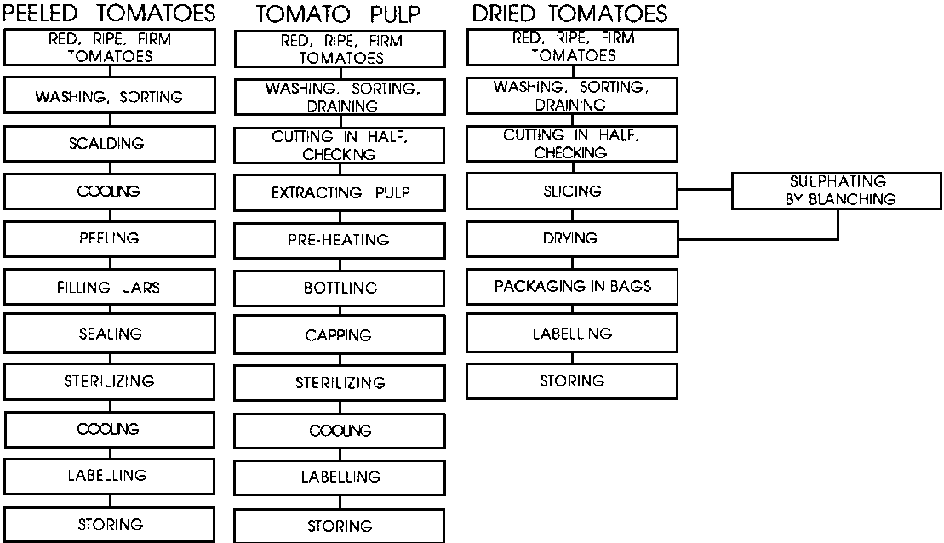
Production diagram for the three
preservation techniques storage time
Jars of peeled tomatoes and bottles of pulp for making sauces and other preparations can be used for twelve months, and dried tomatoes for three or twelve months depending on the processing (see the expiry date on the label).
|
| ||||||||||||||||||||||||
Recommendations
1 Wash your hands before every operation. This rule is particularly important in preparing dried tomatoes.
2 Remove the damaged parts of fresh tomatoes.
3 Wash utensils, equipment and trays after use in clean water.
4 Addition of the preservative, potassium metabisulphite, protects the tomatoes forms bacteria, yeast and moulds. However, this solution cannot prevent the multiplication of germs if the preparation and drying are done in unsanitary conditions.
5 For each finished product jar, bottle, bag) the label must show:
- the nature of the product (peeled tomatoes, tomato pulp, dried tomatoes)
- the net weight
- the origin (name of the group or cooperative)
- the expiry date
|
| ||||||||||||||||||||||||
Sterilization time
|
Size of container in litres |
Temperature of the contents |
Sterilization time |
|
0,33 |
60 ºC |
40 minutes |
|
0,50 |
60 ºC |
45 minutes |
|
0,66 |
60 ºC |
55 minutes |
|
0,75 |
60 ºC |
60 minuses |
|
1 litre |
60 ºC |
70 minutes |
|
| ||||||||||||||||||||||||
Processing materials and equipment
PROCESSING MATERIALS AND EQUIPMENT
Aluminium or plastic 20-litre buckets
Plastic 40 litre
basin
Stainless-steel or aluminium 30-litre cooking pots
Aluminium
25-litre pots
Half-litre jars and lids
Half-litre bottles and
caps
Polythene bags and bands to close them
Labels
Knives
Wooden
spoons
Stainless-steel or aluminium skimmers
Stainless-steel or aluminium
ladles
Stainless-steel or plastic strainers
Stainless-steel or plastic
funnels
Lemon squeezer
Small spoons
Chemical products: potassium
metabisulphite
EQUIPMENT
Improved stove
Extractor
Bottle-capper
Solar dryer
N.B. Never use copper utensils, because this metal destroys some of the vitamin C