 |
| ||||||||||||||||||||||||||||||||||||||||||||||||||||||||||||||||||||||||||||||||||||||||||||||||||||||||||||||||||||||||||||||||||||||||||||||||||||||||||||||||||||||||||||||||||||||||||||||||||||||||||||||||||||||||||||||||||||||||||||||||
|
| ||||||||||||||||||||||||||||||||||||||||||||||||||||||||||||
Division 402
Environmental Protection and Conservation of
Resources/Dissemination of Appropriate
Technology GATE
Solar Drying in Morocco Programme Sp�cial Energie (PSE) Maroc
CENTRE DE DEVELOPPEMENT DES ENERGIES RENOUVELABLES (CDER)
Deutsche Gesellschaft f�r Technische Zusammenarbeit (GTZ ) GmbH Centre de D�veloppement des Energies Renouvelables Deutsche Gesellschaft f�r Technische Zusammenarbeit
Manual of Solar Drying
Centre de D�veloppement des Energies Renouvelables (CER) Office Regional de Mise en Valeur Agricole du Haouz (ORMVAH) Deutsche Gesellschaft fur Technische Zusammenarbeit (GTZ) GmbH
Authoren: Markus H�user, Omar Ankila
|
| ||||||||||||||||||||||||||||||||||||||||||||||||||||||||||||
1. Introduction
Preservation of agricultural produce is one of the central problems facing developing countries. Owing to the lack or inadequacy of preservation methods, large quantities of urgently needed food spoil there. And as time goes on, these problems will be aggravated by the growing dietary needs of these countries burgeoning populations.
In Morocco this problem exists with many fruit and vegetable varieties, which cannot be marketed fast enough owing to their limited keep-ability. Large quantities of apricots, grapes, and tomatoes spoil owing to inadequate infrastructure, insufficient processing capacities, and growing marketing difficulties caused by intensifying competition and protectionism in the world's agricultural markets. Drying these products can help solve these problems, while also making an important contribution to improving the population's income and supply situation.
However, traditional sun drying methods often yield poor quality, since the produce is not protected against dust, rain and wind, or even against insects, birds, rodents and domestic animals while drying. Soiling, contamination with microorganisms, formation of mycotoxins, and infection with disease-causing germs are the result. The drying equipment used in industrialized countries overcomes all of these problems, but unfortunately is not very well-suited for use in Morocco because it requires substantial investments and a well-developed infrastructure.
Solar drying facilities combine the advantages of traditional and industrial methods, namely low investment costs and high product quality. Based upon this realization, the "Special Energy Program Morocco (SEP)" of the Deutsche Gesellschaft f�r Technische Zusammenarbeit (GTZ) GmbH provided the framework for an effort to develop a solar dryer that is appropriate to the climatic and structural conditions prevailing in Morocco. This work was conducted in cooperation with the Office Regional de Mise en Valeur Agricole du Haonz (ORMVAH) in Marrakech, the Institut Agronomique et V�t�rinaire Hassan II (IAV) in Rabat, the Centre de D�veloppement des Energies Renouvelables (CER) in Marrakech and the Institute for Agricultural Engineering in the Tropics and Subtropics of the University of Hohenheim (UK) in Stuttgart, Germany.
The first phase (1989-1990) of the project section "Solar Drying" was devoted to developing a dryer for fruits and vegetables that could be constructed using locally available materials only. In the second phase (1991-1993), this solar dryer served as the basis for devising a batch dryer for medicinal and spice plants to diversify the product palette. Parallel to this, market analyses were carried out for the dried products and the economic efficiency of the solar dryer was calculated. In the ongoing third phase (1994-1996), additional demonstration facilities are being installed to support dissemination of the solar dryer.
|
| ||||||||||||||||||||||||||||||
Solar Drying in Morocco (GTZ)
2. Solar dryer of the Marrakesh type
2.1 Solar dryer for fruits and vegetables
A solar dryer of the Marrakech type for drying fruits and vegetables was set up in 1991 on the test plot of the Centre de Mise en Valeur (CMV) S�ada des Office Regional de Mise en Valeur Agricole du Haouz (ORMVAH). Its design was based on that of the tunnel-type solar dryer of the Hohenheim type, but exclusive use was made of materials available in Marrakech Province for constructing it.
The solar dryer of the Marrakech type exists in two different versions. One is a standard model that nuns on electricity from a power source and must therefore be plugged in, and the other is a model equipped with a photovoltaic (PV) drive system for locations where no electricity is available. The basic construction consists of a platform of hollow bricks supported by a reinforced concrete frame. This modular design makes it possible to lengthen or shorten the collector, or dryer, depending on what kind of produce needs to be dried and the desired output.
Since hardly any rain falls during the drying season, the system is not equipped with a saddle-back roof, instead being merely covered with a plastic sheet stretched taut across its top.
In the standard version, the overall length of the dryer is 30 m with a width of 2 m. In order to prevent the produce from being contaminated by earth and dust, and also in order to simplify filling and emptying of the dryer, the entire structure is mounted on pedestals 75 cm high (see Fig. 1).

Fig. 1 Solar dryer of the Marrakech
type for fruits and vegetables
In order to reduce heat losses, a layer of granular cork 20 mm thick is inserted as insulation.
On top of the granular cork is a 10-mm layer of smoothly troweled concrete that is coated with dullblack, nontoxic paint. The absorption surface area is 18.8 m2 (see Fig. 2).

Fig. 2: Cross-sectional view of the
collector
The system powered by electricity from an external source uses a radial fan. The one with PV drive works with a solar module and an axial fan.
The solar module can be set up outside the dryer, or else directly positioned horizontally in the flow of air from the fan. This has the advantage of cooling the solar module, thus improving its efficiency.
An intake nozzle at the air inlet and air-baffle plates on the outlet of the fan achieve even distribution of the air flow over the entire cross-section of the drying system.
The air is sucked in from below and blown between the absorber and the cover sheet through the collector and into the dryer.
There is fine-meshed wire screen both at the fan inlet and at the dryer outlet, in order to make it more difficult for insects, rodents, and birds to enter the system.
In the mains-powered version, the drying temperature can be kept from exceeding the desired maximum by voltage-dependent speed control for the fan. The supply voltage is controlled by a remote thermostat with a temperature sensor and a toroidal-core transformer. The air flow rate can then be set to any value between 0 and 1300 m³/h. Assuming constant insolation, increasing the air flow rate causes the temperature in the collector to drop.
In the PV-powered system, the fan is directly coupled to the solar module, working without an accumulator and load controller. Increasing insolation increases the module's output, thus speeding up the fan. This has the advantage of permitting temperature control merely by appropriately designing the components of the PV system, thus obviating any additional control devices as long as the system is suitably dimensioned.
Table 1: Technical data of the drive systems (freely blowing)
|
Drive system |
|
Mains-powered |
|
Photovoltaic (P V) |
|
Components | |
Radial fan |
Axial fan |
Solar module |
|
Maker | |
ebm |
Fiat |
Solarex |
|
Type | |
R4E 280-AD0805 |
Uno, gasoline-fueled model |
MSX 83 |
|
Rated voltage |
V |
220 |
12 |
16.9 |
|
Rated current |
A |
0.33 |
7.0 |
4.92 |
|
Nominal consump tion |
W |
70 |
84.0 |
83.2 |
|
Air flow rate |
m³/h |
1360 |
1520 | |
|
Rated speed |
RPM |
1400 |
2800 | |
The dryer is also covered by PE sheet 0.2 mm thick. The system is opened and closed using a winding shaft. A hand-crank is turned to wind up the entire length of the plastic sheet on the shaft, thus exposing the inside of the dryer for loading or unloading (see Figure 3).
At the dryer's inlet and outlet, the PE sheet is affixed by a special clamp closure to keep the air in while keeping dust and rain water out.
The produce to be dried is spread out on a wire grating 20 mm high, which is covered by a finely-woven polyester fabric stretched taut.
When drying is in progress, the warm air flows evenly over and beneath the produce, which therefore does not need to be turned. The air absorbs water vapor and then escapes at the other end of the system. The effective drying surface is 40 m².

Figure 3: Cross-section of dryer
Table 2 lists all of the materials used to build the solar dryer.
2.2 Solar dryer for medicinal and spice plants
The solar dryer of the Marrakesh type for medicinal and spice plants was set up in 1993 on the test plot of CMV S�ada. This system had been jointly developed by all project partners during the course of a seminar on drying of medicinal and spice plants that was held at the University of Hohenheim in 1992.
Table 2: Parts list for the solar dryer of the Marrakesh type for fruits and vegetables
|
Designation |
|
Quantity |
|
Sand | |
5 m³ |
|
Gravel |
8/15 |
3 m³ |
|
Cement |
250/315 |
72 dt |
|
Hollow bricks |
30 x 30 x 15 cm |
615 units |
|
Rebars |
10 mm dia. x 12 m |
36 units |
| |
8 mm dia. x 12 m |
45 units |
| |
6 mm dia. x 12 m |
45 units |
|
Metal angles |
30 x 30 mm x 6 m |
lo units |
|
Pipe |
1/2" x 6 m |
4 units |
|
Wire mesh |
40 x 40 x 3 mm |
40 m² |
| |
10 x 10 x 0,5 mm |
60m² |
|
Sheet metal |
2000 x 1000 x 1.5 mm |
3 units |
|
Polyester fabric |
|
40 m² |
|
Cork |
1000 x 500 x 20 mm |
1.15 m³ |
|
PE sheet | |
83.2 m² |
|
Paint |
Black, matte |
30 kg |
|
Clamping strip |
Snappan |
65 m |
|
Small parts and materials |
(Nails, screws, wire, adhesive tape, cables, etc.) | |
|
PV drive: |
Fan from Fiat Uno gasoline-fueled 1unit model |
1 unit |
| |
Solar module: Solarex |
MSX 83 |
|
Mains-powered drive: |
Fan, EBM R4E 280 AD |
1 unit |
| |
Toroidal core transformer |
1 unit |
| |
Temperature control system |
1 Unit |
The dryer is integrated into a building with a saddle-back roof. The solar dryer for fruits and vegetables serves as the collector for warming the air.
The originally installed fan is replaced by a more powerful one.
The warm drying air is introduced into the batch dryer by way of a removable connecting passage.
The drying building is 7 m long, 3.4 m wide, and 5 m high (see Figure 4).
Batch drying of herbal medicinal and spice plants requires the system to be operated with substantially greater air throughput rates than for drying fruits or vegetables. The mains-powered system is therefore equipped with a larger radial fan, and the PV-driven version has a total of four solar modules and three axial fans connected in parallel.
Here again, the fans are equipped with inlet nozzles and air-baffle plates in order to achieve even distribution of airflow in the collector.
The air is taken in from below, then blown through the collector between the absorber and the cover sheet, whereupon it passes through the connecting passage to enter the batch dryer.
Temperature control works as described in section 3.1. The air flow rate varies between 0 and 3850 m3/h.
Table 3 lists the data for the different drive systems.

Figure 4: Solar dryer of the
Marrakesh type for medicinal and spice plants
Table 3: Technical data of the drive systems (freely blowing)
|
Drivesystem |
|
Mains-powered |
Photovoltaic (PV) | |
|
Components | |
Radial fan |
Axial fan |
Solar module |
|
Maker | |
Ziehl-Abegg |
Fiat |
Solarex |
|
Type | |
RH40M4Ek.4F. lR |
Uno gasoline-fueled MSX 83 model | |
|
Rated voltage |
V |
220 |
12 |
16.9 |
|
Rated current |
A |
2.4 |
7.0 |
4.92 |
|
Nominal consumption - |
W |
520 |
84.0 |
83.2 |
|
Air Bow rate |
rn³/h |
4100 |
1520 | |
|
Rated speed |
rpm |
1365 |
2800 | |
The connecting passage is made of plywood elements lined on the inside with Styrofoam and attached to the building by hinges. In just a few steps, the side sections and the floor of the passage can be folded into place by hand to make the connection to the collector. The passage is sealed on the top by a PE sheet. Like in the other described system, this sheet is held in place by clamps on metal strips attached to the long sides (see Figure 5).

Figure 5: Lengthwise cross-section
of connecting passage
The building frame for the batch dryer is made of brick masonry. The roof consists of wooden beams covered by plywood and roofing felt. On top of the ridge is a raised, 30-cm-high venting stack extending the entire length of the building (see Figures 6 and 7).
There are additional venting apertures on both gables and on one long side (each measuring 80 x 56 cm). To keep out insects, all venting apertures are covered with wire screen.
A double-leafed door (300 x 200 cm) can be opened to fill the dryer directly from a transport vehicle via the loading platform.
The drying air flows from the collector into the thermally insulated expansion compartment, where its volume increases. It then flows vertically through the produce on the grating, absorbing water vapor in the process. Finally, it escapes through the venting apertures.
An upright plywood partition of variable height lets the produce be piled up to 1.5 m thick. While drying, the produce can be turned from the side aisle using a pitchfork.
To prevent the produce from falling into the expansion compartment, a finally-woven polyester fabric is attached to the grating. The grating is 6 m long and 2 m wide, yielding a total drying area of 12 m².
Table 4 lists all of the materials used to build the batch dryer building.

Figure 6: Cross-section of dryer
building

Figure 7: Lateral view of dryer
building
Table 4: Parts list for the batch dryer of the Marrakech type for medicinal and spice plants
|
Designation |
|
Quantity |
|
|
Sand | |
4 m | |
|
Gravel |
8/15 |
4 m³ | |
|
Cement |
250/315 |
80 dt | |
|
Solid bricks |
40 x 15 x 10 cm |
350 units | |
|
Hollow bricks |
40 x 15 x 15 cm |
550 units | |
|
Rebars |
10 mm dia. x 12 m |
7 units | |
| | |
8 mm dia. x 12 m |
24 units |
| | |
6 mm dia. x 12 m |
6 units |
|
Wire screen |
Moustiquaire |
4 m² | |
|
Metal plates |
50 x 5 mm x 6 m |
4 units | |
|
Styrofoam sheets |
100 x 50 x 2 cm |
70 units | |
|
Wooden rafters |
7 x 20 x 600 cm |
8 units | |
| | |
7 x 20 x 480 cm |
2 units |
| | |
7x20x420cm |
9 units |
| | |
7 x 20 x 200 cm |
1 unit |
|
Plywood sheets |
200 x 122 x 1 cm |
2 units | |
| |
250 x 122 x 1 cm |
12 units | |
|
Roofing felt |
|
40 m² | |
|
Small parts and materials |
(Nails, screws, steel wire, wood glue, | |
|
|
|
threaded bars, hinges, etc.) | | |
| | |
| |
|
PV drive: |
Fan from Fiat Uno gasoline-fueled model |
3 units | |
| |
Solar module: Solarex MSX 83 |
4 units | |
|
Mains-powered drive: |
Fan, ZIEHL-ABEGG RH 40 M |
1 unit | |
| |
Toroidal-core transformer |
1 unit | |
| |
Temperature control system |
1 unit | |
2.3 List of suppliers
Table 5 gives a list of suppliers of the materials required to build solar dryers of the Marrakesh type for fruits and vegetables or medicinal and spice plants.
Table 5: List of suppliers in Morocco
Steel, shaped metal parts, sheetmetal, gratings, screens,
wire:
COMPTOIR DES MILIES, Rue Yougoslavie, Marrakesh Gu�liz
COMPTOIR METALLURGIQUE MAROCAIN, Boulevard Mohamed V, Marrakesh Gu�liz
ETS SAFA, Boulevard Allal EL Fassi, Marrakesh
FATH METALL, Avenue Abdellah Ben Yassine, Marrakesh Quartier Industriel
Wooden beams, plywood, PE sheet, roofing felt, paint, polyester
fabric, small parts and materials:
DROGUERIE UNIVERSELLE DU SUD, Rue R'Mila, Marrakesh M�dina
COMPTOIR BAB DOUKALA, 1 l, Avenue Hassan II, Marrakesh
ETABLISSEMENT DEBBAGH, 80, Rue Mouritania, Marrakesh
Electrical supplies:
ELECTRICITE MENARA; 10, Avenue Fatim Zohra R'Mila, Marrakesh
FOURNITURES GENERALES D'ELECTRICITE, 14, Boulevard Allal El Fassi,
Marrakesh
Clamping strips (Snappan):
ABDELGHANI, 49, Avenue Fatim Zohra R'Mila, Marrakesh
Fans for PV drive:
AUTO HALL, Rue Yougoslavie, Marrakesh Gu�liz
Fans for mains-powered version, solar modules, remote thermostats, transformers:
AFRISOL 219 Rue Mustapha El Maani Casablanca
|
| ||||||||||||||||||||||||||||||||||||||||||||||||||||||
Solar Drying in Morocco (GTZ)
3. Drying techniques
3.1 Drying of fruits and vegetables
3.1.1 Principle of operation
The solar dryer of the Marrakesh type converts solar energy into heat and electricity, exhibiting typical operational characteristics that are described in the following on the basis of selected examples.
Figure 8 shows the daily pattern of global radiation, ambient temperature, and temperature of the drying air at the dryer intake and outlet while the drying system is empty, on a typical cloudless summer day (June 20, 1991).
Total daily global radiation reached a value of 7.85 kWh/m² When the sun was at its zenith, a maximum radiation intensity of 973 W/m² was measured.
The global radiation is absorbed by the collector and the dryer, converted into heat energy, and then convectively emitted to the drying air. The temperature of the drying air increases with the global radiation, reaching 65°C at the dryer intake about 45 minutes after zenith. This yields a maximum temperature rise in the collector of 29 K. Inside the dryer, the temperature increases by another 14 K; the daily maximum at the dryer outlet is 79°C. During the night, the system radiates heat and the drying air cools to a temperature that is 4 K below ambient on average.

Figure 8: Daily pattern of global
radiation, ambient temperature, and temperature of the drying air at the dryer
intake and outlet in Marrakesh on June 20, 1991 (V = 730 m³/h)
When the system is being used for drying, evaporation of the moisture content of the produce causes the air inside the dryer to cool. If the produce contains a great deal of moisture, the resulting cooling effect is correspondingly great; with a low moisture content, by contrast, absorbed radiation completely offsets the cooling effect and the temperature even continues to rise toward the dryer outlet. Consequently, during operation a drying zone forms and gradually migrates from the intake to the outlet.
The temperature rise in the collector is proportional to the global radiation (see Figure 9). While air is flowing through the collector, the supply voltage applied to the fans—and consequently the air flow rate—is inversely proportional to the temperature reached. At a radiation intensity of 1000 W/m², the solar dryer of the Marrakesh type heats up by l9 K at an applied voltage of 220 V (air flow = 1300 m³/h), and by 29 K at 100 V (air flow = 730 m³/h). The point where the regression line intersects the x-axis indicates the radiation level at which the collector begins supplying heat energy. At an air throughput of 1300 m³/h, nearly 200 W/m² global radiation is needed in order to compensate for the system's heat losses.

Figure 9: Temperature rise in the
collector at supply voltages of 100 and 220 V, as a function of global radiation
The PV-powered version has the advantage that the supply voltage powering the fans, and thus also the air flow volume, increases with the intensity of radiation. This prevents the produce from being damaged by excessive temperatures. Over the course of the day, the operating air flow volume varies between 370 and 930 m³/h. At a radiation intensity of 1000 W/m², the solar module generates 16.9 V. If the voltage drops below 6 V, the fans come to a halt. Consequently, they cannot operate at night.
Figure 10 shows the collector's effective output as a function of global radiation.
As long as the air flow rate remains constant, there is a linear relationship between useful output and global radiation.
The collector requires a certain minimal radiation intensity in order for the system to begin supplying useful energy. This minimum is higher at greater temperature differentials, that is, at lower air flow rates. This is because of better transmission of heat between the absorber and the air current on the one hand, and the smaller heat losses at faster air speeds. All radiation above this level is converted into useful output with a constant efficiency factor.
Figure 11 shows the regression line in mains-powered operation. The daily efficiency of the collector in each case can be read off the slope of the regression lines. It is 41% at a supply voltage of 100 V and 45% at 220 V.
In photovoltaic-driven operation, the effective output also increases linearly with the global radiation, starting at a radiation intensity of 300 W/m², At 1000 W/m², the air flow rate is 930 m /h; at this point the generated useable output is about 450 W per m² of collector surface area.

Figure 10: Effective collector
output as a function of global radiation (100 V = 730 m³/h. 220 V = 1300
m³/h.

Figure 11: Regression lines of the
collector's output in mains-powered
operation
3.1.2 Drying apricots
In Morocco the Canino variety ripens between late May and early July, depending on the weather. The harvest campaign lasts an average of four weeks. The fruits are medium-sized, deeply furrowed, nearly smooth, and orange-yellow in color with reddish dots. The flesh of the fruit is light-yellow, firm, juicy, aromatic, tart to the taste, and rich in carotene (1.79 g/100 g) and vitamin C (9.40 mg/100 g). Canino apricots are used almost exclusively for canning.
A typical drying batch comprises 640 kg of fresh apricots. After being halved and depitted, 600 kg of apricot halves are left. All of the following steps refer to this processing quantity.
Preparation: Unripe, overripe, rotten, and damaged fruits and foreign material are sorted out, and pesticide residues and dirt are washed off. The apricots are then halved and depitted either using a kitchen knife or, on special work tables, with parabolic-shaped knifes; while the knife is held steady, the fruit is rotated against the. blade, so that it is cut around the seam. The flesh is checked for insect attack, and culled if necessary. The pits are collected separately. Only flawless fruits should be used for drying.
Pretreatment: In order to retain the fruit's color and flavor, prevent loss of vitamin A and C, and prevent the growth of microorganisms, the apricots are treated with sulfur. For this purpose, the apricot halves are submerged for 30 minutes in a 7% solution of sodium disulfite (Na2S2O5) (mixing 7.5 kg of Na2S2O5 per 100 liters of water). The weight ratio of apricot halves to the submersion bath should be about l: 3; in other words, 300 liters of solution are needed to treat 100 kg of apricots. An entire batch can be sulfited in 6 successive submersion operations. Once mixed, the same solution can continue to be used throughout the apricot season. After treating a drying batch, the submersion container is refilled with water up to its original level, adding a corresponding amount of Na2S2O5 plus the amount absorbed by the apricots, which is 2.1 kg of Na2S2O5. The submersion container must then be sealed air-tight by covering it with a plastic sheet or a lid until it is time to treat the next batch. In order to rule out health hazards, in Europe the SO2 content in dried apricots is not permitted to exceed 2000 mg/kg. The submersion treatment described remains within this limit.
Drying: The fruits are spread out in a single layer on the grating of the dryer, in a shingled pattern with the cut surface facing up (application density = 15 kg/m²). The dryer is then closed and placed in operation. In order to prevent damage to the fruits, the temperature of the drying air must not exceed 65°C. In mains-powered operation, the built-in temperature control system ensures this (the permissible maximum temperature must be manually set); in PV-driven operation, it is automatically ensured. The way to test whether the fruits are dried is to pinch one between the thumb and index finger; if none of the fruit flesh is squeezed out, the final moisture content of 25% has been reached and the dried apricots (120 kg) may be removed from the dryer. Under cloudless weather conditions, drying takes about two days.
Storage: The dried apricots are placed in cardboard boxes lined with plastic sheet, and stored in a cool, dark place. The storage room should be aerated and clean and kept free of insects and other pests. From time to time, the condition of the merchandise must be checked.
Time requirements: 50 worker-hours are needed to prepare and treat one batch with sulfur. Another 16 worker-hours are required to load the dryer, and 0.6 worker hour to unload and package the dried apricots.
Work schedule: If, for example, 8 workers are available, the work can be organized as follows:
|
9:00 a.m. |
12:00 a.m. |
Preparation |
|
12:00 a.m. |
1:30 p.m. |
Break |
|
1:30 p.m. |
4:45 p.m. |
Preparation and sulfur treatment |
|
4:45 p.m. |
4:50 p.m. |
Unloading of the dryer |
|
4:50 p.m. |
6:50 p.m. |
Loading of the dryer |
If more workers than this are available, the dryer can also be loaded earlier. It is not possible to speed up the 2-day duration of drying, however.

Figure 12: Drying of apricot halves
in the mains-powered solar dryer, expressed as moisture content over time
Because the temperature of the drying air depends on global radiation, the drying pattern of the solar dryer of the Marrakech type is strongly influenced by the time of day. To illustrate this, Figure 12 depicts drying of apricots in the mains-powered solar dryer as recorded on June 21-23, 1992. The system was loaded with 600 kg (15 kg/m²) sulfur-treated apricot halves and placed in operation at 6:00 p.m., at an air throughput rate of 1000 m³/h. During the first night the moisture content of the fruits dropped from the original level of 85% to 82%. At 6:00 p.m. in the evening of the second day the moisture content had fallen to 65%. The desired final moisture content of 25% was reached at 5:00 p.m. on the following day, after a total drying time of 47 hours. 120 kg of dried apricots were then unloaded (see Table 6).
In PV-powered operation, the fans do not work at night. During the day, however, the air throughput rate increases with global radiation, so that the temperature remains high at all times. Despite the lack of ventilation during the night, drying does not take any longer than in the mains-powered system.
Table 6: Parameters for drying apricot halves in the mains-powered solar dryer
|
Parameter |
|
Value |
|
Dryer surface area |
m² |
40 |
|
Batch weight when loaded |
kg |
600 |
|
Duration of drying |
h |
47 |
|
Extracted water |
kg |
480 |
|
Throughput |
kg/d |
308 |
|
Final quantify produced |
kg |
120 |
|
Electric power requirements |
kWh |
1.4 |
3.1.3 Drying of grapes
Depending on the weather, the King's Ruby variety ripens in Morocco sometime between late August and late October. The harvest campaign lasts an average of nine weeks. The grapes are small, seedless, and very sweet; on any given vine, they may vary in color from white to dark red. King's Ruby grapes were originally planted in Morocco for syrup production, although the factory was never built. King's Ruby is not suitable either for consumption as fresh fruit or for making wine, and consequently today this variety is exclusively processed into raisins in industrial drying facilities.
A drying batch normally comprises 800 kg of grapes. All of the following steps refer to this processing quantity.
Preparation: Unripe, dry, rotten, and damaged grapes are carefully removed, and pesticide residues and dirt are washed off Large clusters are divided in half by using the nails of the thumb and index finger to make a slit in the end of the stem, which is then pulled apart into two halves. Only flawless grapes should be used for drying.
Pretreatment: In order to remove the waxy outer coating of the grapes—thus increasing water vapor diffusion and helping to control microorganisms—they are treated with an alkaline solution. For this purpose, the grapes are submerged for 3 minutes in an aqueous emulsion consisting of 7% potassium carbonate (K2CO3) and 0.2% olive oil (100 liters of water are mixed with 7.5 kg of K2CO3 and 0.215 liter of olive oil), vigorously moving them up and down the whole time. In terms of weight, the ratio of grapes to solution should be about l: 3—in other words, if 30 kg of grapes are to be treated at once, there should be 90 liters of solution. The entire batch can then be treated in 27 successive submersion operations. Because the olive oil tends to become rancid, the solution should not be used for any longer than 3 weeks. While treating a drying batch, the solution should be regularly freshened by adding small amounts of olive oil. After treating a drying batch, it must then be topped up to the original level with water, and an appropriate amount of K2CO3 added. Afterwards the treatment container should be covered by a plastic sheet or lid air-tight until it is time to treat the next batch.
Drying: The grapes are placed in the dryer and spread evenly on the grating (application density = 20 kg/m²). The dryer is then closed and placed in operation. In order to avoid damaging the fruits, the temperature of the drying air must not exceed 65°C. In mains-powered operation, the built-in temperature control system ensures this; it is only necessary to manually set the maximum permissible temperature. In PV-powered operation, the same effect is automatically achieved. The way to tell whether the fruit is ready is to squeeze a grape between the thumb and index finger. If no fruit flesh is squeezed out, then the final desired moisture content of about 20% has been reached, and the dried grapes (approx. 200 kg) are ready to be taken out of the dryer. In all, the drying process takes about six days on average.
Follow-up treatment: The raisins are rubbed between the palms of the hands to separate them from the coarse stems. They are then placed in a sieve and shaken back and forth to get rid of the fine stems. Any remaining stems are removed by hand.
Storage: The raisins are placed in cardboard boxes lined with plastic sheet and stored in a cool, dark place. The storage room should be aerated and clean, and kept free of insects and other pests. From time to time the condition of the merchandise should be checked.
Time requirements: Depending on the quality of the raw fruit, up to 38 worker-hours can be needed to prepare and pre-treat one drying batch. Another 2 worker-hours are needed to load the drier and 8 worker-hours for unloading, follow-up treatment, and packaging.
Work schedule: f, for example, six workers are available, the work can be organized as follows:
|
- 8:00 a.m. - 12:00 a.m. |
Preparation |
|
- 12:00 a.m. - 1:30 p.m. |
Break |
|
- 1:30 p.m. - 3:50 p.m. |
Preparation and pretreatment |
|
- 3:50 p.m. - 3:55 p.m. |
Unloading of the dryer |
|
- 3:55 p.m. - 4:15 p.m. |
Loading of the dryer |
|
- 4:15 p.m. - 5:30 p.m. |
Follow-up treatment and packaging |
Figure 17 shows, by way of example, drying of raisins in the mains-powered solar dryer as recorded on September 21, 1991.
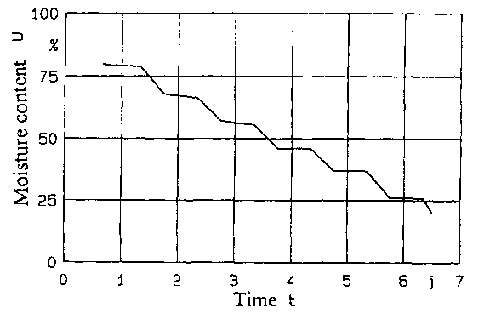
Figure 17: Drying of grapes in the
mains-powered solar dryer, expressed as moisture content over time
The system was loaded with 800 kg (20 kg/m²) of pretreated grapes and placed in operation at 4:00 p.m.; the air throughput rate was 1000 m /h. The initial moisture content of the grapes was about 80%. Following a total drying time of 140 hours, the desired final moisture content of 20% was reached at 12:00 a.m. on the sixth day. 200 kg of raisins were then unloaded. After the fourth day, the fan must be switched off at night to prevent the raisins from reabsorbing moisture. This is not necessary in the PV-powered system (see Table 7).
Table 7: Parameters for drying grapes in the mains-powered solar dryer
|
Parameter |
|
Value |
|
Dryer surface area |
m² |
40 |
|
Batch weight when loaded |
kg |
800 |
|
Duration of drying |
h |
140 |
|
Extracted water |
kg |
600 |
|
Throughput |
kg/d |
33 |
|
Final quantity produced |
kg |
200 |
|
Electric power requirements |
kWh |
4.2 |
3.2 Drying of medicinal and spice plants
3.2.1 Principle of operation
Figure 22 shows the pattern of global radiation and the temperature of the drying air at the collector and dryer intakes over the course of the day with the drying system empty, as recorded on August 11, 1993.
The total global radiation for this day reached a value of 6.92 kWh/m². When the sun was at its zenith, a maximum radiation intensity of 900 W/m², was measured.
As global radiation increased, so did the temperature of the drying air, reaching 53°C at the dryer intake about 90 minutes after the sun was at its zenith. This corresponds to a maximum temperature rise in the collector of 13 K.
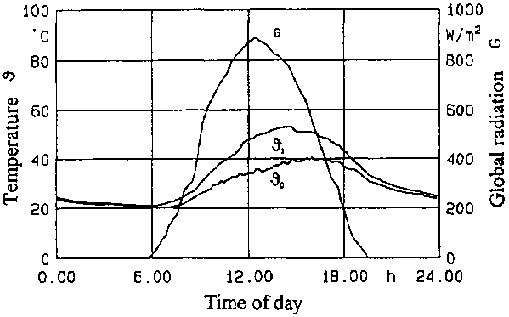
Figure 22: Pattern of global
radiation and temperature of the drying air at the collector and dryer intakes
over the course of the day, as recorded in Marrakesh on August 11, 1993 (air
flow rate = 3850 m³/h)
While the system is being operated, evaporation of the moisture content of the produce cools the air in the dryer. A high moisture content results in a correspondingly great cooling effect. A drying zone forms and migrates vertically in an upward direction through the layer of produce.
Figure 23 shows the effective output of the collector per unit of surface area, expressed as a function of global radiation. Owing to the collector's ability to store heat, during the morning hours a substantial portion of the radiation energy is needed to heat up the collector, whereas during the afternoon and evening the stored heat is re-emitted to the drying air.
The slope of the regression line yields a daily efficiency of the collector of 47%.
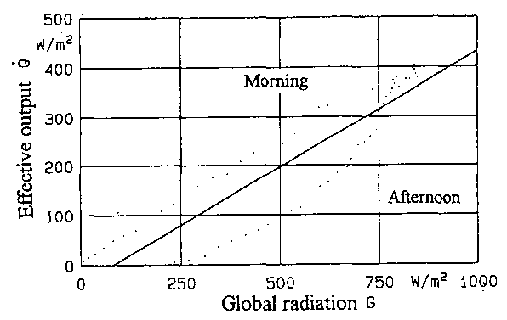
Figure 23: Effective collector
output as a function of global radiation (220 V = 3850
m³/h.
3.2.2 Drying of spearmint
So far, the solar dryer of the Marrakesh type for medicinal and spice plants has been used to dry spearmint, verbena and sage. Taking the example of spearmint, which is a typical medicinal herb with readily volatile components, the solar drying process involved is depicted in the following.
If planted in the autumn, spearmint can be harvested up to three times the following year. The leaves are dark-green and ovate-lanceolate in shape, with wavy, irregularly serrate edges. The plants grow to a height of 50 to 100 cm, with branching stems. They develop surface runners. The principal constituent of the essential oil is carvone (50-80%), followed by eucalyptol, limonene, linalool, etc. Resins, bitter substances and tanins are also present. Spearmint is mainly consumed fresh or used in dried form to brew tea. Spearmint oil is used in sweets, condiments, and medications.
Right after being cut, the spearmint is placed in the dryer and spread evenly using a pitchfork. The moisture content of the fresh spearmint is about 82%. The dryer can be filled with up to 50 kg/m²). of spearmint; this is equivalent to loading it to a height of about 80 cm. But it is important not to exceed this limit of 80 cm or it will be difficult to turn the spearmint. Consequently, a maximum of 600 kg of fresh spearmint can be loaded into the dryer. The dryer is then closed and placed in operation. To avoid damaging the spearmint, the temperature of the drying air must not exceed 50°C. If this critical value is reached at the dryer intake during the hot months of July and August, the collector must be partially covered with an opaque sheet for a couple of hours. This is not necessary during the other drying months. The spearmint being dried should be turned once in the morning and once in the evening. As soon as the spearmint crumbles when rubbed between the palms of the hands, its final moisture content of about 10% has been reached. Depending on how full the dryer is loaded, drying can take up to four days. The dried spearmint should then be packaged in large, clean paper sacks and stored in a cool, dark place. The storage room should be fresh and clean and kept free of insects and other pests. From time to time the condition of the merchandise should be checked.
By way of example, Figure 24 depicts drying of spearmint in the solar dryer as recorded on August 67, 1993. The system was loaded with 200 kg (16.7 kg/m²) of spearmint and placed in operation at 9:00 a.m.; the air throughput rate was 3800 m³/h. The initial moisture content of the spearmint was about 82%. The desired final moisture content of 10% was reached on 6:00 p.m. on the following day, after a total drying time of 33 hours,. It was then possible to remove 40 kg of dried spearmint from the system (see Table 8).
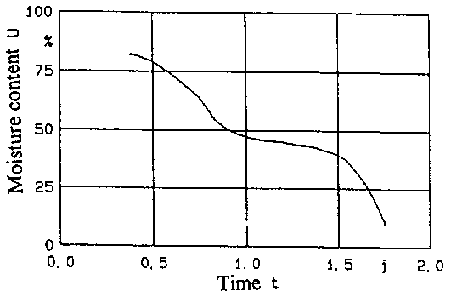
Figure 24: Drying of spearmint in
the mains-powered solar dryer, expressed as moisture content over time.
Table 8: Parameters for drying spearmint in the mains-powered solar dryer
|
Parameter |
|
Value |
|
Dryer surface area |
m² |
12 |
|
Batch weight when loaded |
kg |
200 |
|
Duration of drying |
h |
33 |
|
Extracted water |
kg |
160 |
|
Throughput |
kg/d |
24 |
|
Final quantity produced |
kg |
40 |
|
Electric power requirements |
kWh |
17.2 |
|
| ||||||||||||||||||||||||||||||||||||||||||||||||||||||||||||||||||||||||||||||
Solar Drying in Morocco (GTZ)
4. Economics of solar drying
4.1 Production
4.1.1 Purchase costs
It costs DH 23,683 to install a solar dryer of the Marrakesh type for fruits and vegetables (see Table 9). Of this sure materials account for DH 17,940. A mason and two assistants require 20 days to build the system. The mason earns DH 45 per day, with each assistant receiving DH 34.20; this yields total wage costs of DH 2,268. The cost of purchase is linearly depreciated over a period of ten years for an annual depreciation of DH 2,368.30.
Implicit costs for interest and operator's wages were added to these costs. The implicit interest was taken to be equal to the opportunity costs of the capital tied up by purchasing the drying system. At an interest rate of 9%, which is what the Caisse Nationale du Credit Agricole (Bank Al-Maghrib) paid on long-term savings accounts in June 1993, this yields Implicit interest amounting to DH 1,065.74. Work done by the farmer that the other labor costs do not cover, like bookkeeping and instructing workers, is taken into account as a cost factor by assuming implicit operator's wages of 300 DH.
4.1.2 Costs of producing solar-dried apricots
In the following, the costs of producing solar-dried apricots of the Canino variety are calculated based on the assumption that the dryer is used in an agricultural context and that no other products besides apricots are dried.
The variable costs per batch (600 kg of depitted apricot halves ~ 639 kg of whole apricots) amount to DH 1,062.20 (see Table 10). Most of this goes for the raw produce, for which production costs of
Table 9: Purchase costs of a solar dryer of the Marrakech type (as of June 1, 1993)
|
Cost item |
Calculation: |
DH | |
|
Material costs | | | |
|
Sand |
5 m³ x DH 62.30 |
311.50 | |
|
Gravel |
3 m³ x DH 42.50 |
127.50 | |
|
Cement |
72 dt x DH 25.50 |
1,836.00 | |
|
Bricks |
615 x DH 3.80 |
2,340.00 | |
|
Structural steel |
580 kg x DH 5.86 |
3,400.00 | |
|
Wire screen |
40 m² x DH 73.00 |
2,920.00 | |
|
Sheet metal |
6 m² x DH 130.00 |
780.00 | |
|
Polyester fabric |
40 m² x DH 25.00 |
1,000.00 | |
|
Cork |
1.15 m³ x DH 1,740.00 |
2,000.00 | |
|
PE sheet |
83.2 m² x DH 4.50 |
375.00 | |
|
Paint |
30 kg x DH 25.00 |
750.00 | |
|
Small materials | |
2,100.00 | |
|
PV drive |
Fan (Fiat Uno) |
1,000.00 | |
| |
Solar module (MXP 83) |
2,475.00 | |
|
or | |
| |
| |
Fan (ebm) |
1,670.00 | |
|
Mains-powered |
Transformer |
845.00 | |
|
Remote thermostats | |
960.00 | |
|
Wage costs: |
| | |
|
Mason |
20 worker-days x DH 45.00 |
900.00 | |
|
Assistants |
40 worker-days x DH 34.20 |
1,368.00 | |
|
Total: |
|
23,683.00 | |
4.1.2 Costs of producing solar-dried apricots
In the following, the costs of producing solar-dried apricots of the Canino variety are calculated based on the assumption that the dryer is used in an agricultural context and that no other products besides apricots are dried. The variable costs per batch (600 kg of depitted apricot halves ~ 639 kg of whole apricots) amount to DH 1,062.20 (see Table 10). Most of this goes for the raw produce, for which production costs of
Table 10: Variable costs of drying one batch of apricots in the solar dryer
|
Cost item |
Calculation |
DH |
|
Material costs: | | |
|
Apricots |
639 kg x DH 1.16 |
741.24 |
|
Na2S2O5 |
2.4 kg x DH 9.16 |
21.98 |
|
Water |
1 m³ X DH 2.50 |
2.50 |
|
Packaging |
|
8.00 |
|
Maintenance |
|
14.90 |
|
Wage costs: |
| |
|
Workers |
8 worker-days x 34.20 |
273.60 |
|
Total (120 kg of dried apricots) | |
1,062.22 |
|
Unit costs per kg of dried apricots |
8.85 | |
1.16 DH/kg were calculated. The material costs for sulfur treatment, packaging, and maintenance are low, only adding DH 47.38. In mains-powered operation, additional costs of DH 2.40 are incurred for electricity. Eight workers are needed for one day for depitting, sulfur treatment, and loading and unloading the dryer. The wage costs amount to DH 273.60.
Drying takes two days. The production coefficient is 0.188, so 639 kg of fresh apricots yield 120 kg of dried produce. The variable unit costs per kg of dried apricots are DH 8.85.
The harvest period for Canino apricots lasts 4 weeks on average. Owing to their poor keep-ability, if there is no way to store them under refrigerated conditions they must also be processed within this time period. Since drying takes two days, a single drying system is able to process 14 batches per harvest campaign, in other words, 8946 kg of apricots can be turned into 1680 kg of dried merchandise. Table 11 shows the overall costs per campaign.
The costs of producing solar-dried apricots of the Canino variety amount to 11.07 DH/kg, and are thus about DH 1.26 below the production costs of conventionally dried Turkish produce.
Table 11: Costs of producing dried apricots (per campaign)
|
Cost item |
DH |
|
Material costs |
11,040.68 |
|
Wage costs |
3,830.40 |
|
Dryer depreciation |
2,368.30 |
|
Implicit costs |
1,365.74 |
|
Total (for production of 1680 kg) |
18,605.12 |
|
Unit costs per kg |
11.07 |
At an average per-hectare yield of 16 tonnes per year, a solar tunnel-type drying system can be used to dry the apricot crop grown on 0.6 ha. For larger growing areas, capacity must be increased by adding more drying systems (see Figure 28).
4.1.3 Costs of producing solar-dried raisins
Here again, the costs of producing solar-dried raisins of the King's Ruby variety were calculated based on the assumption that no other products besides raisins are dried.
The variable costs per batch (800 kg of grapes) amount to DH 1,197.86 (see Table 12). Most of this goes for the raw produce, for which production costs of 1.15 DH/kg were calculated. The material costs for submerging treatment, packaging, and maintenance only amount to DH 72.66. In mains-powered operation, additional costs of DH 7.20 are incurred for electricity. Six workers are needed for one day to sort and dip the grapes and to load and unload the dryer. The wage costs amount to DH 205.20.
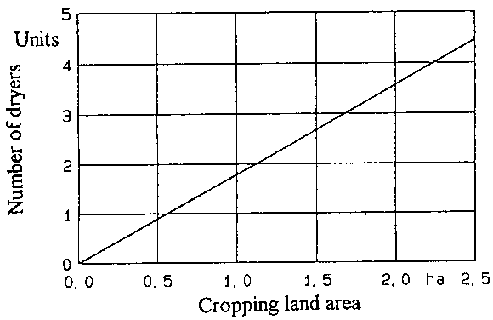
Figure 28: Need for solar
tunnel-type drying systems as a function of apricot-growing area
Table 12: Variable for drying one batch of grapes in the solar dryer
|
Cost item |
Calculation |
DH |
|
Material costs: | | |
|
Grapes |
800 kg x DH 1.15 |
920.00 |
|
K2CO3 |
4.6 kg x DH 9.10 |
41.86 |
|
Water |
1 m³ x DH 2.50 |
2.50 |
|
Packaging |
|
13.40 |
|
Maintenance |
|
14.90 |
|
Wage costs: |
| |
|
Workers |
6 worker-days x DH 34.20 |
205.20 |
|
Total (200 kg of raisins) | |
1,197,86 |
|
Unit costs per kg of raisins | |
5.99 |
Drying takes six days. The production coefficient is 0.25; accordingly, 800 kg of fresh grapes yield 200 kg of dried raisins. The variable unit costs per kg of raisins amount to DH 5.99.
It takes an average of nine weeks to harvest a crop of King's Ruby grapes. Since drying takes six days, one drying system can process ten batches, or a total of 8000 kg of grapes, into 2000 kg of raisins per harvest campaign. Table 13 shows the overall costs per campaign.
The costs of producing solar-dried raisins of the King's Ruby variety amount to 7.86 DH/kg.
Table 13: Costs of producing raisins (per campaign)
|
Cost item |
DH |
|
Material costs |
9,926.60 |
|
Wage costs |
2,052.00 |
|
Dryer depreciation |
2,368.30 |
|
Implicit costs |
1,365.74 |
|
Total (production of 2000 kg) |
15,712.64 |
|
Unit costs per kg |
7.86 |
At an average per-hectare yield of 20 tomes per year, a solar tunnel-type drying system is able to dry the crop from 0.4 ha of vineyard. For larger areas, capacity must be increased by adding more drying systems (see Figure 29).
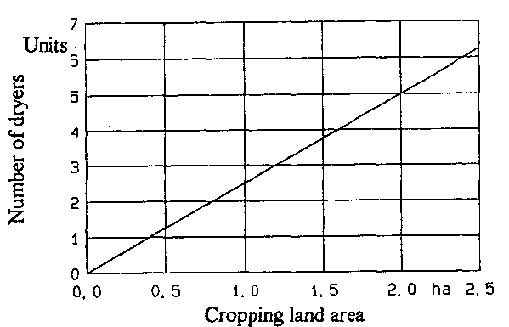
Figure 29: Need for solar
tunnel-type drying systems as a function of grape-growing land
area
4.1.4 Multiple use of the dryer
The calculations presented so far have been based on the assumption that the solar dryer is used exclusively to dry either apricots or grapes. This means that its capacity is being inefficiently utilized, since it is only in operation for 4 or 9 weeks out of each year. The ascertained production costs should therefore be regarded as those for the "worst case scenario", namely that in which the investment and fixed costs must be completely recovered from sales of dried apricots or raisins.
But if the dryer is used to dry apricots in May/June and grapes in September/October, the production costs diminish. It then only costs DH 9.84 to produce 1 kg of dried apricots, and DH 7.03 for 1 kg of raisins (see Table 14).
Table 14: Costs of producing both apricots and raisins (per campaign)
|
Cost item |
DH | |
| |
Apricots |
Raisins |
|
Material costs |
11,040.68 |
9,926.60 |
|
Wage costs |
3,830.40 |
2,052.00 |
|
Dryer depreciation |
1,052.58 |
1,315.72 |
|
Implicit costs |
607.00 |
758.74 |
|
Total |
16,530.66 |
14,053.06 |
|
Unit costs per kg |
9.84 |
7.03 |
Besides apricots and grapes, the solar dryer can also be used to dry chili peppers, peaches, and meat. Nor do the possibilities stop there; figs, apples, dates, onions, carrots, etc. could be dried as well. Such a varied production program, with harvest periods following upon one another in succession, permits the system to be used during a larger part of each year. This can be achieved in either of two ways:
1. A farmer uses the dryer for as many of his own products as are harvested at different times.2. Several farmers who grow different products and harvest them at different times take turns using the dryer.
The first of these approaches will rarely lead to satisfactory utilization of the dryer's capacity, since hardly any farmers grow an adequately large range of different crops.
The second approach lends itself well to establishment of a cooperative or self-help group, whose members then together raise the capital needed to invest in a dryer. An alternative to a collective of this kind is for a farmer to rent the system to his neighbors. When the system has spare capacity, the owner can dry produce for his neighbors on a fee basis.
Yet another possibility is contractual drying. A company, for instance an agro-business, could fund drying systems and install them on farms. The farmers then produce under contract, supplying appropriate dried products for the client to market.
Drying might also be done in the immediate vicinity of urban centers, where all fruit and vegetable varieties are available. There would be much less dependency on harvest times and harvested quantities, letting the capacity of dryers be optimally utilized. These drying systems could be operated by skilled individuals from agriculture and the food industry. These people would be sufficiently well qualified to successfully introduce this new technology and master the associated drying and marketing methods within a short time. One problem that could arise here, however, concerns the space needed for drying; it is usually hard to find and/or expensive so close to the markets.
4.2 Marketing
4.2.1 Apricots
4.2.1.1 The Moroccan market
Dried apricots are virtually unknown in Morocco. They can only be bought in just a few shops in Casablanca and Rabat, at prices ranging from AH 70 to well over AH 100 per kilogram. For the most part, this is very sweet Turkish produce; no Moroccan dried apricots are offered.
In response to this situation, in 1993 a consumer survey and a sales test with solar-dried Moroccan apricots were carried out. The goal of these measures was to identify consumption habits, potential demand, trade margins, and consumer prices in order to compare these with production costs.
A standardized questionnaire was used for the survey, combined with distribution of a product sample consisting of 500 g of dried apricots and a product description. The survey covered 100 representative households with at least one gainfully employed member belonging to all income groups in the Marrakesh administrative district.
The surveyed households comprised 7 persons on average. The average monthly household income was AH 4,720. 93% of the surveyed households had never experienced dried apricots before.
The survey revealed that dried apricots are used almost exclusively as an ingredient for making tajine or eaten straight as a snack. Only 10% of the surveyed households would bake with apricots. The questioned households would be willing to spend an average of AH 19.81 on a kilogram of apricots. 31% would pay AH 24, and 22% would still accept a price of AH 30.
Several merchants in Marrakesh and Casablanca sold dried apricots packaged in 500 g bags on a trial basis, yielding retail margins of between 15 and 50%. The merchants were required to charge at least 20 DH/kg; the prices actually obtained were between AH 23 and 30. The supermarkets proved able to sell them quite successfully, but the shops in the old city of Marrakesh had a harder time.
At production costs of 11.07 DH/kg, a market price of 24 DH/kg would permit a gross margin of more than 100%. This is more than adequate for a distribution system to function, especially with a product that is so easy to store and takes up relatively little space for transport. But considering the traditional consumption patterns of Moroccan consumers, it will take some time for the market for dried apricots to develop. In other words, demand is increasing very slowly. But if drying capacities were utilized more fully, and if the associated cost reductions were passed on to consumers, demand would presumably be greatly stimulated, owing to the high price elasticity of dried apricots.
4.2.1.2 The market in Germany and Switzerland
In 1991 and 1992, two written surveys were conducted of German and Swiss importers of dried fruits in order to analyze the market.
The first survey was devoted to collecting general information about the commercial market and the structure and activities/behavior of importers. The second survey included distribution of a sample, and was intended to ascertain the market status of Moroccan dried apricots. For the first survey, 115 importers were written to; 28 of these filled out and returned the questionnaire. These then received the second questionnaire, which was returned by 16 of them.
The distributed product sample met the expectations of virtually all of the importers. They approved of its color, sulfur content, type of processing, and residual moisture content. On the other hand, they criticized the high total acid content, hard texture, and small and/or irregular size of the fruits.
Seven of the 16 companies that responded to the second survey were basically interested, despite their reservations, in importing Moroccan dried apricots. The prices they were willing to pay were based on the prices for Turkish merchandise.
In October/November of 1991, Turkish dried apricots were still being traded at just under 19,000 DH/tonne f.o.b. in Izmir; by January 1992 the price had climbed to AH 28,000, and in June 1992 it was AH 31,300. Following a good harvest in 1992, however, by autumn of 1992 the price had fallen back down to AH 20,000.
Assuming a 50% margin for domestic traders, solar-dried apricots Dom Morocco could be offered at between 19,000 and 22,000 DH/tonne f.o.b. in Casablanca, depending on the season and on storage costs. This price is internationally competitive, being below that of the most important competitor, Turkey. Another advantage is that the harvest begins six weeks earlier in Morocco, making it possible to supply the market with new merchandise sooner.
4.2.2 Raisins
In Morocco, raisins rank among the staple foodstuffs; they are mainly used as an ingredient in making couscous and tajine. Numerous different qualities of different grape varieties are available. The most important quality attribute is color, followed by size, seedless-ness, sugar content, and moisture content (i.e., texture). The supply ranges from small, nearly black raisins with seeds all the way to large, amber-colored, seedless varieties. Accordingly, the retail prices stretch from 6 to 35 DH/kg.
Ripe grapes of the King's Ruby variety can be either white or dark-blue. King's Ruby raisins dried at high temperatures in oil- or gas-fired industrial dryers consistently have a dark-brown color. With solar drying, by contrast, the lower temperatures involved preserve the original color of the grapes, and the final product is a colorful mixture of raisins ranging in color from brown to amber.
A survey of dried fruit merchants in Marrakesh in 1991 revealed a retailer purchase price for industrially dried produce of between 13 and 17 DH/kg. By contrast, solar-dried raisins commanded prices between 15 and 19 DH/kg. and one merchant even sold them at 25 DH/kg. The consumer prices were between 20 and 24 DH/kg. In the merchants' opinion, even higher prices could be charged if the raisins were sorted by color.
When the merchandise is marketed by way of a wholesaler, then an additional margin of 3 to 5 DH/kg must be incorporated into the calculation, depending on the purchased quantity and the transport distance.
4.2.3 Other products
It is known from other countries in which comparable solar drying methods are practiced that solar-dried fruits and vegetables are vastly superior to conventionally dried products in terms of both quality and hygiene, complying with all international standards. The same holds for chili peppers and peaches, which were successfully dried in the solar dryer of the Marrakesh type in 1992 and 1993. No market tests or importer surveys have yet been carried out for these two products, however.
4.3 Assessment
The economic discussion has shown that dried apricots can be produced more cheaply in Morocco with a solar dryer of the Marrakesh type than in conventional ground drying in Turkey. One dryer is able to process the yield of half a hectare of intensively cultivated apricot-growing land. In order to increase the capacity, additional drying systems must be operated.
Owing to traditional consumption habits, the market for dried apricots within Morocco can only be expected to develop slowly. The chances of selling them in Europe may be regarded as good, however. Moroccan dried apricots largely meet the importers' requirements. In addition, Morocco is able to enter the market with its merchandise earlier while charging prices lower than those of its main competitor, Turkey.
If farmers sell their merchandise directly to retailers, then a solar dryer pays for itself in less than two years if used exclusively to produce dried apricots or raisins (see Table IS). If both apricots and raisins are dried, the payback period is reduced to less than one year.
When marketing dried products by way of wholesalers, owing to the greater trading margins the achievable sales price is lower and the payback period is longer (see Table 16).
If the amount of time the system is used each year is increased by drying additional products, then the fixed costs incurred for the system are spread out and both the production costs and the payback diminish.
Table 15: Payback period of a solar dryer of the Marrakesh type when selling directly to retailers
|
Production |
|
Apricots |
Raisins |
Apricots and raisins | |
|
Production quantity |
kg |
1680 |
2000 |
1680 |
2000 |
|
Production costs |
DH/kg. |
11.07 |
7.86 |
9.84 |
7.03 |
|
Sales price |
DH/kg. |
19.00 |
17.00 |
19.00 |
17.00 |
|
Trading margin |
DH/kg. |
5.00 |
5.00 |
5.00 |
5.00 |
|
Consumer price |
DH/kg. |
24.00 |
22.00 |
24.00 |
22.00 |
|
Profit |
DH/year |
13,322.00 |
18,290.00 |
15,389.00 |
19,940.00 |
|
Payback period |
Years |
1.8 |
1.3 |
0.7 | |
Table 16: Payback period of a solar dryer of the Marrakesh type when selling to wholesalers
|
Production |
|
Apricots |
Raisins |
Apricots and raisins | |
|
Production quantity |
kg |
1680 |
2000 |
1680 |
2000 |
|
Production costs |
DH/kg |
11.07 |
7.86 |
9.84 |
7.03 |
|
Sales price |
DH/kg |
14.00 |
12.00 |
14.00 |
12.00 |
|
Trading margin |
DH/kg. |
10.00 |
10.00 |
10.00 |
10.00 |
|
Consumer price |
DH/kg. |
24.00 |
22.00 |
24.00 |
22.00 |
|
Profit |
DH/year |
4,922.00 |
8,280.00 |
6,989.00 |
9,940.00 |
|
Payback period |
Years |
4.8 |
2.9 |
1.4 | |
|
| ||||||||||||||||||||||||||||||||||||||||||||||||
Solar Drying in Morocco (GTZ)
5. Bibliography
5.1 Studies
ANONYMOUS: Elaboration d'un schema de commercialisation des abricots et raisins sees. Ecole Sup�rieure de Commerce, Marrakesh, 1993.
ANKILA, O.: Amelioration du s�choir marocain. CDER; Marrakesh, 1992.
BENSOUDA, K.: Etude du potentiel du Haonz en abricot et raisin a s�cher. ORMVAH, Marrakesh, 1989.
BENSOUDA, K.: Cycle de formation sur les techniques du s�chage solaire. ORMVAH, Marrakesh, 1992.
HAWSER, M.: Logiciel "Trik-Marokko". PSE-Maroc, Stuttgart, 1992.
KERKAB, M.: Etude de march� d'abricots seches au Maroc: Une analyse du march� national et international. PSE-Maroc, Marrakesh, 1992.
MISRAR, A.: Synth�se sur les diff�rents s�choirs fabriqu�s a l'Universit� de Hohenheim. CDER, Marrakesh, 1990
OESTERLE, M.: Etude de march� et evaluation �conomique de la production des abricots et raisins en tenant particuli�rement compte du s�chage solaire au Maroc. PSE-Maroc, Marrakesh,, 1992.
SENHAJI, F.A.: Note d 'orientation pour la r�alisation de la campagne de s�chage des abricots. IAV Hassan II, Rabat, 1989.
5.2 Reports
ANKILA, O.: Rapport synth�tique de journ�e nafionale d'information sur le s�chage solaire organisee � Marrakesh le 21.05.1993. CDER, Marrakesh, 1993.
BENSOUDA, K.: Operation s�chage des abricots - campagne 1988 - 1989. ORMVAH, Marrakesh, 1989.
EL BOUAMRI, M.: Rapport synth�tique de la construction du s�choir solaire type Hohenheim. ORMVAH, Marrakesh, 1990.
EL BOUAMRI, M. and M.D. JAMILI: Rapport synth�tique de la construction du s�choir solaire type Marrakesh pour les plantes m�dicinales et aromatiques. ORMVAH Marrakesh, 1993.
HAWSER, M.: Rapport Annuel: 01.02.89 - 31.01.90. PSE-Maroc, Stuttgart, 1990.
HAWSER, M.: Rapport Final Phase I: 01.02.89 - 31.01. 90. PSE-Maroc, Stuttgart, 1991.
5.3 Study papers and graduation theses
BAREHMI, K.: Solare Trocknung von Krauseminze, Salbei und Verbenenkraut in Marokho. University of Hohenheim, graduation thesis, Stuttgart, 1994.
B�SCHEL, M.: Einfluss der Sonnenstrahlung auf das Trocknungsverhalten und die Produltqualit�t von Aprikosen. University of Hohenheirn, graduation thesis, Stuttgart, 1994.
FAHI, M.: Dimensionnement des s�choirs solaires type tunnel. Ecole Nationale de l'Industrie Min�rale, graduation thesis, Rabat, 1994.
HAUSCHILD, H.: Die Wirtschaftlichkeit der Produktion und Vermarktung solar getrockneter Fr�chte, dargestellt am Beispiel Marokko. University of Hohenheim, graduation thesis, Stuttgart, 1993.
HENSEL, O.: Untersuchung und Modifikation einer solaren Tunneltrocknungsanlage fur den Einsatz bei der Aprikosentrocknung in Marokho. University of Hohenheim, graduation thesis, Stuttgart, 1990.
KROSCHEL, U.: Vergleichende Untersuchung verschiedener Schwefelungsverfahren und deren Einfluss auf das Trocknungsverhalten und die Produitqualit�t von Aprikosen. University of Hohenheirn, graduation thesis, Stuttgart, l 994.
MORAD, I. und M. FADILI: s�chage solaire des abricots dans le Haonz - 6�me campagne. Essais de comparaison d 'un s�choir type Hohenheim et du s�choir Abrisec 2. Universit� Hassan II, graduaeion thesis, Rabae, 1989.
OESTERLE, M.: Marktanalyse und betriebswirtschaftliche Beurteilung der Produktion von Aprikosen und Trauben unter besonderer Ber�cksichtigung der solaren Trocknung in Marokko. University of Hohenheim. graduation thesis, Stuttgart, 1991.
PAULY, B.: Produktion und Vermarktung von Heil- und Gew�rzpflanzen in Marokko. University of Hohenheim, graduation thesis, Stuttgart, 1996.
SCHROFF, E.: Die �kobilanz als Informations- und Bewertungsinstrument - Fallbeispiel Solartrockner versus konventionelle Trocknungssysteme. University of Hohenheim, graduation thesis, Stuttgart, 1994.
SCHULTZ, A.: Optimierung der Prozessfahr�ng bei der Aprikosentrocknung mit einer solaren Tunneltrocknungsanlage in Marrakesh, Marokko. University of Hohenheim, graduation thesis, Sttutgart 1991.
WITT, A.: Untersuchung von Niedervolt-Gleichstromventilatoren f�r den Einsatz in Trocknungsanlagen. University of Hohenheirn, study paper, Stuttgart, 1992.
5.4 Presentations and lectures
ANKILA, O.: "Presentation des aspects techniques du projet s�chage solaire". Journ�e d'Information sur le s�chage Solaire, Marrakesh, 21.05.1993.
BENSOUDA; K.: "Presentation des aspects �conomiques du projet s�chage solaire". Journ�e d'lnformation sur le s�chage Solaire, Marrakesh, 21.05.1993.
EL BOUAMRI, M.: "Adaptation du s�choir solaire type Marrakesh aux plantes m�dicinales et aromatiques". Journ�e d 'Information sur le s�chage Solaire, Marrakesh, 21.05.1993.
HAWSER, M.: "Solartrocknung von Aprikosen in Marokko". Seminar Nacherntetechnologie in den Tropen und Subtropen, Inseieut fur Agrartechnik in den Tropen und Suberopen, Stuttgart, 19.12.1990.
HAWSER, M.: "Le logiciel 'Trik-Marokko' et son manipulation". Journ�e d 'Information sur le s�chage Solaire, Marrakesh, 14.10.1992.
HAWSER, M.: "Le s�chage des abricots et des raisins avec un s�choir solaire type tunnel. Journ�e d 'Information sur le s�chage Solaire, Marrakesh, 15.10.1992.
HAWSER, M.: "Applications du s�chage solaire au niveau international". Journ�e d 'Information sur le s�chage Solaire, Marrakesh, 21.05.1993.
JAMILI, M.D.: "Potential de la region du Haouz en plantes m�dicinales et aromatiques". Journ�e d 'Information sur le s�chage Solaire, Marrakesh, 21.05.1993.
KASTAL, K.: "Presentation des aspects strat�giques du projet s�chage solaire". Journ�e d 'Information sur le s�chage Solaire, Marrakesh, 21.05.1993.
KERKAB, M.: "Marc h� des abricots sees au niveau national et intemational. Journ�e d'Information sur le s�chage Solaire, Marrakesh, 21.05.93
OECHSLE, P. und M. HAWSER: "Solar drying of apricots". Xth International Symposium on Apricot Culture, Izrnir, 20.-24.09.1993.
SENHAJI; F.A.: "Historique du s�chage solaire au Maroc". Journ�e d 'Information sur le s�chage Solaire, Marrakesh, 21.05.1993.
5.5 Publications
ANKILA, O.: Le s�chage solaire. Planete, in press.
HAWSER, M.: Solare Trockmmg von Obst und Gem�se in Marokko. Erneuerbare Energiequellen. Zentralstelle fur Solartechnik ZfS, 1992, pp. 70-71.
HAWSER, M.; M. EL BOUAMRI and W. M�HLBAUER: Solare Trocknung von Aprikosen in Marokko. 8. intemationales Sonnenforum Berlin 1992. Deutsche Gesellschaft f�r Sonnenenergie, p. 1123-1132.
HAWSER, M.; M. EL BOUAMRI and W. M�HLBAUER: Le s�chage solaire des abricots. L'Arboriculture Fruiti�re, No. 465, 10/1993, pp. 33 40
HAWSER; M.: M. EL BOUAMRI and W. M�HLBAUER: "Solar drying of apricots in Morocco". Tropentag 1992 - Tagungsband. University of Hohenheit, 1992, pp. 50-51.
KROSCHEL, U. and M. HAWSER: "Vergleichende Untersuchung verschiedener Schwefelungsverfahren und deren Einflu� auf die Produktqualit�t von Trockenaprikosen". Poster Symposium der Gesellschaft Deutscher Lebensmitteltechnologien, Berlin, 12.-13.11.1993.
OWSLANOWSKI, R-P.: "Sonderenergieprogramm Marokko". 9. Symposium Photovoltaische Slarenergfe, OTTI, Staffelstein, 1994, pp. 193-207.
SCHROFF, E; T. CONRAD; M. HAWSER and R. DOLUSCHITZ: "Die �kobilanzierung als Entscheidungshilfe bei der Produktentwicklung - Fallbeispiel Informationsbereitstellung fur die Entwicklung solarer Trocknungssysteme". GIL-Kongress, 09/1994, in press.
5.6 Newspaper articles
Almaghrib: "L'Allemagne propose la technique, le Maroc ['applique". 26.10.1993.
Apricot News: "Use of solar energy in apricot drying". 11/1992.
Evs-Bericht:"BesuchausMarokko".1/1992.
Filder Schaufenster: "Trockenfr�chte stats Obst aus der rose". 13.06.1990
Filder Zeitung: "Trockenfr�chte stats Obst aus der Dose". 08.06.1990.
Forum Internationales Universit�tsmagazin: "Trockenaprikosen im Test". 1/1994.
Lebensmitteltechnik: "Posterausstellung von Diplomanden". 1-2/1994.
Le Matin: "Marrakesh: Journ�e d'information sur le s�chage solaire". 28.05.1993.
Stuttgarter Zeitung: "Hohenheimer Agrartechniker entwickeln Solartrockenanlage fur Tropenfruchte". 13.04.1994.
Spore: "Un tunnel solaire pour s�cher fruits et legumes". No. 46, 8/1993.
Stuttgarter Nachrichten: "Getrocknetes Obst und Gem�se aus dem Solartunnel". 23.12.1993.
|
| ||||||||||||||||||||||||||||||||||||||||||||||||||||||||||||
Concluding remarks by the editor
This Manual of-Solar Drying presents the results of phases 1 to 3 (1989-1994) of the project section "Solar Drying" within the scope of German-Moroccan cooperation in the "Special Energy Program Morocco".
The project benefited from the outstanding commitment of the project's Moroccan and German staff, for which we would like to sincerely thank them.
Our gratitude is also due to the Office Regional de Mise en Valeur Agricole du Haonz (ORMVAH) for making available the test plot, for providing support for conducting the tests and various farm analyses, and for its willingness to provide accomodations for several Moroccan and German students and interns that took part in the project. Particularly deserving of mention in this connection are the Service de la Production Agricole (SPA) and, most especially, the Service de Materiel (SM) and the Centre de Mise en Valeur (CMV) S�ada, without whose generous contribution of personnel and equipment it would have been impossible to carry out the planned work on this scale.
We would like to extend our heartbelt thanks to the Service des Energies Solaires of the Centre de D�veloppement des Energies Renouvelables (CER) and the SEP Office for coordinating the project and providing support for conducting the various market analyses and surveys.
We are also indebted to the Institute for Agricultural Engineering in the tropics and subtropics of the University of Hohenheim for holding the seminars on solar dying equipment and drying of medicinal and spice plants.
Our thanks also go to Prof. Senhaji, Institut Agronomique et V�t�rinaire (IAV) of the University of Hassan II for providing ideas and valuable assistance on all aspects of solar drying and preservation of foodstuffs.
Deutsche Gesellschaft fur Technische Zusammenarbeit (GTZ) GmbH
USER'S GUIDE TO THE SOLAR DRYER OF THE MARRAKECH TYPE
Drying apricots
Drying grapes
Dryer maintenance
|
| ||||||||||||||||||||||||||||||||||||||||||||||||||||||||||||
User's guide to the soar dryer of the Marrakech type
What is a solar dryer and how does it work?
A solar dryer is an appliance consisting of two parts: an air collector and a dryer.
The air collector traps the sun's radiation and converts it into heat. A fan circulates the hot air through the dryer.
The hot air eliminates a large proportion of the moisture content from the produce laid out in the dryer, dehydrating and preserving it.
What are solar dryers used for?
Solar dryers are used to dehydrate agricultural products such as fruit (apricots, grapes, peaches, plums, figs, etc.), vegetables (niora, tomatoes, onions, etc.) and even meat, for preservation purposes.
What are the advantages of solar dryers over traditional drying methods?
In contrast to traditional drying methods, solar dryers:
enable fast, controlled dehydration of produce
yield a better-quality dried product
protect the produce from insects, animals, dust, etc. during drying
|
| ||||||||||||||||||||||||||||||
Solar Drying in Morocco (GTZ)
User's guide to the solar dryer of the Marrakech type
Drying apricots

Apricots of the Canio variety
ripen period (end of May - begnning of July)

Preparing the sodium disulfite
solution (Na2S2O5) for the submersion treatment

Preparing the sodium disulfite
solution (Na2S2O5) for the submersion treatment
(continued)

Preparing the apricots

Preparing the apricots (continued)

Preparing the apricots (continued)

Drying process

Drying process (continued)

Drying process (continued)

Drying process (continued)

During the drying process

During the drying process
(continued)

During the drying process
(continued)

During the drying process
(continued)
Drying grapes

Grapes of the King’s Ruby
variety ripen over a longer period (late August - late October)

Preparing the potassium carbonate
solution (K2CO3) for the submersion treatment

Preparing the potassium carbonate
solution (K2CO3) for the submersion treatment (continued)

Preparing the grapes

Preparing the grapes (continued)

Preparing the grapes (continued)

Drying process

Drying process (continued)

Drying process (continued)

Drying process (continued)

Drying process (continued)

During the drying process

During the drying process
(continued)

During the drying process
(continued)

During the drying process
(continued)
Dryer maintenance

Daily maintenance

Daily maintenance (continued)

Daily maintenance (continued)

Weekly maintenance

Weekly maintenance (continued)

Seasonal maintenance

Seasonal maintenance (continued)

Seasonal maintenance (continued)
Deutsche Gesellschaft f�r Technische Zusammenarbeit (GTZ) GmbH
Postfach 5180
65726 Eschborn
Dag-Hammarskj�ld-Weg
1-5
65760 Eschborn
Telefon: 0 61 96- 79 31 85
Telefax: 0 61 96- 79 73
52
e-mail: GATE-ISAT@GTZ.DE
Internet:http:/lwww.gtz.de/gate/isat
Information and Advisory Service on Appropriate Technology