 |
| ||||||||||||||||||||||||||||||||||||||||||||||||||||||||||||||||||||||||||||||||||||||||||||||||||||||||||||||||||||||||||||||||||||||||||||||||||||||||||||||||||||||||||||||||||||||||||||||||||||||||||||||||||||||||||||||||||||||||||||||||||||||||||||||||||||||||
|
| ||||||||||||||||||||||||||||||||||||||||||||||||||||||||||||||||||||||||||||||||||||||||||||||||||||||
CEEST
The
Centre for
Energy,
Environment,
Science and
Technology
A Case Study of Merelani, Kahama, Nzega, Geita and Musoma
By
A. Y. Hangi
|
CEEST RESEARCH REPORT SERIES NUMBER 1 |
This report is a CEEST publication
Copyright © Centre for Energy, Environment, Science and
Technology (CEEST) 1996
B3-16 TIRDO Estate, Morogoro Stores Uganda
Avenue
Oysterbay
P.O. Box 5511
Dar es Salaam
All Rights Reserved
ISBN 9987 612 02 4
|
| ||||||||||||||||||||||||||||||||||||||||||||||||||||||||||||||||||||||||||||||||||||||||||||||||||||||
List of Abbreviations
|
ADI |
Acceptable Daily Intake |
|
ALA |
&-aminolevulinic acid |
|
AREMA |
Arusha Region Miners Association |
|
As |
Arsenic |
|
Ba |
Barium |
|
Bi |
Bismuth |
|
BOT |
Bank of Tanzania |
|
CEEST |
Centre for Energy, Environment Science and Technology |
|
Cr |
Chromium |
|
Cd |
Cadmium |
|
Co |
Cobalt |
|
Cu |
Copper |
|
EIA |
Environmental Impact Assessment |
|
FAO |
Food and Agriculture Organization |
|
Hg |
Mercury |
|
Li |
Lithium |
|
MRD |
Mineral Resources Division |
|
MARICO |
Mwanza Mining Company Limited |
|
Mo |
Molybdenum |
|
NEMC |
National Environmental Management Council |
|
NMCS |
Nyabigena Miners Cooperative Society |
|
S |
Sulphur |
|
Sb |
Antimony |
|
Sn |
Tin |
|
STAMICO |
State Mining Corporation |
|
SSM |
Small Scale Mines |
|
TIRDO |
Tanzania Industrial Research and Development Organization |
|
Tl |
Thallium |
|
Th |
Thorium |
|
WHO |
World Health Organization |
|
Zn |
Zinc |
|
| ||||||||||||||||||||||||||||||||||||||||||||||||||||||||||||||||||||||||||||||||||||||||||||||||||||||
Preface
The Centre for Energy, Environment, Science and Technology (CEEST) is a non-governmental and not-for-profit organization whose overall objective is to foster research, development, analysis, information and expertise in matters related to energy, the environment, water and sanitation, science and technology and sustainable natural resources use and management.
In order to achieve its objective, CEEST has identified five major core programmes for its activities. These include, the Energy Development and Management Programme; Environment and Natural Resources Assessment and Management Programme; Water and Health and Sanitation Development and Management Programme; Science and Technology Development and Management; and Women and Development Programme.
This publication is on part of CEEST activities in the field of mining and the environment under the Environment and Natural Resources Assessment and Management Programme. It is one of a series of CEEST reports on research and studies on energy, the environment, sustainable natural resource use and management, and science and technology. The field work was "undertaken in 1993.
The Centre wishes to acknowledge several people who volunteered in time to discuss about the small scale mining industry in Tanzania and its consequences on the environment. CEEST in particular would like to thank Eng. A. Y. Hangi, an Associate of the Centre, who led the study team and all those who assisted the work including Zonal Mines Officers Mr. S. Mwakyolile and Mr. Kibumo and Mining Engineers Mr. Mwaipopo and Mr. O. Chambo of Mwanza and Shinyanga respectively; the Ministry of Water, Energy and Minerals; National Environment Management Council (NEMC); the office of the Government Chief Chemist; the Tanzania Industrial Research Development Organization (TIRDO); and the Audio Visual Institute.
Above all CEEST wishes to acknowledge the generous support of the Sinclair Group and especially James and Marlene Sinclair.
Prof. M. J. Mwandosya
CEEST
June 1996
|
| ||||||||||||||||||||||||||||||||||||||||||||||||||||||||||||||||||||||||||||||||||||||||||||||||||||||
Executive Summary
1. AN OVERVIEW
In terms of Government revenue, Tanzania's mining sector has been growing since 1990 the main reason being the sudden surge in gold production countrywide. Besides the fact that this country has substantial gold reserves, increase in gold production was came in the wake of macro-economic reforms and particularly, the introduction of new arrangements in the marketing of gold and the attractive prices offered by the Bank of Tanzania (BOT). BOT is presently vested with the responsibility of buying all the gold produced in the country, although this responsibility is likely to shift away from the Central Bank to an appropriate commercial organization.
Since 1991, all gold in the country has been produced within the informal mining sector or by artisanal miners involved in the mining of gemstones, gold and diamonds and which are estimated to number in excess of 300, 000. From only the few kilograms before 1990, gold production has increased to over 3.0 tons annually to-date. However, the word 'increase' should be treated with caution here since the informal mining sector existed in the country prior to 1990 (albeit illegally), and was apparently involved in substantial smuggling activities.
Parallel with the ongoing artisanal mining activities is the extensive environmental degradation caused by inefficient mining and the poor processing technologies currently being employed (by miners), and the lack of effective environmental monitoring, regulations and legislation.
The purpose of this report is to make an assessment of the extent of environmental impacts caused by artisanal mining activities in selected areas. In accordance with the terms of reference, the areas studied (and which represent a great deal of artisanal mining activities in Tanzania), are Merelani (for gemstones), and Mara, Nzega, Kahama, Geita and Musoma (for gold).
The recommendations put forward in this report are targeted to unveil the extent of environmental degradation created by artisanal mining activities on the land, air and in water. This environmental impact assessment (EIA), it is hoped, will result in an increased awareness on the part of those directly concerned with the mining sector. Subsequently, it is hoped that the need to prepare an Environmental Action Plan for Implementation aimed at averting further environmental destruction - the human habitat - which would therefore ultimately lead to the destruction of human lives.
2. ARTISANAL GOLD MINING
Artisanal or small scale subsistence mining is a fast growing sector in Tanzania. The Bank of Tanzania on collaboration with its other banking institutions such as the Co-operative and Rural Development Bank and the National Bank of Commerce are currently purchasing about 3.5 tons of gold annually from artisanal miners whose worth amounts to about US $40.0 million. As a result, Government revenue from gold has multiplied several times over in comparison to a paltry US $1.2 million obtained in 1990. These figures exclude illegal exports.
Gold that used to leave the country through unscrupulous illegal dealers is now tapped by the Government due to:-
(i) the better prices offered to the miners by the Bank of Tanzania; and
(ii) an organized marketing system.
The above notwithstanding, however, the benefits accruing from the activities of artisanal miners are overshadowed by the adverse environmental effects caused by these very activities - some of which maybe irreversible.
2.1. Environmental Aspects
Field observations have essentially identified the major causes of environmental destruction to be the following:-
· DustThis is a product emitted during rock drilling either in charging explosives used for blasting or fragmenting ore. This is rampant in the gold mining areas particularly where reefs are being worked. The nature of the dust consists mainly of silica which may ultimately develop silicosis or "widow maker" as it is popularly known. Similarly, tanzanite mines in Merelani emit carbon dust (due to existence of a graphite horizon as country rock).
During ore preparation in the recovery of gold, the ore-crushing method consists of a car axle (which acts as a pestle) being pounded into a wooden mortar several times over a long period. This labourious job in turn produces a lot of siliceous dust which is directly inhaled by the miners thereby posing a potential health hazard.
· Mercury
The gold recovery process involves a number of stages, the main ones being: crushing, grinding, amalgamating with Mercury and finally heating the amalgam to drive off the Mercury from the gold (which is then ready for sale).
It was observed that the washing and panning of amalgam is conducted mainly alongside and inside rivers. This methodology of handling Mercury results in river water, streams and water wells getting polluted. Besides, this practice also causes silting.
Water samples taken in several locations and analyzed by the Government chemist have revealed staggering levels of Mercury in them. Samples which showed the highest Mercury level in water were from Mugusu (Geita District), which measured 2.306 micrograms per litre. Drinking water from Ushirombo (Kahama District) measured 0.106 microgram per litre, the lowest. These values are rated as being very high for effluents meant for direct discharge in receiving waters given that the maximum permissible level is only 0.005 microgram per litre. In addition, water for domestic use should record zero Mercury values.
The Bank of Tanzania which has been given the mandate to sell Mercury has sold around the Lake Victoria zone 1, 474.30 kilograms of Mercury since 1990-June, 1993. It is important to mention here that the impact of Mercury pollution can be felt several thousand kilometres downstream. Essentially, this means that artisanal mining activities which actually surround Lake Victoria may already have started polluting it to the detriment of the millions of people depending on it and not discounting the far-reaching ramifications on the Nile river itself.
· Pit Excavation
Reaching the ore body involves digging deep excavations ranging between anything from 10 to 100 metres. The number of mine pits in any one location is anywhere between 100 and 1, 000 in a closely knit "honeycomb" structure many of which are inactive yet having been abandoned without being refilled or adequate protection provided. Along with this are large stockpiles of excavated materials which have not been removed but left around the mine pits. These materials could be used for refilling.
This uncontrolled digging of thousands of pits in the mining areas has caused the massive destruction of land. Of equal importance and consideration is that these pits are not refilled nor is the land properly reclaimed to enable other economic activities once the mineral resources have been depleted or abandonment due to technical reasons or on economic grounds.
It is therefore recommended that:-
(i) Simple, appropriate but more advanced technologies should be employed in order to minimize or eliminate the emission of dust during ore extraction or during ore processing caused by the poor technologies currently employed by the artisanal miners in the mining of valuable minerals.A technical audit which culminates in the production of a study on the technological needs appropriate to artisanal miners should be carried out.
(ii) As the continued use of Mercury in gold recovery has far-reaching environmental repercussions, NEMC, in conjunction with the Mineral Resources Division (MRD) of the Ministry of Water, Energy and Minerals should carry out periodic checks on rivers, streams and wells in the artisanal mining areas to determine levels of toxicity.
(iii) On the technology side, a study aimed at identifying simple appropriate recovery methods which should result into economizing the use of Mercury, instituting Mercury's efficient recovery and at the same time saving the environment from being continuously polluted.
(iv) The need to refill the many mine pit excavations resulting from actual mining, them after mining activities was emphasized. The Mineral Resources Department through Zonal mines officers should be made responsible, through mining regulations, to ensure that excavations are refilled/maintained. Some active mining areas or abandoned sites require that permanent protection be installed (in the form of steel fencing, rock walls or concrete covers).
3. ARTISANAL TANZANITE (GEMSTONE) MINING
Tanzanite mining at Merelani is undertaken in a manner similar to gold mining. A number of mining pits are excavated in order to reach the tanzanite horizon. Pit depths are in the region of 50-100 metres. However, it was observed that no chemicals were used in the process of recovering this valuable gem.
3.1. Environmental Aspects
The main environmental degradants comprises the hundreds of mine pit excavations of which a large percentage are inactive and have not been refilled. No protection is provided to both active and inactive mines. It is therefore recommended that all abandoned inactive mine pits be refilled and/or protected. The Mineral Resources Department should oversee and ensure that this exercise is carried out within the constraints which are currently being faced by the claim holders such as the financial constraint, and the lack of equipment.
4. ENVIRONMENTAL LEGISLATION
At present, the Government policy on all forms of mining falls under the Ministry of Water, Energy and Minerals and is governed through the Mining Act, 1979 and supported by various mining regulations such as the following:-
(i) The Mining (Claims) Regulations relating to claims which applies to Tanzanian citizens.(ii) The Mining (Prospecting Rights) Regulations which concerns prospecting activities by Tanzania citizens.
(iii) The Mining (Minerals Rights) Regulations which apply to foreign and local companies which deal with a sequence of reconnaissance and exploration, and mining licenses for large-scale/formal mines.
(iv) The Mining (Royalty) Regulations which is targeted at raising Government revenue by getting a portion/percentage of the mineral sales.
Whereas the Mining Act 1979 is silent on environmental issues, the Mining (Claims) Regulations contain sections which dwell on environmental controls. In particular, Article 13 underscores the obligations of a claim holder when abandoning a mining pit. An essential feature is that all shafts, pits and excavations should be filled up or fenced.
Article 23 dwells on the conditions and preconditions for the deposit of tailings; particularly "those which may terminate in any water-course. However, no mention of standards is made.
On the other hand, the Government formed the National Environment Management Council in 1983 whose main functions are to formulate policy, co-ordinate activities and evaluate existing and proposed environment management policies. As such, it is in a state which can be described as a "toothless bulldog" which can only bark but is not allowed to bite. The biting part is assumed to be the job of the Minerals Resources Department.
Despite the provisions of the Mining (Claim) Regulations 1980, as stated above, there appears to be no action on the part of those concerned to stem the ever-increasing artisanal mining activities and the apparent environmental destruction that is continuing without any sort of obstruction. It is therefore my view that the existing environment regulatory regime is ineffective to deal with this otherwise insurmountable problem.
It is therefore recommended that:-
· Institutional capabilities should be strengthened to create an enabling environment for the Minerals Resources Department with the possible participation by the National Environment Management Council, miners associations and co-operatives and the various claim holders. This multi-disciplinary approach would assist in increasing awareness on environment issues to all parties concerned. This would also serve to avoid duplication of work.· All streams, rivers and lakes in the vicinity of artisanal mining activities, where chemicals such as Mercury or cyanide are employed, should be periodically checked.
· It is further recommended that a separate study on the health of the artisanal mining communities be conducted to determine the extent of damage. This should also include the determination of Mercury levels in marine species such as fish in the streams, rivers, and in Lake Victoria.
· Due to the complexities involved in dealing with the artisanal miners, the government could consider setting up a "Reclamation Fund" to assist claim holders with the immense task of land reclamation.
5. TRAINING IN ENVIRONMENTAL ISSUES
It has been elucidated that the training of small scale miners (particularly on environment issues), is lacking. This fact has manifested itself in the continued land degradation resulting from mining activities. Perhaps this is so because those who are expected to impart knowledge to the miners are themselves not really trained in environmental studies (i.e. environmental studies were not part of their core subjects).
It is therefore recommended that:-· There is an urgent need for zonal mines officers to conduct seminars and workshops intended for small scale miners that place particular emphasis on environmental education. This could be done in the field or at the Madini Institute in Dodoma in the form of short courses. Formal University/College courses should be provided to engineers and officers at ministerial level.
· Deliberate steps to introduce large posters that dwell on environmental issues (as a way of motivating the miners to go the 'green' way during mining activities) should be taken.
|
| ||||||||||||||||||||||||||||||||||||
Environmental Impacts of Small Scale Mining (CEEST, 1996, 62 p.)
1. Introduction
This report was commissioned by the Centre for Energy, Environment, Science and Technology (CEEST) to assess environmental impacts on small scale mining in Tanzania. The case study was made covering major small mining areas of Merelani, Musoma, Nzega, Kahama and Geita. In the process of undertaking the study, some 4, 267 kms. were travelled, 9 artisanal mining locations visited, and discussions held with 30 Government officials, miners co-operatives or associations, claim holders and miners.
1.1. Objective of the Study
Small scale mining in gemstones, gold and other minerals is known to have existed for the last three decades in Tanzania. The recent Government move (since 1990), to streamline and improve the marketing system in mineral trade by offering better prices for mineral commodities (such as gold) has motivated more people to join the sector. The resulting increased production has, on the other hand, caused a tripling effect on the environmental degradation normally associated with artisanal mining activities.
In recognition of the need to sustain small-scale mining activities which have continued to grow in the past five years 1988-93, CEEST found it necessary to assess the nature and extent of environmental destruction which it is hoped would form a basis for further specialized work in this field.
1.2. Scope of Work and Methodology
Small scale mining for gold and gemstones are carried out on a large scale around the greenstone belt (for gold), and Merelani in Kiteto district (for gemstones).
Literature surveys were done in Dodoma and Dar es Salaam. Apart from literature surveys, there were field visits to the mining areas. The areas visited were Merelani, Nyabigena, Isungangwanda, Lusu, Ushirombo, Kahama, Nyakagwe, Nyarugusu and Mugusu.
A combination of interviews, site inspections, photographs, and video photographing were among the methods used to get the data and information necessary for the successful completion of this report. Water samples were collected and sent to the Chief Government Chemist for analysis and evaluation of chemical composition.
1.3. Duration of the Assignment
It took a total of 12 days to cover all the targeted areas in the field surveys. Sample analysis took three weeks to accomplish. The first phase of the study, which concentrated in the Merelani Tanzanite mining area, started on 9-11 July 1993 and the second phase, which focused on the gold mining areas of the greenstone around Lake Victoria, started on 26 August 1993 and was completed on 3 September 1993.
|
| ||||||||||||||||||||||||||||||||||||
Environmental Impacts of Small Scale Mining (CEEST, 1996, 62 p.)
2. Artisanal Mining Activities
2.1. Characteristics
The definition of small scale mining indeed differs from that of United States, Canada, Australia or even India and South America. Whereas small scale mining activities are linked with the level of investment as well as annual revenues from individual mines in most of these countries, in Tanzania, the case is slightly different. The characteristics of small scale mining can best be elucidated once a definition befitting small scale mining is established.
Williamson Diamonds Limited and Kiwira Coal Mines Limited are considered large scale mines involving large investment outlays and so are limestone quarries for cement manufacture in Dar es Salaam, Mbeya and Tanga. All other mines and quarries can be classified as small scale mines.
In accordance with the Mining Act of 1979, most of the small scale mining in the country is regulated under Part IV of the Act which categorizes them as prospecting and mining operations by methods involving very low capital investment and mining technologies which are not so specialized. In practice, small scale mining in the country spans from informal subsistence mining or artisanal mining to formally organized small mines which are privately or publicly owned.
As there are no formal mines categorized as small scale mines involved in gemstone and gold mining at the moment, the present adverse environmental effects are attributed to "artisanal" or informal mining activities. However, for the purpose of this report the words small scale and artisanal mining (or miners) are used interchangeably.
2.2. Artisanal Operations
Artisanal mining activities in Tanzania are characterized by the following factors:-
(i) Many artisanal miners are individuals or families who typically have no mining rights, no mining plans and invariably prefer to sell their products in the parallel market.(ii) Some mine operators are in possession of legal rights entitling them to carry out mining operations. These are mainly claim holders who normally engage subcontractors to dig pits for winning ore.
(iii) Most mining is done near surface but there are many pits whose depth is in excess of 100-150 metres.
(iv) Activities are predominantly associated with high value, low volume products (i.e high grade low tonnage deposits with no proven reserves).
(v) A large cross-section of the miners are unskilled and possess no formal education, and have limited technical and financial capabilities.
(vi) Mining is undertaken haphazardly and mines abandoned in favour of areas with more potential. The risk element is extremely high.
(vii) Mining and ore beneficiation is done using the most rudimentary and backward of technologies (involving the use of picks, shovels, motor axles, wooden mortar, grinding rocks and sluice boxes). When more advanced technologies are used, which occurs to a lesser extent, one is likely to find compressors, jackhammers and the use of explosives. Pumps are a scarce commodity despite the presence of large amounts of water in the pits. This kind of technology results in inefficient mining practices and low recoveries as well as the loss of foreign exchange.
(viii) Mining communities in these areas have little or no regard for sanitation, health, or safety and have no knowledge whatsoever of the environmental hazards caused by their activities.
(ix) The positive aspects of artisanal mining include increases in rural employment and incomes, and until recently, artisanal mining was the source of major fiscal benefits to the Government - all of which stimulate the local economy. It is estimated that more than 300, 000 Tanzanian miners and their families depend on artisanal mining for part of their livelihood.
(x) Artisanal mining is a precursor to formal mining (be it medium or large scale), as it forms the first step in mineral exploration and frequently provides basic geological information to industrial mining concerns.
2.3. Small Scale Mines
This group includes small mining operations which abide to all the legal provisions and employ mechanised to semi-mechanised production with definite management and marketing arrangements. Essential features characterizing small mining operations in Tanzania are:-
(i) Basic equipment such as blast hole drilling equipment, compressors, explosives and accessories, and earthmoving equipment is used. Beneficiation machinery includes crushers, ball mills, stamp mills, jigs, and shaking tables.(ii) Financing of such projects follows the normal pre-investment cycle preceded by proper feasibility studies.
(iii) In most cases, the hierarchy includes a Board of Directors, a General Manager and the normal line of staff.
Generally, many small mines are operated by the State Mining Corporation (STAMICO) which is a parastatal body. These include Pugu Kaolin, Minjingu Phosphate, Coastal Saltworks, Nyanza Salt Mines; and Tanzania Gemstone Industries.
Tanzania Gemstone Industries-operates on joint venture two other gemstone companies namely Longido Gemstone Mining Company and Graphtan Limited.
2.4. Contribution of Small Scale Miners
The contribution of small scale mining to the Tanzanian economy has been in the form of:-
(i) direct mineral exports;
(ii) payment Government royalty, taxes, duties and license fees; and
(iii) provision of informal employment and income to several miners and their dependants.
Table I shows the value of different minerals exported. Apart from diamonds and salt, the remaining of minerals whose worth is about US $44.0 million in exports can largely be attributed to small scale gold and gemstone miners. In the case of gold and gemstones, it is estimated that due to the existence of a parallel market, the revenues officially recorded are only 40%-50% of the actual production value.
Table 1 shows the income generated from the sale of gemstones and other minerals. Table 2 shows the gold purchases for the Lake Region alone (Geita, Musoma, Nzega and Kahama).
Table 1: Minerals Exports (Values in Million US $)
| |
1967 |
1970 |
1980 |
1985 |
1986 |
1987 |
1988 |
1989 |
1990 |
1991 |
1993 |
|
Diamonds |
32.4 |
13.9 |
35.7 |
15.2 |
19.5 |
10.1 |
9.2 |
14.4 |
10.1 |
11.9 |
8.3 |
|
Gemstones |
0.4 |
0.4 |
0.2 |
0.1 |
0.0 |
0.4 |
0.3 |
0.8 |
1.6 |
1.8 |
3.2 |
|
Gold |
0.7 |
0.7 |
0.0 |
0.3 |
0.4 |
0.0 |
0.0 |
1.2 |
13.6 |
29.1 |
40.3 |
|
Tin |
0.9 |
1.0 |
0.0 |
0.0 |
0.0 |
0.0 |
0.0 |
0.0 |
0.0 |
0.0 |
0.0 |
|
Salt |
0.4 |
0.4 |
3.0 |
3.6 |
1.4 |
1.6 |
1.8 |
0.5 |
0.9 |
1.5 |
1.0 |
|
Other |
0.4 |
0.3 |
0.0 |
0.4 |
0.2 |
1.3 |
1.5 |
0.1 |
0.1 |
0.0 |
0.2 |
|
Total Mineral Exports |
35.2 |
16.7 |
38.9 |
19.6 |
21.5 |
13.4 |
12.8 |
16.9 |
26.3 |
44.3 |
53.0 |
|
Total Exports |
244.0 |
246.0 |
508.0 |
324.7 |
346.4 |
346.8 |
372.0 |
411.0 |
407.0 |
325.6 |
N/A |
|
(Share of Minerals in Total Exports) |
14.4% |
6.8% |
7.7% |
6.0% |
6.2% |
3.9% |
3.4% |
4.1% |
6.5% |
12.6% |
- |
Sources: Ministry of Water, Energy and Minerals & Planning Commission.
Table 2: Raw Gold Purchased in the Lake Zone between 1990-1993 (Value in Kilogrammes)
|
CENTRE |
1990 |
1991 |
1992 |
19931 |
TOTAL |
|
BOT - Mwanza |
562.5 |
979.9 |
451.3 |
89.3 |
2,083.0 |
|
NBC-Geita |
27.7 |
495.8 |
698.5 |
279.5 |
1,501.5 |
|
NBC - Kenyatta |
40.9 |
114.9 |
68.5 |
- |
224.3 |
|
NBC - Manonga |
26.0 |
41.5 |
136.7 |
119.1 |
323.3 |
|
NBC-Nzega |
7.8 |
133.3 |
162.9 |
175.6 |
479.6 |
|
NBC - Tarime |
73.8 |
512.8 |
655.4 |
151.8 |
1,393.8 |
|
NBC - Mukendo |
122.7 |
156.9 |
72.6 |
32.0 |
384.2 |
|
NBC-Kahama |
0.3 |
29.1 |
40.7 |
19.1 |
89.2 |
|
NBC-Kigoma |
4.0 |
437.8 |
688.9 |
203.3 |
1, 334.0 |
|
CRDB - Shinyanga |
- |
47.7 |
286.7 |
161.5 |
495.9 |
|
TOTAL |
865.7 |
2,949.7 |
3,262.2 |
1,231.2 |
8,308.8 |
Sources: Mwanza Zonal Mines Office & Bank of Tanzania, Mwanza.
1Period covered: January to June 1993.
|
| ||||||||||||||||||||||||||||||||||||||||||||||||||||||||||||||||||||||||||||||
Environmental Impacts of Small Scale Mining (CEEST, 1996, 62 p.)
3. Artisanal Gold Mining
Artisanal gold mining in Tanzania is currently concentrated in the following areas:-
(i) The Lake Victoria Goldfield;
(ii) The Mara/Musoma Goldfield;
(iii) The Iramba Sekenke Goldfield;
(iv) The Mpanda Minerals field; and
(v) The Lupa Goldfield.
However, new or reactivated gold mines have recently emerged in areas such as Manyoni and Nzuguni near Dodoma and Mbinga in the Southern Highlands.
A great deal of time and funds would be required to cover in adequate detail all the above-mentioned areas. Therefore, this study limits itself to parts of the Lake Victoria Goldfield mainly; Nzega, Kahama, Ushirombo, Nyakagwe, Nyarugusu and Mugusu areas2. In the Mara/Musoma Goldfield, the mines visited were at Nyabigena, near Tarime.
2As per the Terms Of Reference (TOR).
Most of the small scale mining activities share common visible similarities with respect to mining and gold recovery methods either from alluvial, eluvial or reef gold deposits which are referred to as primary ores (reef gold deposits) and secondary ores (alluvial and eluvial gold deposits).
Miners prefer to work on secondary ore deposits because they contain free gold which can easily be recovered. Experienced miners work on reefs due to the fact that they can be worked perennially (hence eliminating the need to move from prospect to prospect during the heavy rainy seasons). However, miners working in primary deposits encounter bottlenecks due to hardness of the ore which does not easily yield to mining and processing tools currently being employed.
3.1. Mining Methods
After the potential gold area has been 'discovered' by 'bush' prospectors, something that occurs mostly misadvertently than by design, the first task is to get to the ore body. This is done by sinking prospecting pits which approximately measure 1.5 metres by 2.0 metres (or even less). These pits later on develop into a shaft which serves as man-way and for the hoisting of ore, waste and supplies.
The waste material is not transported away but is piled up around the mine shaft opening. The shaft develops to depths of between 15 metres and 100 metres in some cases. Deeper shafts were observed in Nyabigena mines, Mugusu and Nyarugusu. At Ushirombo, mines are found only at shallow depths due to a high water table which cannot be drained efficiently.
Mine support is achieved through the use of timber which is usually obtained from the surrounding forests. At Nyabigena, where the rock is able to withstand the mining operations, timbering is not used. In Ushirombo mine, timbering is used extensively due to poor rock competence and the presence of underground water.
Tools used for rock excavation are very simple and include picks, shovels, hammers, wedges, and sharpened steel rods. These tools were employed in all the artisanal mining areas visited. In areas such as Nyabigena, one miner had his own compressor, generator, water pump, drilling accessories and employed explosives for underground rock breaking. However, most artisanal miners use hand tools as shown in Figure 1.
The hoisting of materials from an underground mine to the surface is done by simple timber fabrications whereby two V-like timber posts are erected on both sides of the shaft. A timber log on which sisal or tree-bark rope is wound is placed in between the two poles. The log is then turned manually to elevate or descend the rope which is fitted to a leather sack for hoisting ore and waste or to a 25-50 litre bucket for mine drainage. The most common hoisting arrangement is illustrated in Figure 2.
It was generally observed that ventilation was poor, which raises an issue of concern as the depth of the mines would demand proper and adequate ventilation. However, a single shaft is used in most of these mining activities; which means that natural ventilation does not occur easily. In most cases, the air supply is improved when a heading connects two mine shafts thereby creating a natural draught.
Lighting for the underground mine is generally done using torches powered by dry batteries (two 1.5 volts batteries connected in series). This is a normal practice at Nyabigena, Nyarugusu and Mugusu. At Isungangwanda and Lusu in Nzega, the miners use small kerosene lanterns called 'koroboi'3. However, this method produces a lot of soot in the underground mines. The more advanced artisanal miners have their own power generating sets.
3A 'koroboi' consists of a small can which has a cover and into which paraffin is fed. The top cover is pierced at the centre to allow for the entry of a thin cloth dipped into the paraffin (serving to draw the paraffin up). With the tin cover in place, the end of the cloth that protrudes outside the cover is lit providing light to the miners.
Safety gears are almost non-existent in these mines. As this is a precarious occupation, one would expect miners to use boots, helmets, dust muffs, safety glasses, and have first aid kits. However, it was merely in 2% of the areas visited that miners paid some attention to the safety aspects.
Flooding in the mines is a common phenomenon. Many underground mines are abandoned not because of ore depletion, but due to excessive water inflow. This has been a major production bottleneck which most miners have failed to contend with. Those with pumps charge exorbitant fees to miners requiring such services.

Figure 1: Artisanal Miners' Simple
Hand Tools

Figure 2: Illustration of a Commonly
Used Hoisting
Arrangement
3.2. Gold Recovery
The recovery of gold from mined out ore showed striking similarities in the various mining areas visited. The basic ore-processing steps (in descending order) were primary crushing, screening, secondary crushing, grinding and repeated screening, pulping in a pan ('karai") amalgamation with Mercury, amalgam heating, and finally recovering the gold (as shown in Figure 3).
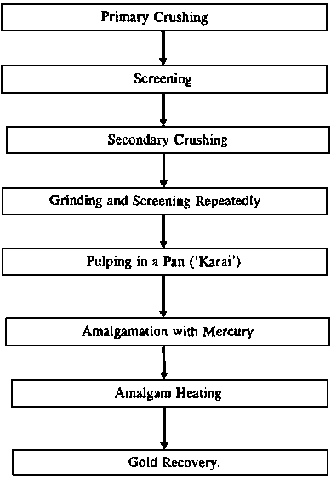
Figure 3: Gold Recovery Process
The above processes can be modified depending on the properties of the ore.
3.3. Environmental Aspects
The subject of environmental impacts emanating from activities of small scale miners in gold and other minerals is currently receiving increasing awareness. On the other hand increasing serious pollution problems are being posed by the growing number of small scale mining entrepreneurship. It is worthwhile to note that these activities have grown for a number of reasons which include:-
(i) the shedding of labour force from formal but inefficient mines and processing plants;
(ii) growing poverty causing families to search for alternative income and
(iii) the new "gold rush" phenomenon associated with new discoveries.
The environmental behaviour of these small miners is closely linked to the conditions of poverty which gave rise to them. These miners are generally poorly educated with no formal, or technical training. With the exception of a few miners coming from formal mines, they have little access to technology and lack the credit to buy it. Many of them should be considered as squatters on gold bearing "land" or they rent it from local claim holders or "land owners" to whom they are obliged to sell their gold under a "production-sharing scheme". In the process, huge mounds of materials are moved from the earth when digging mining pits.
The nature of such small-scale mining poses a number of policy challenges to the Government. First, it is an extremely inefficient way to produce minerals and in the long-term limited source of revenue as the miners reach both technological and financial limitations to enable them to continue mining. Also, such activities lead to the exhaustion of the high quality ores and inhibit more efficient forms of investment.
3.3.1. Dust
A typical artisanal gold mine as was seen during the survey is poorly conceived without much emphasis due to the lack of knowledge on rock stability or rock supports. It is estimated that at least 5% of the fatality rate per annum is possible through such workings, while injury rates are much higher. In some artisanal underground mines, drilling (with jack hammers) is done without water. Once the ore is brought to the surface, it is crushed and grounded. In both cases, this may cause acute respiratory problems due to the inhalation of silica-containing dust. Such a case is as shown in Figure 4.
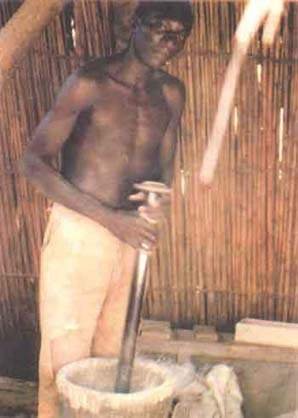
Figure 4: Crushing and Grounding of
Ore Using the Jack
Hammer
3.3.2: Land Degradation and Mine Reclamation
The digging of thousands of mining pits by the artisanal miners is bound to be the single most disturbing problem; particularly because the miners are normally on the move to " more lucrative" areas in a nomadic fashion, with no regard whatsoever to the pits left behind. Table 3 shows the number of mine pits in the area visited. There is no evidence showing that any efforts are geared towards reclaiming the mined-out pits.
Table 3: Estimated Number of Mine Pits
|
Name of Location |
Total Number of Pits |
Active Pits |
Status of Inactive Pits |
|
Merelani Tanzanite Mine, (Gemstones) |
459 |
100 |
Not refilled |
|
Nyabigena Mining Cooperative Society, (Gold) |
199 |
140 |
Not refilled |
|
Isungangwanda and Lusu, (Gold) |
510 |
10 |
Not refilled |
|
Ushirombo, Kahama, (Gold) |
40 |
40 | |
|
Bulyanhulu, (Gold) |
500 |
200 |
Not refilled |
|
Mugusu, (Gold) |
700 |
300 |
Not refilled |
3.3.3. Mercury Use and Effects on the Environment
In the gold recovery process, tremendous amounts of Mercury are used to amalgamate the gold; this is caused by the erroneous belief that the more Mercury used, the greater the rate of gold extraction. A lot of ore is treated in the rivers and Mercury finds its way into the water and finally into the ecosystem affecting the food chain. This was found to be rampant at Ushirombo, Bulyanhulu, Nyarugusu and Mugusu.
As shown in Table 4, 739.5, 564.3 and 170.5 kilogrammes of Mercury were sold around the Lake Zone in 1991, 1992 and between January-June 1993 respectively.
Table 5 shows atomic absorption spectrophotometric analytical results from river and well water samples collected; these results reveal the presence of high Mercury concentrations. The lowest (0.106 microgram per litre), and the highest (2.306 micrograms per litre) which are considered to be very high values particularly as the maximum permissible is 0.005 microgram per litre (i.e considering that these are values refer to effluents discharging straight into receiving waters). On the other hand, the usage rate has been estimated at one kg. of Mercury for one kg. of gold produced (Madini officials, Mwanza). Figure 5 shows an amalgam in which gold is contained.
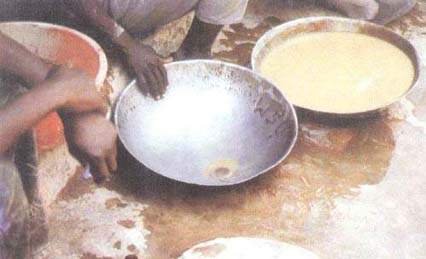
Figure 5: Gold-Containing Amalgam

Figure 6: Children Near a Stream
Active in Gold Panning
Table 4: Quantity of Mercury Sold per Annum Within the Lake Zone (in Kgs)
|
Year |
Amount (in kgs) |
|
1991 |
739.5 |
|
1992 |
564.3 |
|
1993 |
170.5 |
|
TOTAL |
1,474.3 |
Source: Mwanza Zonal Mines Office.
Table 5: Results of Analysis of Mercury in Water
|
Sample |
Mercury Concentration (Microgram/Litre) |
|
1. Ushirombo: Drinking water |
0.105 |
|
2. Ushirombo: Gold washing area |
0.977 |
|
3. Bulyanhulu: Gold washing area |
0.347 |
|
4. Bulyanhulu: Drinking water |
0.135 |
|
5. Bulyanhulu: Gold washing water |
0.179 |
|
6. Nyarugusu: Gold washing water |
0.649 |
|
7. Mugusu: Upstream Mugusu river gold washing area |
0.117 |
|
8. Mugusu: Downstream Mugusu river (1) |
0.574 |
|
9. Mugusu: Area with the highest number of gold washers at Mugusu river |
2.306 |
|
10. Mugusu: Downstream Mugusu river (2) |
1.205 |
Analysis by: Government Chemist.
It is important to note that all rivers around the Lake Zone lead to Lake Victoria which is essentially the life line not only for Tanzania but also for Kenya, Uganda and all other countries along the River Nile drawing water from Lake Victoria. This is the magnitude of the problem or rather, its source.
A study of small-scale alluvial gold mining in the Madeira River Basin in Brazil (Malm et. al. 1990) shows high concentration levels of Mercury in fish as far as 19, 780 kms. downstream from the main gold mining areas and very high values of Mercury in hair samples obtained from the local Indian population and local gold miners.
In the Tanzanian case, Lake Victoria is surrounded by artisanal mines located only a few kilometres away; therefore, one cannot rule out the possibility of Mercury pollution in the Lake itself - and subsequently River Nile. The seriousness of the problem therefore, is reinforced by the complexities of the food chain and the fact that affected fish can be eaten hundreds of kilometres downstream (far from the actual mining areas). Figure 6 shows two children holding fish near a stream active in gold panning that makes use of Mercury. The Mercury concentration in the water here was analysed; it was 0.649 microgram per litre.
Heating the amalgam to drive off Mercury also presents a health hazard; Mercury fumes are inhaled and particularly by those who decide to do this exercise at home - inside closed rooms.
Artisanal mining is increasingly becoming a fact of life in Tanzania as employment in the formal industrial sector continues to decrease. This is a fact that has to be recognized. Trying to limit or abolish artisanal mining activities without providing alternative sources of income is likely to meet with stiff resistance. Artisanal miners, are, in all likelihood, here to stay.
3.3.4. Social and Environmental Aspects
Environmental problems are not only restricted to the mining and processing of ore; informal villages spring up which have little or no basic sanitary facilities and which often bring problems with regard to law and order. The shift from farming to speculative digging has reduced food production which threatens famines in some areas. The greater availability of money has created pockets of inflation and put pressure on the price of essential goods, thus serving to further impoverish those who do not participate in mining.
In all the areas visited, severe environmental side effects required urgent attention. Where large numbers of artisans work, the common practice is to clear the bush by burning and thus establish both the mine site and villages, thus destroying the flora and driving out wildlife. With most of the ground covered with dug out pits created by artisanal mining activities, agriculture becomes virtually impossible or costly to carry out.
3.3.5. Silting in Rivers
Silting is a common phenomenon in artisanal mining areas. This happens when miners wash their ores in the river to recover gold. The result has been the raising of river bed levels and, in some cases, this has been manifested in the drying up of streams, rivers and dams. Since this is a slow process, it becomes difficult for the miners to notice the differences in river bed levels each subsequent season. The combined effect of silting due to floods and silting caused by artisanal mining activities is bound to speed up the degradation of drainage patterns. In areas such as Bulyanhulu, Nyarugusu and Mugusu the effects of silting can clearly be observed already and as shown in Figures 7 and 8 (taken at Mugusu and Bulyanhulu respectively).

Figure 7: Effects of Silting in the
Mugusu Area

Figure 8: Effects of Silting in the
Bulyanhulu
Area
3.4. Observations and Recommendations
Gold production in the whole of Tanzania, currently stands at about 3.5 tons per annum, and is produced by the informal industry (mainly through artisanal mining activities).
The artisanal miners use crude gold extraction methods which include the haphazard digging of thousands of mine pits and the recovery of gold using Mercury. Some of the Mercury finds its way into streams and rivers and hence continuously pollutes them.
Due to the poor organizational structure of the artisanal miners, it has become increasingly difficult for Officers in the Mines Department to regulate artisanal mining activities.
Neither the Minerals Resources Department, nor artisanal mining communities has any concrete plans designed to carry out land reclamation measures or to control the chemical pollution of streams and rivers.
Health and sanitation in the area is extremely poor.
As shown in Figure 9, artisanal mining operations affect the environment in ways that raise concern. Lateritic soils contaminated with Mercury causes silting in rivers and results in the subsequent raising of the river bed. During floods (in the rainy season) part of the contaminated material may be transported into Lake Victoria thus polluting it.
It is recommended that the extensive and intensive use of Mercury for recovering gold should either be technologically controlled or discontinued altogether if efforts to control its use do not succeed.
It is recommended that the Mineral Resources Department designs and implements plans to reclaim all mined out and abandoned mine pits.

Figure 9: Artisanal Mining Versus
Environmental
Hazards
|
| ||||||||||||||||||||||||||||||||||||||||||
Environmental Impacts of Small Scale Mining (CEEST, 1996, 62 p.)
4. Small Scale Gemstone Mining
Small scale gemstone mining is carried out in several areas in Tanzania. Gemstones are found in the Usagaran and Ubendian granulite system. Areas of concentrated artisanal workings include:-
(i) Merelani in Kiteto District, Arusha Region - famous for the mining of tanzanite (a blue-violet zoisite).(ii) Matombo and Mahenge in Morogoro Region, Longido in Arusha and Umba in Tanga Region are famous for ruby and sapphire mining.
(iii) Rukwa Region and Manyara in Arusha Region are known to produce emeralds.
For the purpose of this study, a visit to Merelani Tanzanite Mines was made; the target area being Block D which belongs to Arusha Region Miners Association (AREMA).
4.1. Mining Methods
An area is normally allocated to interested persons by the Association in return for a 10% fee levied on tanzanite sales.
Once the area has been allocated, a prospecting pit is excavated to depths of 30-50 metres until the graphitic zone has been encountered. It is in this zone that tanzanites are found. To a large extent, the miners at Merelani appear to be employing mechanization that is higher than that employed by the gold diggers (they are semi-mechanized). Machines such as compressors, jack hammers, explosives and accessories could be seen, the main underground extraction method used being room-and-pillar. Pits measure approximately 1.5m × 2m and in the gemstone zone horizontal drifts measure 1.5m × 2m on average and have a length of up to 150 metres as shown in Figure 10 below.

Figure 10: Structure of Gemstone
Mining Pits
Explosives are extensively used for fragmenting the rock. For lighting purposes, miners use dry battery torches which have turned out to be very expensive inputs. In such precarious working conditions, no consideration is given to safety gear. The miners do not wear safety boots, glasses, dust muffs or helmets, and are therefore exposed to all possible hazards.
Ventilation is provided by compressed air normally used for drilling purposes. However, this is not sufficient, given the working depths. Miners have to come to the surface time and again to inhale oxygen.
Hoisting is carried out in three very dangerous ways:-
(i) manual (through pulleys mounted on wood);
(ii) manual drum hoists; and
(iii) tractors pulling hoisting rope through pulleys.
During the time of the visit, an accident happened where a tractor pulled the hoisted rope beyond its length, resulting in the destruction of the tripod system to which the pulley was connected. These methods are shown in Figures 11, 12 and 13.

Figure 11: Artisanal Hoisting
Mechanism at Merelani Tanzanite Mines
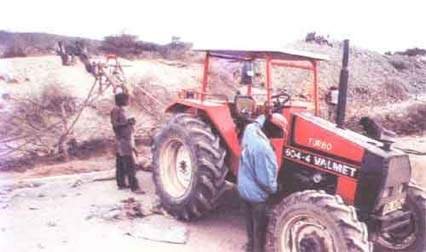
Figure 12: Artisanal Hoisting
Mechanism at Merelani Tanzanite Mines

Figure 13: Artisanal Hoisting
Mechanism at Merelani Tanzanite
Mines
4.2. Gemstone Recovery
The process of gemstone recovery is extremely simple and only involves screening. If a 'pocket' is found, the lot would be sieved and the oversize consists of tanzanite and gangue (uneconomical material) is discarded.
However, once the material is brought to the surface, scavenging takes place to recover even the smallest tanzanites.
4.3. Environmental Aspects
As cited in the mining method, pits have to be excavated to win the gemstones and in so doing the area allocated to mining operations suffers severe degradation caused by hundreds of mine pit excavations. In Block D alone there were 459 pits out of which only 100 of them were active. Inactive pits were not reclaimed by being refilled and it would appear that no priority was being given to this exercise.
Excavated materials are not transported from the area but remain piled up near the mine pits; thereby posing the danger of rocks falling back into the pits. The pits have fragile, and with no protection around them, can endanger the lives of miners. Figures 14 and 15 clearly demonstrate the extent of environmental destruction.
4.4. Observations and Recommendations
(i) Tanzanite gemstone miners do not use any harmful chemicals to recover the minerals.(ii) Ventilation is inadequate, and graphitic (carbon) dust pollutes the ambient atmosphere. The subsequent inhalation of carbon dust is a health hazard to miners and could result in the black lung disease.
(iii) Abandoned mine pits are not refilled; this endangers people's lives. Although leaders of the association recognize the need to reclaim the mined out areas,, it appears that this is not the priority at the moment. It is recommended that the Mineral Resources Department, in cooperation with the miners associations should prioritize this implementation exercise.
(iv) Sanitation is poor, as is health in the mining areas. Cases of e.g. diarrhoea, malaria, and dysentery are the order of the day.

Figure 14: A Mound of Stockpiled Rock
from Artisanal Mining Activites at merelani

Figure 15: Land Degradation at
Merelani Tanzanite Mines: Inactive Mine
Pits.
|
| ||||||||||||||||||||||||
Environmental Impacts of Small Scale Mining (CEEST, 1996, 62 p.)
5. Environmental Legislation
5.1. Mining Act 1979 and Mining Regulations
Currently, the Tanzania Mining Act 1979 and Mining Regulations provisions are not sufficiently effective as far as environmental protection to regulate the small scale mining industry is concerned. In essence, very few developing countries have effective, comprehensive and proven environmental regulations for mining. Many of these countries only give high priority to the development of mineral exploitation for economic gain with lower priority directed towards environmental problems. It is difficult to discern why the environment, being an intimate part of mining, has not been given its deserved attention -particularly in a country plagued by a host of environmental degradants such as erosion caused by animals, water action, deforestation, and rampant artisanal mining activities. The subject is currently receiving its due attention and it is hoped that the Government will conduct a more thorough review in the near future.
The current legislation which touches on environmental issues is contained in the Mining (Claims) Regulations, 1980 in which Article 13 (Obligation on Abandonment) states that:-
1. "Any person who abandons his claim or whose claim (other than a disc claim) shall forthwith notify the Commissioner of the abandonment.2. Any person who abandons his claim or whose claim expires or is cancelled.
a. Shall forthwith fill up, fence or secure to the satisfaction of the Commissioner or other prescribed officer all shafts, pits, holes and excavations in such a manner as to prevent person or stock inadvertently entering them; andb. Shall remove the location beacon and all boundary posts thereon.
3. Any person who fails or neglects to comply with sub-regulation (1) shall be guilty of an offence and liable on conviction to a fine not exceeding Tshs. 1, 000.00 or to imprisonment for a term not exceeding six months or to both that fine and imprisonment and in addition shall be liable to pay such sum as the Commissioner may certify the cost of doing so will be."
Article 23 (Deposit of Tailings), also states that:-
1. "The holder of a claim whose mine has access to water-course, may deposit in it tailings from that mine.2. The Commissioner may, by order published in the Gazette, prohibit the deposit of tailings in any water-course or any part of it; or may limit the extent of the deposit in such manner as he may think fit and in that case may prescribe the manner of disposal of tailings from mines having access to the water-course, or any part of it; or may limit the extent of the deposit in such a manner as he may think fit; and in that case may prescribe the manner of disposal of tailings from mines having access to the water-course.
3. No such order shall come into force until two months after the date of its first publication, unless the Commissioner, for special reason stated in the order directs otherwise.
4. The holder of a claim shall not, except with the consent of the Commissioner, deposit in any water-course or permit to except from the area of his claim any chemical or other substance deleterious to animal or vegetable life.
5. When tailings are not deposited in a water-course the holder of a claim may be ordered to retain all or any specified class of tailings, within the area limited by his claim, or within such other area as the Commissioner may direct."
From the above set of rules one, is at liberty to judge whether the above environmental regulatory framework can effectively deal with the immense task which is at hand. The burning question thus is: "What Constitutes Effective Environmental Regulations?"
Effective implies that the nation is seeking to achieve some goal or satisfy specific objectives that have been identified and also implies practicability (in terms of the industries ability and willingness to comply), or workability (for example, the regulatory system must be workable within the constraints of manpower availability and training and within the means granted to implement the regulatory functions). The present field situation does indeed confirm the total non-compliance of even the existing environmental regulatory regime as stipulated in the Mining (Claims) Regulations, 1980.
The problem then is how to draft and implement an environmental protection policy and legislation which fits the administrative, practical and philosophical needs of the country. This is not a problem with a single solution. It calls for a global approach by considering the unique social, political, economic, legal circumstances and education level of the masses involved in artisanal, medium or large scale mining businesses/ventures.
In recognition of the complex nature of this subject, the Government formed the National Environment Management Council (NEMC) in 1983. NEMC is a body corporate which inter alia formulates, coordinates, evaluates, reviews and appraises environmental issues and creates awareness country-wide. In carrying out its duties, NEMC maintains close collaboration with the Ministries concerned. However, it could be argued that the presence of this institution has not been fully felt as yet (for a brief look of NEMC's mandate refer to excerpts of the Act Establishing NEMC which are contained in Appendix II).
5.2. Observations and Recommendations
(i) The present Mining (Claims) Regulations of 1980 is inadequate to deal with the environmental problems created by artisanal miners.(ii) The Government, on the other hand, exacerbates the environmental pollution problems currently experienced by its continued selling of chemicals like Mercury without regard to the environmental consequences.
(iii) Efforts by the Government or its agencies or institutions (such as NEMC) to monitor and arrest the current trend in order to avert the more serious environmental problems are inadequate although NEMC has the mandate to perform these functions (see Appendix II for excerpts on the NEMC Act of 1983).
(iv) It is recommended that the Government and its agencies and institutions should review the present guidelines, regulations, etc. on mining and the environment with the aim of designing effective environmental regulations.
(v) It is also recommended that streams, rivers and lakes in the vicinity of mining activities be periodically checked for possible pollutants. This should also apply to human beings as well as aquatic species. NEMC could be given the responsibility of seeing to this.
(vi) Due to the complex nature of dealing with artisanal miners, the Government could set up a "reclamation fund" to assist claim holders to reclaim the mined-out land before abandonment.
|
| ||||||||||||||||||
Environmental Impacts of Small Scale Mining (CEEST, 1996, 62 p.)
6. Training in Environmental Issues
6.1. Overview, Observations and Recommendations
Within the Ministry of Water, Energy and Minerals, the training and development of human resources in environmental issues is lacking. This gives rise to a secondary problem, that of inability to train the artisanal miners themselves. It has manifested during the field study that many artisanal miners were unaware of the chemical, sanitary, or health hazards, or other negative consequences.
(i) Zonal Mines offices are responsible for imparting mining knowledge to miners within their zones. In most zonal offices, the officers concerned do not have transport facilities to enable them to adequately cover the areas they are responsible for, and as a result, it becomes impossible to attend to the needs of miners. No visual aids on environment protection were seen anywhere in the areas visited.(ii) It is recommended that urgent steps be taken to adequately equip the zonal offices so that periodic visits to mining areas can be made.
(iii) It is recommended the training should be in the form of seminars and courses for miners at the Madini Institute in Dodoma, or other relevant college, and that formal university/college courses should be provided for Government engineers and officers.
(iv) It is recommended that deliberate efforts be made to prepare large posters to be sent to the mining areas. These should essentially cover proper mining and processing technology, proper sanitation and health, environmental pollution control and other relevant issues.
Observations and recommendations have been given at the end of each chapter in the report; in addition, they have also been highlighted in the executive summary.
|
| ||||||||||||||||||||||||||||||||||||||||||||||||||||||||||||||||||||||||||||||||||||||||||||||||||||||
Appendix I: Trip Notes
PHASE I: MERELANI TANZANITE MINES
Day 1: 9 July 1993
We travelled from Dar es Salaam to Moshi.
Day 2: 10 July 1993
We arrived at Merelani village, some 40 kilometres West of Moshi in the afternoon and visited the AREMA office (Arusha Region Miners Association) where we met Mr. Henry Urio, the person in-charge of security within the association.
The village seemed to be thriving with activity. We met officials of Tanzania Gemstone Industries who have set-up a gemstone buying post. Mr. Henry Urio took us to their area of mining activities named block D. The following data was gathered:-
(i) The population of miners is around 35.000 people.(ii) Currently there are 459 mining pits out of which 10 are productive.
(iii) He cited the main problem to be lack of suitable mining equipment because of the depth miners have to dig to find the valuable mineral. At present only a handful of miners own compressors and jack hammers.
(iv) Revenues realised since May 1991 amounted to Tshs.90 million.
We then went for a tour of the diggings accompanied by Mr. Mwaipape and Urio. The following were observed:
(i) The entire area (about 0.5kms2) is impregnated by several mining pits clustered together and without any protection around the entrance.(ii) Huge heaps of mined out rock surround the mining pits without any protection around. This means the mine pits are not protected from rock falling back into the pits, this could endanger life of miners.
(iii) Miners emerging from the pits are smeared in black powdery material i.e. graphite.
It therefore implies that graphite dust poses a danger to the miners.
(iv) Although compressors work throughout for mining and ventilation, miners complain of inadequate oxygen as pits depth have reached 200 feet or more.
(v) From what we were told, it appears there are no plans to reclaim the mined out and unproductive pits. The reason we were given is that the miners do not have sufficient funds to carry out the exercise.
(vi) In this area no chemicals are used, hence pollution of the environment resulting from chemical use is not present.
Day 3: 11 July 1993
We travelled back to Dar es Salaam.
PHASE II: THE LAKE ZONE Day 1: 28 July 1993
· Mwanza Zonal Mines Office
At the Mwanza Zonal Mines office, we met Mr. Elias Azaria who is the zonal mining technician. During the time of our visit, the zonal mining engineer and the zonal mines officer were attending other official duties.
Since our intention was to proceed to Musoma on the same day, Mr. Azaria assisted us with the names of officials to meet in Musoma/Tarime. We then proceeded to Musoma, 215 kilometres north-east of Mwanza.
Day 2: 27 July 1993
· Musoma/Tarime
From Musoma we proceeded to Tarime (80 kilometres north-east of Musoma town). We were accompanied by Mr. Alis Kusekwa, the District Mines Officer, and travelled with him to Nyabigena which is an active gold mining area. We met and held discussions with members of the Nyabigena Miners Co-operative Society (NMCS). The following were the pertinent points gleaned:-
· Mr. Masanda Umtima who is the NMCS Secretary explained the organizational setup of the co-operative. He told us that it was constituted by a Chairman, Vice-Chairman, Secretary, Assistant Secretary, Treasurer and an agent whose main duty is to liaise with outside organizations.· The co-operative consisted of 150 members
· The population was altogether some 40, 000 people i.e. this included people from the surrounding villages.
· The type of ore mined is reef.
· The number of mine pits totalled 199, the sizes of which ore 1.5 metres by 2 metres.
· Physical inspection of the claim (1500 feet × 600 feet) revealed that the mining pits are clustered together at short distances.
· Ore extraction is done using picks, shovels, hammers and chisels. Rock breaking is done using explosives due to hardness of the rock. The mine is drained using pumps. No ventilation machinery was available. However, natural draught is created due to proximity of the pits which also join at some point underground.
· The area around the pits are surrounded by huge heaps of rocks already mined out. We saw that the pits had no protection around them posing a danger to both underground and surface workers in the event of rock falling from the heaps into the mine pits.
· Mr. Umtima took us to an isolated area where some elderly women were engaged in gold recovery by panning using Mercury to produce an amalgam bed which is later heated in the open to sublime Mercury and recover gold.
· When the women were asked whether they had any knowledge of the dangers of Mercury/Mercury fumes, they replied that they had no knowledge. One lady by the name Gaayi, told us that she normally heated the amalgam bed at home. We hinted to them that Mercury was a dangerous chemical which could cause damage to both man and the environment. This fact raised their eyebrows since they had been using Mercury intensively.
· We were taken to a river running along the mine area (River Tigite). One Amos Marwa who is a miner and an executive member of the co-operative told us that Mercury is not used for panning gold near the river, all panning is done far from the river. He intimated to us that some organizations visited them and told leaders of the co-operative not to use Mercury near the rivers. It appeared that they were not told why they should not.
· We were later told that out of the 199 mine pits, only 140 pits were active. We found out that all inactive pits were not covered. Most of the miners interviewed did not consider reclaiming the land to be an important aspect. If a new gold prospect was found, they simply abandoned the present pits and moved to a new area.
· During our wrap-up meeting we gave them some advice on how environmental damage can be minimized. We informed them about simple retorts which can be used to treat amalgam gold and eliminate the presence of ambient Mercury fumes. We explained to them how Mercury interferes with the food chain to the detriment of human beings.
· As far as land reclamation is concerned they believe that this should be the Government's responsibility since they do not have the means and funds to execute such tasks.
Day 3: 28 July 1993
· Mwanza Zonal Mines Office
We had discussions with Mr. Seth Mwakyolile who is the Zonal Mines Officer In-charge together with Mr. Asa Mwaipopo. Our discussion focussed mainly on environmental issues arising out of artisanal mining activities. They raised the following points:-
· They were of the view that artisanal miners have no mining culture and regarded most of them as mere opportunists, who, like "nomads"; were always moving to "greener pastures".· Most artisanal miners had no regard to environmental problems they create. In fact they were not aware that they are causing massive land degradation which is bound to affect their very existence.
· Miners were oblivious of the dangers of Mercury or cyanide pollution dusts or water silting created by mining activities. We were told that cyanide used at Bulangamirwa mine (operated 1936/37) still poses a problem today. Mr. Mmole of Madini Laboratories, Dodoma, did some analysis on some tailings from this mine. They have estimated that one unit of Mercury produces one unit of gold.
· Most mining communities lacked the basic infrastructural support (e.g. lacked any medical facilities or hygienic standards).
Day 4: 20 July 1993
· Shinyanga
Discussions were held with Mr. Kibumo, the Shinyanga Zonal Mines Officer and Mr. Omari Chambo, the Zonal Mining Engineer. We were told that in this zone, miners use a lot of timber for mine support (resulting into deforestation as there was no tree replanting programme). Another problem was the intensive use of Mercury and, in some areas (like Matinje), cyanide was also used by one Mr. Joshua Nelson, of course, the scattered mine pits top the list of areas facing environmental problems.
They said that their office was duty bound to enforce mining laws and regulations but due to the lack of funds and vehicles, the work is impossible to execute. They hoped for some institutional support from the World Bank.
We later proceeded to Nzega accompanied by a mining technician - Mr. Zephrine.
· Nzega Ndogo
In this area, we visited two artisanal mining areas; one was Isungangwanda, which is about 58 kilometres from Shinyanga along the Shinyanga-Nzega road and the other was Lusu, about 1 kilometre from Isungangwanda. At Isungangwanda, a few artisanal miners could be seen working. A river passing by the workings had dried up due to silt accumulating in the river because ore is washed inside the river. We were told that only a few years back, the river was free flowing. Several grazing cow herds and children and adults moving around on bicycles could be seen around the mining area.
We then drove to the diggings (about one kilometre from Isungangwanda).
· Here we met with one claim holder by the name of Mr. Kassim Mfaume who holds claim No. Five. He told us he has 500 mine pits with depths up to 150 feet spread all over his claim. However, only 10 pits were active and the rest were not covered. As we toured his claim, he said that there had been accidents in some of the pits. He said he tried to cover the pits using timber without much success because the timber became a source of fuelwood to the villagers. Some of the pits we saw were as close as one metre from a busy village road.· Mercury is used for amalgamating gold. However, there are no rivers around the vicinity of the mines. Water is transported by traders on bicycles and costed up to Tshs.25.00 per litre. It was apparent (to us, at least), that the environment here suffered from extensive diggings of mine pits without any reclamation plans, or dealing with the health hazards brought about by the dusts emanating from crushing the ore by pestle-and-mortar (in most cases the workers crush the ore for non-stop over 24 hours) or the Mercury fumes come out of heating the amalgam.
· When Mr. Mfaume was asked whether he knew of the dangers of using Mercury, he replied that he had no knowledge.
· Before leaving he was given advice on safe handling of amalgam by using simple retorts which he was prepared to buy. The question was whether these were available.
We then proceeded to another location within Lusu-claim No. 1 belonging to one Anaclet Patrick who was not available. We spoke to Mr. Salim Adhifa, who was in-charge of the mine.
· He showed us small ball mills made out of two truck reams welded together. They are connected in series and driven by a tractor with one wheel removed. The rear wheel drive member is connected to the ball mills through 2 series of axles. Grinding media consisted of balls of different sizes (0.5" - 1.0'). Gold extraction was done by using Mercury and a Copper plate. We were told that cyanide leaching would be introduced later on.
The mine-in-charge told us that he was aware of the hazards of both Mercury and Cyanide which he learned from a certain company - TANCAN which operates in the Matinje area.
Day 5: 30 July 1993
· Ushirombo Kahama
We travelled to Ushirombo Gold Mines accompanied by Mr. Kizuguto who is the Kahama District Mines Officer. It is 191 kms. from Kahama town and 5 kms. east of the Kahama-Rwanda Highway.
Here we met officials of the Katente Miners Co-operative Union Mr. Alex Petro (the Vice Chairman) and Mr. Paulo Nchema (the Secretary), who told us that me society was registered in April 1993. The organizational set-up consisted of a Chairman, Vice Chairman, Secretary, Assistant Secretary and Committee Members.
We proceeded to the mining areas where hundreds of mine pits could be seen. We learnt the following:-
· Timber logs used for mine support were scattered around the pits ready for use.· Mr. Alex Petro said that the timber logs are obtained near the village. When asked whether there was any afforestation plans, he replied that the Government had these plans so they were not worried about any impending danger of deforestation. They expressed a strong belief that environmental issues are a responsibility of the Government which they said gets all the Gold they produced under very difficult conditions.
· Mr. Kizuguto explained that he normally runs seminars for the miners, the aim being to educate them on proper ways of mining and how to care for the environment; however, he said a large number of miners have had no formal education which was a source of exasperation for him.
· We were then taken to see the place where washing was done to recover gold. A simple sluice is used and in the next stage amalgamation using Mercury is done. We noted that this place was about 2 metres from a well where villagers obtained their drinking water. Water samples were taken at the washing area and at the water well to check for the presence of Mercury.
· During the wrap-up meeting (with the leaders and members of the miners cooperative union), we took time to give pertinent advice on proper/appropriate mining and ore-processing technology and the dangers that emanate from land degradation and the improper use of Mercury. The following were some of the points raised:-
(i) Ore comminution (i.e. the crushing and grinding of rock) can be done in a simple crushers and ball mills.(ii) Amalgamation can be done in a simple barrel coupled with a copper plate.
(iii) Mercury can be separated from gold using a simple retort.
The reply to the above explanations was that all the above equipment were not locally available. The general view was that most claim holders had the financial capability to buy these equipment if they were fairly priced.
Day 6: 31 July 1993
· Bulyanhulu (Kahama)
We took a short-route from Ushirombo and arrived at the STAMICO mine camp in Kahama.
The next morning we went straight to the artisanal mining areas. Gold exploration at Kahama by STAMICO and its Finnish partners and later on by Placer Dome had revealed three distinctive reefs; gold reserves are estimated at 40 tons.
Here, we could see several hundred pits some measuring as small as 3 ft × 3 ft. The strike length of the ore body was impregnated by these small pits which made it look like a 'honey comb' or an 'ant-hill'.
Characteristic of all the artisanal mining sites visited, many mine pits left in reef No. 2 after underground water was encountered, were not covered. We found people selling and others buying rock for crushing to liberate gold.
Mr. Kizogoto, the Mines Officer who accompanied us condemned some of the mine pits outright. However, as we left people could be seen continuing with their activities as usual.
We then proceeded to the ore washing area which is in very close proximity to Bulyanhulu River. The following is what we saw:-
· There were hundreds of gold panners using simple sluices named 'Mboka' by the miners.
· Smooth river flow was hampered by huge mounds of earth to be washed to recover gold.
· More miners with ore joined the others to pan for gold.
· Mercury was used intensively for gold recovery.
· To drive-off the Mercury, heat treatment was employed in the open.
"We then took some water samples upstream, downstream and at the area of concentrated washing.
We concluded that it was simply a matter of time before the river dries up due to silting.
· Nyakagwe
We travelled about 5 kms. north-west of Bulyanhulu to Nyakagwe where Kiganga and Associates Company Ltd. hold a Prospecting License (PL). There we were met with Messrs. Deusdedit Rwezimuro; the Manager, Paul Mabele, the Mechanical Engineer and Robert Kiganga, the Accountant.
The Manager said that their prospecting License covered an area of 32kms2 and were currently negotiating for joint venture with East Africa Mines Ltd., an Australian owned company. Drilling is in progress following which a feasibility study will be prepared. A joint venture company - Ikina Reef Company Limited, will be formed if the project is found to be financially viable.
The company set-up a small pilot mill to recover the gold. It consists of a generator, crusher, ball mill and local sluice box. We were informed that production was about 36 grams/day. The ore came from holders of mineral rights.
The Manager said that the feasibility study would incorporate land reclamation plans. He was not sure as yet which process would be used for recovering the gold.
· Nyaruguru
This famous mining town is 30 kms. from Nyakagwe. We had the opportunity to hold a discussion with members of Mwanza Region Miners Association (MWAREMA) the headquarters of which was Nyarugusu.
Mr. Obadia Muamwamu gave us a rundown of the organization as follows:-
MWAREMA had three branches; Nyarugusu, Mugusu and Nyamtondo. Invariably, the organization of MWAREMA is similar to the other mining co-operatives earlier discussed. However, MWAREMA has formed a subsidiary Mwanza Mining Company Limited (MWAMICO) to be its commercial wing.
A tour of the mining areas revealed the following:-
· Massive land degradation is a result of many years of artisanal mining activities in which the area concerned is simply destroyed.· There are in total 12 registered claims. Many mine pits could be seen to the extent that most of the officials did not know their numbers.
· Some of the pits had caved in, vegetation was scarce, and only a few trees could be seen.
· One dam which was operative only some years back, had disappeared under heaps of tailings.
· Mercury was invariably used in the recovery of gold.
When we asked whether or not MWAREMA had any plans to reclaim the abandoned areas for other purposes, we got replies from which we deduced that no such plans existed.
While proceeding to Geita, we stopped at a bridge where some people were panning using sluices and Mercury to recover gold; a few metres away, two young boys were fishing.
Day 7: 1 August 1993
· Mugusu (Geita District)
We travelled from Buckreef Gold mine (where we spent the night), to Mugusu which is about 22 kilometres from Geita town. A Geita district mine technician, Mr. Kabadi accompanied us.
There are two claims in Mugusu, owned by Mr. Chipaka. We met Mr. Jarida Ngonyani, CCM Secretary; Fadhili Magoya, Security Advisor; and Hussein and Kassim Mbonde own the mine.
We were given the following information:-
· The Population of Mugusu consists of about 15, 000-20, 000 people.· There are 700 mining pits in the Mugusu Hills out of which 300 are active mines.
· Shaft depths went down to 300-400 feet.
· Mining was done using picks, hammers, shovels and hoisting done by using wooden pulleys and rope, buckets and karais.
· No explosives are used. The ore is soft (quartz stringers).
· Mine ventilation is very poor (except where two pits meet underground).
Processing follows the following steps to recover gold:-
· Comminution using pestle and wooden mortar; the pestle being a heavy axle.
· Regrinding of ore is done using grinding stones.
· Use is made of simple locally made sluice.
· Amalgamating the finely ground ore is done using Mercury in a water medium (pulping).
· Squeezing the Mercury using a piece of cloth to squeeze the Mercury out.
· The amalgam is heated to drive off the Mercury.
It is estimated that the gold produced at Mugusu per annum is around 18-25 kilograms.
We then visited the Mugusu River where we saw hundreds of miners sluicing the ore and amalgamating it in order to recover the gold.
· The river bed is extensively damaged due to excessive silting.· One of the miners admitted that a few years back the river was free flowing - and deeper than it was at present.
· None of the miners knew the dangers of using Mercury in rivers or the effects produced by heating the amalgam.
We took water samples upstream, downstream and at the core activity to check for the presence of Mercury.
We concluded that the river could disappear in the following few years.
Day 8: 2 August 1993
· Mwanza Zonal Mines Office
The day was spent at the Mwanza Madini office obtaining statistics of both gold production and Mercury sales to artisanal miners.
We left for Dar es Salaam on 3 August 1993.
|
| ||||||||||||||||||||||||||||||||||||||||||||||||||||||||||||||||||||||||||||||||||||||||||||||||||||||
Appendix II: The NEMC (1983) Act
The following has been extracted from the Act No. 19 that established the National Environment Management Council (NEMC) which was enacted by an Act of Parliament on 16 July 1983. Under part II: Functions of the Council4. These excerpts, taken from the National Environment Management Council (1983) Act show the functions and powers NEMC has been vested with - and which have relevance to this study.
4The full text can be provided upon request.
Part I of the NEMC Act is the "Preliminary" part of the Act which provides a description of the terms used, part of the terms relevant to this study are provided below.
...' 2. In this Act, unless the context otherwise requires:-"beneficial" means the use of the environment or of any part thereof that is conducive to human benefit, welfare, safety and health;
... "the Council" means the National Environmental Management Council...;
... "conservation " means any act or a combination of acts, processes or procedures aimed at the protection, development and control of the environment, or the elimination, minimization or prevention of harm to the environment as a result of biological, chemical, economic, physical or social developmental activity;
... "environment" means the land, water and atmosphere of the earth;
... "pollution" means any direct or indirect contamination or alteration of any part of the environment so as:-
(a) to affect any beneficial use adversely; or(b) to cause a condition that is detrimental or hazardous or likely to be detrimental or hazardous to:-
(i) human health, safety or welfare;
(ii) animals, plants or microbes; or
(iii) property
Caused by emitting anything.
The functions of NEMC are listed under Part II; excerpts from which read as follows:-
"... Functions of the Council: -
... 4. The functions of the Council shall be to advise the Government on all matters relating to the environment, and in particular the Council shall:-
a. formulate policy on environmental management and recommend its implementation by the Government;b. co-ordinate the activities of all bodies concerned with environmental matters and serve as a channel of communication between those bodies and Government;
c. evaluate existing and proposed policies and the activities of the Government directed to control of pollution and the enhancement of the environment and to the accomplishment of other objectives which affect the quality of the environment and, on the basis of that formulate policies and pro-grammes which will achieve more effective management and enhancement environmental quality;
d. recommend measures to ensure that Government polices, including those for the development and conservation of natural resources, take adequate account of environmental pro-grammes;
e. foster co-operation between the Government, local authorities and other bodies engaged in environmental programmes;
f. stimulate public and private participation in programmes and activities for the national beneficial use of natural resources;
g. seek advancement of scientific knowledge of changes in the environment and encourage the development of technology to prevent or minimize adverse effects that endanger man's health and well-being;
h. specify standards, norms and criteria for the protection of beneficial uses and the maintenance of the quality of the environment;
i. establish and operate a system of documentation and dissemination of information relating to the environment;
j. formulate proposals for legislation in the area of environmental issues and recommend their implementation by the Government;
k. establish and maintain liaison in other national and international organisations respect of issues and matters relating of environmental protection and management;
I. undertake or promote general environmental educational programme for the purpose of creating an enlightened public opinion regarding the environment and the role of the public in its protection and improvement;
m. perform such other functions as the Minister may assign to the Council, or as are incidental or conductive to the exercise by the Council of all or any of the preceding functions.
... 4. (3). For the purposes of the better performance of its functions the Council shall establish and maintain a system of collaboration, consultation and cooperation with any person or body of persons established by or under any written law and having junctions related to those specified in subsection (1) or which relate to environmental management or environmental matters generally....... 5. The Council may, for the purposes of carrying out its functions under this Act, do all such acts as appear to it to be requisite, advantageous or convenient for or in connection with the carrying oat of those functions or to be incidental to their proper performance and may carry on any activities in that behalf either alone or in association with any other person or body of persons.
Further down, under Part II of the NEMC Act, it is clearly stipulated that the Council may seek environmental-related information from concerned person or body of persons (as quoted below).
...11. (1) The Council may require in writing any person or body of persons engaged in research, or engaged in an activity effecting or relating to the environment within Tanzania, to furnish to it such information relating to that research or activity as the Council may specify.(2) Every person or body of persons which is required to furnish information under subsection (1) shall comply with the requirement and any person or body of persons which refuses or fails to comply with that requirement shall be guilty of an offence and shall be liable on conviction to a fine not exceeding five thousand shillings.
Under the Financial Provisions Part III of the NEMC Act, the Council can seek funds from various funding sources as shown below.
...13. (1) The funds and resources of the Council shall consist of:-
a. such sums as may be provided for that purposes to the Council by Parliament, either by way of grant or loan;b. such donations, grants, bequests and loans as the Council may, from time to time receive from any person or organisation;
c. any sums or property which may vest in the Council under this Act or any other written law or which may vest in the Council in any other manner in the performance of its functions.
(2) The funds and resources of the Council shall be applied for the purposes for which the Council is established under this Act.
The Minister of the Ministry to which NEMC belongs as a subsidiary5 has powers to impose duty to any person or body of persons benefitting from the activities of the Council. Part III of the Act, (no. 15 - as shown below - NEMC has powers to charge fees for any service rendered by it or any of its committees (e.g. the EIAs).
5NEMC falls under the Division of Environment, which was formerly part of the Ministry of Tourism, Natural Resources, and Environment. However, in 1995, following a Government decision, the Ministry of Tourism, Natural Resources and Environment has been divided into the Ministry of Tourism and Natural Resources; and the Division of Environment shifted the Prime Minister's Office.
|
...14. |
(1) If the Minister considers it necessary in the public interest he may, after consultation with the Minister for the time being responsible for finance, by order published in the Gazette, impose a duty payable to the council by any person or body of persons benefiting from the activities of the council or whose activities affect the activities of the Council, and every such person or body of persons specified in the Order, shall take all necessary measures to pay to the Council such amount of duty and in such manner as may be specified in the order. | |
| | | |
| |
(2) Every amount of duty required to be paid under subsection (1) shall be paid by the specified person or body of persons, and the amount so pay able shall be a debt due to the Council and may be recovered from the specified person or body of persons as a civil debt by a suit at the instance of the Director-General or any person authorised by him in that behalf. |
|
| | | |
| |
(3) Where any amount of duty is due form any specified person or body or persons, the Director-General may file in a court of a Resident Magistrate having jurisdiction over the area in which the specified person or body of persons are on business, a certificate stating:- | |
| | |
|
|
| |
a. the name and address of the specified person or body of person form whom the amount is due; and |
| | | |
| | |
b. the amount due, and upon the certificate being lodged in court the certificate shall be deemed to be a plaint duty lodged under Order XXXV of the Civil Procedure Code 1966, and the court shall proceed in the matter in accordance with the provision, of that Order, and in the event of a judgement being given in favour of the plaintiff the court shall pass a decree for payment by the defendant to the Council of the amount found due together with interest on that amount at five per centum per month form the date on which the certificate was filed until payment. |
| | | |
| |
(4) The provisions of subsection (3) shall apply notwithstanding that the amount involved exceeds the pecuniary jurisdiction of a court of a Resident Magistrate. | |
| |
| |
|
|
(5) Every certificate filed in a court of Resident Magistrate pursuant to the provisions of subsection (3) shall, unless the contrary is proved, be conclusive evidence of the truth of the statements contained in that certificate. | |
| | | |
|
15. |
For the purpose of the better and proper performance of its functions the Council may, subject of any directions which the Minister may give in that behalf, charge fees for any services rendered by it or by any of its committees. | |
Section 3 (2) of the Schedule, the Minister can appoint members who could assist in the realization of the Council's objectives as quoted below:-
... 1. The Council shall consist of:-
a. a Chairman, who shall be appointed by the President;b. fifteen members appointed by the Minister upon nomination; one each of such Ministries and organisations involved in matters relating to the management or protection of the environment as the Minister may determine;
c. three other members appointed by the Minister from amongst persons, who, in his opinion, have the necessary experience in make a useful contribution to the realization of, and to the deliberations of the Council.

Figure 16: Organization Plan for
the National Environmental Management Council
(NEMC)
|
| ||||||||||||||||||||||||||||||||||||||||||||||||||||||||||||||||||||||||||||||||||||||||||||||||||||||
Appendix III: Toxicity of Metals
I. INTRODUCTION AND GENERAL REMARKS
A number of metals have toxic effects on mammals.
The toxicity of metals is concerned with some 80 elements and their compounds. These compounds range from simple ionic salts to complex structures consisting of metal atoms and a set of ligands, and organometallic compounds. Pollution of the environment, food and drinking water may occur naturally as well as from human activities. The industrial and private uses of metal are continuously increasing in the world. New applications have been found for the less familiar elements. The modern chemical industry makes an ample use of catalysts, many of which are metals or metal compounds. The production of plastics such as PVC involves metal compounds, particularly as heat and U.V. stabilizers. All these activities increase the discharge of metals into the environment.
Metallic elements are found in all living organisms, where they may be structural elements, stabilizers, components of control mechanisms, and above all, enzyme activators, components of control mechanisms, and above all enzyme activators or components of redox systems. Some metals are therefore essential elements and deficiency results in impairment of biological functions. When present in excess essential elements become toxic.
For centuries it has been known that several metals are toxic for man and animals. Well-documented are the effects of Lead mining and smelting, Mercury mining, etc. on the health of workers in those industries.
What is it that makes exposure to metals a special toxicological problem? One important aspect is that metals are elements and as such they are intrinsic components of the environment to which man, animals, and plants are adapted. Natural exposure to all metals may thus be harmless to the human being. Some metals are even required for life (i.e. are essential elements).
Metals are not broken down in organisms or in the environment. Once absorbed, they stay (as various metal compounds) in the body until they are excreted. Some metals are transformed (e.g. by being methylated by micro-organisms) to much more toxic substances.
Several metals have a very long biological half-life and tend to accumulate in the body. For example, the half-life for Cadmium in humans is estimated to be two decades or more. With continuing exposure, accumulation will thus go on during the whole lifetime.
Metal toxicity can, in many cases, be explained by its interference with cellular biochemical systems, often interacting at important sites such as the SH-groups of enzyme systems. They may also compete with other (essential) metals - as enzyme cofactors. Thus the effects of a toxic metal can mimic the deficiency symptoms of an essential element.
Exposure may be by inhalation, through ingestion or absorption through the skin, although inhalation is the most important route for occupational situations. Ambient air, except in the vicinity of an emission source, does not usually significantly contribute to the total exposure (however. Lead may be found in city air due to the heavy traffic). There can be a secondary exposure from soil or water polluted via the air which can result in polluted (drinking) water, vegetables, and animals.
Ingestion via food and drinking water is the main way that the population gets exposed to metals in general.
Epidemiological studies of occupational groups as well as the general population have often been concerned primarily with well defined but rather late clinical symptoms. In future the aim should be to identify the effect of a metal on the critical organ; this can be observed when a critical organ first reaches its critical concentration of the metal in question. However, such a critical effect may or may not be of immediate importance to the health of the organism as a whole as occurs when there is an increased excretion of &-aminolevulinic acid (ALA) in the urine after critical exposure to lead, and an increased excretion of low-molecular weight proteins after exposure to critical levels of Cadmium. Once reliable data on critical organs, critical concentrations, and critical effects have been established, it may be possible to estimate the critical exposure (at least when enough information on the metabolism and the kinetics of that metal have been obtained).
Concentrations of metals in urine, blood or hair are often used for the evaluation of the exposure. When interpreting such data, an appropriate model, describing the behaviour of the metal in the body is necessary since it will depict the relationships between concentrations in indicator media (such as blood or hair) and concentrations in different organs, especially in the critical organ. For instance, blood levels of methyl-mercury are valuable for assessing metal concentrations in the nervous system. Urinary levels cannot be used since excretion of methyl-mercury is mainly via the bile into the faeces. For Cadmium, the situation is more complicated. In the long-term, under low exposure, urinary levels give an indication of the concentration in the kidneys and the total body burden. There is however, very wide variation among individuals. When the critical level has been reached in the kidneys, Cadmium excretion via the urine increases suddenly; simultaneously proteins appear in the urine (a situation referred to as tubular proteinurial). Levels of the metal in the blood can be useful to estimate recent exposure, but do not reflect the total body burden. The biological half-life of Cadmium in the blood is much shorter than that in the kidneys.
Metal concentrations in hair can be used to evaluate the exposure situations of groups (and not of individuals).
It is obvious that exposure to metals may be related to health risks. The crucial questions are which safety margins are needed and subsequently have them established. These questions are not easy to answer because of the lack of insufficient data (lack of adequate fundamental knowledge). Several factors (e.g. the age, occupation, food habits, the chemical forms of the metal) are of particular importance for an estimation of the risks associated with metal toxicity.
1.2. Metal Intoxications and their Treatment
The treatment of an intoxicated person or animal has to be done by a medical specialist with much experience in this field. Some of the antidotes in use to cure metal-intoxicated patients only serve to illustrate some of the toxicological characteristics of metals.
In case of a metal intoxication use can sometimes be made of the so called "chelating agents". Chelating agents are substances that form stable complexes with metals. When the affinity of the metal-iron to the chelator is stronger than the affinity to the tissue to which the metal is bound then this bond will be broken. Not every chelator in vitro will also be a good antidote in vivo. Therefore, some requirements must be fulfilled:-
The good chelator will have the following characteristics:-
(i) be water soluble;
(ii) not be transformed in the body;
(iii) not be (too) toxic itself;
The metal-chelator complex (the chelate) is:-
(i) stable at the pH in the tissues;
(ii) good for excretion by the kidneys;
(iii) less toxic than the metal itself;
(iv) not pass the blood-brain barrier better than the metal.
The following are a few good examples:-
|
|
|
|
dimercaprol |
Penicillamine > Pb, Cu |


1.3. Some Acute Clinical Effects of Metals
· Gastro-intestinal effects
Gastro-intestinal effects caused by metals include the following:-
Soluble salts (in acidic food/drinks) can lead to 'food poisoning' i.e. vomiting, diarrhoea, cramps, and collapse; its causes include exposure to e.g. Antimony (Sb), Cadmium (Cd), Copper (Cu), Tin (Sn), and Zinc (Zn). Mercury (Hg) ions lead to bloody diarrhoea; while Pb ions lead to colic ('gripes').
· Respiratory effects
Respiratory effects resulting from metals include the following:-
Metal (oxide) fumes cause chemical pneumonia i.e. 'metal fume fever' and is caused by Cd, Arsenic (As), Ferric carbonate Fe (CO)5, Selenium dioxide (SeO2), Zinc chloride (ZnCl2), Mrecurous oxide (HgO), Zinc oxide (ZnO), and Cu.
· Cardiovascular effects
Cardiovascular effects from metal salts include arrhythmias (i.e. irregularity of the heart beat) and ventricular fibrillation and is caused by Antimony (Sb), Barium (Ba), Lithium (Li), and Cobalt (Co) salts.
Hypotension is caused by Sb, Cd, Co, Cu, and Fe; Fe salts can lead to shock.
· Effects on the central nervous system
When lead affects the central nervous system it can cause convulsive attacks, and other mental effects (especially in children). It can also cause coma and death. The same effects can be caused by Iron, Barium, Lithium, Thorium, organic tin and ethlylead leading to delusions, hallucinations, hyperactivity, and even coma and death.
· Renal effects
Renal effects include oliguria or anuria (little or no urine excretion) due to tubular necrosis, often preceded by the formerly mentioned effects Mercury and Iron salts. These effects sometimes occur after metal fume intoxication.
· Effects on the blood formation
Haemolysis is caused by soluble Copper salts.
1.4. Some Chronic Clinical Effects of Metals
Some of the chronic clinical effects of metals are given below.
· Gastro-intestinal effects
Gastro-intestinal effects such as prolonged diarrhoea can occur due to salts of copper and tin salts, or low level exposure to e.g. Lead, Selenium, Thallium. Occurs in industrial workers and children.
· Hepatic effects
Hepatic effects include jaundice; (due to Antimony, Arsenic, Bismuth, Copper, Chromium, Iron, Manganese and Selenium).
· Respiratory effects
There are different types of respiratory effects by metal dusts and fumes.
· Nervous system effects
Nervous system effects sometimes occur during the recovery period after acute Antimony or Thallium intoxication. Lead, on the other hand, can lead to permanent brain damage.
Methyl Mercury leads to cerebellum degeneration, and tremors of the hands, eyelids, and tongue.
Mercury vapour leads to personality changes.
· Renal effects
Renal effects are caused by Cadmium and Lead; and can also result in proximal tubular dysfunction, while Mercury and Bismuth salts can lead to proteinuria and edema.
· Blood
The blood can also be affected by Antimony leading to anaemia (red cell destruction and its decreased formation). The effects of Lead are the same as in the above case. Cobalt can cause polycythemia (i.e. above normal increases in the number of red blood cells). Hair loss occurs when there are critical levels of Thallium.
1.5. Carcinogenic Metals
Metals proven to have carcinogenic effects in man are Nickel, Chromium, and Antimony although it is probable that Cadmium, Beryllium (Be), and Antimony. It is probable that other metals can also cause cancer. In animals, it has been experimentally proven that Beryllium, Iron, Cobalt, Zinc, Titanium (Ti) and Lead do have a carcinogenic effect. Specific metals and their carcinogenic effects on humans are given below:-
· Nickel
Nose, larynx and lung cancer has been found in Nickel refinery workers (mainly exposed to Nickel sulphide). Latency time is 10-40 years.
· Chromium
There is a general agreement that some hexavalent Chromium compounds are carcinogenic for humans. An increased risk of lung cancer has been found in chromate production and chromate pigment workers.
· Arsenic
The relation between human exposure to inorganic Arsenic and lung and skin cancer and possibly leukemia in workers in the chemical industry, in Copper smelters and vineyards has been clearly demonstrated.
2. OCCURRENCES AND EFFECTS OF SELECT METALS
The negative effects that occur from exposure to the metals associated with the mining industry in Tanzania or used in their processing is given below.
2.1. Cadmium
For a metal, cadmium is a relative new comer. It became known as an element from the year 1817. Chemically, it is very similar to Zinc and occurs together with Zinc and Lead in minerals and soils. It is obtained as a by-product during the refining of Zinc. Only a minor part of the world's production is recycled, that's why it is called 'the dissipated element'.
Cadmium is used to coat metals (it protects them against corrosion) and in making Copper-Cadmium alloys and the soldering of Silver. Cadmium compounds are used as stabilizers in for example, plastics (Cadmium stearate) and pigments. It is also present in some phosphate fertilizers.
Human exposure is mainly by food (it is readily taken up by plants from the soil). Only 0.5% -15% of the Cadmium ingested is really absorbed. Cadmium and Iron in the food and also the Calcium and Iron levels in the body have an effect on the percentage absorbed. Uptake through the lungs can be very high (up to 50% for Cadmium present in cigarette smoke).
Absorbed Cadmium is transported in the blood cells bound to metallothionein and haemoglobin and bound to high molecular proteins in the blood plasma. Excretion is via faeces and urine. About 50% of the body's burden is found in the liver and the kidneys. After low level exposure the liver contains the highest amounts, but after high level exposure the kidneys contain the highest amounts. The excretion is slow: the biological half-life of Cadmium is more than 20 years for humans. The placental barrier is effective against Cadmium and the new-born baby is practically free from this metal. Ingestion of highly contaminated food or drinks results in acute gastro-intestinal effects. Excessive inhalation of Cadmium fumes and dusts in industries causes acute and chronic lung disease and chronic renal disease later on. After World War II there was a chronic low level exposure of the general population (by inhalation), but mostly by food. The concentrations in food are mostly less than 0.1 mg/gm fresh weight, but in some products like shellfish and liver often it is often higher than 10 ug/gm. The provisionally accepted weekly intake for human adults is 400-500 ug/person/week (WHO/FAO).
Chronic renal disease occurs after long-term exposure. The renal damage is primarily a defect of the reabsorption process in the proximal tubules. The first sign of chronic Cadmium intoxication is the appearance in the urine of low-molecular weight proteins ('proteinuria'). Later on, increased urinary excretion of amino acids, glucose and phosphates may occur. Disturbances in mineral metabolism may cause mineral depletion in bones. The effect of this has been found in industrially exposed workers and in women with the Itai-itai disease. Anaemia and disturbance in the liver functions may also result from Cadmium exposure. Some of the effects can be due to the interference of Cadmium with Zinc-containing enzymes. In order to detect renal tubular dysfunction at an early stage, examination of urine proteins and determination of certain low-molecular-weight proteins must be carried out. Once fully established, the renal dysfunction does not regress if exposure ceases. There is no specific therapy for chronic Cadmium poisoning.
2.2. Mercury
Mercury can occur as element, as inorganic or as organic compound (e.g. Hg-vapour, salts, and alkyl Mercury compounds).
The toxicity of Mercury depends on the oxidation state. There are three oxidation states:
Hg°, Hg1+, and Hg2+.
Elementary Mercury (Hg°) gives rise to symptoms associated with damage of the central nervous, system.
Mercurous (Hg+) compounds are few in number, an example is the antiseptic calomel (i.e. Mercury chloride/HgCl.
Mercuric (Hg2+) compounds form a variety of inorganic salts, most of which have a high acute toxicity consisting of damage to the gastro-intestinal tract, kidneys and haemorrhages in the lower intestinal tract. The lethal dose in man is about 1 gram.
Inhaled Mercury vapour (a mono-atomic gas) crosses the alveolar membranes rapidly. A certain amount stays unchanged long enough in the blood to cross the blood brain barrier. Mercuric (Hg3+) ions do not cross this barrier. The element is poorly observed from the gastro-intestinal tract.
In nature methyl-mercury can be formed from inorganic Mercury by biochemical processes. It can be taken up by inhalation, skin penetration and by ingestion (in fish the major amount of Mercury is present in the form of methyl-mercury). In the blood, it is bound to plasma proteins and transported through the cell walls. It can be metabolized (back) to inorganic Hg. It crosses the blood-brain barrier as well as the placenta (giving prenatal exposure). The biological half-life is about 70 days, with excretion primarily via the bile.
Some organic Mercury compounds are used in medicine to increase the volume of urine for the treatment of edema (diuretics). Because of their toxicity, they are used to a lesser extent since the introduction of better diuretics.
Low level exposure to organic Mercury (0.05 mg/day) leads to neurological effects like bad vision, tickling sensations in the skin and physical weakness caused by a general neuron degeneration in parts of cerebral cortex accompanied by atrophy. It is possibly carcinogenic and teratogenic.
The accepted weekly intake of inorganic Mercury via water and food is 5ug/kg bodyweight (with a maximum of 3.3 ug as methyl-mercury).
2.3. Lead
Lead is used as a metal for cable sheetings, in storage batteries, etc. and as Lead compounds like pigments (white-lead), alkyl-lead (in automobile fuel, etc).
Lead poisoning was known from ancient times. The disease "plumbism" was described by a Greek poet-physician more than 200 years ago. As far as we know, Nutritionally, Lead is not an essential trace element.
The resorption in the gastro-intestinal tract depends on the chemical form (solubility) and on the circumstances (for instance, resorption is higher in the case of insoluble salts taken during meals). The resorption from food is on the average 5-10%. All the Lead resorbed via the stomach or the lungs arrives via the blood; 90%-95% of it being carried by the red blood cells. It can pass through the placenta (the concentration in the mother is almost equal to that found in the baby). During life, there is a build up of Lead in the bones.
The biological half-life for Lead in bones is about 20 years; while that for Lead in blood is 20 days. Excretion is mainly via the urine.
The primary source of exposure in cities is/was caused by automobile exhausts. Lead in drinking water (Lead tubes)) and in food is also important. Important sources for children are Lead paint, soil and dust. Young and unborn children are in the high-risk group. The established acceptable maximum level of 250 gms-300 gms Pb/l blood for adults is probably too high for children. The best measure for estimating health risk from Lead is the Lead in the blood level (this Lead is the biologically active part). The relations between e.g. Lead-air, Lead-food, etc remains uncertain.
Lead has many biochemical effects in the body, all probably related to the ability of Lead to combine with specific biochemical molecules containing SH-groups.
Four major systems are affected:-
(i) the haematopoietic system (disturbances in the blood formation, giving anaemia and porphyria);(ii) the gastro-intestinal tract (anorexia and constipation, eventually leading to colic);
(iii) the kidneys (only after long-term exposure);
(iv) the central and the peripheral nervous system (giving loss of appetite, hyperkinesia, aggressiveness and in severe cases encephalopathy; in industrial workers symptoms like wrist and foot drop - 'palsy' - are seen).
There are probably no carcinogenic effects.
The acceptable daily intake (ADI), according to FAO/WHO 1972 of 430 ug Pb/day is toxicologically not well-founded.
· Tetraethyl-lead
Organic tetraethyl lead when added to gasoline during combustion in the engine, is converted to different solid an organic Lead compounds. The compound itself behaves completely different from inorganic lead. It can be inhaled, absorbed through the skin and through the intestines. The main organ affected is the central nervous system giving rise to, among others, insomnia, psychosis with hallucinations and excitement. Recovery is possible.
2.4. Copper
Copper is widely used as metal, metal-salts and organic metal compounds (pesticides, wood-preserving agents, etc.) It is an essential element, being part of enzymes like tyrosinase, cytochrome oxidase, etc. The daily requirement is estimated as 30 ug/kg bodyweight for adults, which can be obtained from meat, fish and vegetables (milk is poor in Copper). The absorption is normally regulated by homeostatic mechanisms.
Absorbed Copper is transported by albumin to the liver and mainly stored there, and also in the brain, the kidneys and muscles. In the tissues it is mainly bound to proteins, many of which are enzymes. Sheep store a very high amount in the liver, and are very susceptible to higher amounts of Copper in the food. Excretion is mainly via bile into the faeces. The biological half-life for Copper in humans is about 4 weeks. Copper deficiency can occur, especially in cattle, when the Molybdenum (Mo) intake is high.
Acute toxic effects are seen after exposure to copper fumes or dusts or by ingestion of Copper salts. The first type of exposure produces acute irritation of the upper respiratory tract and 'metal fume fever'; the second type. causes acute gastro-intestinal disturbances. Copper sulphate solutions induce vomiting.
Chronic Copper poisoning probably does not normally occur in human beings.
3.0. BIBLIOGRAPHY
Anonymous, Air Quality Guidelines for Europe. WHO European Series, No. 23, 1987.
Friberg. L. et al. (eds.), Handbook on the Toxicology of Metals, (2nd edition.) Elsevier, Amsterdam. 1986.
Friberg, L. et. al. (eds,). Cadmium and Health: A Toxicological and Epidemiological Appraisal. Vol. 1 (1985), Vol. II (1986) CRC Press, Boca Raton, USA.
Hamilton and Hardy's Industrial Toxicology, 4th edit. John Wright, Boston, 1983.
Hutchinson T. C. &. K. M. Meena. (eds.) Lead, Mercury, Cadmium and Arsenic in the Environment. Scope 31. John Wiley & Sons. New York, a.o. 1987.
Janus, J. A. et al.. Integrated Criterial Document on Copper, RIVM Report 758474003+ Appendix. Bilthoven, Nat. Inst. of Public Health and Environmental Hygiene, 1987.
Musch, A., Toxicology, International Institute for Hydraulic and Environmental Engineering, Delft, Netherlands, 1990.
Rose, J., Trace Elements in Health, Butterworth, 1980.
Salem, H. (eds.). The Chromium Paradox in Modern Life. Special issue of Science of the Total Environment, 86 (1-3), 1989.
Singhal, R. L. & J. A. Tomas, Lead Toxicity, Urban & Schwarzenberg, Baltimore, 1980.
Smith, M. A., L. D. Grant, and A. I. Sors, Lead Exposure and Child Development, Kluwer Acad. Publ., Dordrecht/Boston/London, 1988.
Underwood, E. J. Trace Elements in Human and Animal Nutrition, 1977 Acad. Press, New York, 1977.
|
| ||||||||||||||||||||||||||||||||||||||||||||||||||||||||||||||||||||||||||||||||||||||||||||||||||||||
Appendix IV: Scope of Work and Methodology
1. Literature survey, gathering of data to be done in Dar es Salaam, Dodoma and Mwanza.
2. Field visit to Merelani gemstone area.
3. Field visits to gold artisanal mines in Kahama, Nzega. Nyarugusu, and Geita.
4. Estimate amount of Mercury wasted in the gold recovery process.
5. Evaluate dust problems and its effect, gold and gemstone mining and processing.
6. Interview of mine workers on the processes they use: e.g. were they aware of the health and environmental hazards of Mercury, dust, Cyanide, etc?
7. Interview workers on the mining methods used: were they carrying out any mine reclamation measures following mining of gold and gemstones? If not, what were the hazards and problems?
8. Collect some samples for chemical analyses.
9. After collection and analysis of data, an Interim Report was prepared and discussed with CEEST.
10. The Final Report has been prepared after receiving CEEST comments on the Interim Report.
|
| ||||||||||||||||||||||||||||||||||||||||||||||||||||||||||||||||||||||||||||||||||||||||||||||||||||||
Appendix V: List of Persons Met
|
1. |
Mr. Seth Mwakyolile |
- |
Zonal Officer In-Charge, Mwanza. |
|
2. |
Mr. Assa Mwaipopo |
- |
Zonal Mining Engineer, Mwanza. |
|
3. |
Mr. Kibumo |
- |
Zonal Officer In-Charge, Shinyanga. |
|
4. |
Mr. Oman Chambo |
- |
Zonal Mining Engineer, Shinyanga. |
|
5. |
Mr. Anaclet Patrick |
- |
Claim holder, Lusu-Nzega Ndogo. |
|
6. |
Mr. Salum Adhifa |
- |
Mine In-Charge, Lusu. |
|
7. |
Mr. Kassim Mfaume |
- |
Claim Holder, Lusu-Nzega Ndogo. |
|
8. |
Mr. Kizuguto |
- |
District Mines In-Charge, Kahama. |
|
9. |
Mr. Alex Petro |
- |
Vice Chairman-Katente Miners Cooperative Society. |
|
10. |
Mr. Mr. Paulo Nchema |
- |
Secretary-Katente Miners Co-operative Society. |
|
11. |
Mr. Alexander |
- |
STAMICO Kahama Gold Mining Co. Ltd. Camp In-Charge. |
|
12. |
Mr. Deusdedit Rwezimuro |
- |
Manager, Kiganga & Associates Co. Ltd. |
|
13. |
Mr. Robert Kiganga |
- |
Accountant, Kiganga & Associates. |
|
14. |
Members of the Mwarema |
- |
Mwanza Region Miners Association. |
|
15. |
Mr. Jarida Ngonyani |
- |
CCM Secretary, Mugusu. |
|
16. |
Mr. Fadhili Magaya |
- |
'Sungusungu' Advisor, Mugusu. |
|
17. |
Mr. Hussein Mbonde |
- |
Mine owner, Mugusu. |
|
18. |
Mr. Kassim Mbonde |
- |
Mine owner, Mugusu. |
|
19. |
Mr. Kabadi |
- |
Geita Mines Office, Technician. |
|
20. |
Mr. Jotham |
- |
Geita Mines Office, In-Charge. |
|
21. |
Mr. Muganda Murimi |
- |
Mine owner, Nyabigena-Tarime. |
|
22. |
Mr. Mwita Chacha |
- |
Mine owner, Nyabigena. |
|
23. |
Mr. S. S. Mkuula |
- |
Principal Pollution Control Officer, National Environment Management Council. |
|
24. |
Mrs. Rwegoshora |
- |
Government Chemist. |
|
25. |
Mr. S. D. Nghambi |
- |
Assistant Commissioner Mines, Ministry of Water, Energy and Minerals. |
|
26. |
Mr. Mponguliana |
- |
Director General, Audio Visual Institute. |
|
27. |
Mr. Mlay |
- |
Technician, Audio Visual Institute. |
|
28. |
Dr. P. Haule |
- |
Director General, Tanzania Industrial Research and Development Organization. |
|
| ||||||||||||||||||||||||||||||||||||||||||||||||||||||||||||||||||||||||||||||||||||||||||||||||||||||
Back Cover
INVESTMENTS IN SCIENCE ARE SECURABLE THROUGH INSURANCE

Figure
Investment in scientific activities which include environment protection and development, land prospecting energy and technological issues are beset with high risks on people and their property.
To avoid gigantic losses that may be caused by such exercises, investors or their managers need to have amongst many other insurances, Public Liability Insurance to recover for claims made for third parties' loss of life, materials, or personal injury.
Furthermore, investors are invited to enjoy the security offered through the Group Personal Accident Insurance, and Workmen's Compensation Insurance which takes care, on behalf of the employers, for claims for injury or death to the personnel on duty.
For details on these and other related insurances, contact:
The Managing Director
National Insurance Corporation (T) Ltd.
P.O. Box 9264
Dar es Salaam.
CEEST
The
Centre for
Energy, Environment,
Science and Technology
The mission of CEEST is to develop and sustain expertise and a capacity for independent policy analysis, research and information dissemination in the fields of energy, environment, water and sanitation and natural resource use and management. It is recognised and appreciated that the success of this endeavour will to a large extent depend on the development, application, judicious use and masterly of science and technology for development.
The objectives of CEEST include, inter alia, the following:-
· To undertake studies in fields related to energy, water and sanitation, the environment, science and technology;· To undertake research in energy, water and sanitation, the environment, science and technology and development;
· To undertake studies, research and offer expert advice in management and use of natural resources;
· To forge links between institutions with similar endeavours in other countries and institutions in Tanzania;
· To initiate and carry out collaborative work on energy, water and sanitation, the environment, science and technology with other institutions within and outside the Country; and
· To publish and disseminate information on energy, water and sanitation, the environment, science and technology through seminars, symposia, workshops and the media.
In order to achieve its objectives, the Centre implements its activities under five major Core Programmes.
These five Core Programmes are:-
· Energy Development and Management Programme (EDMP);
· Natural Resources, Environment Assessment and Management Programme (EAMP);
· Water, Health and Sanitation Development and Management Programme (WHSDMP);
· Science and Technology Development and Management (STDM);
· Women Development and Training Programme (WDP).
For further information please contact:
The Centre For Energy, Environment Science and Technology (CEEST)
B3-16 TIRDO Estates, Morogoro Stores, Oysterbay,
P.O. Box
5511,
Dar es Salaam, Tanzania.
Tel. 255-51-67569
Fax.
255-51-66079
E-Mail. ceest@ceest.gn.apc.org
ISBN 9987 612 02 4