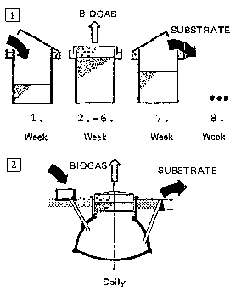
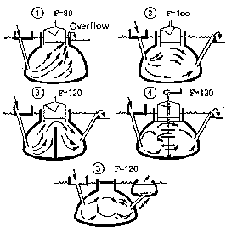
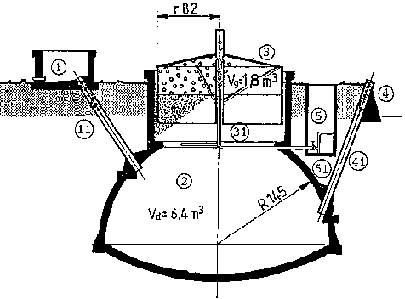
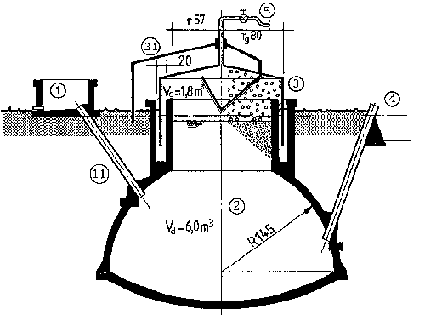
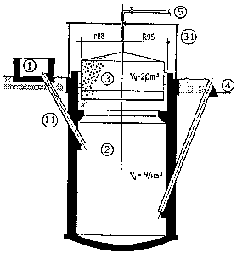
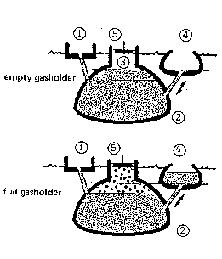
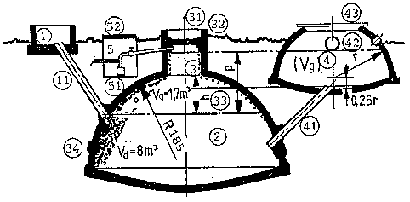
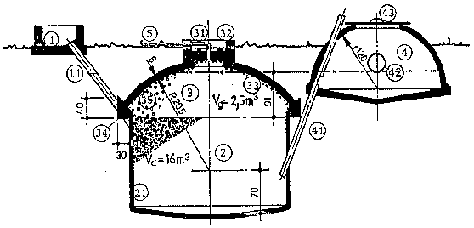
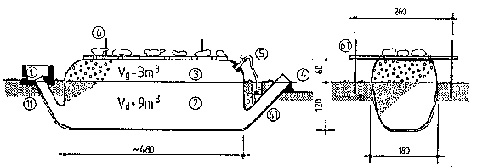
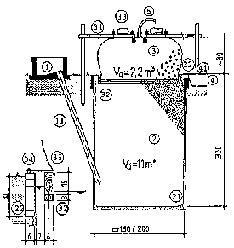
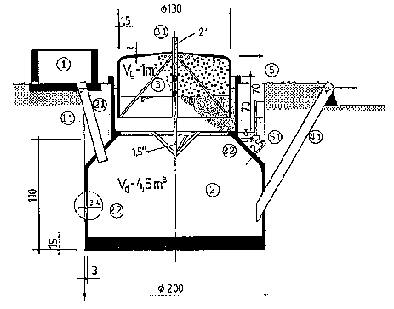
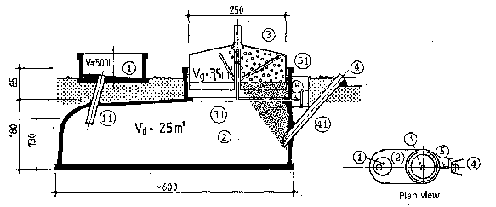
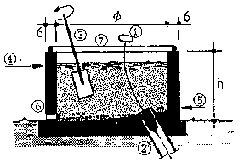
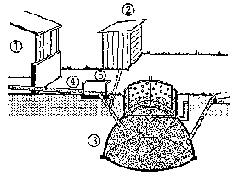
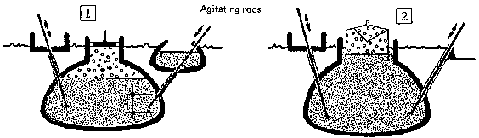
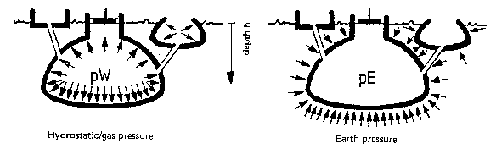
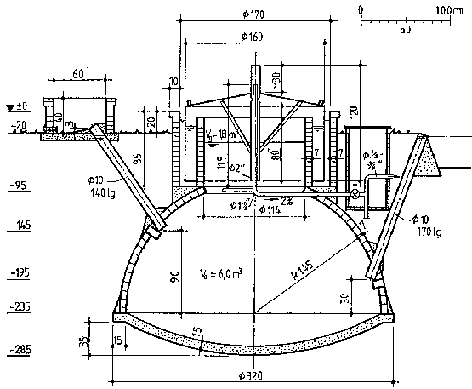
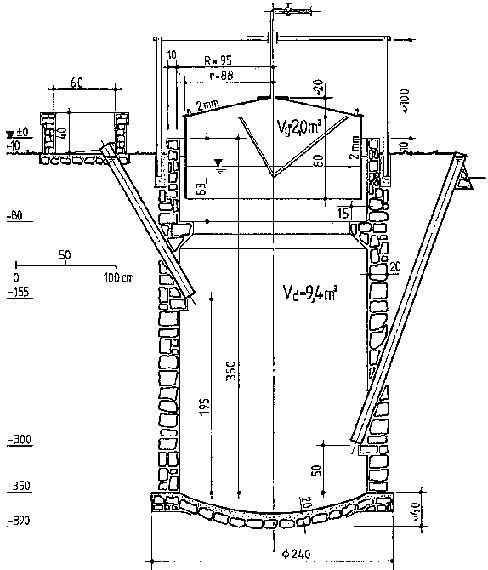
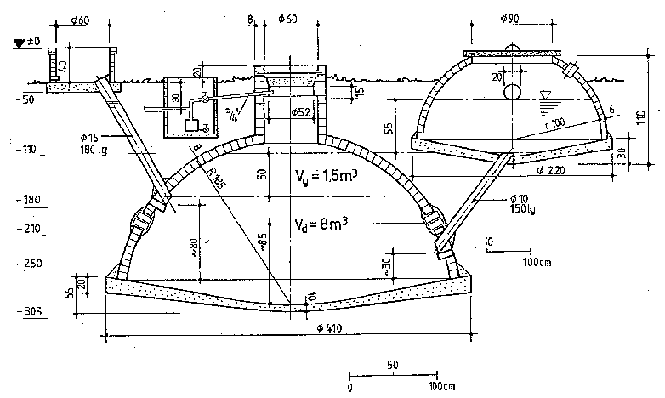
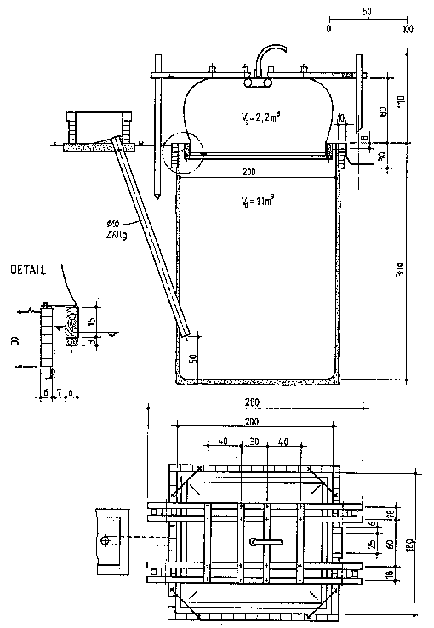
A simple 8 - 10 m³ biogas plant produces 1.5-2 m³ and
1001 digested-slurry fertilizer per day on dung from 3-5 head of cattle or 8 -
12 pigs. With that much biogas, a 6 - 8 person family can:
- cook 2-3 meals or - operate one refrigerator all day and
two lamps for 3 hours or - operate a 3 kW motor generator for 1 hour.
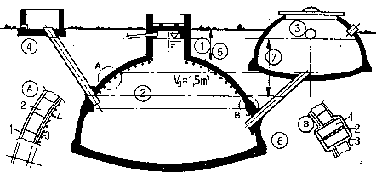
Of the many alternative forms of agricultural biogas systems,
two basic types have gained widespread acceptance by reason of their time-tested
reliability and propagability:
- floating-drum plants with a floating metal gasholder, -
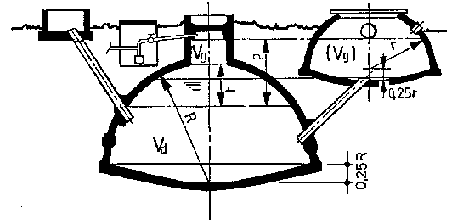
fixed-dome plants with gas storage according to the displacement principle.
The main difference between the two is that the biogas generated
in a fixed-dome plant collects in the domed roof of the digester, while that
produced in a floating-drum plant collects in a metal gasholder. The gasholder,
the purpose of which is to cover peak demand, is directly hooked up to the
consumers (kitchen, living quarters, refrigerator, motor generator, . . .) by
way of pipes.
Plant construction is effected with as much local material as
possible, i.e.:
- bricks, rocks, sand, cement for the digester, - metal or
plastic tubes for the gas pipes, - metal for the gasholder, - gas valves,
fittings and appliances.
Target groups and applications
The prime field of application for biogas plants is family
farms, particularly those engaging in animal husbandry. Also, biogas plants are
a proven successful means of disposal for wastewater and organic waste.
Differentiation is made between the following groups of users:
- Small and medium-sized farms equipped with family-size plants
(6-25 m³ digester) use biogas for cooking and lighting. The installation of
a biogas plant usually goes hand in hand with a transition to either overnight
stabling or zero grazing. The modified stabling, coupled with the more intensive
care given to the animals, improves the quality of animal husbandry as an
inherent advantage of biogas technology.
- Specialized stock-farming operations involving the medium to
large-scale production of cattle, pigs and/or poultry can use medium-to-large
biogas systems with digester volumes ranging from 50 m³ upward. The
resultant safe disposal of fresh manure is a real contribution toward
environmental protection, particularly with regard to the prevention of water
pollution. Moreover, that contribution is rewarding for the farmer, too, since
the biogas constitutes an autonomous source of energy for production processes.
- For agroindustrial estates and slaughterhouses, the pro-biogas
arguments are similar to those mentioned above in connection with stock farms:
safe disposal of potentially hazardous solid and liquid waste materials, coupled
with a private, independent source of energy for generating electricity,
powering coolers, etc.
- Biogas plants in schools, hospitals and other public
institutions provide a hygienic means of toilet/kitchen-waste disposal and a
low-cost alternative source of energy. Schools in particular can serve as
multipliers for the dissemination of information on biogas.
Gas appliances
A number of Third World manufacturers offer specially designed
cooking burners and lamps that operate on biogas. Standard commercial cookers
and lamps can also be converted to run on biogas.
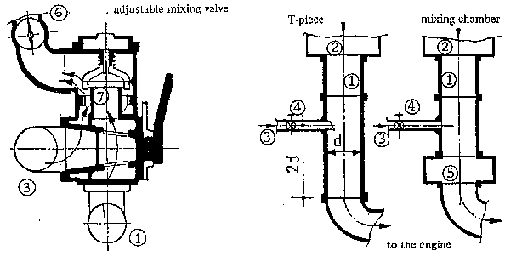
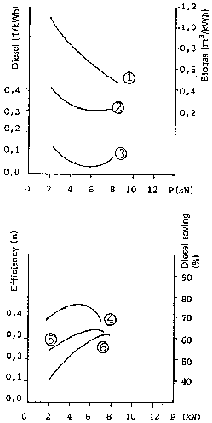
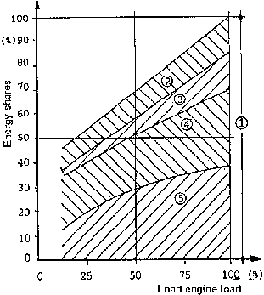
Diesels and spark-ignition engines can be fueled with biogas
following proper modification; diesel engines prefer a mixture of biogas and
diesel fuel. Biogas-fueled refrigerators, though not very efficient, are
attractive alternatives for hospitals, schools and restaurants without
electrification.
Slurry utilization
The digested slurry from biogas plants is a valuable organic
fertilizer, since most of the main nutrients (N, P, K) are preserved. In areas
where regular fertilizing is uncommon, the use of digested slurry for that
purpose requires intensive counseling of the farmer. Biogas technology can play
an important role in self-sustaining ecofarming.
The advantages of biogas technology
. . . for the user consist chiefly of direct monetary returns,
less work and various qualitative benefits.
The monetary returns consist mainly of:
- savings on kerosene, diesel fuel, bottled gas and, possibly,
wood or charcoal, - an additional energy supply for commercial
activities, - savings on chemical fertilizers and/or additional income from
higher agricultural yields.
The qualitative benefits are:
- easier, cleaner cooking and better hygiene, - better
lighting during the evening hours, - energy independence, - improved
stock-farming practice, - good soil structure thanks to fertilization with
digested sludge.
The regional and overall domestic significance derives from the
following merits and aspects:
- development of a reliable, decentralized source of energy
operated and monitored by the users themselves,
- less local deforestation,
- improved conditions of agricultural production,
- more work and income for local craftsmen,
- infrastructural development,
- expanded indigenous technological know-how.
While the absolute figures corresponding to the above effects
may often be marginal as compared to the overall economy; they nonetheless have
a noticeable impact within the project region.
Cost of construction, amortization
As a rule, it costs DM 1000 or more to install a masonry biogas
plant, including all peripheral equipment, i.e. improved stabling, gas
appliances, piping, etc. A favorable payback period of less than 5 years can be
anticipated for such an investment, if the biogas is used in place of a
commercial energy source like kerosene or firewood, but not if it is used as a
substitute for "free" firewood.
Dissemination of biogas technology
Thanks to the broad scale of potential uses for biogas, in
conjunction with an increasingly advanced state of technical development'
numerous developing countries are intensively promoting the dissemination of
biogas plants. The undisputed leaders are the PR China (4.5 million plants),
India (200 000 plants) and Brazil (10 000 plants). Other countries also have
launched biogas dissemination programs with some or all of the following
components:
- development of appropriate appliances and plants, -
establishment of technology and advisory-service centers, - continuous
support for the users, - training of biogas practicians, - advertising and
promotional activities, - assistance for private craftsmen, - provision of
financing assistance.
Criteria for the utilization of biogas technology
Building a biogas plant is not the kind of project that can be
taken care of "on the side" by anyone, least of all by a future user with no
experience in biogas technology. The finished plant would probably turn out to
be poorly planned, too expensive and, at best, marginally functionable - all of
which would disappoint the user and spoil the prospects for the construction of
additional plants. Consequently, the following rules of thumb should be
observed:
- There are workable alternatives to biogas technology:
Regarding energy: energy-saving cookstoves, afforestation,
wind/solar energy, small-scale hydropower, etc.; better access to commercial
energy supplies
Regarding fertilization: spreading or composting of fresh dung
Regarding animal husbandry: pasturing instead of stabling in
combination with a biogas plant.
Any decision in favor of or against the installation of a biogas
plant should be based on due consideration of how it compares to other
alternatives according to technical, economic, ecological and socioeconomic
criteria.
- Both the available supply of substrate and the energy
requirements must be accurately calculated, because the biogas plant would not
be worth the effort if its energy yield did not cover a substantial share of the
energy requirements.
- The system must be properly built in order to minimize the
maintenance & repair effort.
- Siting alternatives must be painstakingly compared, and only a
really suitable location should be selected for the biogas plant.
The financial means of the plant's user must not be overextended
(risk of excessive
indebtedness).
Biogas plants in Animal Husbandry (GTZ, 1989, 153 p.)
2. A planning guide
2.1 Introduction
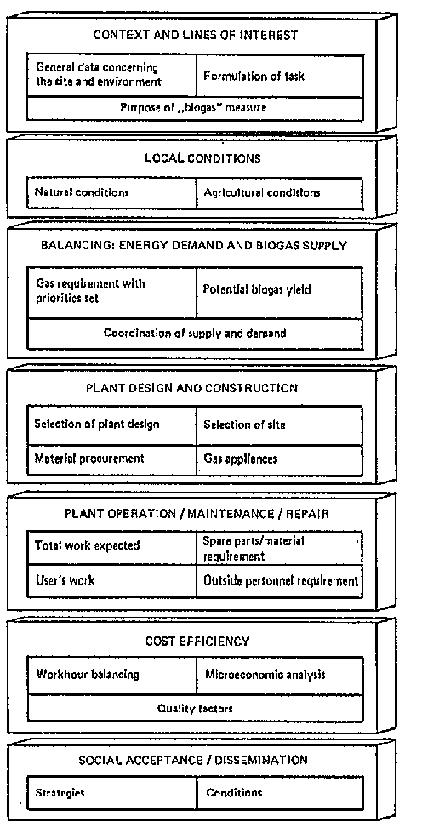
2.3 Checklist for building a biogas plant
Biogas plants in Animal Husbandry (GTZ, 1989, 153 p.)
2. A planning guide
2.1 Introduction
This guide to planning is intended to serve agricultural
extension officers as a comprehensive tool for arriving at decisions concerning
the suitability of locations for family-size biogas plants. The essential siting
con-ditions capable of influencing the decision for or against a biogas plant
are covered (cf. figure 2.1 for a summary survey). The detailed planning outline
(table 2.1) has a ´'data" column for entering the pertinent information and
a "rating" column for noting the results of evaluation.
Evaluation criteria
+ Siting condition favorable o Siting condition unfavorable,
but a) compensable by project activities, b) not serious enough to cause
ultimate failure, - Siting condition not satisfied / not satisfiable
Information on how to obtain and evaluate the individual data
can be found in the corresponding chapters of this manual by following the
pointers provided in the "reference" column. .
Despite its detailed nature, this planning guide is, as
intended, nothing more than a framework within which the extension officer
should proceed to conduct a careful investigation and give due consideration,
however subjectively, to the individual conditions in order to arrive at a
locally practical solution. By no means is this planning guide intended to
relieve the agricultural extension officer of his responsibility to thoroughly
familiarize himself with the on the-spot situation and to judge the overall
value of a given location on the basis of the knowledge thus gained. Fig.
2.1: Biogas planning modules (Source: OEKOTOP) 2.2 Detailed Planning Guide Table 2.1: Detailed planning
guide for biogas plants
Item
Reference
Data
Rating
0. Initial situation
Addresses/project characterization
Plant acronym:
.......
Address of operator/customer:
.......
Place/region/counky:
.......
Indigenous proj. org./executing org.:
.......
Extension officer/advisor:
.......
General user data
Household structure and no. of persons:
.......
User's economic situation:
.......
Animals: kind, quantity, housing:
.......
Crops: types, areas, manner of cultivation:
.......
Non-agricultural activity:
.......
Household/farmincome:
.......
Cultural and social characteristics of user:
.......
Problems leading to the "biogas" approach
Energy-supply bottlenecks:
.......
Workload for prior source of energy:
.......
Poor soil structure/yields:
.......
Erosion/deforestation:
.......
Poor hygiene . . ., other factors:
.......
Objectives of the measure "biogas plant"
User interests:
.......
Project interests:
.......
Other interests:
.......
1. Natural / Agricultural conditions
Natural conditions
Chapter 3.1
Mean annual temperature:
.......
Seasonal fluctuations:
.......
Diurnal variation:
.......
Rating:
.......
+ o -
Subsoil
Chapter 3.1
Type of soil:
.......
Groundwater table, potable water catchment area:
.......
Rating:
+ o -
Ratings: + Siting condition favorable
o Siting condition unfavorable but compensable and/or not too
serious
- Siting condition not satisfied / not satisfable
Water conditions
Chapter 3.1
Climate zone:
Table 3.1
.......
Annual precipitation:
.......
Dry season (months):
.......
Distance to source of water:
.......
Rating:
+ o -
Livestock inventory, useful for biogas
Chapter 3.2/3.3
production
.......
Animals: kind and quantity:
.......
Type and purpose of housing:
.......
Use of dung:
.......
Persons responsible for animals:
.......
Rating:
Vegetable waste, useful for biogas production
Chapter 3.2/3.3
Types and quantities:
.......
Prior use:
.......
Rating:
+ o -
Fertilization
Chapter 3.4
Customary types and quantities of fertilizer/areas fertilized:
.......
Organic fertilizer familiar/in use:
.......
Rating:
+ o -
Potential sites for biogas plant
Chapter 3.3
Combined stabling/biogas plant possible:
.......
Distance between biogas plant and livestock housing:
.......
Distance between biogas plant and place of gas consumption:
.......
Rating:
+ o -
Overall rating 4
+ o -
2. Balancing the energy demand with the biogas production
Chapter 4
Prior energy supply
Chapter 4
Uses, source of energy, consumption:
.......
Anticipated biogas demand (kWh/day or l/d)
Chapter 5.5.3
for cooking:
Table 5.17
.......
for lighting:
Table 5.20
.......
for cooling:
Table 5.22
.......
for engines:
Chapter 5.5.4
.......
Total gas demand
Chapter 4.1
a) percentage that must be provided by the biogas plant:
.......
b) desired demand coverage:
.......
Ratings: + Siting condition favorable
o Siting condition unfavorable but compensable and/or not too
serious
- Siting condition not satisfied / not satisfiable
Available biomass (kg/d) and potential gas production (l/d)
Chapter 3/4
from animal husbandry
Table 3.2
.......
...pigs:
Table 3.5
.......
...poultry:
Table 4.3
.......
...cattle:
Figure 5.2
.......
Night soil
Table 3.2
.......
Vegetable waste (quantities and potential gas yield)
Table 3.3
1...............................
Table 3.5
.......
2...............................
Totals: biomass and potential gas production
Chapter 4.2
a) easy to procure:
.......
b) less easy to procure:
.......
Balancing
Chapter 4.4
Gas production clearly greater than gas demand = positive rating
(+)
.......
Gas demand larger than gas production
= negative rating (-); but review of results in order regarding:
.......
a) possible reduction of gas demand by the following measures
.......
b) possible increase in biogas production by the following
measures
.......
If the measures take hold:
.......
= qualified positive rating for the plant location (o)
If the measures do not take hold:
.......
= site rating remains negative (-)
Overall rating 2
+ o -
3. Plant Design and Construction
Chapter 5
Selection of plant design
Chapter 5.3
Locally customary type of plant:
.......
Arguments in favor of floating-drum plant:
Chapter 5.3.1
.......
Arguments in favor of fixed-dome plant:
Chapter 5.3.2
.......
Arguments in favor of other plant(s):
Chapter 5.3.3
.......
Type of plant chosen:
.......
Selection of site
.......
Ratings: + Siting condition favorable
o Siting condition unfavorable but compensable and/or not too
serious
- Siting condition not satisfied / not satisfiable
Availability of building materials
Bricks/blocks/stone:
.......
Cement:
.......
Metal:
.......
Sand:
.......
Piping/fittings:
.......
Miscellaneous:
.......
Availability of gas appliances
Cookers:
.......
Lamps:
.......
...........................................
.......
...........................................
.......
Overall rating 3
+ o -
4. Plant operation / maintenance / repair
Chapter 7
Assessment of plant operation
Chapter 7.1
Incidental work:
Chapter 7.2
.......
Work expenditure in h:
.......
Persons responsible:
.......
Rating with regard to anticipated implementation:
+ o -
Plant maintenance
Chapter 7.3
Maintenance-intensive components:
.......
Maintenance work by user:
Table 7.2
.......
Maintenance work by external assistance:
.......
Rating with regard to anticipated implementation:
+ o -
Plant repair
Chapter 7.4
Components liable to need repair:
.......
Repairs that can be made by the user:
.......
Repairs requiring external assistance:
.......
Requisite materials and spare parts:
Rating with regard to expected
repair services:
+ o -
Overall rating 4
+ o -
5. Economic analysis
Chapter 8
Time-expenditure accounting
Chapter 8.2
Time saved with biogas plant
Table 8.1
.......
Time lost due to biogas plant
.......
Rating:
Ratings: + Siting condition favorable
o Siting condition unfavorable but compensable and/or not too
serious
- Siting condition not satisfied / not satisfiable
Microeconomic analysis
Chapter 8.3
Initial investment:
Table 8.2
.......
Cost of operation/maintenance/repair:
.......
Return on investment:energy, fertilizer, otherwise:
.......
Payback time (static):
Table 8.3
.......
Productiveness (static):
.......
Rating:
+ o -
Quality factors, useful socioeconomic effects and costs
Drawbacks: need to handle night soil, negative social impact:
.......
Rating:
+ o -
Overall rating 5
+ o -
6. Social acceptance and potential for dissemination
Chapter 9
Anticipated acceptance
Chapter 9.1
Participation in planning and construction:
.......
Integration into agricultural setting:
.......
Integration into household: .
.......
Sociocultural acceptance:
.......
Rating:
.......
Establishing a dessemination strategy
Chapter 9.2
Conditions for and chances of the professional craftsman
approach:
.......
+ o -
Conditions for and chances of the self-help oriented approach:
.......
+ o -
General conditions for dissemination
Project-executing organization and its staffing:
Chapter 9.3
.......
Organizational structure:
.......
interest and prior experience in biogas technology:
.......
Regional infrastructure for transportation and communication:
.......
material procurement:
.......
Craftsman involvement, i.e.
Chapter 9.4
which activities:
.......
minimum qualifications:
.......
tools and machines:
.......
Training for engineers, craftsman and users:
Chapter 9.5
.......
Ratings: + Siting condition favorable
o Siting condition unfavorable but compensable and/or not too
serious
- Siting condition not satisfied/not satisfiable
Proprietary capital, subsidy/credit requirement
on the part of
Chapter 9.6
user:
.......
craftsmen:
.......
Rating:
.......
+ o -
Overall rating 6
.......
+ o -
7. Summarization
Siting conditions
No.
Rating
Natural/agricultural conditions
1
+ o -
Balancing the energy demand and the biogas production
2
+ o -
Plant design and construction
3
+ o -
Plant operation/maintenance/repair
4
+ o -
Economic analysis
5
+ o -
Social acceptance and potential for dissemination
6
+ o -
Overall rating of siting conditions
+ o -
Ratings: + Siting condition favorable
o Siting condition unfavorable but compensable and/or not too
serious
- Siting condition not satisfied / not satisfiable
Following assessment as in table 2.1, the biogas-plant site in
question can only be regarded as suitable, if most of the siting factors have a
favorable (+) rating. This applies in particularly to item 2, the positive
energy balance, meaning that the potential biogas production must cover the gas
demand.
If the favorable and unfavorable ratings are fairly well
balanced, the more decisive factors should be re-evaluated to determine the
extent to which supplementary measures could provide the missing conditions for
building and operating a biogas plant despite some reservations but without
injustifiable effort. Then, if the overall evaluation does not swing toward the
positive side, the plant should not be built. If the site is given a favorable
rating, further planning hints can be taken from the following
checklist.
2.3 Checklist for building a biogas plant
1. Finishing the planning, i.e. site evaluation, determination
of energy demand and biomass supply/biogas yield, plant sizing, selection of
plant design, how and where to use the biogas, etc., ail in accordance with the
above planning guide.
2. Stipulate the plant's location and elaborate a site plan,
including all buildings, gas pipes, gas appliances and fields to be fertilized
with digested slurry.
3. Draft a technical drawing showing all plant components, i.e.
mixing pit, connection to stabling, inlet/outlet, digester, gasholder, gas
pipes, slurry storage.
4. Preparation of material/personnel requirements list and
procurement of materials needed for the chosen plant:
- bricks/stones/blocks for walls and foundation - sand,
gravel - cement/lime - inlet/outlet pipes - metal parts (sheet metal,
angle irons, etc.) - gas pipes and fittings - paint and sealants - gas
appliances - tools - mason and helper - unskilled labor - workshops
for metal (gasholder) and pipe installation.
5. Material/personnel assignment planning, i.e. procedural
planning and execution of:
- excavation - foundation slab - digester masonry -
gasholder - rendering and sealing the masonry - mixing pit - slurry
storage pit - drying out the plant - installing the gas pipe -
acceptance inspection.
6. Regular building supervision.
7. Commissioning - functional inspection of the biogas plant
and its components - starting the plant
8. Filling the plant.
9. Training the
user.
Biogas plants in Animal Husbandry (GTZ, 1989, 153 p.)
3. The agricultural setting
3.1 Natural parameters for biogas plants of simple design
3.2 Suitable types of biomass and their characteristics
3.3 Agricultural/operational prerequisites and stock-farming requirements
3.4 Fertilizing with digested slurry
3.5 Integral agriculture
Biogas plants in Animal Husbandry (GTZ, 1989, 153 p.)
3. The agricultural setting
3.1 Natural parameters for biogas plants of simple design
Climate zones
A minimum temperature of 15 °C is required for anaerobic
fermentation of organic material (cf. chapter 5.1). Since simple biogas plants
are unheated, they can only be used in climatic zones in which the minimum
temperature is not fallen short of for any substantial length of time. In
general, this is true of the area located between the two tropics, i.e. in the
geographic region referred to as the "Tropics".
In the climatic sense, however, the Tropics are inhomogeneous,
containing various climatic zones with their own typical forms of vegetation and
agricultural practices. Proceeding on that basis, it may be said that a
particular zone does or does not qualify as a "biogas zone'' (cf. table 3.1).
With the exception of subtropical arid regions (deserts and
semideserts), all tropical climates are characterized by:
- increasingly small diurnal and seasonal temperature variation
in the direction of the equator, - decreasing annual rainfall and number of
humid months with increasing distance from the equator.
This basic zonal breakdown, though, is altered in several ways
by other climatic factors such as wind, elevation and ocean currents.
Consequently, the climatic zones serve only as a basis for rough orientation
with regard to the climatic evaluation of potential sites for biogas plants. The
locally prevailing climatic conditions are decisive and must be ascertained on
the spot. Fig. 3.1: Global 15ºC isotherms for January and July, indicating
the biogas-conductive temperature zone (Source: OEKOTOP) Table 3.1: Climatic zones and
their suitability for biogas plants (Source: OEKOTOP)
Climatic zone
Factors of relevance for biogas generation
As biogas zone:
Tropical rain forest
Annual rainfall > 1500 mm;unfavorable
temperature fairly constant at 25-28 °C; little animal
husbandry due to various diseases, i.e. scarcity of dung; vegetable waste from
permacultures and gardening
Wet savanna
Water usually available all year (rainfall: 800-1500 mm),
livestock farming on the increase, integral farms (crop farming + livestock)
favorable
Dry savanna
Short rainy season, long dry season; most livestock pastured,
but some integral farming
possible
Thornbush steppe
Short rainy season (rainfall: 200400 mm) extensive-type
pasturing (nomads, cattle farmers), dung uncollectable; shortage of water
unsuitable
Dry hot desert
- - -
unsuitable
Soil conditions
Since the digesters of simple biogas plants are situated
underground, the temperature of the soil is of decisive importance. It depends
on the surface structure, the type of soil and the water content. The soil
temperature usually varies less than the air temperature, e.g. tropical soils
show nearly constant temperature at a depth of 30-60 cm. Due to lower
absorption, the temperature amplitude of light soils is smaller than of dark
soils. Since moist soil appears darker than dry soil, the same applies with
regard to temperature amplitude. As a rule of thumb, the region's mean annual
temperature may be taken as the soil temperature in tropical areas.
For biogas plants with unlined digesters and/ or underground
masonry, it is important to know the stability of the soil structure. The
stability of a given soil increases along with the bedding density. Natural
soils are generally stable enough for biogas plants. Caution is called for,
however, in the case of alluvial and wet, silty soils. Most of the laterite soil
prevailing in the tropics shows high structural stability and is therefore quite
suitable for biogas plants with unlined digesters. Unlined earth pits usually
become more or less impermeable within a short time, but preparatory seepage
trials should be conducted in exploratory holes, just to make sure. Previous
experience has shown that seepage can drop to below 5% of the initial rate
within a week. In the case of large-scale biogas plants, it is always advisable
to have an expert check the soil stability.
Biogas plants should never be located in groundwater, areas
subject to flooding, or near wells. On the other hand, an adequate supply of
water must be available in the immediate vicinity of the biogas plant, because
the substrate must be diluted. If the direction of groundwater flow is known,
the biogas plant should be placed downstream of the
well.
3.2 Suitable types of biomass and their characteristics
Practically any kind of watery organic substance is suitable for
anaerobic digestion. The agricultural residues and waste materials that can be
used as substrate for biogas plants consist chiefly of:
- waste from animal husbandry, e.g. dung, urine, fodder residue
and manure, . - vegetable waste, e.g. straw, grass, garden residue, etc.
(though such materials do not ferment well alone), - household waste like
night soil, garbage, wastewater, etc.
Solid and liquid agroindustrial waste materials, from
slaughterhouses for example, and wastewater from sugar/starch processing are not
gone into here, since small-scale biogas plants of simple design would not
suffice in that connection (cf. chapter 6).
Waste from animal husbandry
Most simple biogas plants are "fueled" with manure (dung and
urine), because such substrates usually ferment well and produce good biogas
yields. Quantity and composition of manure are primarily dependent on:
- the amount of fodder eaten and its digestibility; on average,
40 - 80% of the organic content reappears as manure (cattle, for example,
excrete approximately 1/3 of their fibrous fodder),
- quality of fodder utilization and the liveweight of the
animals.
It is difficult to offer approximate excrement-yield values,
because they are subject to wide variation. In the case of cattle, for example,
the yield can amount to anywhere from 8 to 40 kg per head and day, depending on
the strain in question and the housing intensity. Manure yields should therefore
be either measured or calculated on a liveweight basis, since there is
relatively good correlation between the two methods.
The quantities of manure listed in table 3.2 are only then fully
available, if all of the anirnals are kept in stables all of the time and if the
stables are designed for catching urine as well as dung (cf. chapter 3.3).
Thus, the stated values will be in need of correction in most
cases. If cattle are only kept in night stables, only about 1/3 to 1/2 as much
manure can be collected. For cattle stalls with litter, the total yields will
include 2 - 3 kg litter per animal and day. Table 3.2: Standard liveweight
values of animal husbandry and average manure yields (dung and urine) as
percentages of liveweight (Source: Kaltwasser 1980, Williamson and Payne
1980)
Species
Daily manure yield as % of liveweight
Fresh-manure solids
Liveweight (kg)
dung
urine
TS (%)
VS (%)
Cattle
5
4-5
16
13
135 - 800
Buffalo
5
4-5
14
12
340-420
Pigs
2
3
16
12
30- 75
Sheep/goats
3
1 - 1.5
30
20
30 - 100
Chickens
4.5
25
17
1.5 - 2
Human
1
2
20
15
50- 80
Table 3.3:
TS and VS-contents of green plants (Source: Memento de l'agronome
1984)
Material
TS
VS
(%)
(% of TS)
Rice straw
89
93
Wheat straw
82
94
Corn straw
80
91
Fresh grass
24
89
Water hyacinth
7
75
Bagasse
65
78
Vegetable residue
12
86
Vegetable waste
Crop residue and related waste such as straw, cornstalks,
sugar-beet leaves, etc. are often used as fodder and sometimes processed into
new products, e.g. straw rnats. Consequently, only such agricultural "waste"
that is not intended for some other use or for composting should be considered.
Most green plants are well-suited for anaerobic fermentation.
Their gas yields are high, usually above that of manure (cf. table 3.5). Wood
and woody parts of plants resist anaerobic fermentation and should therefore not
be used in biogas plants. Due to the poor flow properties of plant material and
its tendency to form floating scum, it can only be used alone in a batch-type
plant. In practice, however, batch plants are unpopular because of the need for
intermittent charging and emptying.
In continuous-type family-size biogas plants, crop residue
therefore should only be used as an addition to animal excrements. Any fibrous
material like straw has to be chopped up to 2 - 6cm - and even that does not
fully preclude scum formation. Table 3.4: Digestion
characteristics of animal-husbandry residues (Source: OEKOTOP)
Substrate
Scum formation/ sedimentation
Digestion
Recommended retention time (days)
Gas yield compared to cattle manure
Cattle manure
none
none
very stable
60- 80
100%
ditto, plus 10% straw
heavy
slight
very stable
60-100
120%
Pig manure
slight to heavy
heavy to slight
Danger of "tilting", i.e. acidification, at the beginning; slow
run-up with cattle manure necessary
40 - 60
200%
ditto, plus 10% straw
heavy
slight
ditto
60 - 80
. . .
Chicken manure
slight to heavy
heavy
Slow run-upwith cattle manure advisable; danger of "tilting"
80
200%
Sheep/gcat manure manure
medium to heavy
none
stable
80-100
80%
Table 3.5:
Mean gas yields from various types of agricultural biomass (Source: OEKOTOP,
compiled from various sources)
Substrate
Gas-yield range (1/kg VS)
Average gas yield (1/kg VS)
Pig manure
340-550
450
Cow manure
150-350
250
Poultry manure
310-620
460
Horse manure
200-350
250
Sheep manure
100-310
200
Stable manure
175-320
225
Grain skew
180-320
250
Corn straw
350-480
410
Rice straw
170-280
220
Grass
280-550
410
Elephant grass
330-560
445
Bagasse
140-190
160
Vegetable residue
300-400
350
Water hyacinth
300-350
325
Algae
380-550
460
Sewage sludge
310-640
450
Table 3.6:
C/N-ratios of varios substrates (Source: Barnett 1978)
Substrate
C/N
Urine
0.8
Cattle dung
10-20
Pig dung
9-13
Chicken manure
5-8
Sheep/goat dung
30
Human excrements
8
Grain straw
80-140
Corn straw
30-65
Fresh grass
12
Water hyacinth
20-30
Vegetable residue
35
Digestion characteristics and gas yields
As long as the total solids content of the substrate does not
substantially exceed 10%, simple biogas plants can be expected to operate
smoothly on a mixture of animal excrements and plant material (straw, fodder
waste).
Manure from ruminants, particularly cattle, is very useful for
starting the fermentation process, because it already contains the necessary
methanogenic bacteria. On the other hand, the gas yield from cattle dung is
lower than that obtained from chickens or pigs, since cattle draw a higher
percentage of nutrients out of the fodder' and the leftover lignin complexes
from high-fiber fodder are very resistant to anaerobic fermentation. Urine, with
its low organic content, contributes little to the ultimate gas yield but
substantially improves the fertilizing effect of the digested slurry and serves
in diluting the substrate.
The carbon(C)/nitrogen(N)-ratio of animal and human excrements
is normally favorable for the purposes of anaerobic fermentation (9 - 25:1),
while that of plant material usually indicates an excessive carbon content.
In many cases, various substrates should be mixed together in
order to ensure a favorable gas yield while stabilizing the fermentation process
and promoting gas production. The following formulae can be used to calculate
the C/N-ratio and total-solids content of a given mixture:
MC/N = [(C/N1 x Wl) + (C/N2 x W2) + . . . + (C/Nn x Wn)]/(W1 +
W2 + . . . + Wn)
MTS = [(TSI x Wl) + (TS2 x W2) + . . . + (TSn x Wn)]/(W1 +W2 +
... + Wn)
MC/N = C/N-ratio of mixed substrate, MTS = TS-content of mixed
substrate, C/N = C/N-ratio of individual substrate, W = weight of individual
substrate, TS = TS-content of fresh
material.
3.3 Agricultural/operational prerequisites and stock-farming requirements
In order to fulfill the prerequisites for successful
installation and operation of a biogas plant, the small farm in question must
meet three basic requirements regarding its agricultural production system:
- availability of sufficient biomass near the biogas plant, -
use for digested slurry as fertilizer, - practical use(s) for the biogas
yield.
Farms marked by a good balance between animal husbandry and crop
farming offer good prerequisites for a biogas tie-in. Unfortunately, however,
such farms are rare in tropical countries. In numerous Third World countries,
animal husbandry and stock farming are kept separate by tradition.
As the world population continues to grow, and arable land
becomes increasingly scarce as a result, the available acreage must be used more
intensively. In wet savannas, for example, the fallow periods are being
shortened, even though they are important for maintaining soil fertility. In
order to effectively counter extractive agriculture, animal husbandry must be
integrated into the crop farming system, not least for its fertilizing effect.
On the other hand, systematic manuring is only possible as long as collectible
dung is allowed to accumulate via part-time or full-time stabling.
The installation of a biogas plant can be regarded as
worthwhile, if at least 20-40 kg manure per day is available as substrate. This
requires keeping at least 3 - 5 head of cattle, 8-12 pigs or 16-20 sheep/goats
in a round-the-clock stabling arrangement. The achievable gas yield suffices as
cooking fuel for a family of 4-6 persons. That, in turn, means that the farm
must be at least about 3 hectares in size, unless either freely accessible
pastures are available or extra fodder is procured. Crop residue like rice
straw, sorghum straw, cornstalks, banana stalks, etc. should be chopped up,
partially composted and mixed with animal excrements for use in the fermentation
process (cf. chapter 3.2). Fig.
3.2: Integration of a biogas plant into the agricultural production cycle
(Source: OEKOTOP) Table
3.7: Biogas compatibility of farm types (Source: OEKOTOP)
Mostly nighttime stabling; only a few animals; 50% of dung
collectible
possible
- meat production
extensive
Pasturing; no stabling; dung wasted
unsuitable
intensive
Fattening in stables; dung directly usable
suitable
- milk production
Frequently permanent stabling; all dung and urine usable
suitable
Crop farming:
- vegetables
Near house; crop residue and water available year-round
possible!
- field-tilling
unirrigated
1 harvest per year, scarcity of fodder, long-distance hauling of
water and manure
unsuitable
irrigated
2-3 harvests per year; water available, small fields
possible
Adding a biogas plant to an integrated agricultural production
system not only helps save firewood and preserve forests, but also contributes
toward sustained soil fertility through organic fertilization and ensures the
long-term crop-bearing capacity of the soil. Work involving the dissemination of
biogas. technologies must account for and call attention to that complex
relationship. If no organic fertilizing has been done before, a biogas plant
will mean more work. Organic waste has to be collected and afterwards spread on
the fields. Only if the owner is willing to invest the extra effort can the
biogas plant be expected to serve well in the long term.
There are two central demands to be placed on the stock-farming
system in relation to biogas utilization:
- permanent or part-time stabling or penning and - proximity
of the stables or pens to the place of gas utilization (usually the farmhouse).
If the distance between the stables/pens and the place of gas
utilization is considerable, either the substrate must be hauled to the biogas
plant (extra work) or the gas must be transferred to the place of use (cost of
installing a supply pipe). Either of the two would probably doom the biogas
plant to failure. The best set of circumstances is given, when
- the animal excrements can flow directly into the biogas plant
by exploiting a natural gradient, - the distance of flow is short, and -
the stables have a concrete floor to keep contamination like soil and sand from
getting into the plant while allowing collection of urine.
Cattle pens
Dung from earth-floor pens has a very high total-solids content
(TS up to 60%), and the urine is lost. Daily collection is tedious and there is
no way to prevent sand from getting into the digester. Consequently, at the same
time a biogas plant is being installed, concrete floors should be installed in
such pens and provided with a collecting channel. This increases the total cost
of the biogas plant, but is usually justified, since it lowers the subsequent
work input, helps ensure regular feeding of the plant, reduces the chance of
hoof disease and keeps sand and stones out of the digester. The overall effect
is to enhance acceptance of the biogas plant.
The collecting channels can be designed as open gutters or
covered ducts. Concrete split tiles serve well as construction material for the
second (more expensive) version. The slots should be about 2 - 3 cm wide, i.e.
wide enough to let the dung pass through, but not wide enough to cause injury to
the animals.
Cattle dung dries rapidly in a hot climate, particularly if the
pen has no roof. The cleaning water also serves to liquefy the dung and reduce
its TS content to 5-10%. for the purposes of fermentation. The main advantage of
this system is that the pens can be cleaned and the biogas plant filled in a
single operation. The collecting channel should be designed to yield a
floating-manure system with gates at the ends, so that a whole day's dung and
cleaning water can collect at once. The advantages:
- easy visual control of the daily substrate input, -
prevention of collecting-channel blockage due to dung sticking to the walls and
drying out, - adding the substrate at the warmest time of day, which can be
very important in areas with low nighttime temperatures. Fig.
3.3: Pen with concrete floor and collecting channel for dung and urine.
1. Water through, 2 Feeding through, 3 Collecting channel, 4
Sand and rocks, 5 Concrete (Source: OEKOTOP)
Intensive forms of animal husbandry often involve the problem of
excessive water consumption for cleaning, which leads to large quantities of
wastewater, dilute substrate and unnecessarily large biogas plants (cf. chapter
6). In areas where water is scarce, the digester drain-water can be used for
scrubbing down the pens and diluting the fresh substrate, thus reducing the
water requirement by 30-40%.
Stables
Differentiation is generally made between: - stabling
systems with litter and - stabling systems without litter, with the design
details of the stalls appropriate to the type of animal kept.
For use in a biogas plant, any straw used as litter must be
reduced in size to 2-6 cm. Sawdust has poor fermenting properties and should
therefore not be used.
Cattle shelter
Variants suitable for connection to a biogas plant include: -
Stanchion barns with a slurry-flush or floating removal system (no litter) or
dung collecting (with litter), - Cow-cubicle barns with collecting channel
(no litter).
Piggeries
The following options are well-suited for combination with a
biogas plant: - barns with fully or partially slotted floors (no
litter), - lying bays with manure gutter (no litter), - group bays (with
or without litter). Fig.
3.4: Stanchion barn with floating gutter. 1 Collecting channel, 2 Stable, 3
Floating gutter leading to the biogas plant, 4 feeding aisle, 5 Feeding trough
(Source: OEKOTOP) Fig.
3.5: Cow-cubicle barn with floating gutter. 1 Collecting channel, 2 Cubicle, 3
Floating gutter leading to the biogas plant, 4 Feeding aisle, 5 Feeding trough
(Source: OEKOTOP) Fig.
3.6: Piggery with group bays (no litter). 1 Feeding aisle, 2 Feeding trough, 3
Floating gutter leading to the biogas plant, 4 Bay (pigpen) (Source: Manuel et
Preas D levage No. 3, 1977)
Liquid manure from swine normally has better flow properties
than liquid manure from cattle, the main reason being that swine eat less
fibrous material. Additionally, though, swine drop more urine than dung.
In tropical countries, few pigsties have fully or partially
slotted floors. Most pigs are kept in group bays. Figure 3.6 shows a schematic
representation of a piggery with bays of different size to accommodate animals
of various weight categories. The animals are moved in groups from one bay to
the next as they grow.
Chicken coops
Hens kept in battery-brooding cages never have litter. Despite
the name, straw yards can be managed with or without litter.
In either system, the dry droppings are collected, transferred
to the biogas plant and diluted to make them flowable. Feathers and sand are
always problematic, since they successfully resist removal from the substrate.
In many cases, the coop is only cleaned and disinfected once after the entire
population is slaughtered. As a rule such systems are not suitable as a source
of substrate for biogas
plants.
3.4 Fertilizing with digested slurry
The practice of regular organic fertilizing is still extensively
unknown in most tropical and subtropical countries. Due, however, to steady
intensification of agricultural methods, e.g. abbreviated fallow intervals, some
form of purposeful organic fertilizing, naturally including the use of digested
slurry as fertilizer, would be particularly useful as a means of maintaining
tropical soil fertility. Since Third World farmers have little knowledge of or
experience in organic fertilizing methods, particularly with regard to the use
of digested slurry, the scope of the following discussion is limited to the
general plantgrowth efficiency factors of digested slurry.
Fermentation-induced modification of substrate
- Anaerobic digestion draws carbon, hydrogen and oxygen out of
the substrate. The essential plant nutrients (N, P, K) remain, at least in
principle, in place. The composition of fertilizing agents in digested slurry
depends on the source material and therefore can be manipulated within certain
limits.
- For all practical purposes, the volume of the source material
remains unchanged, since only some 35 - 50% of the organic substances
(corresponding to 5 - 10% of the total volume) is converted to gas.
- Fermentation reduces the C/N-ratio by removing some of the
carbon, which has the advantage of increasing the fertilizing effect. Another
favorable effect is that organically fixed nitrogen and other plant nutrients
become mineralized and, hence, more readily available to the plants.
- Well-digested slurry is practically oderless and does not
attract flies.
- Anaerobic digestion kills off or at least deactivates
pathogens and worm ova, though the effect cannot necessarily be referred to as
hygienization (cf. Table 3.8). Ninety-five percent of the ova and pathogens
accumulate in the scum and sediment. Plant seeds normally remain more or less
unaffected.
- Compared to the source material, digested slurry has a finer,
more homogeneous structure, which makes it easier to spread. Table 3.8: Survival time of
pathogens in biogas plants (Source: Anaerobic Digestion 1985)
Bacteria
Thermophilic fermentation
Mesophilic fermentation
Psycrophilic fermentation
53-55 °C
35-37 °C
8-25 °C
Fatality
Fatality
Fatality
Days
Rate
Days
Rate
Days
Rate
(%)
(%)
(%)
Salmonella
1-2
100.0
7
100.0
44
100.0
Shigella
1
100.0
5
100.0
30
100.0
Poliviruses
9
100.0
Schistosoma ova
hours
100.0
7
100.0
7-22
100.0
Hookworm ova
1
100.0
10
100.0
30
90.0
Ascaris ova
2
100.0
36
98.8
100
53.0
Colititre
2
10-1 - 10-2
21
10-4
40-60
10-5 -10-4
Table 3.9:
Concentration of nutrients in the digested slurry of various
substrates! (Source: OEKOTOP, compiled from various sources)
Type of substrate
N
P2O5
K2O
CaO
MgO
—% TS—
Cattle dung
2.3 - 4.7
0.9 - 2.1
4.2 - 7.6
1.0 - 4.2
0.6 - 1.1
Pig dung
4.1 - 8.4
2.6 - 6.9
1.6 - 5.1
2.5 - 5.7
0.8 - 1.1
Chicken manure
4.3 - 9.5
2.8 - 8.1
2.1 - 5.3
7.3 - 13.2
1.1 - 1.6
Fertilizing properties
The fertilizing properties of digested slurry are determined by
how much mineral substances and trace elements it contains; in tropical soil,
the nitrogen content is not necessarily of prime importance—lateritic
soils, for example, are more likely to suffer from a lack of phosphorus. The
organic content of digested slurry improves the soil's texture, stabilizes its
humic content, intensifies its rate of nutrient-depot formation and increases
its water-holding capacity. It should be noted that a good water balance is very
important in organically fertilized soil, i.e. a shortage of water can wipe out
the fertilizing effect.
Very few data on yields and doses are presently available with
regard to fertilizing with digested slurry, mainly because sound scientific
knowledge and information on practical experience are lacking in this very broad
domain. Table 3.10 lists some yield data on digested-slurry fertilizing in the
People's Republic of China.
For a practician faced with the task of putting digested slurry
to good use, the following tendential observations may be helpful:
- While the nitrogen content of digested slurry is made more
readily available to the plants through the mineralization process, the yield
effect of digested slurry differs only slightly from that of fresh substrate
(liquid manure). This is chiefly attributable to nitrogen losses occurring at
the time of distribution.
- Digested slurry is most effective when it is spread on the
fields just prior to the beginning of the vegetation period. Additional doses
can be given periodically during the growth phase, with the amounts and timing
depending on the crop in question. For reasons of hygiene, however, lettuce and
vegetables should not be top-dressed.
- The recommended quantities of application are roughly equal
for digested slurry and stored liquid manure.
- The requisite amount of digested-slurry fertilizer per unit
area can be determined as a mineral equivalent, e.g. N-equivalent fertilization.
The N, P and K doses depend on specific crop requirements as listed in the
appropriate regional fertilizing tables.
With a view to improving the overall effect of slurry fertilizer
under the prevailing local boundary conditions, the implementation of a biogas
project should include demonstration trials aimed at developing a regionally
appropriate mode of digested-slurry application. For information on experimental
systems, please refer to chapter 10.6 - Selected Literature.
Proceeding on the assumption that the soil should receive as
much fertilizer as needed to replace the nutrients that were extracted at
harvesting time, each hectare will require an average dose of about 33 kg N, 11
kg P2O5 and 48 kg K2O to compensate for an
annual yield of 1 - 1.2 tons of, say, sorghum or peanuts. Depending on the
nutritive content of the digested slurry, 3-6 t of solid substance per hectare
will be required to cover the deficit. For slurry with a moisture content of
90%, the required quantity comes to 30-60 t per hectare and year. That roughly
corresponds to the annual capacity of a 6-8 m³ biogas plant.
Like all other forms of organic fertilizing, digested slurry
increases the humic content of the soil, and that is especially important in
low-humus tropical soils. Humus improves the soil's physical properties, e.g.
its aeration, water retention capacity, permeability, cation-exchange capacity,
etc. Moreover, digested slurry is a source of energy and nutrients for
soil-inhabiting microorganisms, which in turn make essential nutrients more
available to the plants. Organic fertilizers are indispensable for maintaining
soil fertility, most particularly in tropical areas. Table 3.10: Effects of
digested slurry on crop yields (Source: Chengdu 1980)
Plants tested
Quantity of digested slurry
Yield
Increase
with digested slurry
with liquid manure
(m³ /ha)
(kg/ha)
(kg/ha)
(%)
Sweet potatoes
17
24000
21500
21500
12
Rice
15
6500
6000
500
8
corn (maize)
22.5
5000
4600
400
9
Cotton
22.5
1300
1200
100
8
The importance of digested slurry as a fertilizer is underlined
by the answers to the following questions:
- How much chemical fertilizer cap be saved with no drop in
yield?
- Which yield levels can be achieved by fertilizing with
digested slurry, as compared to the same amount of undigested material, e.g.
stored or fermented liquid manure?
- By how much can yields be increased over those from previously
unfertilized soil? Depending on those answers, a certain monetary value can be
attached to digested slurry, whereas the labor involved in preparing and
applying the fertilizer must be given due consideration.
Storing and application of digested slurry
With a view to retaining the fertilizing quality of digested
slurry, it should be stored only briefly in liquid form in a closed pit or tank
and then applied to the fields. Liquid storage involves a certain loss of
nitrogen due to the evaporation of ammonia. For that reason, and in order to
limit the size of the required storage vessels (a 30-day supply corresponds to
about 50% of the biogas plant volume), the storage period should be limited to
2-4 weeks. The resultant quasi-continuous mode of field fertilization (each 2-4
weeks), however, is in opposition to the standing criteria of optimum
application, according to which fertilizer should only be applied 2-4 times per
year, and then only during the plants' growth phase, when they are able to best
exploit the additional nutrient supply. Fig.
3.7: Slurry storage and composting. 1 Biogas plant, 2 Slurry composting pit with
green cover 3 Masonry storage pit (V = 10 Sd), 31 Sturdy wooden cover, 32
Overflow (Source: OEKOTOP)
The practice of spreading liquid digested slurry also presents
problems in that not only storage tanks are needed, but transport vessels as
well, and the amount of work involved depends in part on how far the digested
slurry has to be transported. For example, transporting 1 ton of dung a distance
of 500 m in an oxcart takes about 5 hours (200 kg per trip). Distributing the
dung over the fields requires another 3 hours or so.
If, for reasons of economy and efficiency, liquid fertilizing
should appear impractical' the digested slurry can be mixed with green material
and composted. This would involve nitrogen losses amounting to 30 - 70%. On the
other hand, the finished compost would be soil-moist, compact (spade able) and
much easier to transport.
If irrigated fields are located nearby, the digested slurry
could be introduced into the irrigating system so that it is distributed
periodically along with the irrigating
water.
3.5 Integral agriculture
Integral agriculture, also referred to as biological or
ecological farming, aims to achieve effective, low-cost production within a
system of integrated cycles. Here, biogas technology can provide the link
between animal husbandry and crop farming. Fig.
3.8: Flow diagram for integral farming with a biogas plant (Source: GTZ
1985) Fig. 3.9: Site plan of the Bouak� Ecofarm in C�te d'lvoire. 1
Impounding reservoir for rainwater, 2 Fallow land, 3 Manioc (1st year), 4 Yams
and Manioc (2nd year), 5 Farmhouse, 6 Stables, 7 Biogas plant, 8 Sugar cane, 9
Water reservoir, 10 Fishpond, 11 Vegetable garden, 12 Various food plants
(Source: GTZ 1985)
Consider, for example, the planning of a GTZ project in Cote
d'Ivoire. The project included the development of a model farm intended to
exploit as efficiently as possible the natural resources soil, water, solar
energy and airborne nitrogen.
The integral agricultural system "Eco-ferme" (ecofarm) comprises
the production elements gardening, crop farming (for food and animal fodder),
stock farming (for meat and milk) and a fishpond. A central component of such
closed-loop agricultural production is the biogas plant, which produces both
household energy and digested slurry for use in the fishpond and as a
fertilizer.
The average family-size "eco-ferme" has 3 ha of farmland with
the following crops:
Fodder plants
Panicum (for the rainy season)
0.15 ha
Sugar cane (for the dry season)
0.50 ha
Leucaena and brachiaria (mixed culture)
0.50 ha
Panicum, brachiaria and centrosema (mixed culture)
0.50 ha
Food plants
Manioc
0.20 ha
Corn
0.40 ha
Yams
0.10 ha
Potatoes - beans
0.10 ha
Vegetables
0.20 ha
Rice and miscellaneous crops
0.17 ha
Figure
Four milk cows and three calves are kept year-round in stables.
The cattle dung flows via collecting channels directly into a 13 m³ biogas
plant. The biogas plant produces 3.5-4 m³ biogas daily for cooking and
lighting. Part of the digested slurry is allowed to flow down the natural
gradient into an 800 m² fishpond in order to promote the growth of algae,
which serves as fish food. The remaining digested slurry is used as crop
fertilizer.
Biogas plants in Animal Husbandry (GTZ, 1989, 153 p.)
4. Balancing the energy demand with the biogas production
(introduction...)
4.2 Determining the biogas production
4.3 Sizing the plant
4.4 Balancing the gas production and gas demand by iteration
4.5 Sample calculations
Biogas plants in Animal Husbandry (GTZ, 1989, 153 p.)
4. Balancing the energy demand with the biogas production
All extension-service advice concerning agricultural biogas
plants must begin with an estimation of the quantitative and qualitative energy
requirements of the interested party. Then, the biogas-generating potential must
be calculated on the basis of the given biomass incidence and compared to the
energy demand. Both the energy demand and the gas-generating potential, however,
are variables that cannot be very accurately determined in the planning phase.
In the case of a family-size biogas plant intended primarily as
a source of energy, implementation should only be recommended, if the plant can
be expected to cover the calculated energy demand.
Since determination of the biogas production volume depends in
part on the size of' the biogas plant, that aspect is included in this
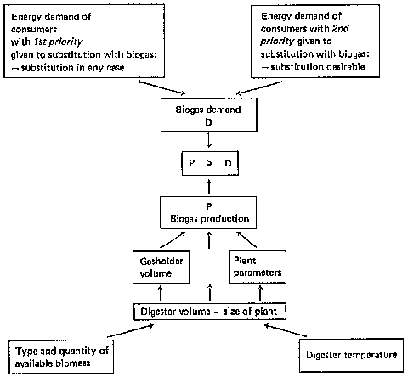
chapter. Fig. 4.1: Balancing the energy demand with the biogas production
(Source: OEKOTOP) 4.1
Determining the Energy Demand
The energy demand of any given farm is equal to the sum of all
present and future consumption situations, i.e. cooking, lighting, cooling,
power generation, etc. With deference to the general orientation of this manual,
emphasis is placed on determining the energy demand of a typical family farm.
Experience shows that parallel calculations according to
different methods can be useful in avoiding errors in calculating the gas/
energy demand. Table
4.1: Outline for determining biogas demand (Source: OEKOTOP)
Energy consumers
data
Biogas demand
(l/d)
1. Gas for cooking (Chapter 5.5.3)
Number of persons
.............
Number of meals
.............
Present energy consumption
.............
Present source of energy
.............
Gas demand per person and meal (Table 5.17)
.............
Gas demand per meal
.............
Anticipated gas demand
...............
Specific consumption rate of burner
.............
Number of burners -
.............
Duration of burner operation
.............
Anticipated gas demand
...............
Total anticipated cooking-gas demand
...............
2. Lighting (Chapter 5.5.3)
Specific gas consumption per lamp (Table 5.20)
.............
Number of lamps
.............
Duration of lamp operation
.............
Gas demand
...............
3. Cooling (Chapter 5.5.3)
Specific gas consumption X 24 h (Table 5.22)
.............
...............
4. Engines (Chapter 5.5.4)
Specific gas consumption per kWh
.............
Engine output
.............
Operating time
.............
Gas demand
...............
5. Miscellaneous consumers
Gas demand
.............
...............
Anticipated increase in consumption (%)
...............
Total biogas demand
...............
1st-priority consumers
...............
2nd-priority consumers
...............
3rd-priority consumers
...............
The following alternative modes of calculation are useful:
Determining biogas demand on the basis of present consumption
. . ., e.g. for ascertaining the cooking-energy demand. This
involves either measuring or inquiring as to the present rate of energy
consumption in the form of wood/charcoal, kerosene and/or bottled gas.
Calculating biogas demand via comparable-use data
Such data may consist of:
- empirical values from neighboring systems, e.g. biogas
consumption per person and meal,
- reference data taken from pertinent literature (cf. chapter
5.5), although this approach involves considerable uncertainty, since
cooking-energy consumption depends on local culture-dependent cooking and eating
habits and can therefore differ substantially from case to case.
Estimating biogas demand by way of appliance consumption data
and assumed periods of use This approach can only work to the extent that the
appliances to be used are known in advance, e.g. a biogas lamp with a specific
gas consumption of 1201/h and a planned operating period of 3 in/d, resulting in
a gas demand of 360 l/d.
Then, the interested party's energy demand should be tabulated
in the form of a requirements list (cf. table 4.1). In that connection, it is
very important to attach relative priority values to the various consumers,
e.g.:
1st priority: applies only when the biogas plant will cover the
demand. 2nd priority: coverage is desirable, since it would promote plant
usage. 3rd priority: excess biogas can be put to these
uses.
4.2 Determining the biogas production
The quantity, quality and type of biomass available for use in
the biogas plant constitutes the basic factor of biogas generation. The biogas
incidence can and should also be calculated according to different methods
applied in parallel.
Measuring the biomass incidence (quantities of excrement and
green substrate)
This is a time-consuming, somewhat tedious approach, but it is
also a necessary means of adapting values from pertinent literature to unknown
regions. The method is rather inaccurate if no total-solids measuring is
included. Direct measurement can, however, provide indication of seasonal or
fodder-related variance if sufficiently long series of measurements are
conducted.
Determining the biomass supply via pertinent-literature
data (cf. tables 3.2/3.3)
According to this method, the biomass incidence can be
determined at once on the basis of the livestock inventory. Data concerning how
much manure is produced by different species and per liveweight of the livestock
unit are considered preferable.
Dung yield = liveweight (kg) x no. of animals x specific
quantity of excrements (in % of liveweight per day, in the form of moist mass,
TS or VS).
Determining the biomass incidence via regional reference data
This approach leads to relatively accurate information, as long
as other biogas plants are already in operation within the area in question.
Determining biomass incidence via user survey
This approach is necessary if green matter is to be included as
substrate. It should be kept in mind that the various methods of calculation
can yield quite disparate results that not only require averaging by the
planner, but which are also subject to seasonal variation.
The biomass supply should be divided into two categories:
Category 1: quick and easy to procure, Category 2:
procurement difficult, involving a substantial amount of extra work. Table 4.2: Outline for
determining biomass incidence (Source: OEKOTOP)
Source of biomass
Moist weight
TS/VS weight
(kg/d)
(kg/d)
Animal dung
Number of cattle: ............
Dung yield per head
.......
.......
Amount collected ...........
Dung yield from cattle
.......
.......
Number of pigs: ..............
Dung yield per pig
.......
.......
Amount collected: ...........
Dung yield from pigs
.......
.......
Sheep, camels, horses etc.................
.......
.......
Green matter
1. grass, etc.
.......
.......
2....................................
.......
.......
Night soil
Number of persons: ..................
Dung yield from night soil
.......
.......
Total biomass incidence
.......
.......
Category 1
.......
.......
Category 2
.......
.......
4.3 Sizing the plant
The size of the biogas plant depends on the quantity; quality
and kind of available biomass and on the digesting temperature.
Sizing the digester
The size of the digester, i.e. the digester volume (Vd), is
determined on the basis of the chosen retention time (RT) and the daily
substrate input quantity (Sd).
Vd = Sd x RT (m³ = m³/day x number of days)
The retention time, in turn, is determined by the chosen/given
digesting temperature (cf. fig 5.2).
For an unheated biogas plant, the temperature prevailing in the
digester can be assumed as 1-2 K above the soil temperature. Seasonal variation
must be given due consideration, however, i.e. the digester must be sized for
the least favorable season of the year. For a plant of simple design, the
retention time should amount to at least 40 days. Practical experience shows
that retention times of 60-80 days, or even 100 days or more, are no rarity when
there is a shortage of substrate. On the other hand, extra-long retention times
can increase the gas yield by as much as 40%.
The substrate input depends on how much water has to be added to
the substrate in order to arrive at a solids content of 4-8%.
Substrate input (Sd) = biomass (B) + water (W) (m³/d)
In most agricultural biogas plants, the mixing ratio for dung
(cattle and/or pigs) and water (B: W) amounts to between 1: 3 and 2: 1 (cf.
table 5.7).
Calculating the daily gas production (G)
The amount of biogas generated each day (G, m³ gas/d), is
calculated on the basis of the specific gas yield (Gy) of the substrate and the
daily substrate input (Sd).
The calculation can be based on:
a) The volatile-solids content
G = kg VS-input x spec. Gy (solids)
b) the weight of the moist mass
G = kg biomass x spec. Gy (moist mass)
c) standard gas-yield values per livestock unit (LSU)
G = no. of LSU x spec. Gy (species)
Table 4.3 lists simplified gas-yield values for cattle and pigs.
A more accurate estimate can be arrived at by combining the gas-yield values
from, say, table 3.5 with the correction factors for digester temperature and
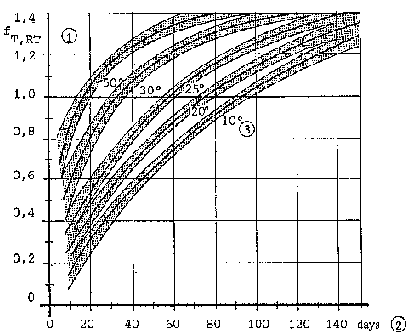
retention time shown in figure 5.2.
GYT,RT = mGy x fT,RT
GYT,RT = gas yield as a function of digester
temperature and retention time mGy = average specific gas yield, e.g. 1/kg VS
(table 3.5) fT,RT = multiplier for the gas yield as a function of
digester temperature and retention time (cf. fig. 5.2)
As a rule, it is advisable to calculate according to several
different methods, since the available basic data are usually very imprecise, so
that a higher degree of sizing certainty can be achieved by comparing and
averaging the results.
Establishing the plant parameters
The degree of safe-sizing certainty can be increased by defining
a number of plant parameters:
Specific gas production (Gp) i.e. the daily gas-generation
rate per m³ digester volume (Vd), is calculated according to the following
equation:
Then, a calculated parameter should be checked against data from
comparable plants in the region or from pertinent literature. Table 4.3: Simplified
gas-yield values for substrate from cattle and pigs (digesting temperature:
22-27 °C) (Source: OEKOTOP)
Type of housing/ manure
Cattle, live wt. 200 - 300 kg
Buffalo, live wt. 300 - 450 kg
Pigs, live wt 50 - 60 kg
manure yield
Gas yield (I/d)
manure yield
Gas yield (I/d)
manure yield
Gas yield (l/d)
(kg/d)
RT=60
RT=80
(kg/d)
RT=60
RRT=80
(kg/d)
RT=40
RT=60
24-h stabling
- dung only (moist),unpaved floor (10% losses)
9-13
300-450
350-500
14-18
450-540
300-620
-
-
-
- dung and urine,concrete floor
20-30
350-510
450-610
30-40
450-600
5440-710
2.5-3.0
120-140
150-180
- stable manure (dung + 2 kg litter), concrete floor
22-32
450-630
530-730
32-42
550-740
630-890
-
-
-
Overnight stabling
- dung only (10% losses)
5-8
180-270
220-310
8-10
240-300
2290-360
-
-
-
- dung and urine,concrete floor
11-16
220-320
260-380
16-20
260-330
330-410
-
-
-
1 kg/d moist dung
~35
~40
~34
~40
-
-
1 l/d manure
~20
~25
~20
~24
~50
~60
1 kg/d manure
~22
~27
~22
~26
-
-
1 kg TS/d
~200
~240
~200
~240
~2270
~340
1 kg VS/d
~250
~300
~250
~300
~3350
~430
Sizing the gasholder
The size of the gasholder, i.e. the gasholder volume (Vg),
depends on the relative rates of gas generation and gas consumption. The
gasholder must be designed to:
- cover the peak consumption rate (Vg 1) and - hold the gas
produced during the longest zero-consumption period (Vg 2).
Vg1 = gc, max x tc, max = vc, max Vg2 = G x tz, max
gc, max = maximum hourly gas consumption (m³/h) tc, max
= time of maximum consumption (h) vc, max = maximum gas consumption
(m³) G = gas production (m³/h) tz, max = maximum
zero-consumption time (h)
The larger Vg-value (Vgl or Vg2) determines the size of the
gasholder. A safety margin of 10-20% should be added. Practical experience shows
that 40-60% of the daily gas production normally has to be stored. Digester
volume vs. gasholder volume. (Vd: Vg) The ratio
Vd : Vg
is a major factor with regard to the basic design of the biogas
plant. For a typical agricultural biogas plant, the Vd/Vg-ratio amounts to
somewhere between 3: 1 and 10: 1, with 5: 1 - 6: 1 occurring most
frequently.
4.4 Balancing the gas production and gas demand by iteration
As described in subsection 4.1, the biogas/ energy production
(P) must be greater than the energy demand (D).
P>D
This central requirement of biogas utilization frequently leads
to problems, because small farms with only a few head of livestock usually
suffer from a shortage of biomass. In case of a negative balance, the planner
must check both sides - production and demand - against the following criteria:
Energy demand (D)
Investigate the following possibilities: - shorter use of
gas-fueled appliances, e.g. burning time of lamps, - omitting certain
appliances, e.g. radiant heater, second lamp, - reduction to a partial-supply
level that would probably make operation of the biogas plant more worthwhile.
The aim of such considerations is to reduce the energy demand,
but only to such an extent that it does not diminish the degree of motivation
for using biogas technology.
Energy supply - biogas production (P)
Examine/calculate the following options/ factors:
- the extent to which the useful biomass volume can be increased
(better collecting methods, use of dung from other livestock inventories,
including more agricultural waste, night soil, etc.), though any form of biomass
that would unduly increase the necessary labor input should be avoided;
- the extent to which prolonged retention times, i.e. a larger
digester volume, would increase the gas yield, e.g. the gas yield from cattle
manure can be increased from roughly 200 1/kg VS for an RT of 40 days to as much
as 320 1/kg VS for an RT of 80-100 days;
- the extent to which the digesting temperature could be
increased by modifying the structure.
The aim of such measures is to determine the maximum
biogas-production level that can be achieved for a reasonable amount of work and
an acceptable cost of investment.
If the gas production is still smaller than the gas demand (P
< D), no biogas plant should be installed.
If, however, the above measures succeed in fairly well matching
up the production to the demand, the plant must be resized according to
subsection
4.3.
4.5 Sample calculations
Energy demand (D)
Basic data 8-person family, 2 meals per day. Present rate of
energy consumption: 1.8 1 kerosene per day for cooking and fueling 1 lamp (0.6 1
kerosene = 1 m³ biogas).
Desired degree of coverage with biogas Cooking:
all Lighting: 2 lamps, 3 hours each Cooling: 60 I refrigerator
Daily gas demand (D) Cooking 1. Present fuel demand for
cooking: 1.21 kerosene = 2 m³ gas 2. Gas demand per person and
meal: 0.15 m³ biogas Gas demand per meal: 1.2 m³
biogas Cooking-energy demand: 2.4 m³ biogas 3. Consumption rate of
gas burner: 175 l/h per flame (2-flame cooker) Operating time: 2 x 3 h + 1
h for tea Biogas demand: 7 h x 3501 = 2.5 m³
Defined cooking-energy demand: 2.5 m³ biogas/d
Lighting Gas consumption of lamp: 120 1/h Operating time:
2 x 3 h = 6 h Biogas demand: 0.7 m³/day
Cooling (60 l refrigerator) Specific gas demand: 30
1/h Biogas demand: 0.7 m³/day Total biogas demand: 3.9 m³/d
1st priority: cooking
2.5 m³
2nd priority: 1 lamp
0.35 m³
3rd priority: 1 lamp/refigerator
1.05 m³
Biomass supply/Biogas production (P)
Basic data 9 head of cattle, 230 kg each, 24-h
stabling, green matter from garden as supplement.
Daily biomass incidence Animal dung, calculated as %
liveweight (as per 1.) or as daily yield per head (as per 2.) as listed in
pertinent literature..
1. Dung as % liveweight Daily yield per head of cattle: 10%
of 230 kg = 23 kg/d Volatile solids/d: 1.8 kg VS per day and
animal Total yield: 207 kg/d (16 kg VS/d)
2. Manure yield on per-head basis Dung yield per head of
cattle: 15 kg/d Urine: 9 1/d Volatile solids: 9% = 2.1 kg VS/d Total
yield: 216 kg/d (19 kg VS/d)
Useful percentage: 75% The lowest values are used as the
basis of calculation.
Green matter: 20 kg agricultural waste with 30% VS.
Total biomass incidence 170 kg/d (18 kg VS/d)
Category 1: cattle 150 kg (12 kg) Category 2: green matter 20
kg ( 6 kg)
Sizing the plant
Basic data (calculation for category 1) Daily biomass: 150
kg/d VS: 12kg/d TS-content: 12% Soil temperature: max 31 °C, min.
22 °C, average 25 °C
Digester volume (Vd) Retention time (chosen): RT = 60 d
(at 25 °C, i.e. f = 1.0) Substrate input: Sd = biomass +
water Digester TS-content: = 7% (chosen) Daily water input: Wd = 100
kg Sd= 100+ 150=250 l Digester volume: Vd = 250 1 x 60 d = 15 000 = 15
m³
Daily biogas yield G = kg/d VS x Gy,vs . = 12 kg/d x 0.25
= 3.0 m³/d G = kgid biomass x Gy (moist) = 150 x 0.02 = 3.0
m³/d G = number of animals x Gy per animal x d = 9 x 0.35 = 3.2
m³/d
Anticipated daily biogas yield = 3.0 m³/d Balancing the
biogas production and demand Demand: 3.9 m³/d Production: 3.0
m³/d
Changes/accommodations On the demand side: 1 less lamp,
reducing the demand to 3.55 m³ Production side: increasing the digester
volume to 18 m³, resulting in a retention time of 75 days (f = 1.2) and a
daily gas yield of 3.6 m³
Plant parameters
Digester volume: Vd = 18m³ Daily gas production: G = 3.6
m³ Daily substrate input: Sd = 2501 Specific gas production: Gp =
G : Vd Gp = 3.6 (m³/d): 18 m³ = 0.2 m³/m³ Vd x
d Digester loading: Ld = TS/VS-input: Vd Ld = 18: 18 = 1.0 kgTS/m³
Vd Ld = 12: 18 = 0.7 kg VS/m³ Vd Gasholder volume: Vg = 1.6
m³, as calculated on the basis of: consumption volume: Vg1 = 0.175
m³/h x 2 flames x 3 h = 1.05 m3 Storage volume: Vg2 = 10 h x 0.15
m³ gas/h = 1.5 m³ Vd:Vg=18: 1.6=11
:1
Biogas plants in Animal Husbandry (GTZ, 1989, 153 p.)
5. Biogas technique
(introduction...)
5.1 Fundamental principles, parameters, terms
5.2 Design principles of simple biogas plants
5.3 Biogas plants of simple design
5.4 Design and construction of plant components
5.5 Biogas utilization
5.6 Measuring methods and devices for biogas plants
Biogas plants in Animal Husbandry (GTZ, 1989, 153 p.)
5. Biogas technique
The design aspects dealt with below concentrate solely on the
principles of construction and examples of simple biogas plants, i.e. plants:
- for small family farms requiring digester volumes of between 5
m³ and 30 m³, - with no heating or temperature control, - with
no motor-driven agitators or slurry handling equipment, - with simple process
control, - built with (at least mostly) local materials, - built by local
craftsmen. Fig.
5.1: Three-stage anaerobic fermentation (Source: Baader et. al
1978)
5.1 Fundamental principles, parameters, terms
Biochemical principles
The generation of biogas by organic conversion (anaerobic
fermentation) is a natural biological process that occurs in swamps, in
fermenting biomass and in intestinal tracts, particularly those of ruminants.
The symbiotic relationships existing between a wide variety of
microorganisms leads, under air exclusion, to the degradation and mineralization
of complex biomass in a sequence of intermeshing stages. The resultant biogas,
consisting primarily of methane (CH4) and carbon dioxide
(CO2) and the mineralized slurry constitute the ultimate catabolites
of the participating bacteria and residual substances.
The process of anaerobic fermentation can be illustrated in the
form of a three-stage model, as shown in figure 5.1. Table 5.1: Basic criteria for
acetobaeters (acid-forming bacteria) and methanobacters (methane-forming
bacteria) (Source: OEKOTOP, compiled from various sources)
Criterion
Acetobacter
Methanobacter
Dominant microorganisms
facultative anaerobes
obligate anaerobes
Temperature range
3 °C - 70 °C
3 °C - 80 °C
Optimum temperature
approx. 30 °C
approx. 35 °C (sensitive to temperature fluctuations of 2-3
°C or more)
pH range
acidic (3.0) 5.0-6.5 relatively short duplication period,
usually less than 24 hours
alkaline, 6.5-7.6 relatively long duplication period (20 - 10
days)
End metabolites
org. acids, H2, CO2
CO2, CH4
Mass transfer by . . .
intensive mixing
gentle circulation
Medium
aqueous (water content > 60%)
Sensitivity to cytotoxins
low
substantial
Requirements regarding nutrient composition
well-balanced supply of nutrients
Special features
viable with or without free oxygen
viable only in darkness and in absence of free oxygen
Table 5.2:
Energy potential of organic compounds (Source: Kaltwasser 1980)
Material
biogas (I/kg)
CH4
CO2
Energy content
vol. fraction %
(Wh/g)
Carbohydrates
790
50
50
3.78
Organic fats
1270
68
32
8.58
Protein
704
71
29
4.96
Anaerobic fermentation converts the "volatile solids" (proteins,
carbohydrates, fats). The "nonvolatile solids" are essential to the bacteria as
"roughage" and minerals. Water serves simultaneously as the vital medium,
solvent and transport vehicle.
Theoretical/laboratory data on maximum gas yields from various
organic materials show that anaerobic fermentation is just as capable of
achieving complete mineralization as is the process of aerobic fermentation.
Note: The theoretical maximum biogas yield can be ascertained by way of the
basic composition of the biomass. Table 5.3: Energetical
comparison of aerobic and anaerobic fermentation (Source: Inden 1978)
Metabolite
aerobic
anaerobic
energy fraction (%)
Cytogenesis
60%
10%
Heat
40%
-
Methane
-
90%
Characteristics that set anaerobic fermentation apart from
aerobic fermentation (e.g. composting) include:
- fixation of biochemical energy in biogas - little formation
of new biomass - low heat development - fixation of minerals in the
digested slurry.
It is important to know that anaerobic fermentation involves a
steady-state flux of acetobacters and methanobacters, with the methanobacters,
being more specialized and, hence, more sensitive, constituting the defining
element. Any biogas plant can develop problems during the starting phase and in
the case of overloading or uneven loading of the digester, and as a result of
poisoning. This underlines the importance of cattle dung, which is rich in
methanobacters and therefore serves as a good "starter" and "therapeutic
instrument" in case of a disturbance.
With regard to technical exploitation, anaerobic fermentation
must be regarded from a holistic point of view, since the "organism" is only
capable of operating at optimum efficiency under a certain set of conditions.
The process of anaerobic fermentation is quite variable and capable of
stabilizing itself as long as a few basic parameters are adhered to.
Parameters and terminology of biomethanation
Feedstock/substrate: As a rule, all watery types of biomass
such as animal and human excrements, plants and organic wastewater are suitable
for use in generating biogas. Wood and woody substances are generally
unsuitable.
The two most important defining quantities of the biomethanation
process are the substrate's solids content, i.e. total solids (TS, measured in
kg TS/m³) and its total organic solids content, i.e. volatile solids (VS,
measured in kg VS/m³ ). Both quantities are frequently stated as weight
percentages.
The total-solids and water contents vary widely from substrate
to substrate (cf. table 3.2 for empirical values). The most advantageous TS for
the digester of a continuoustype biogas plant is 5-10%, compared to as much as
25% for a batch-operated plant. A TS of 15% or more tends to inhibit metabolism.
Consequently, most substrates are diluted with water before being fed into the
digester.
Substrate composition All natural substrates may be assumed
to have a nutritive composition that is adequately conducive to fermentation.
Fresh green plants and agroindustrial wastewater, however, sometimes display a
nutritive imbalance.
An important operating parameter is the ratio between carbon
content (C) and nitrogen content (N), i.e. the C/N-ratio, which is considered
favorable within the range 30 :1 to 10: 1. A C/N-ratio of less than 8: 1
inhibits bacterial activity due to an excessive ammonia content.
Fermentation/digester temperature As in all other microbial
processes, the rate of metabolism increases along with the temperature. The
fermentation/digester temperature is of interest primarily in connection with
the time required for complete fermentation, i.e. the retention time: the higher
the temperature, the shorter the retention time. It has no effect on the
absolute biogas yield, which is a constant that depends only on the type of
biomass in the digester.
For reasons of operating economy, a somewhat shorter period of
fermentation, the technical retention time (RT, t, measured in days) is selected
such as to achieve an advantageous, temperature-dependent relative digestion
rate (Dr, measured in Yo), also referred to as the yield ratio, since it defines
the ratio between the actual biogas yield and the theoretical maximum. The
average agricultural biogas system reaches a Dr-value of 30-60%.. Fig.
5.2: Gas yield as a function of temperature and retention time
(fT,RT-curves). 1 fT,RT: relative gas yield, serving as a
multiplier for the average gas yields, e.g. those listed in table 3.5, 2
retention time (RT), 3 digester temperature (T), measured in °C (Source:
OEKOTOP) Table 5.4:
Temperature ranges for anaerobic fermentation (Source: OEKOTOP, compiled from
various sources)
Fermentation
Minimum
Optimum
Maximum
Retention time
Psycrophilic
4-10 °C
15-18 °C
25-30 °c
over 100 days
Mesophilic
15 - 20 °C
28-33 °C
35-45 °C
30-60 days
Thermophilic
25-45 °C
50-60 °C
75-80 °C
10-16 days
Volumetric digester charge/digester load
The volumetric charge, i.e. how much substrate is added per unit
of digester volume each day (Vc, measured in m³/m³ Vd x d), is given
by the chosen (technical) retention time (RT).
The digester load (Ld, measured in kg digested TS (VS)/m³
Vd x day) serves as a measure of digester efficiency. The digester load is
primarily dependent on four factors: substrate, temperature, volumetric burden
and type of plant. For a typical agricultural biogas plant of simple design, the
upper limit for Ld is situated at roughly 1.5 kg VS/m³ x day. Excessive
digester loading can lead to plant disturbances, e.g. a lower pH. In practice,
the amount of TS/VS being added is frequently equated to the digester load.
Specific biogas yields / specific biogas production
The specific gas yield (Gy, measured in m³ gas/kg TS (VS))
tells how much biogas can be drawn from a certain amount of biomass (cf. table
3.5 for empirical values). The rate of gas generation is naturally dependent on
the digester temperature and retention time (cf. fig. 5.2).
The term specific gas production (Gp, measured in m³
gas/m³ Vd x day) supplements the above expression by defining the
digester's biogas output.
pH/volatile acids
The pH is the central parameter of the biochemical bacterial
environment.
As soon as the pH departs from the optimum range, bacterial
activity is seriously impaired, resulting in lower gas yields, inferior gas
composition (excessive CO2 content) and obnoxious odor
(H2S - like rotten eggs). Table 5.5: pH ranges for
biomethanation (Source: OEKOTOP, compiled from various sources)
pH
7-7.2
optimum
pH
< 6.2
acid inhibition
pH
> 7.6
ammonia inhibition
Table 5.6:
Substances with an inhibiting effect on biomethanation (Source: OEKOTOP,
compiled from various sources)
Substance
Disruptive effects beginning (mg/l)
Copper
10-250
Calcium
8000
Magnesium
3000
Zinc
200-1000
Nickel
350-1000
Chromium
200-2000
Cyanocompounds
25
Chlorinated hydrocarbons
traces
Herbicides
traces
Insecticides
traces
Toxins Even a slight concentration of cytotoxins suffices to
disrupt bacterial activity, with a resultant shift in pH, lower gas yield,
higher CO2 content and pronounced odor
nuisance.
5.2 Design principles of simple biogas plants
The technical conception of biogas plants is determined by the
aim of achieving optimal parameters for the biological process (cf. chapter
5.1).
That being so, the following operating requirements/limitations
must be given due consideration:
- type and composition of organic material, which determines the
choice of process
- given demand for biogas and fertilizer, in addition to the
available substrate quantities, which determines the size of the biogas plant
- economy of labor input for building and operating the plants,
including consideration of the necessary mechanical equipment. Fig.
5.3: The batch-feed principle (1) vs the continuous feed principle (2) (Source:
OEKOTOP) Fig. 5.4: The fermentation channel (1) vs the complete-mixed digester
(2) (Source: OEKOTOP) Fig.
5.5: Slurry flow for various configuration of feed, discharge and stirring. 1
Low inlet, outlet at top (beside the gasholder); 2 High inlet, low outlet
(normal); 3 Low inlet, low outlet (with partition wall); 4 Vertical agitator; 5
Fixed-dome plant; F: Quality factor for thorough mixing and favorable
throughflow conditions, normal situation = 100% (Source: OEKOTOP)
The range of simple biogas plants includes the following basic
types:
Batch-type plants are thus referred to because they are charged
with successive batches of organic material and a certain amount of seeding
slurry to serve as starter. The digestion process is interrupted as soon as the
rate of biogas production has slowed down to the point that continued digestion
would be uneconomical. Then, the plant is cleaned out and refilled. To achieve a
more or less uniform rate of biogas production, several digesters must be
operated in parallel, i.e. filled at staggered intervals. Differentiation is
made between semi-dry plants (operating on a total-solids content of more than
15%) and liquid plants.
Batch plants are suitable for digesting strawy, fibrous material
with a high solids content, usually in areas with low annual precipitation, and
for use as simple demonstration plants.
Continuous-feed plants are those in which there is a continuous
throughflow of biomass, resulting in a near-constant volume of slurry in the
digester. In practice, such plants are fed once or twice each day. There are
three main sub-versions: - complete-mixed digesters - fermentation
channels and - combinations of the two.
The advantage of continuous-feed plants is that the bacteria
receive a regular supply of substrate and are therefore able to generate a more
constant supply of biogas. The problem is that buoyant constituents tend to form
a stiff layer of scum that impedes biogas production and may even plug up the
plant. That drawback can be countered by installing suitable agitators and
lengthening the retention time.
The digester inlet, outlet and, to the extent applicable, the
agitator must be designed to work together in ensuring the proper retention
time, i.e. to avoid short-circuit flow, because the gas production rate would
otherwise stay well below the optimum level.
Continuous-feed biogas plants are sized on the basis of the
desired retention time for the organic material, in combination with the
digester load, which in turn is a function of the prevailing temperature and
type of substrate (cf. chapter
4.3).
5.3 Biogas plants of simple design
There are two basic types of tested biogas plants that have
gained widespread acceptance in agricultural practice:
- floating-drum plants in which the metal gasholder floats on
the digester, and - fixed-dome plants in which gas storage is effected
according to the displacement principle. 5.3.1 Floating-drum plants
A floating-drum biogas plant essentially consists of a
cylindrical or dome-shaped digester and a movable, floating gasholder, or drum.
The drum in which the biogas collects has an internal or external guide frame
that provides stability and keeps the drum upright. Braces can be welded into
the drum as a means of breaking up the scum layer when the drum is rotated. The
digester is usually made of brick, concrete or quarrystone masonry with
rendering, while the gasholder is normally made of metal.
Floating-drum plants are used chiefly for digesting animal and
human excrements on a continuous-feed mode of operation, i.e. with daily input.
They are used most frequently by:
- small-to-midsize family farms (digester size: 5 - 15
m³) - institutions and large agroindustrial estates (digester size:
20-100 m³).
Advantages: Floating-drum plants are easy to understand and
operate. They provide gas at a constant pressure, and the stored volume is
immediately recognizable.
Drawbacks: The steel drum is relatively expensive and
maintenance-intensive due to the necessity of periodic painting and rust
removal. If fibrous substrates are used, the gasholder shows a tendency to get
"stuck" in the resultant floating scum.
Floating-drum plants can be recommended as a mature,
easy-to-operate, functionally capable means of producing biogas, particularly
when reliability is deemed more important than inexpensiveness.
Floating-drum plants with gasholder in the digester (cf. fig.
5.6)
The dome shape is inherently sturdy, compact and
material-sparing. The digester is easy to build, and the techniques can be
learned by local craftsmen in a short time (cf. fig. 5.21).
Water-jacket plant (cf. fig. 5.7)
Water-jacket biogas plants are characterized by a long useful
life and a more aesthetic appearance (no dirty gasholder). Due to their superior
hygiene, they are recommended for use in the fermentation of night soil and for
cases involving pronounced scumming, e.g. due to rapid evaporation, since the
gasholder cannot get stuck in the scum. The extra cost of the masonry water
jacket is relatively modest.
Cylindrical plant for quarrystone masonry and concrete (cf. fig.
5.8)
It is anything but easy to make a dome-shaped digester out of
quarrystone masonry; it is much easier to build a concrete cylinder. In such
cases, the classical (Indian) version with a cylindrical digester is quite
practical Note: Quarrystone masonry consumes a lot of mortar. Fig.
5.6: Floating-drum plant with internal guide frame. 1 Mixing pit, 11 Fill pipe,
2 Digester, 3 Gasholder, 31 Guide frame, 4 Slurry store, 41 Discharge pipe, 5
Gas pipe, 51 Water trap (Source: Sasse 1984) Fig.
5.7: Water-jacket plant with external guide frame. 1 Mixing pit, 11 Fill pipe, 2
Digester, 3 Gasholder, 31 Guide frame, 4 Slurry store, 5 Gas pipe (Source: Sasse
1984) Fig. 5.8: Cylindrical plant design for quarrystone masonry
construction. 1 Mixing pit, 11 Fill pipe, 2 Digester, 3 Gasholder, 31 Guide
frame, 4 Slurry store, 5 Gas pipe (Source: KVIC) Fig.
5.9: Basic function of a fixed dome biogas plant. 1 Mixing pit, 2 Digester, 3
Gasholder, 4 Displaceinent pit, 5 Gas pipe -(Source: OEKOTOP) 5.3.2 Fixed-dome plants
A fixed-dome plant comprises a closed, dome-shaped digester with
an immovable, rigid gasholder and a displacement pit. The gas collects in the
upper part of the digester. Gas production increases the pressure in the
digester and pushes slurry into the displacement pit. When gas is extracted, a
proportional amount of slurry flows back into the digester.
The gas pressure does not remain constant in a fixed-dome plant,
but increases with the amount of stored gas. Consequently, a special-purpose
pressure controller or a separate floating gasholder is needed to achieve a
constant supply pressure. The digesters of such plants are usually made of
masonry, with paraffin or bituminous paint applied to the gas-flled area in
order to make it gastight.
Fixed-dome plants can handle fibrous substances in combination
with animal excrements, since the motion of the substrate breaks up the scum
each day. The plant is a continous-feed type, but can accept several days' worth
of substrate at a time, if the displacement pit is large enough.
Fixed-dome plants must be covered with earth up to the top of
the gas-filled space as a precautionary measure (internal pressure up to
0.1-0.15 bar). As a rule, the size of the digester does not go beyond 20
m³, corresponding to a gasholder volume of 3-4 m³. The earth cover
makes them suitable for colder climates, and they can be heated as necessary.
Advantages: Fixed-dome plants are characterized by low initial
cost and a long useful life, since no moving or rusting parts are involved. The
basic design is compact and well-insulated.
Drawbacks: Masonry is not normally gaslight (porosity and
cracks) and therefore requires the use of special sealants. Cracking often
causes irreparable leaks. Fluctuating gas pressure complicates gas utilization,
and plant operation is not readily understandable.
Fixed-dome plants are only recommended in cases where
experienced biogas technicians are available for building them, and when the
user is amply familiar with how the plant operates.
Fixed-dome plant with central entry hatch (cf. fig. 5.10)
The digester has the form of a hemispherical dome which is easy
to build. Floating scum can be removed from the full digester through the
central entry hatch.
Fixed-dome plant with suspended dome (cf. fig. 5.11)
Providing a separate foundation for the gas dome yields a
statically advantageous, material-saving configuration that is very well suited
for fixed-dome plants of ample size. The dome's foundation helps prevent
cracking due to tensile stress, and the digesting space is made less expensive,
since it can be built of thinner masonry, ferrocement rendering or - in the case
of impervious soil - even left unlined. Fig.
5.10: Fixed-dome plant with central entry hatch. 1 Mixing pit, 11 Fill pipe, 2
Digester, 3 Gas holder, 31 Entry hatch, 32 Gas cover, 33 Seal coating, 34 Rated
break ring, 4 Displacement pit, 41 Outlet pipe, 42 Overflow, 43 Cover, 5 Gas
pipe, 51 Water trap, 52 Cover (Source: Sasse 1984 / BEP Tanzania 1987 /
OEKOTOP) Fig. 5.11: Fixed-dome plant with suspended dome. 1 Mixing pit, 11 Fill
pipe, 2 Digester, 21 Digester rendering, 3 Gas holder, 31 Entry hatch, 32 Cas
cover, 33 Seal coating, 34 Dome foundation, 35 Dome masonry, 4 Displacement pit,
41 Outlet pipe, 42 Overflow, 43 Cover, 5 Gas pipe (Source: BEP Tanzania 1987/
OEKOTOP) 5.3.3 Other
types of construction
In addition to the two most familiar types of biogas plant, as
described above, a selection of special-purpose and otherwise promising designs
are briefly presented below. Fig.
5.12: Horizontal balloon-type biogas plant. 1 Mixing pit, 11 Fill pipe, 2
Digester, 3 Gasholder, 4 Slurry store, 41 Outlet pipe, 5 Gas pipe, 51 Water
trap, 6 Burden, 61 Guide frame (Source: OEKOTOP)
Inflatable balloon plants (cf. fig. 5.12)
Inflatable biogas plants consist of a heatsealed plastic or
rubber bag (balloon), the top and bottom parts of which serve as the gasholder
and digester, respectively. The requisite gas pressure is achieved by weighting
down the bag. Since the material has to be weather-resistant, specially
stabilized, reinforced plastic or synthetic caoutchouc is given preference. The
useful life amounts to 2 - 5 years.
Advantages: Standardized prefabrication at low cost; shallow
installation suitable for use in areas with a high groundwater table.
Drawbacks: Low gas pressure requires extra weight burden, scum
cannot be removed. The plastic balloon has a relatively short useful life, is
susceptible to damage by mechanical means, and usually not available locally. In
addition, local craftsmen are rarely in a position to repair a damaged balloon.
Inflatable biogas plants are recommended, if local repair is or
can be made possible and the cost advantage is substantial. Fig.
5.13: Earth-pit plant with plastic-sheet gasholder. 1 Mixing pit, ll Fill pipe,
2 Digester, 21 Rendering, 22 Peripheral masonry, 3 Plastic-sheet gasholder, 31
Cuide frame, 32 Wooden frame, 33 Weight, 34 Frame anchorage, 35 Plastic
sheeting, 4 Slurry store, 41 Overflow, 5 Gas pipe (Source: OEKOTOP)
Earth-pit plants (cf. fig. 5.13)
Masonry digesters are not necessary in stable soil (e.g.
Iaterite). It is sufficient to line the pit with a thin layer of cement (netting
wire fixed to the pit wall and rendered) in order to prevent seepage. The edge
of the pit is reinforced with a ring of masonry that also serves as anchorage
for the gasholder. The gasholder can be made of metal or plastic sheeting. If
plastic sheeting is used, it must be attached to a quadratic wooden frame that
extends down into the slurry and is anchored in place to counter its buoyancy.
The requisite gas pressure is achieved by placing weights on the gasholder. An
overflow point in the peripheral wall serves as the slurry outlet.
Advantages: Low cost of installation (as little as 1/5th as much
as a floating-drum plant), including high potential for self help.
Drawbacks: Short useful life, serviceable only in suitable,
impermeable types of soil.
Earth-pit plants can only be recommended for installation in
impermeable soil located above the groundwater table. Their construction is
particularly inexpensive in connection with plastic sheet gasholders. Fig
5.14: Ferrocement biogas plant. 1 Mixing pit, 11 Fill pipe, 2 Digester, 21
Backfill soil, 22 Ferrocement, i.e. rendered lathing on surrounding soil, 3
Ferrocement gasholder, 31 Guide frame, 41 Outlet pipe, 5 Cas pipe, 51 Water trap
(Source: OEKOTOP/BEP Caribbean 1986)
Ferrocement plants (cf. fig. 5.14)
The ferrocement type of construction can be executed as either a
self-supporting shell or an earth-pit lining. The vessel is usually cylindrical.
Very small plants (Vd <6 m³) can be prefabricated. As in the case of a
fixed-dome plant, the ferrocement gasholder requires special sealing measures
(provenly reliable: cemented-on aluminium foil).
Advantages: Low cost of construction, especially in comparison
with potentially high cost of masonry for alternative plants.
Drawbacks: Substantial consumption of necessarily good-quality
cement; participating craftsmen must meet high standards; uses substantial
amounts of steel; construction technique not yet adequately timetested; special
sealing measures for the gasholder.
Ferrocement biogas plants are only recommended in cases where
special ferrocement know-how is available. Fig.
5.15: Horizontal biogas plant (KVIC shallow design). 1 Mixing pit, 11 Fill pipe,
2 Digester, 3 Gasholder, 31 Guide frame, 4 Slurry store, 41 Outlet pipe, 5 Gas
pipe, 51 Water trap (Source: OEKOTOP / KVIC 1978)
Horizontal plants (cf. fig. 5.15)
Horizontal biogas plants are usually chosen when shallow
installation is called for (groundwater, rock). They are made of masonry or
concrete.
Advantages: Shallow construction despite large slurry space.
Drawbacks: Problems with gas-space leakage, difficult
elimination of scum.
Plants with separate gasholders
Masonry dome plants are sometimes equipped with separate
gasholders. That approach always involves substantial extra cost and therefore
is rarely recommended. Plants with separate gasholders are justifiable, when the
points of gas consumption are a considerable distance away from the digester (at
least 1 00 m).
Altematively, a separate gasholder could be useful for restoring
the utility value of, say, a fixed-dome plant that has been found to leak at an
elevated pressure level. Table 5.7: Comparison of
various plant designs (Source: OEKOTOP)
Design: Criteria:
Floating-drum
Water-jacket
Fixed dome
Design principle
continuous-feed, mixed digester
continuous-feed, mixed digester
continuous-feed, mixed digester with slurry store
Main components digester/gasholder
masonry digester, floating metal gasholder
masonry digester, floating metal gasholder in sep. water jacket
masonry with displacement pit
Preferred substrates
animal excrements, with or without vegetable waste
animal excrements with or without vegetable waste
animal excrements plus vegetable waste
Anticipated useful life
8-12 years
10-15 years
12-20 years
Digester volume (Vd)
6-100 m³
6-100 m³
6-20 m³
Suitability:
- advantages
easy construction and operation, uniform gas pressure, mature
technology
very reliable, easy construction and operation, uniform gas
pressure, long useful life, mature technology
low cost of construction, long useful life, well-in sulated
- drawbacks
metal gasholder can rust
expensive
sealing of gasholder, fluc tuating gas pressure
- All biogas plants require careful, regular
inspection/monitoring of their gas-containing components -
Operation and maintenance
simple and easy; regular painting of metal gas- holder
simple and easy; regular painting of metal gas- holder
easy after careful familiarization
Daily gas-output
0.3-0.6
0.3-0.6
0.2-0.5
(m³ gas/m³ Vd)
(depends on substrate composition; here: cattle dung)
Cost elements
metal gasholder, digester
metal gasholder, digester
combined digester/ gasholder, Excavation
Comparison factor
100
120
60-90
Recommended uses
fully developed, reliable family size system
like floating-drum, plus longer useful life and operational
reliability (incl. operation with night soil)
inexpensive equipment, good for agroresidue, extensive building
experience required
Suitability for dissemination
+
++
+
++ highly recommended, + recommended with certain reservations
balloon-type
Earth pit
Ferrocement
Horizontal (shallow)
continuous-feed, fermentation channel
continuous-feed, mixed digester
continuous-feed, mixed digester
continuous-ffeed, fermentation channel
integrated digester/gas- holder made of plastic sheeting
earth pit as digester, plastic gasholder
ferrocement digester, gasholder made of metal or ferrocement
masonry digester, floating metal gasholder (or separate)
animal excrements only
animal excrements only
animal excrements, with or without vegetable waste
animal excrements, with or without vegetable waste
2-5 years
2-5 years
6-10 years
8-12 years
4-100 m³
4-500 m³
4-20 m³
20-150 m³
prefab. construction, easy operation
extremely inexpensive, easy operation
potentially inexpensive construction, long useful life, easy
operation, reliable
shallowness, easy operation
in-site processing and short useful life (2-5 years) of plastic
material, low gas pressure
same as with plastic gas holder, plus soil perme- ability
ferrocement construction not yet adequately time
expensive, metal gasholder tested
easy; regular control of gas-pressure weights
easy
simple and easy
simple and easy
0.3-0.8
0.1-0.5
0.3-0.6
0.3-0.7
plastic sheeting
plastic sheeting
concrete (cement), lathing
digester, metal gasholder
20-110
20-40
70-90
90
mostly for large- scale plants and fast solutions
very inexpensive plant
like floating-drum but requires experience in ferrocement
construction
medium-size system where shallowness is required
o
o
-
o
o recommended under certain circumstances, - not yet ready for
recommendation
5.4 Design and construction of plant components
Biogas plants of simple design consist of the following main
components: - mixing pit - inlet/outlet(feed/dischargepipes) -
digester - gasholder - slurry store.
Depending on the available building material and type of plant
under construction, different variants of the individual components are
possible. Table 5.8:
common substrate mixing ratios (Source: OEKOTOP, compiled from various
sources)
Type of substrate
Substrate:
water
Fresh cattle manure
1
: 0.5 -1
Semi-dry cattle dung
1
: 1-2
Pig dung
1
: 1-2
Cattle and pig dung from a floating removal system
In the mixing pit, the substrate is diluted with water and
agitated to yield a homogeneous slurry. The fibrous material is raked off the
surface, and any stones or sand settling to the bottom are cleaned out after the
slurry is admitted to the digester.
The useful volume of the mixing pit should amount to 1.5-2 times
the daily input quantity. A rock or wooden plug can be used to close off the
inlet pipe during the mixing process. A sunny location can help warm the
contents before they are fed into the digester in order to preclude thermal
shock due to the cold mixing water. In the case of a biogas plant that is
directly connected to animal housing, it is advisable to install the mixing pit
deep enough to allow installation of a floating gutter leading directly into the
pit. Care must also be taken to ensure that the low position of the mixing pit
does not result in premature digestion and resultant slurry formation. For
reasons of hygiene, toilets should have a direct connection to the inlet
pipe. Fig. 5.17: Mixing pit, gutter and toilet drain pipe. 1 Barn, 2 Toilet,
3 Biogas plant, 4 Feed gutter 2% gradient), 5 Mixing pit (Source: OEKOTOP)
5.4.2 Inlet and outlet
The inlet (feed) and outlet (discharge) pipes lead straight into
the digester at a steep angle. For liquid substrate, the pipe diameter should be
10-15 cm, while fibrous substrate requires a diameter of 20 - 30 cm. Plastic or
concrete pipes are preferred.
Note:
- Both the inlet pipe and the outlet pipe must be freely
accessible and straight, so that a rod can be pushed through to eliminate
obstructions and agitate the digester contents;
- The pipes should penetrate the digester wall at a point below
the slurry level. The points of penetration should be sealed off and reinforced
with mortar.
- The inlet pipe ends higher than the outlet pipe in the
digester in order to promote more uniform throughflow. In a fixed-dome plant,
the inlet pipe defines the bottom limit of the gasholder, thus providing
overpressure relief.
- In a floating-drum plant, the end of the outlet pipe
determines the digester's slurry level. Fig.
5.18: Inlet and outlet for fixed-dome (1) and floating-drum plants (2) (Source:
OEKOTOP) Fig. 5.19: Forces acting on a spherical-dome digester (Source:
OEKOTOP) 5.4.3 Digester
Design
The digester of a biogas plant must accommodate the substrate
and bacterial activity, as well as fulfill the following structural functions:
- accept the given static forces - provide impermeability to
gas and liquids - be durable and resistant to corrosion
As a rule, the digesters of simple biogas plants are made of
masonry or concrete. Such materials are adequately pressure-resistant, but also
susceptible to cracking as a result of tensile forces.
The following forces act on the digester:
- external active earth pressures (pE), causing compressive
forces within the masonry - internal hydrostatic and gas pressures (pW),
causing tensile stress in the masonry. Fig.
5.20: Level line, excavation and foundation. 1 Workspace, 2 Inclination of
conical foundation, 3 Sloping excavation, 4 Vertical excavation, 51 Quarrystone
foundation, 52 Brick foundation, 6 Packing sand, 7 Mortar screed, 8 Foot
reinforcement for fixed-dome plant, 9 Level line (Source: OEKOTOP / Sasse 1984)
Thus, the external pressure applied by the surrounding earth
must be greater at all points than the internal forces (pE > pW). For the
procedure on how to estimate earth force and hydrostatic forces, please refer to
chapter 10.1.4.
Round and spherical shapes are able to accept the highest
forces—and do it uniformly. Edges and corners lead to peak stresses and,
possibly, to tensile stresses and cracking. Such basic considerations suggest
the use of familiar cylindrical and dome designs allowing:
- inexpensive, material-sparing construction based on modest
material thicknesses - a good volume/surface ratio and - better (read:
safe) stability despite simple construction.
The dome foundation has to contend with the highest loads.
Cracks occurring around the foundation can spread out over the entire dome, but
are only considered dangerous in the case of fixed-dome plants. A rated break
ring can be provided to limit cracking.
Groundwork
The first step of building the plant consists of defining the
plant level line with a taut string. All important heights and depths are
referred to that line.
Excavation
The pit for the biogas plant is excavated by hand in the shape
of a cylindrical shaft. The shaft diameter should be approx. 2 x 50 cm larger
than that of the digester. If the soil is adequately compact and adhesive, the
shaft wall can be vertical. Otherwise it will have to be inclined. The
overburden, if reusable, is stored at the side and used for backfilling and
compacting around the finished plant.
Foundation
The foundation slab must be installed on well-smoothed ground
that is stable enough to minimize settling. Any muddy or loose subsoil (fill)
must be removed and replaced by sand or stones. The bottom must have the shape
of a shallow inverted dome to make it more stable and rigid than a flat slab.
Quarrystones, bricks and mortar or concrete can be used as construction
materials. Steel reinforcing rods are only necessary for large plants, and then
only in the form of peripheral ties below the most heavily burdened part, i.e.
the dome foundation. Fig.
5.21: Construction of a spherical dome from masonry. 1 Dome/masonry, 2
Establishing the centerpoint, 3 Trammel, 4 Brick clamp with counterweights, 5
Backfill (Source: Sasse 1984)
Dome
The dome of the biogas plant is hemispherical with a constant
radius. Consequently, the masonry work is just as simple as for a cylinder and
requires no falsework. The only accessory tool needed is a trammel.
The dome masonry work consists of the following steps:
- finding and fixing the centerpoint of the dome radius in
relation to the level line
- layer-by-layer setting of the dome masonry, with the bricks
set in mortar, positioned and aligned with the aid of the trammel and tapped for
proper seating
- in the upper part of the dome - when the trammel is standing
at a steeper angle than 45°, the bricks must be held in place until each
course is complete. Sticks or clamps with counterweights can be used to
immobilize them.
Each closed course is inherently stable and therefore need not
be held in place any longer. The mortar should be sufficiently adhesive, i.e. it
should be made of finely sieved sand mixed with an adequate amount of
cement. Table 5.9:
Mortar mixing ratios (Source: Sasse, 1984)
Type of mortar
Cement
Lime
Sand
Masonry mortar
2 :
1 :
10
Masonry mortar
1
:
6
Rendering mortar
1
:
4-8
Table 5.10:
Suitability tests for rendering/mortar sands (Source: Sasse, 1984)
Test
Requirement
1. Visual check for coarse particles
Particle size: <7 mm
2. Determining the fines fraction by immersion in a glass of
water: 1/21 sand mixed with 1 1 water and left to stand for 1 h, after which the
layer of silty mud at the top is measured.
Silt fraction: < 10%
3. Check for organic matter by immersion in an aqueous solution
of caustic soda: 1/2 I sand in 1 1 3 % caustic soda with occasional stirring.
Notation of the water's color after 24 h.
Clear-to-light-yellow = low org. content: suitable for use
Reddish brown = high org. content: unsuitable for use
Rendering
Mortar consisting of a mixture of cement, sand and water is
needed for joining the bricks and rendering the finished masonry. Biogas plants
should be built with cement mortar, because lime mortar is not resistant to
water.
The sand for the mortar must be finely sieved and free of dust,
loam and organic material. That is, it must be washed clean.
Special attention must be given to the mortar composition and
proper application for rendering, since the rendering is of decisive importance
with regard to the biogas plant's durability and leaktightness. Ensure that:
- trowelling is done vigorously (to ensure compact
rendering) - all edges and corners are rounded off - each rendering course
measures between 1.0 and 1.5 cm - the rendering is allowed to set|dry slowly
(keep shaded and moist, as necessary) - the material composition is suitable
and mutually compatible - a rated break ring is provided for a fixed-dome
plant
Crack-free rendering requires lots of pertinent experience and
compliance with the above points. Neither the rendering nor the masonry is
gaslight and therefore has to be provided with a seal coat around the gas space
(cf. chapter 5.4.4). 5.4.4 Gasholder
Basically, there are three different designs/ types of
construction for gasholders used in simple biogas plants:
- integrated floating drums - fixed domes with displacement
system and - separate gasholders Fig.
5.22: Construction of a metal gasholder with internal guide frame. 1 Lattice
beam serving as cross pole, 2 Cross pole with bracing, 3 Gas pipe (2% gradient),
4 Guide frame, 5 Braces for shape retention and breaking up the scum layer, 6
Sheet steel (2-4 mm) serving as the drum shell (Source: OEKOTOP/Sasse, 1984)
Floating-drum gasholders
Most floating-drum gasholders are made of 2 - 4 mm-thick sheet
steel, with the sides made somewhat thicker than the top in order to counter the
higher degree of corrosive attack. Structural stability is provided by L-bar
bracing that simultaneously serves to break up surface scum when the drum is
rotated.
A guide frame stabilizes the gas drum and keeps it from tilting
and rubbing on the masonry. The two equally suitable types used must frequently
are:
- an internal rod & pipe guide with a fixed
(concrete-embedded) cross pole (an advantageous configuration in connection with
an internal gas outlet)
- external guide frame supported on three wooden or steel legs
(cf. fig. 5.7).
For either design, it is necessary to note that substantial
force can be necessary to turn the drum, especially if it is stuck in a heavy
layer of floating scum. Any gasholder with a volume exceeding 5 or 6 m³
should be equipped with a double guide (internal and external).
All grades of steel normally used for making gasholders are
susceptible to moisture-induced rusting both inside and out. Consequently, a
long service life requires proper surface protection consisting of:
- thorough derusting and desoiling. - primer coat of
minium - 2 or 3 cover coats of plastic/bituminous paint.
The cover coats should be reapplied annually. A well-kept metal
gasholder can be expected to last between 3 and 5 years in humid, salty air or
8-12 years in a dry climate.
Materials regarded as suitable alternatives to standard grades
of steel are galvanized sheet metal, plastics (glass-reinforced plastic/ GRP,
plastic sheeting) and ferrocement with a gaslight lining. The gasholders of
waterjacket plants have a longer average service life, particularly when a film
of used oil is poured on the water seal to provide impregnation. Fig.
5.23: Construction of a fixed-dome gasholder. 1 Slurry level for an empty
gasholder (zero line), 2 Slurry level for a full gasholder, 3 Overflow, 4 Inlet
= overpressure relief, 5 Earth cover (at least 60 cm), 6 Reinforcing ring at
foot of dome, 7 Max. gas pressure. A Detail: wall construction: .1 Outer
rendering,.2 Masonry, .3 Twolayer inner rendering, .4 Seal coat. B Detail: rated
break point: .1 Masonry bricks (laid at right angles), .2 Joint reinforced with
chicken wire, .3 Seal rendering - inside and out (Source: OEKOTOP)
Fixed domes
In a fixed-dome plant the gas collecting in the upper part of
the dome displaces a corresponding volume of digested slurry. The following
aspects must be considered with regard to design and operation:
- An overflow must be provided to keep the plant from becoming
overfilled.
- The gas outlet must be located about 10 cm higher than the
overflow in order to keep the pipe from plugging up.
- A gas pressure of 1 mWG or more can develop in the gas space,
Consequently, the plant must be covered with enough earth to provide an adequate
counterpressure; special care must be taken to properly secure the entry hatch,
which may require weighing it down with 100 kg or more.
The following structural measures are recommended for avoiding
or at least limiting the occurrence of cracks in the dome (cf. fig. 5.23):
- For reasons of static stability, the centerpoint of the dome
radius should be lowered by 0.25 R (corresponding to bottom center of the
foundation). This changes the geometry of the digester, turning it into a
spherical segment, i.e. flatter and wider, which can be of advantage for the
plant as a whole.
- The foot of the dome should be made more stable and secure by
letting the foundation slab project out enough to accept an outer ring of
mortar.
- A rated break/pivot ring should be provided at a point located
between 1/2 and 2/3 of the minimum slurry level. This in order to limit the
occurrence or propagation of cracks in the vicinity of the dome foot and to
displace forces through its stiffening/ articulating effect such that tensile
forces are reduced around the gas space. Fig.
5.24: Entry hatch of a fixed-dome biogas plant. 1 Concrete cover, 2 Gas pipe, 21
Flexible connection (hose), 3 Cover wedging, 31 Length of pipe anchored in the
masonry, 32 Retaining rod, 33 Wooden/metal wedges, 4 Edge seal made of
loam/mastic compound, 5 Handles, 6 Weights, 7 Water (Source: OEKOTOP)
In principle, however, masonry, mortar and concrete are not
gaslight, with or without mortar additives. Gastightness can only be achieved
through good, careful workmanship and special-purpose coatings. The main
precondition is that the masonry and rendering be strong and free of cracks.
Cracked and sandy rendering must be removed. In most cases, a plant with cracked
masonry must be torn down, because not even the best seal coating can render
cracks permanently gaslight.
Some tried and proven seal coats:
- multilayer bitumen, applied cold (hot application poses
the-danger of injury by burns and smoke nuisance); solvents cause
dangerous/explosive vapors. Two to four thick coats required.
- bitumen with aluminum foil: thin sheets of overlapping
aluminum foil applied to the still-sticky bitumen, followed by the next coat of
bitumen.
- plastics, as a rule epoxy resin or acrylic paint; very good
but expensive.
- paraffin, diluted with 2 - 5% kerosene heated to 100 °C
and applied to the preheated masonry. The paraffin penetrates deep into the
masonry, thus providing an effective (deep) seal. Use kerosene/gas torch to heat
masonry.
In any case, a pressure test must be performed before the plant
is put in service (cf. chapter 7.1). Table 5.11: Quality ratings
for various dome-sealing materials (Source: OEKOTOP)
Material
Processing
Seal
Durability
Costs
Cold bitumen
++
o
o
++
Bitumen with alu-foil
+
++
+
+
Epoxy resin
++
+
++
-
Paraffin
+
o
o
++
++ very good
+ good
o satisfactory
- problematic
Fig.
5.25: Sealing the masonry with paraffin. 1 Heat wall to 60 - 80 °C with
soldering torch, 2 Apply hot (100 °C) paraffin (Source: OEKOTOP/ BEP
Tanzania)
Plastic gasholders
Gasholders made of plastic sheeting serve as integrated
gasholders (cf. chapter 5.3.3: earth pits), as separate balloon/bag-type
gasholders and as integrated gas-transport/ storage elements.
For plastic (sheet) gasholders, the structural details are of
less immediate interest than the question of which materials can be used. Table
5.12 (p. 74) surveys the relative suitability of various commercial grades of
plastic sheeting. Fig.
5.26: Separate, mobile, plastic-sheet gasholder. 1 Cart for gasholder volumes of
1 m³ and more, 2 Stabilizing weights and frame, 3 Reinforced plastic
gasholder (Source: Wesenberg 1985)
Separate gasholders
Differentiation is made between:
- low-pressure, wet and dry gasholders (10 - 50 mbar) Basically,
these gasholders are identical to integrated and/or plastic (sheet) gasholders.
Separate gasholders cost more and are only worthwhile in case of substantial
distances (at least 50-100 m) or to allow repair of a leaky fixed-dome plant.
- medium- or high-pressure gasholders (8 - 10 bar/200 bar)
Neither system can be considered for use in small-scale biogas
plants. Even for large-scale plants, they cannot be recommended under the
conditions anticipated in most developing countries. High-pressure gas storage
in steel cylinders (as fuel for vehicles) is presently under discussion. While
that approach is possible in theory, it would be complicated and, except in a
few special cases, prohibitively expensive. It would also require the
establishment of stringent safety regulations. Table 5.12: Properties of
plastic sheeting - gasholder suitability ratings (Source: UTEC 1985)
Description
Mechanical properties
Stability/resistance values
Application
Material
Spec. weight
Permisible Internal Presure
Slit-tear Resistance
Mechanical Properties
Temperature Stability
Weather Resistance
Animal attack, rot/mold
Chemical Stability
CH4 - Permeability
Processing
Suitability against holder
g/m²
mbar
N
-
°C
-
-
-
1
2
3
4
5
6
7
8
9
10
11
12
13
Solid
PVC
1400
42
50
-
90/65
o
-/o
+
365/1300
HF, HW, HA
-
sheeting
HT, C
per 1.0-
PE
950
42
100
-
90/ 70
-/o
o
o
760/488
HF,HW,HA
-/o
mm thick-
ness
IIR
1300
9
32
+
170/110
++
+
o
290/230
HV,FF,C
+
EPDM
1200
4
32
+
170/120
++
+
o
3200
HV,FF,C
+
Laminated
PVC
750/
59-
240-
++
90/65
o
-/o
+
310/-
HF,HW,HA,
+
synthetic
1400
80
300
HT, C
fabrics
CPE
1100
-
70
+
+
+
165/200
HF,HW,HA
of various
CSM
1100
++
140/90
++
+
o
290/370
HV, C
+
thickness
CR
1100
++
90
++
+
o
1010/720
HV,C
++
2 PVC (polyvinyl chloride)
7 Short-term/continuous load
PE (polyethylene)
11 Permeability coefficient, P, for new material
CPE (chlorinated polyethylene)
12 HF = high-frequency seam welding
IIR (isobutylene-isoprene rubber)
HW = hot-wedge seam welding
EPDM (ethylene-propylene diene monomer)
HA = hot-air seam welding
4 Inflatable gasholder, approx. 2.5 m³,
C = cementing
3-fold protection against rupture
HV = hot vulcanizing
6/8/9 - poor, o satisfactory,
FF = fusion firing
10/13 + good, ++ very good
HT = heat-solvent tape sealing
5.4.5 Gas
pipe, valves and fittings
Gas pipe
The following types of gas pipes are in use: - PVC pipes with
adhesive joints - steel pipes (water supply pipes) with screw couplings -
plastic hoses.
Galvanized steel water supply pipes are used most frequently,
because the entire piping system (gas pipe, valves and fittings) can be made of
universally applicable English/U.S. Customary system components, i.e. with all
dimensions in inches. Pipes with nominal dimensions of 1/2" or 3/4" are adequate
for small-to-midsize plants of simple design and pipe lengths of less than 30 m.
For larger plants, longer gas pipes or low system pressure, a detailed
pressure-loss (pipe-sizing) calculation must be performed (cf. chapter
10.2). Table 5.13:
Gas-pipe pressure losses (Source: OEKOTOP)
Volum
Pipe (galv. steel pipe)
flow, Q
1/2“
¾”
1”
(m³ /h
v1
dp/l2
v1
dp/l2
v1
dp/l2
m/s
cmWG/10m
m/s
cmWG/10m
m/s
cm WG/10 m
0.1
0.35
0.03
0.16
0.004
0.09
0.001
0.2
0.71
0.12
0.32
0.02
0.18
0.004
0.4
1.4
0.47
0.64
0.06
0.36
0.016
0.6
2.1
1.06
0.94
0.15
0.53
0.034
0.8
2.8
1.9
1.3
0.27
0.72
0.06
1.0
3.5
2.9
1.6
0.41
0.88
0.09
1.5
5.3
6.7
2.3
0.85
1.33
0.2
2.0
7.0
11.8
3.2
1.6
1.8
0.4
1 Velocity of flow in the pipe 2
Differential pressure (pipe only) stated in cm WG per 10 m pipe
When installing a gas pipe, special attention must be paid to:
- gastight, friction-type joints
- line drainage, i.e. with a water trap at the lowest point of
the sloping pipe in order to rule out water pockets
- protection against mechanical impact.
Some 60% of all system outages are attributable to defective gas
pipes. For the sake of standardization, it is advisable to select a single size
for all pipes, valves and fittings.
Valves and fittings
To the extent possible, ball valves or cock valves suitable for
gas installations should be used as shutoff and isolating elements. Gate valves
of the type normally used for water pipes are conditionally suitable. Any water
valves used must first be checked for gastightness. Fig.
5.27: Gas pipe, valves and fittings of a biogas plant. 1 Plant shutoff valve, 2
Water trap, 3 Pressure gauge, 4 House shutoff valve, 5 Cookstove, 6 Lamp, 7
Appliance shutoff valve, 8 Gasmeter (Source: OEKOTOP)
Gas manometer
A U-tube pressure gauge is quick and easy to make and can
normally be expected to meet the requirements also of a fixed-dome system.
Fig. 5.28: Gas valves and fittings: U-tube pressure gauge (a), water trap with
drain valve (b), U-tube water separator (c), "gravel-pot" flashback arrestor
(d). 1 Gas pipe, 2 Condensate collector, 3 Shutoff valve, 4 Manometer valve, 5
U-tube pressure gauge made of transparent hose, 6 Wooden balls, 7
Antievaporation cap, 8 U-tube, 9 "Gravel-pot" flashback arrestor (approx. 51)
filled with 20 mm gravel (Source: OEKOTOP)
Pressure relief
The task of running a fixed-dome system can be made easier by
installing a spring-loaded pressure reducing valve that guarantees a constant
(adjustable) supply pressure.
Water separation
If at all possible, the water trap should operate automatically.
However since fixed-dome systems need a high water seal, often amounting to more
than 1 m WG, the use of condensate collector with a manually operated drain
valve is advisable.
Backflow prevention
As a rule, the water trap also functions as a flashback chamber.
If deemed necessary, a gravel trap can be installed for added
safety.
5.5 Biogas utilization
5.5.1 Composition and
properties of biogas
Biogas is a mixture of gases that is composed chiefly of:
- methane, CH4
40 - 70 vol. %
- carbon dioxide, CO2
30-60 vol. %
- other gases
1 - 5 vol.%, including
- hydrogen H2
0-1 vol. %
- hydrogen sulfide, H2S
0-3 vol. %
Like those of any gas, the characteristic values of biogas are
pressure and temperature-dependent. They are also affected by water vapor. The
factors of main interest are:
- volumetric change as a function of temperature and
pressure, - change in value as a function of temperature, pressure and
water-vapor con" tent, and - change in water-vapor content as a function of
temperature and pressure. Chapter 10.2 contains pertinent tables, formulae
and nomograms for use in calculating conditions of state. 5.5.2 Conditioning of biogas
While the biogas produced by the plant can normally be used as
it is, i.e. without further treatment/conditioning, various conditioning
processes are described in this chapter to cover possible eventualities.
Reducing the moisture content of the biogas, which is usually
fully saturated with water vapor. This involves cooling the gas, e.g. by routing
it through an underground pipe, so that the excess water vapor condenses out at
the lower temperature. When the gas warms up again, its relative vapor content
decreases (cf. chapter 10.2 for calculations). The "drying" of biogas is
especially useful in connection with the use of dry gas meters, which otherwise
would eventually fill up with condensed water. Table 5.14: Composition and
properties of biogas, and its constituents under s.t.p. conditions (0 °C,
1013 mbar) (Source: OEKOTOP, compiled from various sources)
Constituents and properties
CH4
CO2
H2
H2S
60% CH4/ 40% CO2
65% CH4/ 34% C02/ 1% rest
Volume fraction (%)
55-70
27-44
1
3
100
100
Net calorific value (kWh/m³)
9.9
-
3.0
6.3
6.0
6.8
Ignition threshold (% in air)
5-1S
-
4-80
4-45
6-12
7.7 - 23
Ignition temperature (°C)
650-750
-
585
-
650-750
650-750
Crit.pressure (bar)
47
75
13
89
75-89
75-89
Crit. temp. (°C)
-82.5
31.0
-240
100.0
-82.5
-82.5
Normal density (g/1)
0.72
1.98
0.09
1.54
1.2
1.15
Gas/air-density ratio
0.55
2.5
0.07
1.2
0.83
0.91
Wobbe index, K (kWh/m³)
13.4
-
-
-
6.59
7.15
Spec. heat, cp (kI/m³ °C)
1.6
1.6
1.3
1.4
1.6
1.6
Flame propagation (cm/s)
43
-
47
-
36
38
Reduction of the hydrogen-sulfide content (H2S) may
be necessary if the biogas is found to contain an excessive amount, i.e. more
than 2%, and is to be used for fueling an engine. Since, however, most biogas
contains less than 1% H2S, desulfurization is normally unnecessary,
especially if it is to be used for operating a stationary engine.
For small-to-midsize systems, desulfurization can be effected by
absorption onto ferric hydrate (Fe (OEI)3), also referred to as bog iron, a
porous form of limonite. The porous, granular purifying mass can be regenerated
by exposure to air.
The absorptive capacity of the purifying mass depends on its
iron-hydrate content: bog iron containing 5-10% Fe(OH)3 can absorb
about 15 g sulfur per kg without being regenerated and approximately 150 g/ kg
through repetitive regeneration. It is a very noteworthy fact that many types of
tropical soil (laterites) are naturally ferriferous and, hence, suitable for use
as purifying mass.
Reduction of the carbon-dioxide content (CO2) is very
complicated and expensive. In principle, CO2 can be removed by
absorption onto lime milk, but that practice produces "seas" of lime paste and
must therefore be ruled out, particularly in connection with large-scale plants,
for which only high-tech processes like microscreening are worthy of
consideration. CO2 "scrubbing" is rarely advisable, except in order
to increase the individual bottling capacity for high-pressure storage. Fig.
5.29: Ferric-hydrate gas purifier. 1 Gas pipe, 11 Raw-gas feed pipe, 12
Clean-gas discharge pipe, 13 Purging line, 2 Metal gas purifier, 3 Shelves for
purifying mass, 4 Purifying mass (Source: Muche 1984) Table 5.15: Pointers on flame
adjustment (Source: OEKOTOP)
Problem
Cause - Remedy
elongated, yellow- ish flame
lack of combustion air - open the air supply
flame "lifts off"
excessive exit velocity - use smaller injector, reduce the gas
pressure, reduce the air supply
flame "flashes back"
exit velocity too low - use larger injector, increase the gas
pressure, open the air supply, reduce the size of the burner jets
flame "too small"; not enough fuel
fuel shortage - use larger injector, increase the gas pressure
excessive fuel supply - reduce the gas pressure, use smaller
injector
5.5.3 Biogas
appliances
Biogas is a lean gas that can, in principle, be used like any
other fuel gas for household and industrial purposes, the main prerequisite
being the availability of specially designed biogas burners or modified consumer
appliances. The relatively large differences in gas quality from different
plants, and even from one and the same plant (gas pressure, temperature,
calorific value, etc.) must be given due consideration.
The heart of any gas appliance is the burner. In most cases,
atmospheric-type burners operating on premixed air/gas fuel are considered
preferable.
Due to complex conditions of flow and reaction kinetics, gas
burners defy precise calculation, so that the final design and adjustments must
be arrived at experimentally. Fig.
5.30: Schematic drawing of a biogas burner and its parts. 1 Gas pipe, 2 Gas-flow
shutoff/reducing valve, 3 Jets (f = 1-2 mm), 4 Mixing chamber for gas and
combustion air, 5 Combustion air intake control, 6 Burner head, 7 Injector
(Source: Sasse 1984)
Accordingly, the modification and adaptation of commercial-type
burners is an experimental matter. With regard to butane and propane burners,
i.e. the most readily available types, the following pointers are offered:
- Butane/propane gas has up to 3 times the calorific value of
biogas and almost twice its flame-propagation rate.
- Conversion to biogas always results in lower performance
values.
Practical modification measures include:
- expanding the injector cross section by a factor of 2-4 in
order to increase the flow of gas
- modifying the combustion-air supply, particularly if a
combustion-air controller is provided - increasing the size of the jet openings
(avoid if possible) The aim of all such measures is to obtain a stable, compact,
slightly bluish flame. Table 5.16: Comparison of
various internationally marketed biogas burners (Source: OEKOTOP, compiled. from
various sources)
Type of burner¹
Number of flames
Gas consumption
Burning properties
Handling
Peking No. 4/PR China (3)
1
200 l/h
+
o
Jackwal/Brazil (1)
2
2 X 1501/h
++
+
Patel GC 32/ludia
2
2 X 2501/h
o
++
Patel GC 8/India
1
2301/h
+
++
KIE burner/Kenya (2)
2
?
+
++
++ very good +good o average 1 Number of burner
shown in figure 5.31 Fig.
5.31: Various types of biogas burners. 1 2-flame lightweight burner (2 X
1501/h), 2 2-flame stable burner (2 X 2501/h), 31-flame burner (200 I/h)
(Source: OEKOTOP)
Gas cookers/stoves
Biogas cookers and stoves must meet various basic
requirements: - simple and easy operation - versatility, e.g. for pots of
various size, for cooking and broiling - easy to clean - acceptable cost
and easy repair - good burning properties, i.e. stable flame, high
efficiency - attractive appearance
A cooker is more than just a burner. It must satisfy certain
aesthetic and utility requirements, which can vary widely from region to region.
Thus, there is no such thing as an all round biogas burner. Field data shows
that 2-flame stable burners are the most popular type (cf. fig. 5.31). Table 5.17: Biogas consumption
for cooking (Source: OEKOTOP, compiled from various sources)
To be cooked:
Gas consumption
Time
11 water
30-40 l
8-12 min
51 water
110-140 l
30-40 min
31 broth
~60 l/h
1/2 kg rice
120-140 l
~40 min
1/2 kg legumes
160-190 l
~60 min
1 tortilla(fried)
10-20 l
~3 min
Gas consumption per person and meal
150-300 l/d
Gas consumption per 5-member family
1500 -2400 l/d
(2 cooked meals)
Single-flame burners and lightweight cookstoves tend to be
regarded as stop-gap solutions for want of suitable alternatives.
Biogas cookers require purposive installation with adequate
protection from the wind. Before any cooker is used, the burner must be
carefully adjusted, i.e.:
- for a compact, bluish flame, - the pot should be cupped by
the outer cone of the flame without being touched by the inner cone, - the
flame should be self-stabilizing, i.e. flameless zones must re-ignite
automatically within 2 to 3 seconds.
Test measurements should be performed to optimize the burner
setting and minimize consumption. The physical efficiency of a typical gas
burner ranges from 0.6 to 0.8. Table 5.18: Tests for biogas
cookers/stoves (Source: OEKOTOP)
1. Measuring the efficiency with water
h =- burner efficiency ( -
) QW = quantity of heated water (kg) T1,T2 = initial and final temperature
(°C) cW = spec. heat capacity = 4.2 kJ/kg EW = quantity of evaporated
water (kg) L = evaporation heat loss = 2260 kJ/kg n.c.v. = net cal. value
of biogas (kJ/m3 ) Q = quantity of biogas (m3)
2. Gas consumption for holding the temperature at boiling point
(simmering temperature -95 °C), i.e. the amount of gas needed per unit of
time to maintain a water temperature of 95 °C
3. Standard cooking test This test determines how much gas
is- needed to cook a standard meal, e.g. 500 g rice and 1000 g water; the
standard meal is specified according to the regional staple diet
4. Complete-meal tests Everything belonging to a complete
meal is cooked by a native person. Fig.
5.32: Schematic drawing of a biogas lamp. 1 Gas pipe, 21 Shutoff valve, 22
Adjusting valve, 3 Primary air supply (adjustable), 4 Mixing chamber, 5
Incandescent body - gas mantle, 6 Porcelain head, 7 Disk reflector, 8 Glass
(Source: OEKOTOP/ Jackwal)
Biogas lamps
The bright light given off by a biogas lamp is the result of
incandescence, i.e. the intense heat-induced luminosity of special metals,
so-called "rare earths" like thorium, cerium, lanthanum, etc. at temperature of
1000 - 2000 °C.
At 400-500 lm, the maximum light-flux values that can be
achieved with biogas lamps are comparable to those of a normal 25-75 W light
bulb. Their luminous efficiency ranges from 1.2 to 2 Im/W. By comparison, the
overall efficiency of a light bulb comes to 3-5 Im/W, and that of a fluorescent
lamp ranges from 10 to 15 lm/W.
The performance of a biogas lamp is depenent on optimal tuning
of the incandescent body (gas mantle) and the shape of the flame at the nozzle,
i.e. the incandescent body must be surrounded by the inner (= hottest) core of
the flame at the minimum gas consumption rate. If the incandescent body is too
large, it wil1 show dark spots; if the flame is too large, gas consumption will
be too high for the light-flux yield. The lampshade reflects the light downward,
and the glass prevents the overly rapid loss of heat. Table 5.19: Standard lighting
terms and units of measure (Source: OEKOTOP)
Term/definition
Unit, formula
Luminous flux (F)
F, measured in lm (lumen)
The light output defined as the luminous flux of a black body at
2042 °K per cm²
Luminous intensity (I)
I, measured in cd (candela)
The solid-angle light power
I = luminous flux / solid angle (w)
I = F/w (cd = lm/w)
half-space w = 2 p = 6.28
Illuminance (E)
-E, measured in lux (Ix)
light power per unit area
E = luminous flux / area (A)
E = F/A (lx = lm/m²)
Spec. illuminance (Es)
Es = ((E x r²) / V ·
n.c.v.)) · (lx ·
m² / kW)
Effective incident illuminance, as measured normal to the light
source at a defined distance from the source referred to the input
E = meas. illuminance
r = distance between the incandescent body and the photoelectric
cell
V = biogas consumption n.c.v. = net calorific value
Luminous efficiency (Re) light power referred to the energy
input (Ei)
Re = F/Ei (lm/kW)
Sample calculation
Measured values:
Results:
Illuminance
Luminous intensity
E=901x
I = E x r² = 90 cd
meas. distance, r = 1.0 m
luminous flux
gas consumption, V = 110 1/h
F = I x w = 90 x 6.28 = 565 lm
cal. value, n.c.v. = 6 kWh/m³
luminous efficiency
Re = F:Q = 565:110 = 5.1 lm/lxh
Re = F/Ei = 565:660 = 0.9 lm/W
Practical experience shows that commercial type biogas lamps are
not optimally designed for the specific conditions of biogas combustion
(fluctuating or low pressure, varying gas composition). The most frequently
observed shortcomings are:
- excessively large nozzle cross sections - excessively large
gas mantles - no possibility of changing the injector - poor or lacking
means of combustion-air control.
Such drawbacks result in unnecessarily high gas consumption and
poor lighting. While the expert/extension officer has practically no influence
on how a givenlamp is designed, he can at least give due consideration to the
aforementioned aspects when it comes to selecting a particular model. Table 5.20: Comparison of
various biogas lamps (Source: Biogas Extension Program)
Type of lamp
Suitability1
Gas consumption
D 80 - 3 Juojiang/PR China
o 2
?
Avandela - Jackwal/Brazil
+
100 l/h
Patel Outdoor-single/India
++
150 l/h
Camping-Gas
+
?
1 Quality criteria: gas consumption, brightness,
control 2 Quality ratings: ++ very good, + good, o average
Biogas lamps are controlled by adjusting the supply of gas and
primary air. The aim is to make the gas mantle burn with uniform brightness and
a steady, sputtering murmer (sound of burning, flowing biogas). To check the
criteria, place the glass on the lamp and wait 2 - 5 minutes, until the lamp has
reached its normal operating temperature. The lamps compared in table 5.20
operate at a gas pressure of 5 - 15 cmWG. If the pressure is any lower, the
mantle will not glow, and if the pressure is too high (fixed-dome systems) the
mantle may tear.
Adjusting a biogas lamp requires two consecutive steps:
1. precontrol of the supply of biogas and primary air without
the mantle, initially resulting in an elongated flame with a long inner core;
2. fine adjustment with the incandescent body in place,
resulting in a brightly glowing incandescent body, coupled with slight further
adjustment of the air supply (usually more).
The adjustment is at its best when the dark portions of the
incandescent body have just disappeared. A luxmeter can be used for objective
control of the lamp adjustment. Fig.
5.33: Schematic drawing of a radiant heater. 1 Gas pipe, 2 Shutoff valve, 3
Safety pilot, 31 Heat sensor, 4 Mixing chamber, 5 Air supply, 6 Injector, 7
Ceramic panel with protective screen, 8 Reflector, 9 Hanger (Source: OEKOTOP /
SBM)
Radiant heaters
Infrared heaters are used in agriculture for achieving the.
temperatures required for raising young stock, e.g. piglets and chicks, in a
limited amount of space. The nursery temperature for piglets begins at 30-35
°C for the first week and than gradually drops off to an ambient
temperature of 18-23 °C in the 4th/5th week. As a rule, temperature control
consists of raising or lowering the heater. Good ventilation is important in the
stable/nursery in order to avoid excessive concentrations of CO or
CO2. Consequently, the animals must be kept under regular
supervision, and the temperature must be checked at regular intervals.
Radiant heaters develop their infrared thermal radiation via a
ceramic body that is heated to 600-800 °C (red-hot) by the biogas flame.
The heating capacity of the radiant heater is defined by
multiplying the gas flow by its net calorific value (E = Q x n.v.c.), since 95%
of the biogas' energy content is converted to heat. Small-heater outputs range
from 1.5 to 10 kW thermal power.
Commercial-type heaters are designed for operating on butane,
propane and natural gas at a supply pressure of between 30 and 80 mbar. Since
the primary air supply is. factory-set, converting a heater for biogas fueling
normally consists of replacing the injector; experience shows that biogas
heaters rarely work satisfactorily because the biogas has a low net calorific
value and the gas supply pressure is below 20 mbar, in which case the ceramic
panel is not adequately heated, i.e. the flame does not reach the entire
surface, and the heater is very susceptible to draft.
Biogas-fueled radiant heaters should always be equipped with a
safety pilot, and an air filter is required for sustained operation in dusty
barns. Table 5.21:
Artificial brooding requirements, exemplified for a chick incubator (Source:
Wesenberg 1985)
Incubation heat
37.8 °C at the beginning, declining to 30.0 °C at the
end of the incubation period. The temperature should be kept as constant as
possible. Any temperature in excess of 39 °c can damage the eggs.
Hatching time:
approximately 21 days
Relative humidity:
60-90 %
Ventilation:
A steady supply of fresh air (but not draft) is required to keep
the CO2 content below 0.8 %.
Turning the eggs:
Incubating eggs must be turned as often as 8 times a day to keep
the chicks from sticking to the inside of the shell.
Barren eggs:
Unfertilized eggs and eggs containing dead chicks must be
removed (danger of infection). The eggs should be candletested once per week to
ensure timely detection.
Fig.
5.34: Schematic drawing of an incubator. 1 Incubating chamber, 2 Removable tray,
3 Cover/ venting lid, 4 Heating element, 41 Heating coil, 42 Burner, 43 Gas
pipe, 5 Water filler neck and expansion tank, 6 Vent valve, 7 Warming element
(plastic hose). Biogas consumption rate: 30-50 1/h (Source: Wesenberg 1985)
Incubators
Incubators are supposed to imitate and maintain optimal
conditions for hatching eggs. They are used to increase brooding efficiency.
Indirectly warm-water-heated planar-type incubators in which a biogas burner
heats water in a heating element for circulation through the incubating chamber
are suitable for operating on biogas. The temperature is controlled by
ether-cell-regulated vents (cf. fig. 5.34).
Refrigerators
Absorption-type refrigerating machines operating on ammonia and
water and equipped for automatic thermosiphon circulation can be fueled with
biogas. Since biogas is only the refrigerator's external source of heat, just
the burner itself has to be modified. Whenever a refrigerator is converted for
operating on biogas, care must be taken to ensure that all safety features
(safety pilot) function properly; remote ignition via a piezoelectric element
substantially increases the ease of operation. Table 5.22: Technical data of
absorption refrigerators (Source: OEKOTOP)
Heating medium
gas, kerosene, electricity
Max. ambient temperature
40ºC
Heating temperature
100-150 °C
Cooling temperature
- refrigerator
5 - 10 °C
- freezer
down to approx. -12 °C
Efficiency
1.5 - 4.0% of the thermal input
Gas consumption
a) calculable via the desired refrigeration capacity
b) conversion of factory data via power input
Energy-
1-4 W/l useful volume
consumption indices
0.3-0.81 biogas/l useful volume X h
5.5.4
Biogas-fueled engines
Basic considerations
The following types of engines are, in principle, well-suited
for operating on biogas:
- Four-stroke diesel engines: A diesel engine draws in air and
compresses it at a ratio of 17: 1 under a pressure of approximately 30-40 bar
and a temperature of about 700 °C. The injected fuel charge ignites itself.
Power output is controlled by varying the injected amount of fuel, i.e. the air
intake remains constant (so-called mixture control).
- Four-stroke spark-ignition engines: A spark-ignition engine
(gasoline engine) draws in a mixture of fuel (gasoline or gas) and the required
amount of combustion air. The charge is ignited by a spark plug at a comparably
low compression ratio of between 8: 1 and 12: 1. Power control is effected by
varying the mixture intake via a throttle (so-called charge control).
Four-stroke diesel and spark-ignition engines are available in
standard versions with power ratings ranging from 1 kW to more than 100 kW. Less
suitable for biogas fueling are:
- loop-scavenging 2-stroke engines in which lubrication is
achieved by adding oil to the liquid fuel, and
- large, slow-running (less than 1000 r.p.m.) engines that are
not built in large series, since they are accordingly expensive and require
complicated control equipment.
Biogas engines are generally suitable for powering vehicles like
tractors and light-duty trucks (pickups, vans). The fuel is contained in 200-bar
steel cylinders (e.g. welding-gas cylinders). The technical, safety,
instrumentational and energetic cost of gas compression, storage and filing is
substantial enough to hinder large-scale application. Consequently, only
stationary engines are discussed below.
Essential terms and definitions
Knowledge of the following terms pertaining to internal
combustion engines is requisite to understanding the context:
Piston displacement is the volume (cm³, l) displaced by a
piston in a cylinder in a single stroke, i.e. between the bottom and . top
dead-canter positions (BDC and TDC, respectively). The total cylinder capacity
(Vtot) comprises the swept volume (Vs) and the compression volume (Vc), i.e.
Vtot = Vs+Vc.
The compression ratio (E) is the ratio of the maximum to the
minimum volume of the space enclosed by the piston, i.e. prior to compression
(Vtot) as compared to the end of the compression stroke (Vc). The compression
ratio can be used to calculate the pressure and temperature of the compressed
fuel mixture (E = Vtot/Vc).
The efficiency (rl = Pc/Pf) is the ratio between the power
applied to the crankshaft (Pc) and the amount of energy introduced with the fuel
(Pf = V x n.c.v.).
Ignition and combustion: The firing point (diesel: flash point;
spark-ignition engine: ignition point) is timed to ensure that the peak pressure
is reached just after the piston passes top dead center (approx. 10° -
15° crankshaft angle). Any deviation from the optimal fiash/ignition point
leads to a loss of power and efficiency; in extreme cases, the engine may even
suffer damage. The flash/ignition point is chosen on the basis of the time
history of combustion, i.e. the rate of combustion, and depends on the
compression pressure, type of fuel, combustion-air/ fuel ratio and the engine
speed. The ignition timing (combustion) must be such that the air/fuel mixture
is fully combusted at the end of the combustion cycle, i.e. when the exhaust
valve opens, since part of the fuel's energy content would otherwise be wasted.
Air/Fuel-ratio and control: Proper combustion requires a
fuel-dependent stoichiometric air/fuel-ratio (af-ratio). As a rule, the quality
of combustion is maximized by increasing the air fraction, as expressed by the
air-ratio coefficient (d = actual air volume/stoichiometric air volume).
For gasoline and gas-fueled engines, the optimal air/fuel ratio
is situated somewhere within the range d = 0.8 - 1.3, with maximum power output
at 0.9 and maximum efficiency (and clean exhaust) at 1.1. The power output is
controlled by varying the mixture intake and, hence, the cylinder's volumetric
efficient and final pressure, via the throttle. Diesel engines require an
air-ratio of d = 1.3 at full load and 4 - 6 at low load, i.e. fuel intake is
reduced, while the air intake remains constant.
Converting diesel engines
Diesel engines are designed for continuous operation (10 000 or
more operating hours). Basically, they are well-suited for conversion to biogas
according to either of two methods:
The dual-fuel approach
Except for the addition of a gas/air mixing chamber on the
intake manifold (if need be, the air filter can be used as a mixing chamber),
the diesel engine remains extensively unmodified. The injected diesel fuel still
ignites itself, while the amount injected is automatically reduced by the speed
governor, depending on how much biogas is introduced into the mixing chamber.
The biogas supply is controlled by hand. The maximum biogas intake must be kept
below the point at which the engine would begin to stutter. If that happens, the
governor is getting too much biogas and has therefore turned down the diesel
intake so far that ignition is no longer steady. Normally, 15 - 20% diesel is
sufficiency, meaning that as much as 80% of the diesel fuel can be replaced by
biogas. Any lower share of biogas can also be used, of course, since the
governer automatically compensates with more diesel.
As a rule, dual-fuel diesels perform just as well as a
comparable engine operating on pure diesel.
As in normal diesel operation, the speed is controlled by an
accelerator lever, and load control is normally effected by hand, i.e. by
adjusting the biogas valve (keeping in mind the maximum acceptable biogas intake
level). In case of frequent power changes joined with steady speed, the biogas
fraction should be reduced somewhat to let the governer decrease the diesel
intake without transgressing the minimum amount. Thus, the speed is kept
constant, even in case of power cycling. Important: No diesel engine should be
subjected to air-side control.
While special T-pieces or mixing chambers with 0.5 to 1.0 times
the engine displacement can serve as the diesel/biogas mixing chamber, at which
a true mixing chamber offers the advantage of more thorough mixing.
Conversion according to the dual-fuel method is evaluated as
follows
- a quick & easy do-it-yourself technique - will
accommodate an unsteady supply of biogas - well-suited for steady operation,
since a single manual adjustment will suffice - requires a minimum share of
diesel to ensure ignition.
Conversion to spark ignition (Otto cycle)
involves the following permanent alterations to the engine:
- removing the fuel-injection pump and nozzle - adding an
ignition distributor and an ignition coil with power supply (battery or
dynamo) - installing spark plugs in place of the injection nozzles -
adding a gas mixing valve or carburetor - adding a throttle control
device - reducing the compression ratio to E = 11-12 - observing the fact
that, as a rule, engines with a precombustion or swirl chamber are not suitable
for such conversion.
Converting a diesel engine to a biogas-fueled spark-ignition
engine is very expensive and complicated - so much so, that only preconverted
engines of that type should be procured.
Converting spark-ignition engines
Converting a spark-ignition engine for biogas fueling requires
replacement of the gasoline carburetor with a mixing valve (pressure-controlled
venturi type or with throttle). The spark-ignition principle is retained, but
should be advanced as necessary to account for slower combustion (approx.
5°-10° crankshaft angle) and to avoid overheating of the exhaust valve
while precluding loss of energy due to still-combustible exhaust gases. The
engine speed should be limited to 3000 r.p.m. for the same reason. As in the
case of diesel-engine conversion, a simple mixing chamber should normally
suffice for continuous operation at a steady speed. In addition, however, the
mixing chamber should be equipped with a hand-operated air-side control valve
for use in adjusting the air/fuel ratio (opt. d = 1.1). Table 5.23: Engine-conversion
requirements for various duty and control modes (Source: Mitzlaff 1986)
Duty mode
Control mode
Conversion mode
Speed: constant power: constant e.g. for a pump with constant
head and constant delivery
Diesel or spark- ignition engine: fixed manual adjustment, no
readjustment necessary under normal circumstances
addition of a simple, manually adjusted mixing chamber
Speed: constant power: variable e.g. for a constant-frequency
subject to varying power; or for a pump with constant head and varying delivery
volume
Automatic speed control: Spark-ignition: electronic governor
controls the throttle Diesel: fixed biogas fraction, with speed control via
diesel intake governor
Spark-ignition: carburetor or gas mixing valve with throttle;
elec tronic control Diesel: Regulator and hand-adjusted mixing chamber
Speed: variable power: variable e.g. for powering various types
of machines
Spark-ignition: by hand (if varying speed is acceptable) or
electric with setpoint control Diesel: by hand via accelerator Iever
Spark-ignition: electronic with set point control, gas mixing
valve or carburetor with throttle, plus regu lator Diesel: simple, hand-adjusted
mixing chamber
Fig.
5.35: Various gas mixers for spark-ignition and diesel engines. 1 Air intake, 2
Air filter, 3 Biogas supply pipe, 4 Biogas control valve, 5 Mixing chamber (0.5
- 1 X piston displacement) 6 Throttle, 7 Mixing valve (Source: OEKOTOP)
Converting a spark-ignition engine results in a loss of
performance amounting to as much as 3070. While partial compensation can be
achieved by raising the compression ratio to E = 11-12, such a measure also
in,creases the mechanical and thermal load on the engine.
Spark-ignition engines that are not expressly marketed as
suitable for running on gas or unleaded gasoline may suffer added wear &
tear due to the absence of lead lubrication.
The speed control of converted spark-ignition engines is
effected by way of a hand-operated throttle. Automatic speed control for
different load conditions requires the addition of an electronic control device
for the throttle.
The conversion of spark-ignition engines is evaluated as
follows:
- Gasoline engines are readily available in the form of vehicle
motors, but their useful life amounts to a mere 3000 - 4000 operating hours.
- The conversion effort essentially consists of adding a
(well-tuned) gas mixer.
- Gasoline engines are not as durable as diesel engines.
Engine selection and operation
Speed
Since biogas burns relatively slowly, biogas-fueled engines
should be operated at - 1300-2000 r.p.m. (diesel) - 1500-3000 r.p.m.
(spark-ignition)
The standard speeds for such engines are 1500 and 3000 r.p.m.
(50 Hz) or 1800/3600 r.p.m. (60 Hz) because of connecting a generator. For
direct-power applications, i.e. a V-belt drive, the transmission ratio should
ensure that the engine operates within its best efficiency range (= lowest fuel
consumption) under normal-power conditions.
(f engine-end pulley speed of machine)/(f machine-end pulley)=
(speed of machine)/(speed of engine)
Consumption
Depending on the gas composition, barometric pressure and type
of engine, the specific consumption will amount to 0.5-0.8 m³/ kWh, i.e. a
10-kW engine will use 5-8 m³ biogas per hour. In a dual-fuel setup, the
biogas consumption rate can be reduced by lowering the biogas fraction. Fig.
5.36: Consumption of diesel and biogas by a 10-kW engine (1 cyl., 1000 ccm),
1300 m above sea level, running at 1500 r.p.m. 1 Biogas consumption in dual-fuel
operation, 2 Diesel consumption in pure diesel operation, 3 Diesel consumption
in dual-fuel operation, 4 Diesel saving, 5 Efficiency in diesel operation, 6
Efficiency in dual-fuel operation (Source: Mitzlaff 1986)
Maintenance and useful life
In contact with water, the H2S content of biogas
promotes corrosion. Consequently, adherence to the prescribed oil-change
intervals is very important (after each 100 operating hours or so for vehicle
spark-ignition engines). Dual-fuel engines should be started on pure diesel,
with biogas being added gradually after about 2 minutes. For shutdown, the
biogas fraction should be gradually reduced prior to stopping the engine. Any
engine that has not been in operation for a considerable length of time should
first be flushed out with scavenge oil (50% motor oil, 50% diesel oil) and
filled with fresh oil. As long as extreme operating conditions are avoided, the
engine can expected to achieve its normal useful life.
Exhaust-heat utilization
Internal-combustion engines have efficiency levels of 25 - 30%
(gasoline engine) and 33 - 38% (diesel engine). A higher overall efficiency can
be achieved by exploiting the heat content of the cooling water and exhaust,
e.g. by:
- an exhaust heat exchanger (danger of H2O-corrosion
if the exhaust gas cools down to 150 °C or less)
- coolant heat exchanger (at coolant temperatures of 60 - 70
°C). Fig. 5.37: Energy shares of an internal-combustion engine. 1 Energy
input, 2 Dissipated energy (radiant heat and exhaust), 3 Useful exhaust energy,
4 Thermal energy in cooling water, 5 Mechanical power applied to crankshaft
(Source: Mitzlaff 1986)
The recovered heat can be used for:
- heating utility water - drying agricultural products -
space heating.
However, the requisite equipment/control effort makes heat
recovery uneconomical except for large heavy-duty engines.
Motor-generators
The most frequent use for biogas-fueled engines is the
generation of electricity. Suitable components include:
- asynchronous generators for system interconnection, i.e. the
generator can only be operated in connection with a central power network. If
the network breaks down, the generator cannot stay in operation. System control
and network adaptation are relatively uncomplicated.
- asynchronous generators for insular networks, i.e. an
electronic control system on the generator stabilizes a constant power network.
Converting one type of generator to the other is very intricate
and involves a complicated electronic control arrangement.
In selecting a particular type of motor generator, one must give
due consideration to the various operating conditions and network requirements
(including the legal aspects of power feed-in).
Checklist for choosing a suitable engine
1. Define the energy requirement and speed of the machine to be
powered;
2. Compare the biogas demand with the given storage capacity; if
a shortage is possible, opt for the dual-fuel approach;
3. Select an engine with performance characteristics that are
sure to provide the required power output in sustained operation in the optimal
duty range:
This accounts for the fact that the continuous-duty power output
is less than the nominal output. On the other hand, choosing an overly powerful
engine would make the specific consumption unnecessarily high. Careful planning
is very important in any project involving the use of biogas in engines;
experienced technicians are needed to make the engine connections; and access to
maintenance and repair services is advisable. Both the biogas plant itself and
the engine require protection in the form of a low-pressure cutout that shuts
down the latter if the gasholder is empty. Chapter 10.5 lists some recommended
types of biogas engines and supplier
addresses.
5.6 Measuring methods and devices for biogas plants
The purpose of conducting measurements on a biogas plant is to
enable timely detection of developing problems, adjustment to optimum operating
conditions, and gathering of practical 'data for comparison with those of other
plants. The following variables can be measured quickly and easily:
- gas production via dry gas meter or by measuring the fill
level of the gasholder - weight of inputs via a hand-held spring scale -
temperature via an ordinary stem thermometer or electronic temperature
sensor - total-solids content by drying a sample at 104 °C and weighing
the residue on a precision balance - H2S content of the gases via
a gas test tube - pH via litmus paper.
The contents of the substrate/slurry can only be determined by a
special laboratory.
Various levels of precision are recommended, depending on the
set objective and corresponding time, effort and equipment expenditure.
Observation by the user
Procedure - measuring the gas consumption through daily
checking of the calibration marks on the gasholder - measuring the daily
input quantities via defined-volume vessels - measuring the air/slurry
temperature with a thermometer.
Documentation Daily notation of measured values.
Interpretation/results Daily gas production as a function of
substrate input and temperature.
Field testing by the extension officer
Procedure - installation and daily reading of a dry gas meter
to determine the rate of gas production - random sampling of the
CO2 and H2S contents of the biogas - determination of
quantities added by weighing the moist mass and water on a spring scale -
random sampling to determine the total solids content of the substrate -
measuring the digester temperature with the aid of a remote electronic
thermometer - measuring the ambient temperature with a mini-max
thermometer - determining pH levels via litmus paper - laboratory testing
to determine the C/Nratio, volatile solids content and manurial quality of
digested slurry. Fig.
5.38: Measuring instruments for biogas field tests. 1 Gas meter, 2 CO2 tester, 3
Mini-max thermometer, 4 Spring scale, 5 Stem thermometer, 6 Insertable
thermometer, 7 Electric remote thermometer, 8 Litmus paper (Source: OEKOTOP)
Documentation Daily entry of measured values in a log book.
Interpretation of results - time history of daily gas
production as a function of temperature and substrate input - time history of
specific gas yield (Gy = m³ gas/kg TS) and of specific gas production
(m³ gas/m³ Vd) as a function of temperature - time history of
pH - time history of maximum and minimum ambient temperatures, i.e. mean
monthly and annual temperatures, plus
extremes.
Biogas plants in Animal Husbandry (GTZ, 1989, 153 p.)
(introduction...)
Foreword
1. An introduction to biogas technology
2. A planning guide
3. The agricultural setting
4. Balancing the energy demand with the biogas production
Organically contaminated wastewater contains mostly dissolved
substances that are measured in terms of COD (chemical oxygen demand) and BOD
(biochemical oxygen demand, i.e. oxygen required for mineralizing the organic
contents).
The main purpose of wastewater treatment is to remove or
mineralize the organic substances, i.e. to prepare them for release into a
receiving body of water or the agricultural environment.
Anaerobic fermentation serves as the biological purifying
process. Purification performance rates of up to 95% BOD are achievable. The
choice of process and the achievable purification performance rates are
determined by the type and composition of the substrate/wastewater. In general,
dissolved organic substances are readily biodegradable. Retention times ranging
from a few hours to a few days are not uncommon. On the other hand, some organic
substances are hard to break down (paints, aromates, etc.), while others are
toxic and/o,r capable of causing a shortage of nutrients and adverse medium
characteristics (e.g. pH-shifts). A number of special-purpose processes have
been developed for use in anaerobic wastewater treatment in order to compensate
for the high hydraulic loads and lack of bacterial colonization areas:
Contact fermenter
Digested slurry is recycled through a continuously stirred
reactor in order to maintain a high level of bacterial concentration and, hence
high performance. The contact process is a suitable approach for both mobile
substrates and substrates with a high concentration of solids.
Upflow fermenter An upflow-type fermenter with a special
hydraulic configuration serves simultaneously as a suspended-solids filter with
a high bacterial density and correspondingly high biodegradation performance.
Fluidized-bed fermenter A vehicle (balls of plastic or clay)
is kept "floating" in the fermenter to serve as a colonizing area for the
bacteria.
Fixed-bed fermenter A vehicle (plastic pellets or lumps of
clay, rock or glass) provides a large, stationary colonization area within the
fermenter. Fixed-bed fermenters are suitable for wastewater containing only
dissolved solids. If the wastewater also contains suspended solids, the
fermenter is liable to plug up.
Two-phase fermentation The acidic and methanogenic phases of
fermentation are conducted separately, each under its own optimum conditions, in
order to maximize the fermentation rates and achieve good gas quality.
The treatment of wastewater marked by heavy organic pollution
must always be looked upon as an individual problem that may require different
processes from one case to the next, even though the initial products are
identical. Consequently, trials must always be conducted for the entire chain:
production process - purification - wastewater utilization - and energy supply/
use.
Thanks to their uncomplicated, robust equipment, the contact
process and fixed-bed fermentation stand the best chance of success in
developing countries.
Waste materials/residues The fact that practically identical
production processes often yield residues that hardly resemble one another also
applies to industrial waste materials. Here, too, pretrials and individual,
problem-specific testing are called for in any case.
The potential range of organic waste materials is practically
unlimited. Of particular interest for the purposes of this manual, however, are
waste materials from factory farms and slaughterhouses.
Large-scale stock farming The characteristics of dung from
cattle, pigs and chickens were described in chapter 3.2. In factory farming, the
dung yield is heavily dependent on the given type of fodder and how the stables
are cleaned. Thus, pinpoint inquiries are always necessary.
The large quantities of substrate, often exceeding 50 m³/d,
lead to qualitative differences in the planning and implementation of
large-scale plants, as opposed to small-scale plants. This has consequences with
regard to substrate handling and size of plant:
- Daily substrate-input volumes of more than 1 m³ cannot be
managed by hand. Pumps for filing the plant and machines for chopping up the
substrate are expensive to buy and run, in addition to being susceptible to wear
& tear. In many cases, careful planning can make it possible to use
gravity-flow channels for filling the plant.
- Plants of a size exceeding 100 m³ usually cannot be made
of masonry, i.e. the types of plant discussed in chapter 5 cannot be used.
The choice of plant is limited to either the mechanized types
used in industrial countries or simple, large-scale plants. Experience shows
that most simple, large-scale plants are - of modular design, - usually
equipped with channel digesters, - and require the use of substrate from
which the scum-forming material has been removed in order to get by with either
low-power mechanical mixers or none at all.
Since large-scale biogas plants produce accordingly large
volumes of biogas, the generation of electricity with the aid of a
motor-generator set is of main interest.
The two Ferkessedougou biogas plants situated in the northern
part of Cote d' Ivoire stand as examples of a successful large-scale
biogas-plant concept based on a simple design. They have been in operation at
the local cattle-fattening station and slaughterhouse since 1982 and 1986,
respectively, where they serve in the disposal of some of the excrements
produced by an average number of 2500 head of cattle. The plant consists of a
simple, unlined earth-pit digester with a plastic-sheet cover serving as
gasholder. The gas is used for generating electricity, heating water and
producing steam. Fig.
6.2: Biogas plant in Ferkessedougou - system OEKOTOP. 1 Cattle feedlot, 2 Manure
gutter, 3 Feedpipe, 4 Sluice, 5 Rubber-sheet gasholder, 6 Earth-pit digester, 7
Discharge pipe, 8 Impounding weir, 9 Slurry storage (Source: OEKOTOP)
At present, some 20% of the slaughterhouse's electricity
requirement is covered by the biogas plants, and the biogas-driven steam
sterilizer saves 50 000 I diesel fuel each year. The total initial investment
amounting to 60 million F.CFA yields annual savings of approximately 12 million
F.CFA after deduction of the operating costs (1 DM = 150 F.CFA). The
Ferkessedougou biogas plants demonstrate how even large-scale installations can
keep biogas technology cost-efficient by relying on simple designs, e.g. large
digester volume despite low cost of construction. Table 6.2: Technical data of
the Ferkessedougou biogas plant (Source: OEKOTOP)
Biogas plant I
Biogas plant II
No. of animals
700 head of cattle in 12 feedlots
Digester volume
400 m³
810 m³
Gasholder volume
80 m³
>600 m³
Slurry storage volume
300 m³
3500 m³
Retention time
40-2s days
40 -22 days
Daily substrate input1
10-18 m3/d
20-38 m³/d
TS-content
4-8%
Daily gas production
250 m³/d
450 m³/d
Specific gas production
0.6 m³/m³ Vd
0.55 m³/m³ Vd
Gas utilization
MWM gas-powered
Deutz gas-powered
motor-generator set
motor generator set
15 kWel
32 kWel, with exhaust heat recovery for heating water
Operating time
22 h/d
10 h/d
Power generation
270 kWh/d
245 kWh/d
Combination gas-oil burner for steam sterilizer, 130-355 kW
1 Fluctuation due to seasonal factors (rainy/dry
season)
Slaughterhouses
The proper disposal of paunch and intestinal contents (fecal
matter), dung and urine and, in some cases, blood and offal is not always
ensured in slaughterhouses. Such residues can be put to good use in a biogas
plant, since:
- the energy demand and the substrate incidence are extensively
parallel and usually involve short distances for transportation;
- the biogas technique is more cost-efffcient and yields more
energy than aerobic processes, so that most slaughterhouses could cover their
own energy demand with such a plant.
Slaughterhouses in developing countries span a wide size range.
Consequently, various techniques are needed for treating and/or disposing of
waste materials and wastewater. While little experience has been gained to date
in connection with the disposal of slaughterhouse wastes via biogas technology,
the following assessment can nonetheless be arrived at:
- Small, village-scale slaughterhouses
in which 50 - 100 animals are slaughtered each week can make use
of simple agricultural biogas plants like those discussed in chapter 5 for
disposing of all offal and other residues, and the digested slurry can be used
as agricultural fertilizer.
The main problem in such plants is the formation of a thick
layer of scum made up of the contents of paunches and fecal matter. For that
reason, and in order to achieve good hygiene, retention times of 100 days or
more are considered practical.
- Medium-sized slaughterhouses (200-500 slaughterings per week)
Here, too, biogas plants are able to provide complete disposal,
although large-scale types like those used in Ferkessedougou are required.
Sometimes, it is a good idea to separate the solid wastes from the wastewater
and possibly compost the solids.
- Large-scale slaughterhouses
Most such slaughterhouses are quite similar to those found in
European cities and are usually located in urban areas. Consequently, proper
waste disposal and wastewater purification call for integrated concepts in line
with European standards. Table 6.3: Slaughterhouse
waste quantities (Source: OEKOTOP)
Type of waste
Cattle
Sheep
Pigs
Stomach contents
11.6%¹
4.3%¹
2.8%¹
Intestinal contents
3.3%¹
Blood
~14 kg
~2 kg
~4 kg
Offal
2-5 kg
0.5-1 kg
1-1.5 kg
Dung (without fodder)
5 kg
0.8 kg
1.5 kg
¹ Expressed as percentages of live
weight
Biogas plants in Animal Husbandry (GTZ, 1989, 153 p.)
7. Plant operation, maintenance and repair
(introduction...)
7.1 Commissioning of biogas plants
7.2 Plant operation
7.3 Plant maintenance
7.4 Plant repair
7.5 Safety measures
Biogas plants in Animal Husbandry (GTZ, 1989, 153 p.)
7. Plant operation, maintenance and repair
The main objective of any plant owner/user is to have a
well-functioning biogas plant that involves a modest amount of work for
operating it and requires very little effort and expense for maintenance and
repair in the long run. Smooth running of a biogas plant is dependent on good
information and careful planning and construction. Operating errors and false
expectations are the most frequent causes of plant
outage.
7.1 Commissioning of biogas plants
The commissioning procedure for a biogas plant includes: -
inspection and final acceptance of all components - initial filling -
starting the plant - user familiarization
Inspection and final acceptance
Prior to filing the plant, all components must be carefully
inspected for proper function and suitability for acceptance. Of particular
importance at the time of final acceptance is seal testing of the digester,
gasholder and gas pipes.
It must be kept in mind that the seal tests described below are
very laborious without pumps (e.g. hauling of more than 10 m³ water) and
may not even be feasible if water is scarce, in which case such testing must be
dispensed with. The time and effort involved must be weighed against the risk of
having to empty the plant after completely filling it with slurry. In either
case, it is very advisable to use a motor pump.
Water-seal testing Fill the entire digester with water and
check the fill level in all components.
Once all components have become saturated with water (after
about 1 day), refill to the zero line, wait one day, and then remeasure. If the
water loss amounts to less than 2% of the digester volume, the plant may be
regarded as leaktight.
Seal testing (water and gas) of a fixed-dome plant Fixed-dome
plants are regarded as leaktight if the water-seal test shows less than 2% water
loss, and the gas-seal test shows less than 5% gas loss.
Gas-seal testing of a floating-drum plant In the case of
floating-drum plant, only the metal gasholder must be subjected to gas seal
testing; any leaks are detected with the aid of soap water. Fig.
7.1: Water-seal testing of a digester. 1 Fill the plant with water, Check the
fill levels: 21 Inlet no water in the mixing pit, 22 Digester - at least 10 cm
neck height above water level. 3 Refill to compensate for moisture absorbed by
the masonry. 31 Mark the water level. 4 Measure the drop in water level as basis
for calculating the water loss (W1 = p r² X h). 5 Repeat measurements as
necessary. (Source: OEKOTOP) Fig.
7.2: Seal testing (water and gas) of a fixed-dome plant. 1 Fill the plant up to
the zero line; Check the fill levels: 21 Gas extraction points at least 10 cm
above discharge level, 22 Water level in the displacement pit. 3 Perform
water-seal test and level-drop check (cf. fig. 7.1). 4 Close the entry hatch. 5
Fill with gas up to maximum a1lowable plant pressure a) with air (pump), b) with
exhaust gas (vehicle exhaust), 51 . . . until the displacement pit overflows, or
52 . . . until gas bubbles out of the inlet pipe. 6 Refill the plant to
compensate for saturation losses. 7 Measure the level drop (h) after one day,
and calculate the gas losses. (Source: OEKOTOP) Fig.
7.3: Gas-seal testing of a metal gasholder. 1 Place the gasholder in position
with the gas valve closed. 2 Mark the top edge of the digester neck on the
gasholder. 3 Check the location of the mark one day later. 4 If the mark is
found to have dropped by 1-3 cm, use soapy water to check for leaks in the
gasholder. (Source: OEKOTOP) Fig.
7.4: Pressure testing a gas pipe. 1 Close all gas valves and fill the water
trap. Find the maximum pipe pressure, i.e. how high the pressure in the pipe can
go until the water trap blows off (not more than 50 cmWG). 2 Adjust the test
pressure with the aid of a manometer-equipped test pump or the gasholder (10%
below max. pressure). Check the pressure loss after one day. 3 Use soapy water
to detect leaks. (Source: OEKOTOP)
Pressure testing of the gas pipe The test must be performed
while all gas pipe connections are still accessible. Pressurize the gas pipe
with the aid of a test pump or by placing weights on the gasholder. If there is
no noticeable loss of gas after one day, the pipe may be regarded as gaslight.
Initial filling of the plant
The initial filling for a new biogas plant should, if possible,
consist of either digested slurry from another plant or cattle dung. It is
advisable to start collecting cattle dung during the construction phase in order
to have enough by the time the plant is finished. When the plant is being filled
for the first time, the substrate can be diluted with more water than usual.
Starting the plant
Depending on the type of substrate in use, the plant may need
from several days to several weeks to achieve a stable digesting process. Cattle
dung can usually be expected to yield good gas production within one or two
days. The breaking-in period is characterized by:
- low-quality biogas containing more than 60%
CO2 - very odorous biogas - sinking pH end - erratic gas
production.
The digesting process will stabilize more quickly if the slurry
is agitated frequently and intensively. Only if the process shows extreme
resistance to stabilization should lime or more cattle dung be added in order to
balance with pH. No additional biomass should be put into the biogas plant
during the remainder of the starting phase. Once the process has stabilized, the
large volume of unfermented biomass will give rise to a high rate of gas
production. Regular loading can commence after gas production has dropped off to
the intended level.
As soon as the biogas becomes reliably combustible, it can be
used for the intended purposes. Less-than-optimum performance of the appliances
due to inferior gas quality should be regarded as acceptable at first. However,
the first two gasholder fillings should be vented unused for reasons of safety,
since residual oxygen poses an explosion hazard.
User familiarization
The plant owner should be familiarized with the details of plant
operation and maintenance at the time of commissioning. It is important that he
be not only familiarized with the theory of function but given ample opportunity
to practice using all parts of the plant. The user-familiarization procedure
should be built up around an operational/maintenance checklist (cf. table
7.2). Table 7.1:
Checklist for the inspection and acceptance of biogas plants (Source:
OEKOTOP)
Check item
Nonconformance
Remedy
Remarks
I Interim inspection prior to backfilling
Site
· unsuitable
· dismantle/demolish the plant
Digester masonry
· cracked/broken bricks/ stones
· demolish the masonry
Fixed-dome plants in particular call for high-quality work.
Tearing down the plant at this point is often . the least-painful solution
· seriously false dimen- signs
· improperly jointed masonry
· fix with mortar, incl.
foundation
inlet/outlet pipes
· false configuration
· demolish
· poor backfilling
· refill
II Final inspection and acceptance
Rendering in digester/ gasholder
· cracks, sandy rendering, low
strength, cavities, poorly worked edges and coving
a) for the gas space of a fixed-dome plant: replace rendering
Ensure high-quality work man-ship for fixed-dome plants
b) for the slurry space: repair or add a new layer of rendering
(usually sufficient)
Masonry seal coats
· cracks, flaws, thin spots,
voids
· renew the coating
(applies only to fixed-dome plants)
Mixing pit/slurry sotre/displacement pit
· cracks, poor workman-ship
· demolish or repair
Inlet/outlet pipes
· plugged, poorly worked
transitions
· remove mortar plug, repair
with mortar/ concrete
Earth fill
· insufficient fill height
· recompact, add
· poorly compacted earth
Water-fill check of all component heights(relative): inlet,
outlet, digester, gas- holder cf. chapter 7.1
for floating-drum plants:
· water in mixing pit, too low;
water spills over the digester, i.e. digester too low; outlet too low for fixed
dome plants:
· shorten the outlet
Differentiation must be made between nonconfor mances that
impair the plant's function and nonconformances that merely prevent optimal
utilization
· water above gas zero line -
· add wall height to digester
· lengthen the outlet
· alter the elevation of the
a) gas outlet
b) displacement pit
· water in mixing pit
· alteration too much trouble
· water in displacement pit
· alteration too much trouble
Seal testing (see chapter 7.1 for details)
for floating-drum plants:
· water loss < 2%
· acceptable as is
In case of doubt, locate and repair all defects, even if it
seems like a lot of trouble at the moment; repairs at a later date would be more
troublesome!
· water loss > 10% for
fixed-dome plants:
· repair masonry
· water loss < 2%
· acceptable as is
(pressureless) > 10%
· repair masonry
· water loss < 5 %
· acceptable as is
(pressurized) > 10%
· repair masonry
Gasholder (of floating- drum plants only)
·false dimensions,wrong
· reject gasholder,
· grade of steel,
build new one
· faulty welds
· repair welds
· faulty painting
· repaint
Gas valves
· stuck valves
· repair or replace
Check carefully; defects most likely in the gas system
· missing valves
· false water trap
Gas pipe
· false gradient
· re-install
· leak found upon pressure
testing
· repair leaks
· poor workmanship
· re-install
Gas appliances
· functional defects
· repair or replace
7.2 Plant operation
The operation of a simple biogas plant is relatively
uncomplicated. The user must be given all the information and practical
assistance he needs before and during the early phases of plant operation.
Collecting substrate
The collection of substrate is a simple matter when combined
with work that has to be done anyway, e.g. cleaning the stables. It can be made
even easier by arranging for the manure to flow directly into the mixing pit.
Experience shows that it is not a good idea to gather dung from fields, roads,
etc. or to go to the trouble of elaborately chopping up or otherwise
preprocessing plant material for use as substrate. The work involved is usually
underestimated, while the motivation is overestimated.
Filling the plant
Filling means: mixing the substrate with water, removing bouyant
materials, allowing the fill material to warm up, flushing it into the digester,
and removing sand and stones. The simple mixing pit shown in figure 5.16 can
handle a daily fill quantity of up to 500 1.
Digested-slurry storage/utilization
The further processing of digested slurry is a critical point in
that it can be quite toilsome (cf. chapter 3.4).
In designing the plant, care must be taken to ensure that the
slurry store will be large enough. Fixed-dome plants in particular should be
equipped with an overflow, so that the digested slurry does not have to be
hauled away every day. Table 7.2: Checklist for the
daily operation and regular maintenance of biogas plants (Source: OEKOTOP)
Daily activities: - fill the plant - clean the mixing
pit - agitate the digester contents - check the gas pressure - check
the gasholder contents - check the appearance and odor of the digested slurry
Weekly/monthly activities: - remove/use the digested
slurry - clean and inspect the gas appliances - check the gas valves,
fittings and appliances for leaks - inspect the water trap
Annual activities: - inspect the digester for scum formation
and remove as necessary by opening the plant - inspect the plant for water
tightness and gas tightness - pressure-test the gas valves, fittings and
pipes - check the gasholder for rust and repaint as necessary
Monitoring the process
If the plant is properly started before being handed over to the
user, it may be assumed to be in proper working order. The user will have become
familiar with what optimum plant operation involves. This is very important,
because from then on he himself will have to watch for any appreciable changes
in how the plant functions; the main indication of a beginning malfunction is a
change in the daily gas
output.
7.3 Plant maintenance
The maintenance scope for a biogas plant includes all work and
inspections needed to ensure smooth functioning and long service life. To the
extent possible, all maintenance work should be done by the user.
Biogas plants can develop a number of operational malfunctions.
The most frequent problem, "insufficient gas production", has various causes.
Often enough, it takes the work of a "detective" to locate and remedy the
trouble. It may be necessary to experiment with and monitor the plant for months
on end in cooperation with the
user.
7.4 Plant repair
Repair measures for biogas plants (cf. table 7.5) are necessary
in case of acute malfunctions and as indicated by routine monitoring. Repair
measures exceeding simple maintenance work usually require outside assistance,
since the user himself may not have the necessary tools or know-how.
It is advisable to have the annual maintenance work mentioned in
chapter 7.3 performed by external artisans With prior experience in biogas
technology. Such maintenance and repair work should be ordered on a contract
basis. Past project experience shows that professional biogas repair and
maintenance services can be very important for ensuring long-term plant
performance. Such services should include general advice, functional testing,
troubleshooting, spare-parts delivery and the performance of repair work. Table 7.3: Checklist for
troubleshooting in case of insufficient gas production (Source: OEKOTOP)
Quantity and quality of substrate - low/less daily input -
excessive dilution with water Ascertain by control measurements
Gas system leaks - gasholder - gas pipe - valves and
fittings Ascertain by checking all components and connections for leaks with
the aid of soapy water
Disturbance of the biological process Indications: - heavy
odor - change of color of digested material - drop in pH
Possible remedial measures: - inspect the quality of the
substrate - stop biomass until the process returns to normal - stabilize
the pH, e.g. with lime - add cattle dung or healthy slurry - investigate
the user's filling methods to determine if pollutants or noxious substances
(detergents, pesticides, etc.) are getting into the plant Table 7.4: Simple-plant
malfunctions and remedial measures (Source: OEKOTOP)
Inspect the plant and repair any seal test damage; tear down the
plant if large cracks are found
Damaged or broken inlet/outlet pipe
(see above)
Replace pipe, repair connection to masonry
Damaged/leaky fixed-dome plants
Gas seal test, visual inspection of open plant
Repair rendering, renew seal coatings
Damaged/corroded gasholder
High gas losses, seal test
Replace gasholder, renew weldings
Broken guide frame
Tilted/immobile gasholder
Remove gasholder, repair guide frame
Leaky/broken/corroded gas pipe
High gas losses, gas seal test of pipe
Locate damage, repair or replace as necessary
Damaged valves/fittings
Functional inspection
as a rule: replace
Damaged gas appliances
Functional inspection
cf. "Gas appliances"
7.5 Safety measures
Biogas is a combustible, explosive gas. Its safe handling and
use can be ensured, or at least promoted, by: - educational measures and
operating instructions - good, careful planning and execution - timely
detection of damage and gas leaks - installation of safety equipment
Safety aspects of planning and implementation
The following basic rules should be adhered to: - plant
located outside of buildings used for other purposes, e.g. stablings -
underground installation of pipes - no use of hoses - careful installation
and regular inspection of gas pipes - regular inspection of gas
appliances - good ventilation of rooms containing gas appliances without
safety pilots - installation of safety stop valves - one directly on the
plant, and another on each appliance.
Educational measures and operating instructions
The user must be made fully aware of the explosive nature of
biogas, possibly by way of demonstration (e.g. by producing a flash flame). He
must learn by heart the following basic rules: - Never leave an open flame
unattended! - Always close the gas and safety valves of each appliance
properly and immediately after each use! - Close the plant's safety valves
each night and whenever the plant is left unattended!
Experience shows that leaks and open gas cocks can be detected
very quickly, i.e. before an explosive mixture forms, by watching for the
conspicuous odor of unburned biogas.
Safety devices As long as the above safety aspects are
adhered to, small biogas plants in rural areas require few or no special safety
devices, the one major exception being appliances that operate on their own,
i.e. refrigerators, radiant heaters, etc., in which case the use of safety
pilots is
obligatory.
Biogas plants in Animal Husbandry (GTZ, 1989, 153 p.)
8. Economic analysis and socioeconomic evaluation
8.1 Procedures and target groups
8.2 Working-time balance
8.3 Micro-economic analysis for the user
8.4 Use of complex dynamic methods
8.5 Qualitative evaluation by the user
8.6 Macro-economic analysis and evaluation
Biogas plants in Animal Husbandry (GTZ, 1989, 153 p.)
8. Economic analysis and socioeconomic evaluation
8.1 Procedures and target groups
Any decision for or against the installation and operation of a
biogas plant depends on various technical criteria as well as on a number of
economic and utility factors. The quality and relevance of those factors are
perceived differently, depending on the respective individual intrest:
- Users want to know what the plant will offer in the way of
profits (cost-benefit analysis) and other advantages like reduced workload, more
reliable energy supplies or improved health and hygiene (socioeconomic place
value).
- Banks and credit institutes are primarily interested in the
economic analysis as a basis for decisions with regard to plant financing.
- Policy-makers have to consider the entire scope of costs and
benefits resulting from introduction and dissemination, since their decisions
usually pertain to biogas extension programs instead of to individual plants.
Fig. 8.1: Basic elements of an economic analysis (Source: OEKOTOP)
The evaluation of biogas plants must include consideration not
only of the monetary cost/ benefit factors, but also of the ascertainable
nonpecuniary and unquantifiable factors. Time and again, practical extension
work with the owners of small and medium-sized farms shows that a purely
monetary approach does not reflect the farmers' real situation. For a farmer who
thinks and works in terms of natural economic cycles, knowing how many hours of
work he stands to save is often more important than knowing how much money he
stands to gain. A similar view is usually taken of the often doubtful monetary
evaluation of such a plant's qualitative and socioeconomic impact.
Figure 8.1 surveys the essential parts of an economic analysis.
In practice, however, the collecting of information and data can present
problems: experience shows, for example, that an exact breakdown of cost and
benefits can hardly be arrived at until the plant has been in service long
enough for the user to have gained some initial experience with its operation.
Economic prognoses therefore should give due regard to such limitations by
including calculations for various scenarios based on pessimistic, average-case
and optimistic assumptions. Consequently, the data stated in the following
calculations and considerations are intended to serve only as reference values.
Any attempt to convert local plant & equipment costs into DM-values is
seriously complicated by the fact that exchange rates are often set more or less
arbitrarily and that the figures used may derive from unstable black-market
prices.
8.2 Working-time balance
For the users of family-size plants - primarily the operators of
small to medium-size farms - the following three elements of the biogas plant
evaluation have the most relevance: - working-time balance -
micro-economic analysis and - socioeconomic and qualitative considerations.
Working-time balancing is most important when the farm is, at
most, loosely involved in cash-crop markets, so that the cost/benefit factors
are more likely to be reflected in terms of hours worked, as in money.
Table 8.1 exemplifies a comparison of time expenditures for a
farm with a biogas plant and for a similar one without a biogas plant. The unit
of calculation is hours worked per year (h/a) by the farmer and his family. Any
expenses for external assistance, e.g. "hired hands", appear only in the
monetary (cashflow) calculation (cf. chapter 8.3). Table 8.1: Comparison of
working time with and without biogas utilization (Source: OEKOTOP)
Working time with biogas plant
h/a
Working time without biogas plant
h/a
Planning/know-how acquisition
.....
Mucking out the stables
.....
Plant construction and installation of appliances
Hauling off/disposal of organic wastes
.....
.....
Collecting, hauling and preparing fuel
.....
Feeding/collecting manure
.....
Cooking
.....
Fetching water
.....
Cleaning and repair of fireplace
.....
Cooking
.....
Spreading of NPK-fertilizer
.....
Maintenance and repair work
.....
Tending of animals
.....
Spreading of digested slurry/fertilizing
.....
Tending of animals
.....
Total
.....
Total
.....
The best indication of a successful biogas plant is a
significant reduction in the average amount of time worked - especially by women
and children who tend the plant and cook with the gas. If, for example, the
family used to cook on wood gathered on the way back from the fields, a practice
that involved little extra work, biogas technology can hardly expect to find
acceptance under the heading "time saved".
The actual value of time saved depends not only on the quantity
saved but also on the quality, i.e. whose workload is reduced at which time of
day.
Real-time savings let the target group: - expand their
cash-crop and/or subsistence production - intensify and improve their
animal-husbandry practice - expand their leisure time and have more time for
their children, education, etc.
It should be noted that all time expenditures and time savings
pertaining to anyone participating in the farm/household work, and which can be
expressed in real monetary terms as cash-flow income or expenses must appear
both in the above working-time balance and in the following micro-economic
analysis (wage labor during the time saved by the biogas plant). Fig.
8.2: Costs and benefits of a fixed-dome biogas plant (Source:
OEKOTOP)
8.3 Micro-economic analysis for the user
The following observations regarding micro-economic analysis
(static and dynamic) extensively follow the methods and calculating procedures
described in the pertinent publication by H. Finck and G. Oelert, a much-used
reference work at Deutsche Gesellschaft fur Technische Zusammenarbeit (GTZ) GmbH
that should be consulted for details of interest. Table 8.2: Investment-cost
comparison for various biogas plants (Source: OEKOTOP)
Cost factor
Water-jacket. Plant
Fixed-dome plant
Plastic-sheet plant
Cost per m³ digester (DM)
200-400
150 - 300
80-120
including:Gasholder
23 %
(part of digester)
8%
Digester/slurry store
35%
50%
42%
Gas appliances/piping
22%
24%
36%
Stable modification
8%
12%
-
General engineering
12%
14%
14%
Surrey of the monetary costs and benefits of a biogas plant
Figure 8.2 shows a breakdown of the basic investment-cost
factors for a - presumedly - standardized fixed-dome plant. The cost of material
for building the digester, gasholder and displacement pit (cement, bricks,
blocks) can, as usual, be expected to constitute the biggest cost item. At the
same time, the breakdown shows that the cost of building the plant alone, i.e.
without including the peripherals (animal housing, gas appliances, piping) does
not give a clear picture.
For a family-size plant, the user can expect to pay between 80
and 400 DM per m³ digester volume (cf. table 8.2). This table shows the
total-cost shares of various plant components for different types of plant.
While the average plant has a service life of 10-15 years, other costs may arise
on a recurrent basis, e.g. painting the drum of a floating-drum plant and
replacing it after 4 - 5 years. Otherwise, the operating costs consist mainly of
maintenance and repair work needed for the gas piping and gas appliances. At
least 3% of the initial investment costs should be assumed for maintenance and
repair.
The main benefits of a biogas plant are:
- savings attributable to less (or no) consumption of
conventional energy sources for cooking, lighting or cooling
- the excess energy potential, which could be commercially
exploited
- substitution of digested slurry in place of chemical
fertilizers and/or financially noticeable increases in crop yields
- savings on time that can be used for wage work, for example.
Usually, a biogas plant will only be profitable in terms of
money if it yields considerable savings on conventional sources of energy like
firewood, kerosene or bottled gas (further assuming that they are not
subsidized).
Financially effective crop-yield increases thanks to fertilizing
with digested slurry are hard to quantify, i.e. their accurate registration
requires intensive observation of the plant's operating parameters.
Such limitations make it clear that many biogas plants are
hardly profitable in monetary terms, because the relatively high cost of
investment is not offset by adequate financial returns. Nonetheless, if the user
considers all of the other (non-monetary) benefits, too, he may well find that
operating a biogas plant can be worth his while. The financial evaluation
(micro-economic analysis), the essential elements of which are discussed in the
following chapter, therefore counts only as one of several decision-making
instruments to be presented to the potential user.
The main advisory objective is to assess the user's risk by
calculating the payback period ("How long will it take him to get back the money
he invested?") and comparing it with the technical service life of the plant.
Also, the user must be given some idea of how much interest his capital
investment will carry (profitability calculation).
The micro-economic analytical methods described in the following
subsections require the highest achievable accuracy with regard to the
identification of costs and benefits for the biogas plant under consideration.
Chapter 10.4 in the appendix includes an appropriate formsheet for data
collection. With a view to better illustrating the described analytical methods,
the formsheet (table 10.10) includes fictive, though quite realistic, data
concerning a familysize biogas plant. Those data are consistently referred to
and included in the mathematical models for each of the various sample analyses.
Calculation of the static payback period according to the
cumulative method (data taken from the appendicized formsheet, table 10.10).
Input parameters: - investment costs - annual
revenues - less the yearly operating costs - less the external capital
costs - annual returns
The cumulative method allows consideration of different annual
returns.
Calculatory procedure: The investment expenditures and annual
returns are added together until the line-3 total in table 8.3 either reaches
zero (end of payback period) or becomes positive.
Evaluation: As far as risk minimization is concerned, a short
payback period is very valuable from the standpoint of the plant's user ("short"
meaning significantly less than 10 years, the data listed in table 8.3 pegs it
at 5.5 years). Should the analysis show a payback period of 10 years or more,
thus possibly even exceeding the technical service life of the plant, building
the plant could not be recommended unless other important factors are found to
outweigh that disadvantage. Table
8.3: Schedule of data for calculating the plant payback period (with case
example; data taken from the appendicized formsheet, table 10.l0) (Source:
OEKOTOP)
Static calculation of profitability (data taken from table 10.10
in the Appendix)
Input parameters: - average capital invested per time
interval, KA
- net profit, NP = annual return - less the external capital
servicing costs - less the depreciation
Calculatory procedure: The profitability, or return on
investment, ROI, is calculated according to the following formula
The linear annual depreciation amounts to:
The technical service life of a biogas plant generally amounts
to 10-15 years. It is advisable to calculate twice, one for a pessimistic
assumption (10-year service life) and once for an optimistic assumption (15-year
service life). Similarly, the net profit should also be varied under pessimistic
and optimistic assumptions.
Evaluation: The user can at least expect the biogas plant to
yield a positive return on his invested capital. The actual interest should be
in the range of locally achievable savings-account interest. Also, the results
of profitability calculation can be used to compare the financial quality of two
investment alternatives, but only if their respective service lives and
investment volumes are sufficiently comparable.
Calculating the profitability using the appendicized data
Initial investment, Io = 1100 Average capital invested, KA
=Io / 2 = 550 Annual returns = 200 Loan servicing costs = none (internal
financing) Depreciation for 10 year service life = 110(case
1) Depreciation for 15 year service life = 73.3 (case 2) Net profit, NP1,
for case 1 = 90 Net profit, NP2, for case 2 = 126.7 Return on investment
in case 1 = NP1 /KA = 16% Return on investment in case
2 = NP2 /KA = 23%
Thus, this sample calculation can be expected to show positive
results regarding the achievable return on invested
capital.
8.4 Use of complex dynamic methods
Dynamic methods of micro-economic analysis are applied to biogas
plants primarily by:
- extension officers, for the purpose of checking, by a dynamic
technique, their own results of static monetary analysis (cf. chapter 8.3), as
already explained to the small farmers and other users of biogas plants
- banks, as a decision-making criteria in connection with the
granting of loans
- operators of large-scale biogas plants, for whom the financial
side of the investment is an important factor in the decision-making
process. Table 8.4: Schedule of data for net-present-value calculation (with
case example, data taken from the appendicized formsheet, table 10.10; Source:
OEKOTOP)
The importance of the dynamic methods lies in the fact that the
results obtained using the simpler static methods of calculation described in
chapter 8.3 can become problematic, if the point in time at which payments
become due is of increasing importance. Any investor naturally will set a lower
valuation to revenues that are due a decade from now than to those which are
coming in at present. Consequently, he would want to compound past payments and
discount future payments to obtain their respective present values.
Net-present-value method
The most commonly employed method of dynamic micro-economic
analysis is the net-present-value method used by many extension officers. It
enables evaluation of both the absolute and relative advantages of a
biogas-plant investment (as compared to other investment alternatives) on the
basis of the anticipated minimum interest rate above and beyond the net present
value of the investment. Simultaneously, the netpresent-value method also serves
as a basis for calculating the dynamic payback period and for calculations based
on the annuities method. (For details on the net-present-value and other dynamic
methods of calculation, please refer to the aforementioned publication by
Finck/Oelert.)
The inflation problem: Either the entire calculation is based on
nominal incomes and expenditures, and market interest rates (= calculatory
interest) are assumed, or the income and expenditures are presumed to remain
constant, and the calculation is based on the real interest rate. The latter is
calculated according to the following formulae (p = market rate of interest and
a = rate of inflation):
Example: market rate of interest = 48%; rate of inflation = 34%
i = [(100 + 48)/(100 +34)]* 100-100=10.4%
Discounting factors: The compounding and discounting factors for
the net-present-value method are shown in table 10.11 (Appendix) for interest
rates of 1-30% and service lives of 1-15 years. Calculatory procedure: The
following information is drawn from the appendicized data survey: calculatory
rate of interest, i (item 1.3); investment costs, I (item 2) and the returns
(item 8). Much like the static mathematical models discussed in chapter 8.3, the
calculatory procedures are again made more readily understandable by inserting
the appropriate data from the formsheet (table 10.10, Appendix). In a real case,
those data naturally would have to be replaced by the actual on-site data.
Results: The biogas plant can be regarded as profitable, if its
net present value is found to be equal to or greater than zero for the minimum
acceptable interest rate, e.g. i= 10%. The net present value is arrived at by
cumulating the cash-flow value. Among several alternative investments, the one
with the highest net present value should be chosen.
Sample calculation: For a plant service life of 10 years
(conservative estimate), the cash flow values reflecting the annual returns
times the discounting factor need to be determined and cumulated (cf. table
8.4). In this example, the net present value, at 129, would be positive, i.e.
the potential investment would be worthwhile. The effects of discounting future
income to its present value are substantial. For example, the return listed as
200 in item 10 would have a cash-flow value of 77 for a calculatory interest
rate of
10°,to.
8.5 Qualitative evaluation by the user
Biogas plants have numerous direct and indirect advantages -
and, under certain circumstances, disadvantages - that cannot be expressed in
terms of money, but which can be very important for the user. Even when a biogas
plant is not financially profitable, meaning that it costs the user more than it
yields, it can still have such a high socioeconomic value as to warrant its
installation. Table 8.5 lists the essential socioeconomic biogas-plant
evaluation factors, including plus, neutral and minus symbols to allow
individual-aspect evaluation. Table 8.5: Socioeconomic
benefits and drawbacks of biogas production and utilization (Source:
OEKOTOP)
Benefits
Possible drawbacks
Assured, regular supply of energy rating: + o -
Direct handling of feces rating: + o -
Improved hygienic conditions through
Limited communication potential, e.g. no
better disposal of feces, no smoky cooking fires, less nuisance
from flies rating: + o -
more gathering of wood together rating: + o -
General improvement of the agricultural production conditions,
e.g. better live stock hygine/care, improved soil structure
rating: + o -
Upgrading of women's work
rating: + o -
Better lighting
rating: + o -
Higher prestige
rating: + o -
+ applicable
o possibly applicable
- not applicable
8.6 Macro-economic analysis and evaluation
The main quantifiable macro-economic benefits are:
- national energy savings, primarily in the form of wood and
charcoal, with the latter being valued at market prices or at the cost of
reforestation
- reduced use of chemical fertilizers produced within the
country.
Additionally, foreign currency may be saved due to reduced
import of energy and chemical fertilizers.
Macro-economic costs incurred in local currency for the
construction and operation of biogas plants include expenditures for wages and
building materials, subsidy payments to the plant users, the establishment of
biogas extension services, etc. Currency drain ensues due to importing of gas
appliances, fittings, gaskets, paints, etc.
In addition to such quantifiable aspects, there are also
qualitative socioeconomic factors that gain relevance at the macroeconomic
level:
- autonomous decentralized energy supply - additional demand
for craftsmen's products (= more jobs) - training effects from exposure to
biogas technology - improved health & hygienic conditions, etc.
Considering the present extent of biogas-plant diffusion, such
effects should be viewed realistically, i.e. not overvalued. While a substantial
number of biogas plants may be installed in one or more regions of a given
developing country, they cannot be expected to have much impact at the national
level. At the regional and local levels, however, the multipartite effects
described in this subsection are definitly
noticeable.
Biogas plants in Animal Husbandry (GTZ, 1989, 153 p.)
9. Social acceptance and dissemination
(introduction...)
9.1 Determining factors of acceptance for biogas plants
9.2 Dissemination strategies
9.3 Implementing agencies
9.4 Artisan involvement
9.5 Training
9.6 Financing
Biogas plants in Animal Husbandry (GTZ, 1989, 153 p.)
9. Social acceptance and dissemination
In many cases, the successful commissioning of a few biogas
plants generates a keen demand for more plants among local farmers and other
interested parties. Consequently, the responsible extension officer often sees
himself confronted with the prospect of planning and building more plants.
However, before any decision is made in favor of launching a biogas extension
program, the extension officer should make an additional detailed analysis of
all positive and negative information concerning experience to date with the
plants that have already been built. Only if the results so indicate, should he
decide to engage in further building and dissemination
activities.
9.1 Determining factors of acceptance for biogas plants
On the whole, the question of acceptance covers all aspects of
biogas technology discussed in this book (agriculture, engineering/
construction, operation and maintenance, economic viability). In order to avoid
redundancy, this chapter is therefore limited to a discussion of general aspects
that have not yet been accounted for.
Biogas extension efforts should include special consideration of
the role played by women, since it is they and their children who perform much
of the important work needed to keep a biogas plant running. This includes
tending cattle, collecting substrate, fetching water, operating gas appliances,
cooking, spreading digested slurry, etc. In many cultures, however, they are by
tradition hardly directly involved in the process of decision making, e.g. the
decision "biogas plant: yes/no and how". Nor are they often allowed for in
connection with external project planning. In other regions, though, e.g. many
parts of West Africa, women are economically independent of their husbands, i.e.
they have their own fields, animals and farm-produce marketing channels.
Extension officers charged with planning and building biogas
plants often have little or no awareness of the specific local and regional
social conventions. Thus, the promotion of participation, the articulation of
user interests, and the involvement of local extension workers are all very
important for doing them at least some degree of justice.
In general, a general willingness to accept the construction and
operation of biogas plants can be expected and/or can be increased by:
Planning/project organization - involving the users,
especially the women, in all decisions concerning "their" biogas plant -
coordinating all essential program measures with target group
representatives - keeping the user/target group informed - establishing
trustworthy, reliable implementing agency;
Sociocultural - existing willingness to handle feces and
gas - identicality of users (beneficiaries) and operators of the respective
biogas plants - positive image of biogas technology, or image polishing
through biogas plants;
Engineering/construction - well-functioning, durable and
good-looking plants from the very start - availability of well-functioning,
inexpensive, modern gas appliances (burners, lamps, refrigerators, etc.) -
user friendliness of plants and appliances - guaranteed supply of materials
and spare parts and assured repair and maintenance;
Agriculture - stabling practice or tendency toward such
practice - effective time savings, e.g. by direct connection of the biogas
plant to the barn - willingness to use digested slurry as fertilizer,
knowledge of storage and spreading techniques, and appreciation of the positive
effects of fertilizing - availability of suitable, inexpensive slurry
spreading implements;
Economy - reasonable expense in terms of money and work
involved (as viewed from the user's standpoint) - real and, for the user,
obviously positive cost-bereft ratio (not necessarily just in terms of
money) - favorable financing(loans,subsidies),
Household advantages - improved working conditions in the
kitchen (less smoke and flies, better appearance, modernization) -
introduction or improvement of artificial lighting - effective workload
reduction - complete, reliable supply of energy through biogas.
It is very important that the biogas extension officer seek
intensive contact with the potential plant users and local decision makers in
order to maximize the chance of early detection of any deficits regarding the
acceptance of biogas technology in order to promptly modify and improve the
project strategy as
necessary.
9.2 Dissemination strategies
Ideally, there are two basic strategies for disseminating
family-size biogas plants (cf. table 9.1). The original "classic" approach to
biogas dissemination - the self-helporiented approach - has in many regions now
taken a backseat to the newer professional-artisan approach. While the "do-it
your self 7' approach has the advantage of reaching target groups with
relatively little capital and of being applicable in regions with a few or more
scattered biogas plants, recent project experience has shown that the
professional-artisan strategy leads to a faster and numerically more substantial
process of dissemination (once the artisans have been adequately familiarized
with the work involved) and that it does more to promote self-supporting local
structures.
Since biogas technology is still regarded as "something new" in
most developing regions - even though some pilot plants may already be in
operation - the extension officer must very carefully study the regional
preconditions for a successful approach to biogas dissemination. This involves
getting answers to the following questions:
- What kind of infrastructure does the region have in the way of
roads, highways, means of transportation, etc.? The biogas dissemination concept
and its timetable must be designed to conform to the given situation.
- How much of the required material is locally available? How
much locally unavailable material can be imported without difficulty? Naturally,
as much locally available material as possible should be used for building,
maintaining and repairing the plants. Table 9.1: Biogas
dissemination strategies (ideal case) (Source: OEKOTOP)
A. Professional-artisan approach
B. Self-help-oriented approach
Dissemination of "turnkey" biogas plants, primarily through
professional artisans
Motivated, interested users do part of the construction work
Preconditions:
Preconditions:
Adequate capital on the part of the owners/users
Willingness to contribute own efforts (building, main tenance,
etc.)
Motivated, qualifiable artisans
User training is highly relevant
High plant density with good income prospects for the artisans
Government or development aid assumes part of the cost for
low-income users
Good supply of materials to the artisans, possibly through
cooperation between the statal and private sectors; statal sector functions as
source of know-how
Well-organized biogas project with adequate presence (despite
low plant density) for giving advice, helping to build the plants, and offering
technical solutions for a wide diversity of task situations
Measures:
Measures:
Offering a complete biogas plant, i.e. a standardized, tested
type of plant of a size adequate to the needs of the user, including gas
appliances
Offering both standard-type systems and solutions for special
problems; reaching out to remote areas
Repair and supply of spare parts by and through local artisans
The project provides the plant elements that can't be built by
the users themselves
Qualification of local artisans for planning, building and
repairing standardized biogas plants
In addition to local artisans, the users themselves are given
training in building, repair and maintenance
Cost reduction through standardization
The project secures locally unavailable materials
Provision of assistance to the user in the form of
subsidies/loans
Table 9.2:
Innovation cycle of biogas dissemination (Source: OEKOTOP)
Regional studies/target groups (ethnological, socioeconomic)
Market analysis (biomass potential, energy demand, purchasing
power, market potential, prior state of development, biogas technique,
suppliers)
Analysis of implementation (general make-up and organizational
structure, finances, personnel qualifications, relation to target
group(s)/regional anchorage, political weight)
Formulation of concept
R & D phase, development and adaptation of suitable type of
plants to accommodate different areas of service
Installation and operation of pilot plants
Establishment of local partners (artisans, self-help
organizations)
Familiarization and training of users, artisans,
engineers/planners, advisors, financing institutions, political decision-makers,
Media/means: workshops, on-the-job training, handbills, manuals, demonstration
models, pictorial material, radio, television
Continuous improvement and sophistication of solutions found
(technology, dissemination strategy, organization)
- Are enough adequately qualified and motivated extension
workers and craftsmen readily availabe?
- Is there an implementing agency with adequate performance
potential and access to the future plant users, thus providing a basis for
mutual-thrust cooperation?
Ascertainment of the extent to which the above preconditions are
either being met already or could be satisfied through appropriate measures is
part of the "biogas innovation cycle" outlined in table
9.2.
9.3 Implementing agencies
As a rule, biogas programs are implemented by national, state or
parastatal institutions. As detailed in chapter 9.4, construction is done by
artisans.
In selecting a implementing agency, it is advisable to consider
the criteria listed in table 9.3 as a basis for evaluating the qualifications of
the implementing agency. This catalogue can be used to examine existing
project partners for real or potential shortcomings with regard to
biogas-related task accomplishments with a view to helping them reorganize in
order to better handle the job at hand. Table 9.3: Catalogue of
attributes for partners in biogas dissemination projects (Source: OEKOTOP)
Legal form/institutional category (ministry, bank, research
institute, rural development institution, etc.)
Work scopes/specialties - experience with biogas and other
renewable energy systems - experience in rural development
Institutional action principle (break-even operation,
maximization of profits, heavy dependence on subsidies)
Managerial organization - organizational structure
(entrenched hierarchy? teamwork? codetermination?) - classification
and-institutional significance of the biogas program within the executing
organization - institutional flexibility
Staff endowment for the biogas project - number and
qualifications (special emphasis on agricultural engineers, farmers,
technicians, social economists, masons and plumbers, office
workers/administrators) - training offered or possible - wage and salary
structure - fluctuation, migration
Sundry institutional appointments - office space, vehicles,
telephone, teletex, workshops - financial endowment of the biogas project
(for personnel, transportation, materials and spare parts, public relation
activities, etc.) - potential for providing complementary services in
connection with biogas (financing, technical and socioeconomic consultancy,
maintenance & repair services, etc.)
Interest in the biogas project - own commercial interest in
biogas - connection with and proximity to the target group and/or to
artisans, probability of target group participation - chances of implementing
a national or regional biogas extension program - domestic
importance/prevailing power Table 9.4: Institutional
breakdown of biogas-dissemination tasks and activities (applies in particular to
the professional-artisan approach discussed in chapter 9.2) (Source:
OEKOTOP)
Task/Activity
Local artisans
Users
Proj.-executing organization
Biogas-program planning; R&D (appropriate gas applicances
and equipment); dissemination strategy concept
participation
participation
respponsibility
Individual-plant planning, possibly including the development of
standardized plant components
responsibility
participation
respponsibility
Provision to users of info and advice
responsibility
-
suppport
Financing
-
own capital
loans/subsidies
Plant construction:
- digester excavation
implementation
assistance
plannning
- masonry and metalwork
implementation
assistance
plannning
- installation of gas pipes and appliances
implementation
assistance
plannning
- adaptation of animal housing
implementation
assistance
plannning
Procurement of materials and appliances
local materials
-
imported/rationed goods
Commissioning/operational advice
responsibility; plant-specific
recipients
suppport; agricultural extension services
Maintenance
support
implementation
-
Repair
implementation
assistance
assistance
Artisan training
recipients
-
implementation
Establishment and development of purchasing and marketing
channels for biogas artisans
need promotion
-
responsibility
Establishment of a legal framework, e.g. war
ranties, liabilities, etc.
-
-
respponsibility
9.4 Artisan involvement
From past experience with inefficient public sponsors and their
distance to small-farm target groups, many biogas projects strive to coordinate
the activities of private businesses and govermental project organisations
through:
- local-scale biogas dissemination work by involving local
artisans through personal~ initiative and customer orientation
- securing the political and organizational framework through
regional/supraregional state/parastate sponsors.
The main objective of providing assistance to artisans in
connection with biogas projects is to build up self-supporting local structures
and promote the formation of regional business cycles with the appropriate
effects on technological innovation, employment and income. An efficient form of
biogas dissemination, i.e. one based on a good cost/ benefit ratio, is
envisaged.
Nonetheless, the following points should be heeded when trying
to get local artisans involved in the process of biogas dissemination:
- How many qualified craftsmen (masons, welders, plumbers, etc.)
are available for work on the project and/or in the villages? To the extent
possible, the biogas extension officer should rely on artisans who live and work
within the project area.
- How much interest do the artisans have in the project, and how
well-motivated are they? What are their expectations regarding income? What is
the least number of plants that have to be built in order to guarantee a
craftsman a full income or at least a satisfactory sideline income?
- How many and what kind of tools and implements do the artisans
have and need? How can the lacking equipment be financed?
Important workscopes for artisans
Depending on the local situation, the artisans' workscopes and
competences can vary substantially from place to place. Still, a general
breakdown of task scopes can be drawn up for the local craftsmen, the biogas
project, the official implementing agency and the user when it comes to planning
and operating a biogas plant (cf. table 9.4). The biogas artisans are generally
responsible for the following tasks:
- detailed planning of plants for individual sites (presupposing
the availability of standardized or modular plant components that are adequate
for the situation and can be installed with no substantial degree of
modification at any suitable site)
- providing advisory services and information to the users
- all work in connection with building and starting the plant,
from the digester excavation to the masonry and plumbing - for which the
requisite tools and materials must be procured
- any necessary maintenance and repair work.
Both the quality standards for the work to be done and the
success of the biogas dissemination efforts are heavily dependent on the
presence of qualified craftsmen, particularly masons, in the project
region.
9.5 Training
The training measures address different target groups, each with
their own specific training contents and methods (cf. table 9.5):
- the engineers and extension officers, who are to do the
planning and assume advisory duties
- the artisans, who are to build the plants and keep them in
repair
- the owners, who require qualification for operating the plants
efficiently and,possibly, know-how for performing at least some of the building,
maintenance and repair work on their own.
The following items require consideration in connection with
biogas training measures:
- Training courses and training material must be held/written in
the national or regional language.
- The training material must correspond to the specific
targetgroup situation, e.g. experience has been good with loose-leaf material
that can be compiled and revised as necessary to fit the needs of each
particular target group.
- The demonstration models must agree with the types of plant
actually proposed, i.e. do not dry to explain the abstract principle of an
oil-drum model or put a fixed-dome on display, when floating-drum plants are
supposed to be installed.
- A great deal of practical training must be provided. Positive
experience has been made with integrated workshops in which theoretical training
is combined with hands-on experience in the construction of a real plant.
- Women must be included in the training measures.
Supraregional workshops, even going beyond the country's borders
(allowing the exchange of experience from country to country) are a worthwhile
training device for engineers, extension officers and, to some extent, artisans.
Training/attendance certificates are recommended as a means of developing
training standards and motivating trainees to participate in the courses
offered. Table 9.5:
Target-group-oriented biogas training measures (Source: OEKOTOP)
Target group
Training elements
Contents
Duration
Instructor
Engineers, local extension officers
Seminars and field trips, national workshops, supra- regional
conferences serving to effect technology transfer
Function of various types of biogas plants and peripheral
equipment, use of digested slurry, maintenance and repair problems, macro- and
microeconomic analysis/evaluation, project management
several blocks of approx. 1 week each
biogas experts, agricultural experts, social economists
Artisans
Integrated workshops with theoretical + practical training,
incl. On- the-job training (OJT)
Function of selected types of plants, design and construction
per drawing, use of local materials, maintenance & repair
workshops lasting several days, participation in plant
construction
engineers, experienced artisans
Users
Field trips to operable plants, participation in workshops
On-the-spot training (own plant)
Function of selected types of plants, operation and optimal use,
fertilizing with digested slurry, maintenance & repair
2-3 days, regular on- site back- stopping
local biogas/ agricultural extension workers
Women
On-the-spot training (own plant), local evening courses
Plant function, operation and optimal use, working with biogas
cookers
continuous familiarization (women!)
local biogas extension workers
9.6 Financing
Small farmers in particular rarely have the DM 1000 - 2500 or
more it takes to cover the cost of a biogas plant. Consequently,
"mixed-financing models" with the three elements own capital/contribution,
subsidy and loan must be available.
Own capital/contribution
While a potential user may not be able to fully finance a biogas
plant by himself, he must be expected to carry at least 30 - 40% of the initial
outlay, possibly in the form of contributed work like digester excavation,
procuring building materials, etc.
Subsidies
The economic benefits of a biogas plant can be quite modest,
e.g. when it serves as a substitute for wood that can be gathered for free. The
overall benefits, however, including such environmental factors as the
protection of forests, can be very substantial. Consequently, the user of the
plant should be eligible for subsidies to make up the difference. Such subsidies
may consist of:
- contributions to the cost of construction in the form of
needed materials (metal gasholder, cement, fittings, etc.), such frequently
scarce goods and materials also including those needed for repairs and
replacements, e.g. rustproofing for the gasholder,
- free planning and consulting
- assumption of interest debt on loans.
On the whole, however, subsidies have the following drawbacks:
- Market prices can become distorted, and needed capital can be
falsely invested.
- Subsidies intended explicitly for the needy may end up in the
hands of well-todo groups.
In addition, prior project experience has shown that user
motivation is frequently lower in the case of heavily subsidized plants than in
the case of plants that have been evaluated and built on a commercial basis.
Loans
The monetary returns from a biogas plant, particularly those
from a small family-size one, are often meagre in comparison to the cost of
investment. In other words, the plant hardly pays for itself in terms of real
income. Additionally, since most small farmers have no access to commercial
loans, but should not be expected to accept an excessive risk of indebtedness,
it can be quite difficult to arrange biogas-plant credit financing for that
group of users. The following conditional factors therefore should be
investigated prior to setting up any particular credit program:
- first, check out all other funding alternatives, e.g. owned
capital;
- then, conduct a detailed socioeconomic analysis of the target
group and farms, e.g. which farm can afford how much debt burden?;
- next, clarify the institutional tie-in, i.e. involvement of
rural development banks or credit unions;
- and, lastly, establish the program quality, e.g. isolated or
integrated credit programs, the latter including technical and economic
extension services, training, plant maintenance and repair.
If the appraisal shows that there is available within the region
a credit program that is open to the financing of biogas plants and would offer
favorable conditions, e.g. a soft-loan program, then the biogas program should
rely on it. Establishing an independent credit program without the assistance of
an experienced institution is usually so complicated as to overtax an individual
project.
A pragmatic loan-tendering model could be designed along the
following lines:
- Development-aid funds are put in a time-deposit account at a
rural development bank. The bank agrees to provide loans amounting to several
times the deposited amount for the purpose of financing biogas plants.
- The loans are not given directly to the beneficiary (plant
owners), but channeled through a biogas extension office.
- The office does not issue the loans in cash, but in the form
of materials (cement, metal gasholders, etc.).
- The material is issued on the basis of construction progress.
- Repayment of the loans is supervised by the biogas extension
office with the assistance of the aforementioned rural development bank.
- A loan guarantee fund into which, say, 10% of each granted
loan is fed helps out in case of loan arrears.
This model involves the following risks:
- The biogas extension office may be overburdened by the task of
investigating creditability, granting loans and helping to monitor repayment of
the loans.
- The guarantee fund could dry up due to default on the part of
the beneficiaries, or because the loans were not properly calculated on a
break-even basis (inflation, inadequate interest).
Such problems can be overcome in the medium-to-long term by
establishing credit unions. That process, though, demands lots of experience and
can normally be expected to by far surpass the project terms. Credit unions
backed by the plant owners could gradually replace the development-aid part of
the lending program. Also, the credit unions could assume responsibility for the
aforementioned loan guarantee fund, thus gaining a say in the control of
repayment. In most cases, that would improve the lending program's reflux quota
while helping to establish rural self-help organizations - a goal that should be
viewed as an implicit element of any biogas program.
Biogas plants in Animal Husbandry (GTZ, 1989, 153 p.)
10. Appendix
10.1 Design calculations and drawings
10.2 Gas-law calculations
10.3 Conversion tables
10.4 Charts and tables for use in performing micro-economic
10.5 List of pertinent suppliers and institutions
10.6 Selected literature
10.7 Lists and indexes
Biogas plants in Animal Husbandry (GTZ, 1989, 153 p.)
10. Appendix
10.1 Design calculations and drawings
10.1.1 Floating-drum plants
Design calculation
Sizing factors
Example
Daily substrate input, Sd
= 115 l/d
Retention time, RT
= 70 days
Daily gas production, G
= 2.5 m³/d
Storage capacity,Cs
= 60%
Digester volume, Vd
= 8 m³
Gasholder volume, Vg
= 1.5 m³
Calculating formulae after Sasse, 1984 1. Vg = Cs · G 2. ha = design-dependent 3. Vg= r · p · h 4. rg = 5. rd = r + 0.03 6. Vd1 = p · d2 · p
· h 7. Vd2 = R3 · p · 2/3 8. R =
9. Vd3 = R2 · p · H/3 10. H =
R/5 11. Vd3 = R3 · p · 1/15 12. Vd2 : Vd3 = 10 : 1 13. Vd(2+3) = 1.1
Vd2 14. Vd(2+3) = Vd - Vd1 15. hd = hg 16. hdk = hd + structurally
dependent free board (0.1 . . . 0.2 m) Fig.
10.1: Conceptual drawing of a floating-drum biogas plant
Vd = Vdl +Vd2 +Vd3 = digester volume Vg = gasholder
volume Index g = gas holder Index d = digester
Sample calculation
Results
1. Vg = 0.6 · 2.5
= 1.5 m³
hg = (specified)
= 0.7 m
4. r =
= 0.82 m
5. r = 0.85 (chosen)
6. Vdl = 0.852 ·3.14 · 0.7
= 1.58 m³
14. Vd (2+3) = 8.45 - 1.58
= 6.87 m³
8+ 14. R =
= 1.45 m
Fig.
10.2: Constructional drawing of a floating-drum plant. Vd = 6.4 m³, Vg =
1.8 m³. Material requirements: Excavation 16.0 m³, Foundation 1.6
m³, Masonry 1.1 m³, Rendered area 18.0 m², Sheet steel 5.7
m². (Source: OEKOTOP, Sasse) Fig.
10.3: Constructional drawing of a water-jacket plant. Vd = 6.0 m³, Vg = 1.8
m³. Material requirements: Excavation 16.0 m³, Foundation 1.6 m³,
Masonry 1.6 m³, Rendered area 21 m², Sheet steel 5.7 m². (Source:
OEKOTOP, Sasse) Fig.
10.4: Constructional drawing of a cylindrical floating-drum plant for
quarrystone masonry. Vd = 9.4 m³, Vg = 2.5 m³. Material requirements:
Excavation 21.0 m³, Foundation 1.0 m³, Masonry 5.4 m³, Rendered
area 27.3 m², Sheet steel 6.4 m². (Source: OEKOTOP, KVIC) 10.1.2 Fixed dome plants
Fig.
10.5: Conceptual drawing of fixed-dome biogas plant. Vg gasholder volume, Vd
digester volume. (Source: OEKOTOP, Sasse) Fig.
10.6: Constructional drawing of a fixed-dome plant. Vd = 8 m³, V = 1.5
m³. Material requirements: Excavation 25 m³, Foundation 2.2 m³,
Masonry 2.0 m³, Rendered area 22.0 m², Sealed area 7.0 m².
(Source: OEKOTOP, Sasse, BEP Tanzania) 10.1.3 Earth pit with
plastic-sheet gasholder Fig.
10.7: Constructional drawing of an earth-pit biogas plant with plastic-sheet
gasholder. Vd = 11 m³, Vg = 2.2 m³. Material requirements: Excavation
16 m, Rendered area 28 m², Sheeted area 10 m² (Source: OEKOTOP) 10.1.4 Estimating the
earth-pressure and hydraulic forces Fig.
10.8: Schematic diagram of earth-pressure and water-pressure forces
In-depth forces, h (e, w)
pW = wW · hw pW = hydrostatic
pressure at depth hw (m) wW = specific weight of water = 1000 kp/m³ pW =
1000 · h (kp/m²) pE = wE · ce · he pE =
active earth pressure, i.e. force of pressure of dry, previously loose but now
compact column of earth on a solid vertical wall wE = specific weight of dry
backfill earth = 1800 . . . 2 100 kp/m³ he = height of earth column
(m) ce = coefficient of earth pressure for the earth column in question =
0.3 . . . 0.4 (-) pE = (600 . . . 700) · h
(kp/m² )
Force acting on a surface
P(E, W) = p · A (kp =
(kp/m²) · m²)
Note: The above formulae are simplified and intended only for
purposes of rough
estimation.
10.2 Gas-law calculations
10.2.1 Calculating the
pressure drop in a gas pipe
dp = FL + Ztot dp = pressure drop (N/m²) FL =
friction losses in the gas pipe (N/m²) Ztot = sum total of friction
losses from valves, fittings, etc. (N/m²) dp = cp l/D · D/2 v2 + (cfl D/2 · v2 + . . . + cfn ·
D/2 · v2) (approximation formula) cp =
coefficient of pipe friction (-) l = length of pipe section (m) D = pipe
diameter(m) g = density of biogas (1.2 kg/m³) v = velocity of gas in
the pipe (m/s) cf = friction coefficients of valve, fittings, etc. Q = v
· A Q = gas flow (m³/s) v = velocity
of gas in the pipe (m/s) A = p r2 = cross-sectional area of pipe
The coefficient of pipe friction (cp = non. dimensional) is a
function of: - the pipe material and internal surface roughness - pipe
diameter - flow parameter (Reynolds number)
For pipe diameters in the 1/2" . . . 1" range, the coefficients
of friction read: PVC tubes approx. 0.03 steel pipes approx. 0.04
Some individual friction-loss factors (cf; nondimensional)
elbow
0.5
valve 3.0
constriction
0.02-0.1
water trap 3 - 5
branch
0.8-2.0
10.2.2
Calculating gas parameters
Temperature-dependent change of volume and density
D = DN · P · TN / (PN · T) V =
VN · PN · T / (P
· TN)
where: D = density of biogas (g/l) DN = density under
s.t.p. conditions (0 °C, 1013 mbar) V = volume of biogas (m³) VN
= volume of biogas under s.t.p. conditions P = absolute pressure of biogas
(mbar) PN = pressure under s.t.p. conditions (1013 mbar) T = absolute
temperature of biogas (measured in ºKelvin = ºC + 273) TN=
temperature under s.t.p. conditions (0 0ºC = 273 °K) Table 10.2: Atmospheric
pressure as a function of elevation (Source: Recknagel/Sprenger, 1982)
Elevation (km)
0
0.5
1.0
2
3
4
6
8
Atm.pressure (mbar)
1013
955
899
795
701
616
472
365
Fig.
10.9: Nomogram for correcting gas pressures/temperatures (Source: OEKOTOP)
Determining the calorific value Fig.
10.10: Nomogram for finding the net calorific value of biogas as a function of
temperature, pressure and moisture content. T gas temperature (°C), F
relative dampness of biogas (%), Hu, N net calorific value (n.c.v.) of biogas
under s.t.p. conditions (0 °C, 1013 mbar), Hu, T net calorific value
(n.c.v.) at gas temperature, P gas pressure (mbar), Hu, T, P net calorific value
(n.c.v.) at gas temperature and pressure, PW partial pressure of water vapor,
Hu, T, PF net calorific value (n.c.v.) of biogas at gas temperature, corrected
to reflect the water-vapor fraction (Source: OEKOTOP)
Using the nomogram
1. Quadrant I: Determine the net calorific value under standard
conditions as a function of the CH4-fraction of the biogas
2. Quadrant II: Determine the net calorific value for a given
gas temperature
3. Quadrant III: Determine the net calorific value as a function
of absolute gas pressure (P)
4. Quadrant IV: Interim calculation for determining the partial
water-vapor pressure as a function of gas temperature and relative dampness.
This yields the gas pressure (PF) = absolute pressure (P) - partial pressure of
water vapor (PW); PF = P - PW. The expanded calorific value determination with
account for the moisture content occurs via quadrant III.
Sample calculation
Given:
Biogas
55 vol. % CH4
Gas temperature
T = 40 °C
Gas dampness
F = 100%
Gas pressure
P = 1030 mbar
Results:
Hu, N
= f (CH4-vol. 70)
Quadrant I
= 5.5 kWh/m³
Hu,T
= f(T)
QuadrantII
= 4.8 kWh/m³
Hu,T,P
= f(T, P)
Quadrant III
= 4.6 kWh/m³
PF
= f(P, T)
Quadrant IV
- f(PW)
Quadrant III
Hu, T, PF = 4.3 kWh/m³
Table 10.3:
Partial pressure of water vapor, PW, and absolute humidity, GM, at the
saturation point (Source: Recknagel / Sprenger, 1982)
T (°C)
PW (mbar)
GM (g/m³)
.0
6.1
4.9
10
12.3
9.4
20
23.4
17.3
30
42.4
30.4
40
73.7
51.2
50
123.3
83.0
60
199.2
130.2
70
311.6
198.2
80
473.6
293.3
90
701.1
423.5
100
1013.3
597.7
10.3 Conversion tables
Table 10.4: SI units of
calculation (selection) (Source: OEKOTOP, compiled from various sources)
Quantity
Symbol
Unit
Conversion
Length
1
m
1 m = 10 dm = 100 cm = 1000 mm
Area
A
m³
1 m³ = 100 dm³ = 10000 cm³
Volume
V
m³
1 m³ = 1000 dm³ = 1 mill. cm³
Mass
M
t; kg
1 t = 1000 kg
Density
D
t/m³
1 t/m³ = 1 kg/dm³
Force, load
F
kN
1 kN= 1000 N ~100 kp
Stress
d
MN/m²
1 MN/m² = 1 N/mm² ~10 kp/cm²
Pressure
p
MN/m²
1 MN/m² = 1 MPa ~10 kp/cm²
Energy
E
kWh
1 kWh = 3.6 · 106 Ws ~3.6 · 105 kpm
Work
W
kNm
1 J = 1 Ws = 1 Nm 1 kNm ~ 100 kpm
Quantity of heat
Q
kWh
1 kWh = 3.6 X 10⁶ Ws; 1 kcal = 4187 Ws
Power
P
kW
1 kW ~100 kpm/s = 1.36 PS
Temperature
t
°C, K
0ºK = -273 °C; 0ºC = 273 °K
Velocity
v
m/s
1 m/s= 3.6 km/in
Acceleration
b
m/s
1 m/s², acceleration due to gravity: 9.81 m/s²
Table 10.5: Conversion of imperial measures (Source: Sasse,
1984)
Length
1 m = 1.094 yrd
1 yrd = 0.914 m
1 cm = 0.0328 ft
1 ft = 30.5 cm
1 cm = 0.394 inch
1 inch = 2.54 cm
Area
1 m² = 10.76 sqft
1 sqft = 0.092 m²
1 cm² = 0.155 sq.in
1 sq.in = 6.452 cm²
1 ha = 2.47 acre
1 acre = 0.405 ha
Volume
1 1 = 0.220 gall.
1 gall. = 4.55 1
1 m³ = 35.32 cbft
1 cbft = 28.31
Mass
1 kg = 2.205 lb
1 lb = 0.454 kg
Pressure
1 MN/m² = 2.05 lb/sqft
1 lb/sqft = 0.488 MN/m²
1 cm Ws = 205 lb/sqft
1 lb/sqft = 70.3 cm Ws
Quantity
1 kcal = 3.969 BTU
1 BTU = 0.252 kcal
of heat
1 kWh = 3413.3 BTU
1000 BTU = 0.293 kcal
1 kcal/kg = 1799 BTU/lb
1 BTU/lb = 0.556 kcal/kg
Power
1 PS = 0.986 HP
1 HP = 1.014 PS
1 kpm/s = 7.24 ft.lb/s
1 ft.lb/s = 0.138 kpm/s
Table 10.6:
Conversion factors for work, energy and power (Source: Wendehorst,
1978) Comparison of work units (work = power X time)
kpm
PSh*
Ws = J
kWh
kcal
1 kpm =
1
3.70 X 10⁻⁶
9.807
2.7 X 10⁻⁶
2.342 X 10⁻³
1 PSh*=
270 X 103
1
2.648 X 10⁶
0.7355
632.4
1 Ws = J =
0.102
377.7 X 10⁻⁹
1
277.8 X 10⁻⁹
239 X 10-6
1 kWh =
367.1 X 10³
1.36
3.6 X 10⁶
1
860
1 kcal =
426.9
1.58 X 10⁻³
4186.8
1.163 X 10⁻³
1
* PS = 0.986 HP UNDEFINED PAGEof_v"> Table 10.7: Energy content of
various fuels (Source: Kaltwasser, 1980)
Fuel
Calorific value
Unit
MJ
kWh
Plants
16-19
4A- 5.3
kg TS
Cow dung
18-19
5.0 - 5.3
kg TS
Chicken droppings
14-16
3.9- 4.4
kg TS
Diesel, fuel oil, gasoline
41-45
11.4-12.5
kg = 1.1 1
Hard coal (anthracite)
30-33
8.3- 9.2
kg
Wood
14-19
3.9- 5.3
kg
Producer gas
5-7
1.4 - 1.9
Nm³
Pyrolysis gas
18-20
5.0- 5.6
Nm³
City gas
18-20
5.0- 5.6
Nm³
Propane
93
25.8
Nm³
Natural gas
33-38
9.2-10.6
Nm³
Methane
36
10.0
Nm³
Biogas
20-25
5.6- 6.9
Nm³
Table 10.8:
Conversion factors for units of pressure (Source: Wendehorst, 1978)
kp/m²
N/m²
pa
cm WG
mbar
at
kp/m²
1
10
10
0.1
0.1
0.0001
N/m²
0.1
1
1
0.01
0.01
10-5
pa
0.1
1
1
0.01
0.01
10-5
cm WG
10
100
100
1
1
0.001
mbar
10
100
100
1
1
0.001
at
104
105
1000
1000
1000
1
Table 10.9:
Table of powers and radicals
n
n2
n3
n
n2
n3
n
n2
n3
n
n2
n3
0.60
0.36
0.22
1.10
1.21
1.33
1.60
2.56
4.10
2.10
4.41
9.26
0.65
0.42
0.27
1.15
1.32
1.53
1.65
2.72
4.49
2.15
4.62
9.94
0.70
0.49
0.34
1.20
1.44
1.73
1.70
2.89
4.91
2.20
4.84
10.65
0.75
0.56
0.42
1.25
1.56
1.95
1.75
3.06
5.36
2.25
5.06
11.39
0.80
0.64
0.51
1.30
1.69
2.20
1.80
3.24
5.83
2.30
5.29
12.17
0.85
0.72
0.61
1.35
1.82
2.46
1.85
3.42
6.33
2.35
5.52
12.98
0.90
0.81
0.73
1.40
1.96
2.74
1.90
3.61
6.86
2.40
5.76
13.82
0.95
0.90
0.86
1.45
2.10
3.05
1.95
3.80
7.41
2.45
6.00
14.71
1.00
1.00
1.00
1.50
2.25
3.38
2.00
4.00
8.00
2.50
6.25
15.63
1.05
1.10
1.16
1.55
2.40
3.72
2.05
4.20
8.62
2.55
6.50
16.58
n
n1/3
n
n1/3
n
n1/3
n
n1/3
n
n1/3
n
n1/3
0.001
0.10
0.22
0.60
1.33
1.10
4.10
1.60
9.26
2.10
17.58
2.60
0.003
0.15
0.27
0.65
1.53
1.15
4.49
1.65
9.94
2.15
18.61
2.65
0.008
0.20
0.34
0.70
1.73
1.20
4.91
1.70
10.65
2.20
19.68
2.70
0.016
0.25
0.42
0.75
1.95
1.25
5.36
1.75
11.39
2.25
20.80
2.75
0.027
0.30
0.51
0.80
2.20
1.30
5.83
1.80
12.17
2.30
21.95
2.80
0.043
0.35
0.61
0.85
2.46
1.35
6.33
1.85
12.98
2.35
23.15
2.85
0.064
0.40
0.73
0.90
2.74
1.40
6.86
1.90
13.82
2.40
24.39
2.90
0.091
0.45
0.86
0.95
3.05
1.45
7.41
1.95
14.71
2.45
25.67
2.95
0.125
0.50
1.00
1.00
3.38
1.50
8.00
2.00
15.63
2.50
27.0
3.00
0.166
0.55
1.16
1.05
3.72
1.55
8.62
2.05
16.58
2.55
28.37
3.05
Fig.
10.11: Fundamental geometric formulae (Source: Sasse
1984)
10.4 Charts and tables for use in performing micro-economic
Notes on using the data sheet (table 10.10)
The data survey (data sheet, table 10.10) contains fictive, but
nonetheless substantially realistic, data on a family-size biogas plant. Those
data are reffered to for explaining and calculating the arithmetic models
described in chapter 8. Such data must be ascertained separately for each
project site.
Notes on the individual data-sheet items
1. In order to keep the calculations uncomplicated, an
unrealistically constant annual rate of inflation is assumed. It is possible to
account for different inflation rates in the various analytical procedures. For
explanatory details beyond those offered in this guide, please refer to
Finck/Oelert, chapter C III.
2. Calculatory interest rate, i: assumed rate of interest for
evaluating the cash flows (income and expenditure) generated by a biogas plant
during its technical service plant. Proceeding on the assumption that the
expenditures are all the more burdensome, the earlier they fall due, while
income is all the more valuable, the earlier it is earned, all cash flows
occuring in connection with the investment are compounded/discounted at an
assumed rate for a fixed point in time. Please refer to chapter 8.4 for the
calculation procedure.
3. Investment costs (incl. wages): - planning - land
aquisition/leasing (as applicable) - civil works - building and
structures/digester - modification of animal housing - gas
appliances/aggregates - slurry spreading implements - assembly and
commissioning - customs, taxes, duties, fees - transportation
4. Manpower costs for: - feeding the plant - spreading the
digested slurry
5. Maintenance and repair: - spare parts/materials - wages
for maintenance/repair work
6. Energy revenues - market value of replaced energy -
energy supplied - production induced with extra energy (market value)
7. Revenues from fertilizer: - market value of replaced
inorganic fertilizer - revenues from sales of digested slurry - higher
cash-crop yields due to fertilizing with digested slurry
8. Time saved (real financial income only) for additional: -
wage work - work on the farm (included additional incom)
9. Depreciation (annual for linear depreciation): =
investment costs / n (technical service life)
In this example, the technical service life of the plant is
conservatively estimated at only 10 years.
10. Depreciation and capital-servicing costs (interest on
loans): neither of these two factors is included as a cost factor in the dynamic
models presented in chapter 8, because the cost of investment is equal to the
sum of cash values from depreciation and interest (cf. Brandt, 1982, for
details). In this example, it is assumed that no external capital is needed,
i.e. that the biogas plant is fully financed with internal capital. Table 10.10: Data sheet for
economic analysis (Source OEKOTOP; Finck/Oelert, Table 1)
Project title:
Location:
Owner:
Type of plant/digester volume:
Technical service life:
years
Item Period
0
1
2
3
4
5
6
7
8
9
10
Year
19...
19...
19...
19...
19...
19...
19...
19...
19...
19...
19...
1.1 General inflation rate 1)
%
34
34
34
34
34
34
34
34
34
34
34
1.2 Market interest rate, p
%
48
48
48
48
48
48
48
48
48
48
48
1.3 Assumed interest rate, i 2)
%
10.4
10.4
10.4
10.4
10.4
10.4
10.4
10.4
10.4
10.4
10.4
2. Investment costs, I 3)
CU
1100
3.1 Manpower costs 4)
CU
-
-
-
-
-
-
-
-
-
-
3.2 Maintenance and repair 5)
CU
-
30
30
30
30
30
30
30
30
30
30
spare-parts requirement
4.1 Taxes and levies not linked to profit
CU
-
-
-
-
-
-
-
-
-
-
-
4.2 Other expenditures
CU
-
50
50
50
50
50
50
50
50
50
50
5. Total operating costs,
Co
35
35
35
35
35
35
35
35
35
35
6.1 Energy-related revenues 6)
CU
-
210
210
210
210
210
210
210
210
210
210
6.2 Revenues from fertilizer 7)
CU
-
250
250
250
250
250
250
250
250
250
250
6.3 Time saved 8)
CU
-
-
-
-
-
-
-
-
-
-
-
6.4 Other income
CU
-
-
-
-
-
-
-
-
-
-
-
6.5 Subsidies
CU
-
-
-
-
-
-
-
-
-
-
-
7. Total income
CU
-
235
235
235
235
235
235
235
235
235
235
8. Returns (item 7- item 5)
CU
200
200
200
200
200
200
200
200
200
200
200
9. Depreciation 9)
CU
110
110
110
110
110
110
110
110
110
110
110
10. Capital servicing costs 10)
CU
-
-
-
-
-
-
-
-
-
-
-
11. Profit
CU
-
90
90
90
90
90
90
90
90
90
90
CU = currency unit; in local currency or DM/US $ (conversion to
DM/US $ rarely advisable due to fluctuating exchange rates) Table 10.11: Discounting
factors for interest rates of i = 1 -30% and periods of t = 1 - 30 years
ti
1
2
3
4
5
6
7
8
9
10
11
12
13
14
15
1
.990
.980
.971
.962
.952
.943
.935
.926
.917
.909
.901
.893
.885
.877
.870
2
.980
.961
.943
.925
.907
.890
.873
.857
.842
.826
.812
.797
.783
.769
.756
3
.971
.942
.915
,889
.864
.840
.816
.794
.772
.751
.731
.712
.693
.675
.658
4
.961
.924
.888
.855
.823
.792
.763
.735
.708
.683
.659
.636
.613
.592
.572
5
.951
.906
.863
.822
.784
.747
.713
.681
.650
.621
.593
.567
.543
.519
.497
6
.942
.888
.837
.790
.746
.705
.666
.630
.596
.564
.535
.507
.480
.456
.432
7
.933
.871
.813
.760
.711
.665
.623
.583
.547
.513
.482
.452
.425
.400
.376
8
.923
.853
.789
.731
.677
.627
.582
.540
.502
.467
.434
.404
.376
.351
.327
9
.914
.837
.766
.703
.645
.592
.544
.500
.460
.424
.391
.361
.333
.308
.284
10
.905
.820
.744
.676
.614
.558
.508
.463
.422
.386
.352
.322
.295
.270
.247
11
.896
.804
.722
.650
.585
.527
.475
.429
.388
.350
.317
.287
.261
.237
.215
12
.887
.788
.701
.625
.557
.497
.444
.397
.356
.319
.286
.257
.231
.208
.187
13
.879
.773
.681
.601
.530
.469
.415
.368
.326
.290
.258
.229
.204
.182
.163
14
.870
.758
.661
.577
.505
.442
.388
.340
.299
.263
.232
.205
.181
.160
.141
15
.861
.743
.642
.555
.481
.417
.362
.315
.275
.239
.209
.183
.160
.140
.123
16
.853
.728
.623
.534
.458
.394
.339
.292
.252
.218
.188
.163
.141
.123
.107
17
.844
.714
.605
.513
.436
.371
.317
.270
.231
.198
.170
.146
.125
.108
.093
18
.836
.700
.587
.494
.416
.350
.296
.250
.212
.180
.153
.130
.111
.095
.081
19
.828
.686
.570
.475
.396
.331
.277
.232
.194
.164
.138
.116
.098
.083
.070
20
.820
.673
.554
.456
.377
.312
.258
.215
.178
.149
.124
.104
.087
.073
.061
21
.811
.660
.538
.439
.359
.294
.242
.199
.164
.135
.112
.093
.077
.064
.053
22
.803
.647
.522
.422
.342
.278
.226
.184
.150
.123
.101
.083
.068
.056
.046
23
.795
.634
.507
.406
.326
.262
.211
.170
.138
.112
.091
.074
.060
.049
.040
24
.788
.622
.492
.390
.310
.247
.197
.158
.126
.102
.082
.066
.053
.043
.035
25
.780
.610
.478
.375
.295
.233
.184
.146
.116
.092
.074
.059
.047
.038
.030
26
.772
.598
.464
.361
.281
.220
.172
.135
.106
.084
.066
.053
.042
.033
.026
27
.764
.586
.450
.347
.268
.207
.161
.125
.098
.076
.060
.047
.037
.029
.023
28
.757
.574
.437
.333
.255
.196
.150
.116
.090
.069
.054
.042
.033
.026
.020
29
.749
.563
.424
.321
.243
.185
.141
.107
.082
.063
.048
.037
.029
.022
.017
30
.742
.552
.412
.308
.231
.174
.131
.099
.075
.057
.044
.033
.026
.020
.015
ti
16
17
18
19
20
21
22
23
24
25
26
27
28
229
30
1
.862
.855
.847
.840
.833
.826
.820
.813
.806
.800
.794
.787
.781
.775
.769
2
.743
.731
.718
.706
.694
.683
.672
.661
.650
.640
.630
.620
.610
.601
.592
3
.641
.624
.609
.593
.579
.564
.551
.537
.524
.512
.500
.488
.477
.466
.455
4
.552
.534
.516
.499
.482
.467
.451
.437
.423
.410
.397
.384
.373
.361
.350
5
.476
.456
.437
.419
.402
.386
.370
.355
.341
.328
.315
.303
.291
.280
.269
6
.410
.390
.370
.352
.335
.319
.303
.289
.275
.262
.250
.238
.227
.217
.207
7
.354
.333
.314
.296
.279
.263
.249
.235
.222
.210
.198
.188
.178
.168
.159
8
.305
.285
.266
.249
.233
.218
.204
.191
.179
.168
.157
.148
.139
.130
.123
9
.263
.243
.225
.209
.194
.180
.167
.155
.144
.134
.125
.116
.108
.101
.094
10
.227
.208
.191
.176
.162
.149
.137
.126
.116
.107
.099
.092
.085
.078
.073
11
.195
.178
.162
.148
.135
.123
.112
.103
.094
.086
.079
.072
.066
.061
.056
12
.168
.152
.137
.124
.112
.102
.092
.083
.076
.069
.062
.057
.052
.047
.043
13
.145
.130
.116
.104
.093
.084
.075
.068
.061
.055
.050
.045
.040
.037
.033
14
.125
.111
.099
.088
.078
.069
.062
.055
.049
.044
.039
.035
.032
.028
.025
15
.108
.095
.084
.074
.065
.057
.051
.045
.040
.035
.031
.028
.025
.022
.020
16
.093
.081
.071
.062
.054
.047
.042
.036
.032
.028
.025
.022
.019
.017
.015
17
.080
.069
.060
.052
.045
.039
.034
.030
.026
.023
.020
.017
.015
.013
.012
18
.069
.059
.051
.044
.038
.032
.028
.024
.021
.018
.016
.014
.012
.010
.009
19
.060
.051
.043
.037
.031
.027
.023
.020
.017
.014
.012
.011
.009
.008
.007
20
.051
.043
.037
.031
.026
.022
.019
.016
.014
.012
.010
.008
.007
.006
.005
21
.044
.037
.031
.026
.022
.018
.015
.013
.011
.009
.008
.007
.006
.005
.004
22
.038
.032
.026
.022
.018
.015
.013
.011
.009
.007
.006
.005
.004
.004
.003
23
.033
.027
.022
.018
.015
.012
.010
.009
.007
.006
.005
.004
.003
.003
.002
24
.028
.023
.019
.015
.013
.010
.008
.007
.006
.005
.004
.003
.003
.002
.002
25
.024
.020
.016
.013
.010
.009
.007
.006
.005
.004
.003
.003
.002
.002
.001
26
.021
.017
.014
.011
.009
.007
.006
.005
.004
.003
.002
.002
.002
.001
.001
27
.018
.014
.011
.009
.007
.006
.005
.004
.003
.002
.002
.002
.001
.001
.001
28
.016
.012
.010
.008
.006
.005
.004
.003
.002
.002
.002
.001
.001
.001
.001
29
.014
.011
.008
.006
.005
.004
.003
.002
.002
.002
.001
.001
.001
.001
.000
30
.012
.009
.007
.005
.004
.003
.003
.002
.002
.001
.001
.001
.001
.000
.000
10.5 List of pertinent suppliers and institutions
Plant engineering, construction and consultancy services in
developing countries
AIT Asian Institute of Technology - Division for Energy
Technology, P.O. Box 2754, Bangkok 10501, Thailand
AVARD Association of Voluntary Agencies for Rural Development,
c/o Safdarjung Development Area, New Delhi, India
BORDA Bremen Overseas Research and Development Association,
Bahnhofsplatz 13, 2800 Bremen, Federal Republic of Germany
Biogas projects: BORDA/UNDARP Poona, India
CEMAT Centro Mesamericano de Estudios sobre Tecnologia
Apropiada, A.P.1160, Guatemala-City, Guatemala
GATE/GTZ German Appropriate Technology Exchange/Deutsche
Gesellschaft fur Technische Zusammenarbeit (GTZ) GmbH, Postfach 5180, 6236
Eschborn, Federal Republic of Germany
GATE/GTZ Biogas Extension Program Projects: Projecto de
Biogas c/o ENPRA, km 11.5 vieja a Leon, A.P.4772 Managua, Nicaragua Biogas
Extension Service c/o CAMARTEC, P.O. Box 764, Arusha, Tanzania Projet Biogaz
Cankuzo, D/S 148, Bujumbura, Burundi
CDB/GATE Biogas Team c/o CDB, P.O. Box 407, Wildey St. Michael,
Barbados Proyeto Biogas PAAC-UMMS-GATE, Casilla 4740, Cochabamba Bolivia
Special Energy Program biogas projects (GTZ-Div.34) GTZ Special
Energy Program, P.O. Box 41607, Nairobi, Kenya Projet Special de l'Energie, c/o
I.V.E., B.P. 5321 Ouagadougou, Burkina Faso
KVIC Khadi and Village Industries Commission, Gobar Gas Scheme,
Ivla Rees, Vila Parle, Bombay 400 056, India
Maya Farms Angona, Rizal, Philippines
OEKOTOP Gesellschaft fur Angepa�te Technologien in
Entwicklungsgebieten, Bingerstr. 25a, 1000 Berlin 33, Federal Republic of
Germany
Biogas projects (by order of GTZ): Projet Biogaz c/o SODEPRA
Ferkessedougou, Cote d'Ivoire Proyecto Biogas Colombo-Aleman c/o CVC, Apto.
A2366, Cali, Colombia
RED-Latino Americana de Biogas, Emprater, W3 Norte Q515,
Brazilia, Brazil
Equipment producers / suppliers
Elster AG, Postfach 129,6500 Mainz, Federal Republic of
Germany Products: gasmeters
Kromschroder AG, Postfach 2809,4500 Osnabruck, Federal Republic
of Germany Products: full range of gas valves
Metallurgica Jackwal Ltd., Rua Braz Cardoso 674, Vila Nova
Canceicao, Sao Paulo, Brazil Products: lamps, burners, reducing valves
OEKOTOP GmbH, Berlin Product: portable biogas measuring set
Patel Gas Crafters Ltd., Shree Sai Bazar, Mahatma Gandhi Road,
Bombay 400 054, India Products: lamps, burners
Saron Vdyog, Shanghai, PR China Products: gasmeters, lamps,
burners
Service Centre for Development on New Energy, NO. 33 Fugiun
Skeet, Shijiazkuang, PR China Products: burners, motors
Shanghai Bioenergy, Shanghai, PR China Products: gasmeters,
lamps, burners, motors
T.A. Schiller, Postfach 1224, 2072 Bargteheide, Federal Republic
of Germany Products: lamps, burners, motors
Producers of biogas-fueled engines
Ford AG, Edsel-Ford-Str., 5000 Cologne 71, Federal Republic of
Germany - Type 2274 E, 15-25 kW, 1500 - 3000 min-1, 4-cylinder, water-cooled,
spark ignition
Kirloska, India, German representative: Schule Co., Postfach
260620, 2000 Hamburg 26, Federal Republic of Germany - Series AVG, TVG,
CAG, TAG, 5 - 12 kW, 1200 - 2000 min-1, 1-, 2-cylinder, air-cooled or
water-cooled, dual-fuel
MWM AG, Carl-Benz-Str., 6800 Mannheim, Federal Republic of
Germany - Series G 227, 18 - 40 kW, 1500 - 2200 min-1, 3-, 4-, 6-cylinder,
water-cooled, spark
ignition
10.6 Selected literature
Biotechnical fundamentals and plant engineering
Anaerobic Digestion, Proceedings of the Fourth International
Symposium on Aerobic Digestion, held in Guangzkou, China on 11 -15 November 1985
Baader et al., Biogas in Theorie and Praxis. KTBL Darmstadt 1980 Biogas
Technology Resource Index, Tata Energy Documentation and Information Cenke,
Bombay 1985 BORDA, Biogas Workshop on Community Plants - Input Papers, Bremen
1984 Braun, R, Biogas - Methangarung organischer Abfalle, Vienna/New York
1982 Guidebook on Biogas Development, Energy Resources Development Series,
ESCAP, Bangkok 1980 Hohlfeld, J. et al., Production and Utilization of Biogas
in Rural Areas of Industrialized and Developing countries, GTZ Eschborn 1986
Eggeling, G. et al., Biogas Manual for the Realisation of Biogas Programmes,
BORDA, Bremen 1980 Biogasanlagen in Europa, Neue Energien, Resultate der
Energieforschung der Europaischen Gemeinschaft, TUV Rheinland, Cologne 1985
Sasse, L., The Biogas Plant, GTZ/GATE, Eschborn 1984 Wellinger et al.,
Biogas-Handbuch, Grundlagen, Planung, Betrieb landwrrtschaftlicher Anlagen,
Aarau 1984
Agriculture
Comberg, G. (Ed.), Tierzuchtungslehre, Stuttga~t 1980 Demant,
D., GATE/GTZ, Arbeitspapier zur einheitlichen Versuchsmethodik fur
Faulachlammdungeversuche Eschborn 1987 Memento de l'agronome, Republique
Francaise, Ministere de la Cooperation, 1984 Rehm/Espig, Die Kulturpflanzen
der Tropen und Subtropen, Stuttgart 1976 Williamson, G./Payne, W.J.A., An
Introduction to Animal Husbandry in the Tropics, London/New York 1977
Economic aspects and dissemination/diffusion
Brandt, H., Projektplanung in der kleinbauerlichen Produktion,
Berlin 1982 Finck, H./Oelert, G., A Guide to the Financial Evaluation of
Investment Projects in Energy Supply, GTZ Eschborn 1982 Oelert et al.,
Economic Issues of Renewable Energy Systems - A Guide to Project Planning,
Eschborn
1985
10.7 Lists and indexes
10.7.1 Illustrations
Fig. 1.1: A typical biogas-system configuration Fig. 2.1:
Biogasplanningmodules Fig. 3.1: Global 15 °C isotherms for January and
July, indicating the biogas-conducive temperature zone Fig. 3.2: Integration
of a biogas plant into the agricultural production cycle Fig. 3.3: Pen with
concrete floor and collecting channel for dung and urine Fig. 3.4: Stanchion
barn with floating gutter Fig. 3.5: Cow-cubicle barn with floating gutter
Fig. 3.6: Piggery with group bays (no litter) Fig. 3.7: Slurry storage
and composting Fig. 3.8: Flow diagram for integral farming with a biogas
plant Fig. 3.9: Site plan of the Bouake Ecofarm in Cote d'Ivoire Fig.
4.1: Balancing the-energy demand with the biogas production Fig. 5.1:
Three-stage anaerobic fermentation Fig. 5.2: Gas yield as a function of
temperature and retention time (fT,RT-curves) Fig. 5.3: The
batch-feed principle vs the continuous-feed principle Fig. 5.4: The
fermentation channel vs the complete-mixed digester Fig. 5.5: Slurry flow
for various configurations of feed, discharge and stirring Fig. 5.6:
Floating-drum plant with internal guide frame Fig. 5.7: Water-jacket plant
with external guide frame Fig. 5.8: Cylindrical plant design for quarrystone
masonry construction Fig. 5.9: Basic function of a fixed-dome biogas plant
Fig. 5.10: Fixed-dome plant with cenkal entry hatch Fig. 5.11:
Fixed-dome plant with suspended dome Fig. 5.12: Horizontal balloon-type
biogas plant Fig. 5.13: Earth-pit plant with plastic-sheet gasholder
Fig. 5.14: Ferrocement biogas plant Fig. 5.15: Horizontal biogas plant
(KVIC shallow design) Fig. 5.16: Mixing pit Fig. 5.17: Mixing pit,
gutter and toilet drain pipe Fig. 5.18: Inlet and outlet for fixed-dome and
floating-drum plants Fig. 5.19: Forces acting on a spherical-dome digester
Fig. 5.20: Level line, excavation and foundation Fig. 5.21: Construction
of a spherical dome from masonry Fig. 5.22: Construction of a metal
gasholder with internal guide frame Fig. 5.23: Construction of a fixed-dome
gasholder Fig. 5.24: Entry hatch of a fixed-dome biogas plant Fig. 5.25:
Sealing the masonry with paraffin Fig. 5.26: Separate, mobile, plastic-sheet
gasholder Fig. 5.27: Gas pipe, valves and fittings of a biogas plant
Fig. 5.28: Gas valves and fittings: U-tube pressure gauge, water trap with
drain valve, U-tube water separator, "gravel pot" flashback arrestor Fig.
5.29: Ferric-hydrate gas purifier Fig. 5.30: Schematic drawing of a biogas
burner and its parts Fig. 5.31: Various types of biogas burners Fig.
5.32: Schematic drawing of a biogas lamp Fig. 5.33: Schematic drawing of a
radiant heater Fig. 5.34: Schematic drawing of an incubator Fig. 5.35:
Various gas mixers for spark-ignition and diesel engines Fig. 5.36:
Consumption of diesel and biogas by a 10-kW engine Fig. 5.37: Energy shares
of an internal-combustion engine Fig. 5.38: Measuringinstruments for biogas
field tests Fig. 6.1: Basic principle of organic wastewater treatment
Fig. 6.2: Biogas plant in Ferkessedougou - system OEKOTOP Fig. 7.1:
Water-seal testing of a digester Fig. 7.2: Seal testing (water and gas) of a
fixed-dome plant Fig. 7.3: Gas-seal testing of a metal-gasholder Fig.
7.4: Pressure testing a gas pipe Fig. 8.1: Basic elements of an economic
analysis Fig. 8.2: Costs and benefits of a fixed-dome biogas plant Fig.
10.1: Conceptual drawing of a floating-drum biogas plant Fig. 10.2:
Constructional drawing of a floating-drum plant Fig. 10.3: Constructional
drawing of a waterjacket plant Fig. 10.4: Constructional drawing of a
cylindrical floating-drum plant for quarrystone masonry Fig. 10.5:
Conceptual drawing of a fixed-dome biogas plant Fig. 10.6: Constructional
drawing of a fixed-dome plant Fig. 10.7: Constructional drawing of an
earth-pit biogas plant with plastic-sheet gasholder Fig. 10.8: Schematic
diagram of earth-pressure and water-pressure forces Fig. 10.9: Nomogram for
correcting gas pressures/temperatures Fig. 10.10: Nomogram for finding the
net calorific value of biogas as a function oftemperature pressure and moisture
content Fig. 10.11: Fundamental geometric formulae 10.7.2 Tables
Tab. 2.1: Detailed planning guide for biogas plants Tab.
3.1: Climate zones and their suitability for biogas plants Tab. 3.2:
Standard liveweight values of animal husbandry and average manure yields (dung +
urine) as percentages of liveweight Tab. 3.3: TS- and VS-contents of green
plants Tab. 3.4: Digestion characteristics of animal-husbandry residues
Tab. 3.5: Mean gas yields from various types of agricultural biomass
Tab. 3.6: C/N-ratios of various substrates Tab. 3.7: Biogas
compatibility of farm types Tab. 3.8: Survival time of pathogens in biogas
plants Tab. 3.9: Concentration of nutrients in the digested slurry of
various substrates Tab. 3.10: Effects of digested slurry on crop yields
Tab. 4.1: Outline for determining biogas demand Tab. 4.2: Outline for
determining biomass incidence Tab. 4.3: Simplified gas-yield values for
substrate from cattle and pigs Tab. 5.1: Basic criteria for acetobacters
(acid forming bacteria) and methanobacters (methaneforming bacteria) Tab.
5.2: Energy potential of organic compounds Tab. 5.3: Energetical comparison
of aerobic and anaerobic fermentation Tab. 5.4: Temperature ranges for
anaerobic fermentation Tab. 5.5: pH ranges for biomethanation Tab. 5.6:
Substances with an inhibiting effect on biomethanation Tab. 5.7: Comparison
of various plant designs Tab. 5.8: Common substrate mixing ratios Tab.
5.9: Mortar mixing ratios Tab. 5.10: Suitability tests for rendering/mortar
sands Tab. 5.11: Quality ratings for various dome-sealing materials Tab.
5.12: Properties of plastic sheeting - gasholder suitability ratings Tab.
5.13: Gas-pipe pressure losses Tab. 5.14: Composition and properties of
biogas and its constituents under s.t.p. conditions (0 °C, 1013 mbar)
Tab. 5.15: Pointers on flame adjustment Tab. 5.16: Comparison of various
internationally marketed biogas burners Tab. 5.17: Biogas consumption for
cooking Tab. 5.18: Tests for biogas cookers/stoves Tab. 5.19: Standard
lighting terms and units of measure Tab. 5.20: Comparison of various biogas
lamps Tab. 5.21: Artificial brooding requirements, exemplified for a chick
incubator Tab. 5.22: Technical data of absorption refrigerators Tab.
5.23: Engine-conversion requirements for various duty and control modes Tab.
6.1: Some examples of biogas production from agro-industrial residues and
wastewater Tab. 6.2: Technical data of the Ferkessedougou biogas plant
Tab. 6.3: Slaughterhouse waste quantities Tab. 7.1: Checklist for the
inspection and acceptance of biogas plants Tab. 7.2: Checklist for the daily
operation and regular maintenance of biogas plants Tab. 7.3: Checklist for
troubleshooting in case of insufficient gas production Tab. 7.4:
Simple-plant malfunctions and remedial measures Tab. 7.5: Potential repair
situations for simple biogas plants Tab. 8.1: Comparison of working time
with and without biogas utilization Tab. 8.2: Investment-cost comparison for
various biogas plants Tab. 8.3: Schedule of data for calculating the plant
payback period Tab. 8.4: Schedule of data for net-present-value calculation
Tab. 8.5: Socioeconomic benefits and drawbacks of biogas production and
utilization Tab. 9.1: Biogas dissemination strategies Tab. 9.2:
Innovation cycle of biogas dissemination Tab. 9.3: Catalogue of attributes
for partners in biogas dissemination projects Tab. 9.4: Institutional
breakdown of biogas-dissemination tasks and activities Tab. 9.5:
Target-group-oriented biogas training measures Tab. 10.1: Calculating
parameters for fixed-dome biogas plants Tab. 10.2: Atmospheric pressure as a
function of elevation Tab. 10.3: Partial pressure of water vapor and
absolute humidity at the saturation point Tab. 10.4: SI units of calculation
(selection) Tab. 10.5: Conversion of imperial measures Tab. 10.6:
Conversion factors for work, energy and power Tab. 10.7: Energy content of
various fuels Tab. 10.8: Conversion factors for units of pressure Tab.
10.9: Table of powers and radicals Tab. 10.10: Data sheet for economic
analysis Tab. 10.11 : Discounting factors for interest rates of i = 1 - 30%
and periods of t = 1- 30 years 10.7.3 Abbreviations
A
area
a
inflation rate
a
year (per annum)
at
atmosphere
B
biomass
B.D.C.
bottom dead center
BEP
GATE/GTZ Biogas Extension Program
BOD
biochemical oxygen demand
C
carbon
C
circumference
CaO
calcium oxide
cd
candela (candle power)
ce
coefficient of earth pressure
cf
coefficient of friction
CH4
methane
cmWG
cm water gage
C/N
carbon/nitrogen ratio
CO2
carbon dioxide
COD
chemical oxygen demand
cp
coefficient of pipe friction
cP
heat capacity
CS
crankshaft
Cs
storage capacity
D
density of biogas
D
energy demand
D, d
pipe diameters
d
day
d
stoichiometric air ratio
DN
density of biogas under normal (s.t.p.) conditions