 |
| ||||||||||||||||||||||||||||||||||||||||||||||||||||||||||||||||||||||||||||||||||||||||||||||||||||||||||||||||||||||||||||||||||||||||||||


|
| ||||||||||||||||||||||||||||||
Acknowledgements
© Crown copyright 1990
First edition published by the Centre for Overseas Pest Research 1978
Second edition published by the Natural Resources Institute 1990
Extracts from this book may be reproduced providing that the source is acknowledged:
Natural Resources Institute (1990) The Desert Locust pocket book (2nd Edn). Chatham: NRI, 46pp.
Thanks are due to Mr L. McCulloch in the Emergency Centre
for Locust Operations at FAO, for report submission addresses (see pages 35-37),
and Mr J. P. Grunshaw, for the identification
paintings.
|
| |||||||||||||||||||||||||||||||||||||||||||||
Desert Locust Pocket Book (NRI)
Introduction
Since agriculture was first practiced, the DesertLocust has been a major pest of semi-arid crops.
Until the early 1940s crop protection measures were organized on a national basis but as the Desert Locust often breeds in remote, sparsely populated areas and swarms frequently cross national boundaries, it was difficult for these organizati�ns to cope with unexpected Desert Locust invasions from neighbouring regions.
A major development in the fight against the Desert Locust was the recognition that, to be effective, antilocust measures had to be internationally coordinated so that locust organizations in affected countries could be informed of the latest developments and prepare accordingly.
A key factor in the efficient control of locusts is the reporting of them whenever they are seen.
Locust control organizations in affected countries need reports about Desert Locusts in their respective areas so that they can organize surveys or control operations. These reports are also sent to regional Desert Locust information centres where summaries of the current situation and forecasts of likely developments are prepared and sent to all interested governments or organizations.
In addition, the Emergency Centre for Locust Operations (ECLO) of the Food and Agriculture Organization of the United Nations (FAO) in Rome has the responsibility of maintaining a complete record of all locust reports for research purposes, and of preparing special situation summaries.
In the past, locusts have been reported by a wide range of people, for example, desert travellers, truck drivers, oil prospectors, pilots and ships' captains, as well as locust officers.
It is still vitally important that accurate reports of all sightings of Desert Locusts are passed on to locust organizations as soon as possible, and this pocket book will help you make these reports.
How to use this pocket book
In the first part of the book, the distribution and appearance of the Desert Locust during the different stages of its life cycle are described and illustrated.
The second part concerns the actual reporting of Desert
Locusts:
WHAT WAS SEEN?
WHEN WAS IT SEEN?
WHERE WAS IT SEEN?
WHO SAW IT?
There is a summary of Points to check when you think you have found a Desert Locust on the last page of this pocket book.
Your help will be greatly appreciated
The third and final part deals with emergency control measures which may need to be undertaken in the absence of specialist locust control officers.
FIGURE
Figure
The desert locust
The Desert Locust is one of about twelve species of grasshopper which are able to change their habits and behaviour when their populations become large. When their numbers increase, they become gregarious and migrate in dense groups. These groups are called swarms when they are composed of winged adults, and bands when they consist of the young wingless stages, often called 'hoppers'.
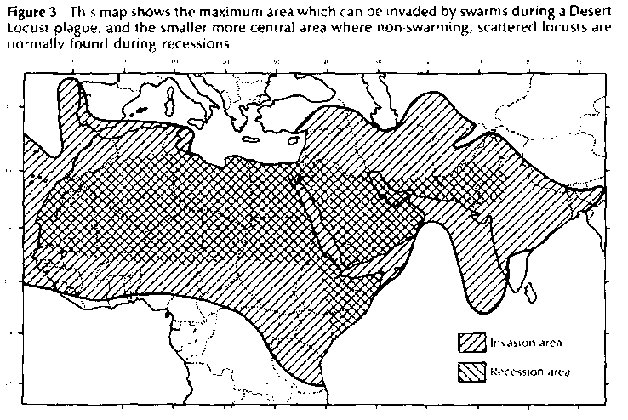
Crops on every continent, except Antarctica, are subject to depredation by locusts, but the areas most heavily infested usually have warmer climates. Areas where the Desert Locust may be found are shown on the map in Figure 3.

Figure 4 This map shows the major
seasonal breeding areas of the Desert Locust during plagues and
recession
Desert locust plagues and recessions
As with many other animals, the number of locusts fluctuates. Sometimes there are periods, which may last several years, when there are large numbers of swarms and hopper bands in many countries. It is during these periods, which are called plagues, that locusts cause greatest damage to crops. The longest plague on record lasted thirteen years.
The intervals between plagues are called recessions and may last several years' During recessions the number of locusts is much smaller; there are few, if any, swarms or bands, and most locusts are found thinly scattered and can be mistaken for large grasshoppers. Even when there are few locusts, however, they should still be reported because it is from them that new plagues arise.
The presence of small swarms or hopper bands in a recession may be one of the early signs of an approaching plague. National and regional locust organizations and the Emergency Centre for Locust Operations are interested in information about such populations.
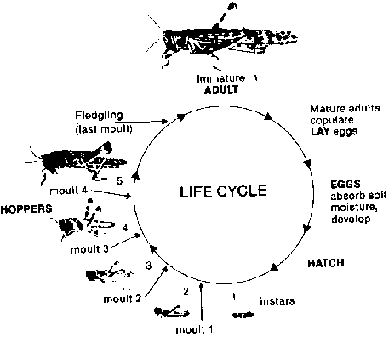
Figure 5 The life cycle of the
Desert Locust showing the relative sizes of each
instar
The life cycle of the desert locust
There are three stages in the life cycle of locusts: egg, hopper, adult.
In order to breed, the Desert Locust must lay its eggs in damp soil. Breeding therefore occurs in the rainy season. The main breeding areas and seasons of the Desert Locust are shown on the map in Figure 4. In recessions the migrations are more restricted and the breeding areas do not extend so far north and south as they do during plagues.
When the eggs, which are difficult to find, have been in the ground long enough to complete development (this is variable depending on the temperature, between 10 and 70 days), hatching occurs. When they hatch, young locusts have no wings and are commonly called hoppers. As they grow older they moult, that is, they shed their skins, five or, occasionally, six times (Figure 5). After the fifth or sixth moult they become adults with fully grown wings. This is their final shape and it is in this stage that they migrate to new breeding areas. You may therefore find adults far from breeding areas where they were hatched or where they will lay.

Figure 6 Size of
hoppers
The size of desert locust hoppers
Between the time when the eggs hatch and the appearance of winged adults there are usually five hopper instars or stages as shown in Figure 5. Each instar is larger than the one before, so size gives an indication of how old the hoppers are, how long ago hatching occurred, and how soon adults may be produced.
If you find a Desert Locust hopper, it helps the locust control organizations and the Emergency Centre for Locust Operations if you can tell them to which instar it belongs. The simplest method of doing this is to compare the hopper with the diagram in Figure 6, even though hoppers of the same instar do vary in size.
In the fourth and fifth instars, the developing wings can be seen clearly. They are 2- 3 mm long in the fourth and about 6-8 mm in the fifth instar.
The colour of desert locust hoppers
Desert Locust hoppers vary greatly in colour as shown in Figure 7. In general, their colour and pattern depend upon the density at which they have been living.
If there are few and they are living apart, they are usually green, but larger ones may be yellowish or pale brown; the exact colour often resembles that of the surrounding plants.
In dense hoppers bands, produced as a result of laying by a swarm, the young hoppers are black, but as they get older the black markings become proportionately smaller and a yellow background colour develops.
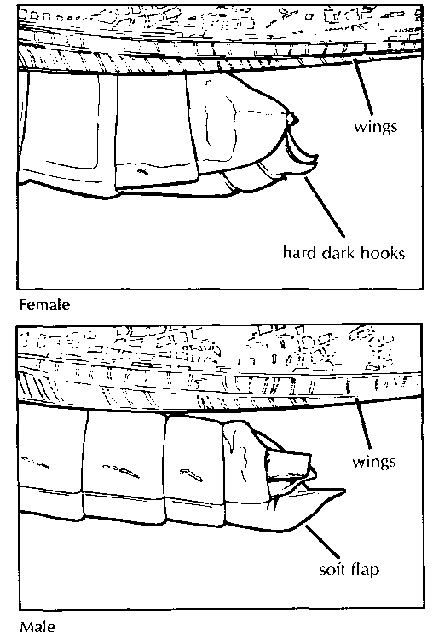
FIGURE Figure 8 The tip of the
abdomen of a female and a male Desert Locust, greatly
enlarged
|
| ||||||||||||||||||||||||||||||||||||||||||||||||||||||||||||||||||||||
Desert Locust Pocket Book (NRI)
Adults
To be sure that you have an adult Desert Locust, it will help to check both size and colour (see pages 20-25), but first determine the sex of your specimen.
How to distinguish males and females
As female locusts must dig a hole in the soil to lay their eggs, the tip of the abdomen (body) carries two pairs of short, hard, dark-coloured hooks. The end of the male abdomen is soft.
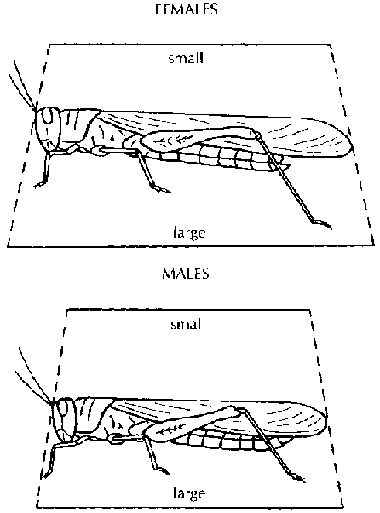
FIGURE Figure 9 Size of
adults
The size of adult desert locusts
Females are usually larger than males. The following
measurements are for the distance from
the front of the head to the tip of
the folded wings.
Females: smallest 7 cm largest 9 cm
Males: smallest 6 cm largest 7.5 cm
These sizes are shown in Figure 9, and when you know whether your specimen is male or female check by laying the specimen on the appropriate figure.
BEWARE: if the size is not within the range of sizes given, the specimen is unlikely to be a Desert Locust
The colour of adult desert locusts from swarms
Young swarming adults are a pink colour which can vary from dark to light
Older but immature adults become browner.
As they become sexually mature they turn yellow. This yellow colour becomes particularly bright in males.
These colours are typical of individuals from swarms; if you find a single locust of these colours, it may indicate that there has been a swarm in the area, even though it was not seen.
REMEMBER: always report the colour of the locusts that you find
The colour of non-swarming adult desert locusts
Non-swarming locusts may be found either singly or in small groups, or even in large numbers if spread over a large area. They usually fly at night and may occasionally be seen near camp lights.
Young non-swarming adults vary considerably in colour; they may be sandy coloured, brown or greyish (Figure 11). Like swarming locusts they gradually turn yellow as they become sexually mature. The yellow colour can be quite bright but solitary females are less bright in colour than those from swarms.
REMEMBER: a yellow locust is not necessarily from a swarm
Environmental conditions
Rainfall is very important for breeding. It provides water in the soil which the eggs need to absorb in order to complete development and it enables the desert vegetation, on which the hoppers feed, to germinate and grow.
Upland regions often receive more rain than surrounding lowlands. Run-off can result in suitable breeding sites in wadi beds downstream of areas where the rain has fallen.
Female locusts prefer to lay their eggs in sandy or silty soils. The soil must hold water for enough time to allow the eggs to develop.
Vegetation attracts adult locusts and provides a supply of food for the newly hatched hoppers.
Temperature affects the rate of development of eggs and hoppers. Lower temperature slows down the rate of development.
Locust reports
A good report should provide answers to the following four basic questions:
1. WHAT WAS SEEN?
2. WHEN WAS IT SEEN?
3. WHERE WAS IT SEEN?
4. WHO SAW IT?
The following notes explain what information should be included in your answers to the four basic questions.
To answer the questions and make an accurate report, you will have to observe the locust population and examine an individual, so that you may identify it from the illustrations and information given in this pocket book.
When you see locusts, always try to catch a live one or find a dead one.
If you have an insect-collecting net, it is easier to catch a sample.
Two other methods of collecting samples are to look in the radiator grille of a vehicle and also around any lights at night.
If you think you have seen a swarm, try to get close enough to see if it is composed of Desert Locusts. Many reported locust swarms have turned out to be groups of other kinds of insects, birds or even clouds of smoke or dust.
Question 1. What was seen?
This question can be divided into three parts:
(a) What kind?
(b) How many?
(c) What were they doing?
(a) What kind?
ADULTS (winged) or HOPPERS (wingless)
In either case give some indication of the colour, and in the case of hoppers also state the instar by comparison with Figure 6 on page 14.
(b) How many?
Except when the number of locusts seen is very small, it will not be possible to give an exact answer to this question, but some general indication of size of the population can be given in descriptive terms. The following examples indicate some of the possibilities.
For winged adults: (i) dense swarm 2 km across; (ii) swarm
flying overhead for 2 hours; (iii) scattered adults seen for 3 km; (iv) 4
locusts seen around camp lights; (v) groups of adults flushed when walking
through a millet cultivation.
For hoppers: (i) 10 dense bands of marching
hoppers seen in a distance of 2 km, the largest band 50 m across; (ii) many
small (approximately 1 m wide) groups in 10 ha of cultivated patches; (iii) 3 or
4 hoppers in each clump of vegetation for 1 km, average 20 clumps per 100 m2.
(c) What were they doing?
Adults may be in high-flying swarms, sometimes visible many kilometres away, or they may be low flying or settled on bare ground or on bushes or trees.
The locust organizations are interested in the direction of movement of a swarm but, as different groups of locusts in a swarm may be flying in different directions, this can be difficult to determine. Always give the direction from which the wind is blowing as the whole swarm is likely to be moving with the wind.
If locusts are on the ground, it is particularly important to report if they are mating or laying. When mating, the bright yellow males sit on top of the paler yellow females. When there are many locusts the males also remain on the females while they are laying, but if there are only a few locusts the sexes may separate. When laying, the females make a hole in the soil with the tip of their body (abdomen).
In the case of hoppers it is less important to report what they are doing.
If a locust population, either of adults or hoppers, is seen in a crop, this should always be reported.
Question 2. When was it seen?
Give the time as well as the date when the locusts were seen. It is important to state whether you saw adults by day or at night.
Question 3. Where was it seen?
Remember that even with maps and gazetteers it is not possible to locate the name of every small village and grazing area. Therefore try to fix the position of your observation with reference to some well-known place, for example, 2 km from the sea, 50 km south of Jeddah; 30 km south of Bikaner. Latitude and longitude are the ideal methods of fixing a report if you have a map, but always include a reference to a well-known place as well.
Remember that the locust organizations plot your report on a map
Question 4. Who saw it?
Your name and address should be included for two reasons:
(i) your report may be particularly important to the locust organization you informed (see page 35) and an official may wish to contact you on special points of interest;
(ii) all reports sent to the Emergency Centre for Locust Operations of the Food and Agriculture Organization of the United Nations, Rome, are recorded in the name of the informant.
Points to remember when making your report
1. What was seen?
Were the locusts adults or hoppers? If they were hoppers, what was their instar?
What colour were the locusts?
How many locusts were seen? Were they in swarms or bands or single individuals? In which direction were they moving?
What were the locusts doing? Were they flying, marching, mating or laying eggs? What were they eating?
2. When did you see them?
Was it daytime or night? Which date did you see them?
3. Where did you see the locusts?
Do you know the map reference? Can you give a rough guess of the distance from a well-known place?
4. Who saw them?
Please give your name and address when making a report.
|
| |||||||||||||||||||||||||
Desert Locust Pocket Book (NRI)
Specimens
If, after comparing your specimen with the illustrations in this pocket book, you are still in any doubt as to whether the insect is in fact a Desert Locust, you should send either a dried insect or just the front wings (the outside ones when the wings are folded) with your report.
A locust which has not dried properly tends to rot. They dry more quickly if the whole abdomen (the portion behind the legs, partly covered by the folded wings) is removed.
What to do with your report
If you are a government official you should send your report to your national locust control organization at its headquarters, either directly or through any locust officer in your district, your local plant protection officer, your local agricultural officer, administrative officer or the police.
You may also inform the appropriate regional Desert Locust information centre, as indicated below.
|
If you see Desert |
Send your report to: |
|
Locusts in: |
|
|
Algeria, Libya, |
FAO Regional Locust |
|
Morocco, Tunisia |
Officer |
| |
c/o PNUD |
| |
BP 823 |
| |
Alger, Algeria. |
|
Benin, Burkina Faso, |
Directeur G�n�ral |
|
Cameroon, Chad, C�te |
Organisation |
|
d'lvoire, The Gambia, |
Commune de Lutte |
|
Guinea, Mali, |
Antiacridienne et de |
|
Mauritania, Niger, |
Lutte Antiaviaire |
|
Senegal |
BP 1066 |
| |
Dakar, Senegal. |
|
Djibouti, Ethiopia, |
The Director General |
|
Kenya, Somalia, |
Desert Locust Control |
|
Sudan, Tanzania, |
Organization for |
|
Uganda |
Eastern Africa |
| |
PO Box 4255 |
| |
Addis Ababa, Ethiopia. |
|
Bahrain, Egypt, Iraq, |
FAO Regional Locust |
|
Jordan, Kuwait, |
Officer |
|
Lebanon, Oman, |
PO Box 327 |
|
Qatar, Saudi Arabia, |
Jeddah |
|
Syria, Turkey, United |
Saudi Arabia. |
|
Arab Emirates, Yemen Republic | |
|
Afghanistan, Ghana, |
Senior Officer |
|
India, Iran, Liberia, |
Emergency Centre for |
|
Nigeria, Pakistan, |
Locust Operations |
|
Sierra Leone, Togo |
AGP Division |
| |
FAO |
| |
Via delle Terme di Caracalla |
| |
00100 Rome, Italy. |
Private individuals seeing Desert Locusts in any country, or at sea, should send their reports to the appropriate address as stated above or they may send their report to:
Senior Officer Emergency Centre for Locust Operations AGP Division FAO Via delle Terme di Caracalla 00100 Rome Italy.
Telegrams FOODAGRI ROME
Telex 610181 FAO I
Facsimile
39-6-57973152
39-6-57975271
Control
When you have submitted your report of sightings the appropriate organizations will investigate and fully trained locust officers will, if necessary, take control measures against the Desert Locust. This insect, however, often occurs in remote areas and can cause great damage before locust organizations can be informed or respond to the problem. In these instances, farmers or officials from the local plant protection departments will have to supervise and carry out local control operations to safeguard crops.
At present, the application of insecticides, often on a wide scale, is the only effective means of controlling the Desert Locust.
For locusts to be killed by an insecticide they must either swallow it or get it on the outside of their bodies. This is achieved by:
(i) putting the insecticide on or in their food, either natural vegetation or a specially prepared bait; this is poisoning by stomach action;
(ii) putting the insecticide directly on to the locusts in a form that will penetrate their skin; this is poisoning by contact action.
Insecticides can be applied in three ways: baiting, dusting and spraying.
Farmers can use backpack sprayers to spray small bands of locusts. If sprayers are not available then locusts have to be dusted or baited.
The most commonly used method of control is a form of spraying known as ultra-low-volume (ULV) in which insecticide is applied to locusts in a concentrated form. ULV spraying operations are complicated and are usually carried out by specially trained plant protection officers. ULV spraying will not be dealt with in this pocket book. The Locust Handbook, also published by the Natural Resources Institute, should be consulted for information on ULV spraying.
Suitable insecticides currently used for Desert Locust control are shown in the table on the following pages. When using any insecticide the manufacturer's instructions should always be read and followed strictly. For your information, suitable insecticides used by plant protection officers for ULV spraying are also listed in this table.
Insecticides can be dangerous. This danger should be minimized by the choice of proper formulations of insecticide, careful handling and correct use of equipment, and the use of protective clothing, especially gloves and face masks.
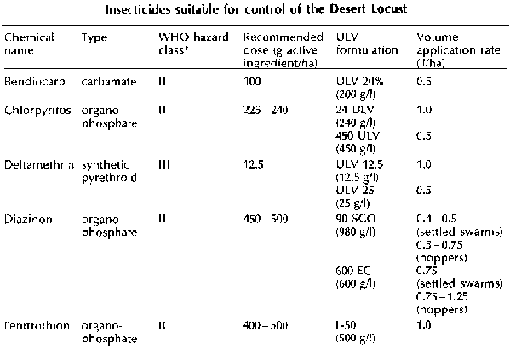
Table Insecticides suitable to
control of the Desert Locust

Table continued
Safety
Insecticides can be highly poisonous. It is important to take adequate safety precautions when transporting, storing or handling them.
Always wear protective clothing: rubber gloves, overalls, face mask and respirator when mixing insecticides; and gloves, long trousers and a long sleeved shirt when applying less hazardous insecticides. These clothes can be uncomfortable in humid climates but it is important not to let insecticides enter the body through the skin, mouth or lungs.
Always read and follow the instructions on the label.
Avoid splashing or spilling liquids and causing powders to puff up or spill.
Only use insecticides when the weather is still and dry.
Never eat, smoke or drink when handling insecticides. Avoid inhaling dusts or vapours.
Keep unauthorized people, especially children, away from insecticides.
Always wash thoroughly with soap and water after handling insecticides.
Keep insecticides in a locked store which is not likely to flood and is well away from water supplies.
Keep an accurate record of insecticide usage.
Dusting
Suitable dusts for killing locusts are bendiocarb and propoxur. The powdered insecticide is mixed with a suitable 'carrier', for example, chalk or talc, and sold in this ready-to-use form. Dust can be applied either by hand or by using a hand-blower.
Dust should be applied under moist conditions, either when there is high humidity, or after a heavy dew. It is most effective against night-roosting hoppers and adults, hoppers marching slowly through vegetation, and during the hatching period. It is dangerous to inhale the dust particles so care must be taken when handling the dust.
Baiting
A bait is a mixture of an insecticide with an edible 'carrier'. Carrier materials readily taken by locusts include maize meal, wheat bran, maize bran, cotton seed husk and rice bran. The insecticides, bendiocarb and propoxur, are recommended for use in baits. Insecticide and bait are usually mixed in the field or at a distribution point, not by the manufacturers. Locusts eat the bait and so take in the insecticide. Bait is usually spread by hand.
The dosage required for baiting will vary considerably with the stage of development and the behaviour of the hoppers. Usually the insecticides are used in concentrations of 1 or 2% active ingredient. A mix of 10 kg of 1% bendiocarb, 25 kg of 2% propoxur or 50 kg of 1% propoxur with 200 kg of carrier gives satisfactory results. Rates of application of mixed baits are: 50-75 kg/ha for resting hoppers; 5-15 kg/ha for actively marching bands; 150-200 kg/ha for settled adults.
Hopper bands should first be tested with a small quantity of bait to see if they will stop to feed. If the hoppers are hungry, baiting should start from the front edge of the band and bait should be scattered thinly and evenly. The younger the hoppers, the less bait will be required to kill them. Baiting gives poor results during the last 2-3 days of the fifth instar and during all moulting periods. It is particularly useful for control of marching bands when there is little annual vegetation and much bare ground.
Baiting can also be used against adult locusts. It is best applied in the morning before they start to fly. Scattering bait is one of the safest methods of controlling locusts among crops.
Spraying
In this method of control, liquid insecticide is broken up into fine droplets and sprayed either on to the locusts or on to the vegetation which they will eat.
To obtain the best kills at the minimum cost the suitable insecticides require special formulations and an appropriate spraying machine should be chosen.
Spraying emulsifiable concentrates with a backpack sprayer can be used to treat relatively small bands of Desert Locust. Large drops should be sprayed in a light wind or in still air. The track spacing (distance between spray runs) should be about the same as the swath width (distance from the start of spray deposit to where it reaches an insignificant level). The drops will fall in a uniform pattern over a 1 metre wide band.
Insecticides are expensive to buy and so their improper use, such as overapplication or underdosing, is costly. They can also be dangerous to man and the environment if not used correctly.
|
| ||||||||||||||||||||||||||||||
Summary
Points to check when you think you have found a Desert Locust
1. Check that you have found the specimen in a reasonably likely area (see Figure 1). It should be noted that adult Desert Locusts are sometimes carried out to sea by the wind.
2. If it has wings you have found an adult, check its size, sex and colour with the illustrations on pages 19-25.
3. If it is wingless you have found a hopper, check its size, instar and colour with the illustrations on pages 14-17.
4. There are numerous other species of locusts and grasshoppers which live in the same areas as the Desert Locust. If you are in doubt whether the specimen you have caught is a Desert Locust, send a dried specimen. In the case of adults a single front wing is sufficient.
5. Send your report with as much information about what was seen, when it was seen, where it was seen and who saw it (see pages 27 - 33) to the local locust organization, the local plant protection officer, the local administrative officer or the police, or to the appropriate regional Desert Locust information centre (see pages 35-37) or the Emergency Centre for Locust Operations, FAO.
6. Where appropriate, control measures should be taken using suitable insecticides.