|
| ||||||||||||||||||||||||||||||||||||||||||||||||||||||||||||||||||||||||||||||||||||||||||||||||||||||||||||||||||||||||||||||||||||||||||||||||||||||||||||||||||||||||||||||||||||||||||||||||||||||||||||||||||||||||||||||||||||||||||||||||||||||


|
| ||||||||||||||||||||||||||||||||||||||||||||||||||||||||||||
Published by arrangement with the
Institut africain pour la
d�veloppement �conomique et social
B.P. 8008, Abidjan, C�te d'Ivoire
FOOD AND AGRICULTURE ORGANIZATION OF THE UNITED NATIONS
Rome
1977
FAO Economic and Social Development Series No. 3/13
Reprinted 1977, 1982, 1984, 1992
P-69
ISBN 92-5-100618-0
© French edition, Institut africain pour le d�veloppement
�conomique et social (INADES) 1967
© English edition, FAO
1970
|
| ||||||||||||||||||||||||||||||||||||||||||||||||||||||||||||
Preface
The first twenty- six volumes in FAO's Better Farming Series were based on the Cours d'apprentissage agricole prepared in the Ivory Coast by the Institut africain de developpement economique et social for use by extension workers. Later volumes, beginning with No. 27, have been prepared by FAO for use in agricultural development at the farm and family level. The approach has deliberately been a general one, the intention being to constitute basic prototype outlines to be modified or expanded in each area according to local conditions of agriculture.
Many of the booklets deal with specific crops and techniques, while others are intended to give the farmer more general information which can help him to understand why he does what he does, so that he will be able to do it better.
Adaptations of the series, or of individual volumes in it, have been published in Amharic, Arabic, Bengali, Creole, Hindi, Igala, Indonesian, Kiswahili, Malagasy, SiSwati and Turkish, an indication of the success and usefulness of this series.
Requests for permission to issue this manual in other languages and to adapt it according to local climatic and ecological conditions are welcomed. They should be addressed to the Director, Publications Division, Food and Agriculture Organization of the United Nations, Via delle Terme di Caracalla, 00100 Rome, Italy.
|
| ||||||||||||||||||||||||||||||||||||
Better Farming Series 13 - Keeping Chickens (FAO - INADES, 1977, 48 p.)
Small livestock farming in the villages
1. Small livestock farming is common in villages all over the world. Everywhere you see around the houses numbers of sheep, ducks, pigs, and above all chickens.
2. The villagers raise all these animals in order to have meat on feast days - for the arrival and departure of visitors, for sacrifices, marriages, births and funerals. And certain families have even got Into the habit of eating meat fairly often and, for instance, giving eggs to their children.
3. Very often, too, villagers sell animals when they need money: to pay taxes, to pay the expenses of children going to school, to buy medicines, salt, cement, sheet iron, tobacco, paraffin.
Small livestock farming is a way to build up reserves of food and money.
Little work but yields little
4. Not much trouble is taken about feeding these animals. The animals find their food by scavenging among the houses of the village.
They get what is left over from the harvest and from people's food.
5. Not much trouble is taken about watering these animals.
Very often they do not get enough to drink, or they get dirty water that gives them diseases.
6. Not much trouble is taken about housing these animals.
They are not put in an enclosure or under a shelter to protect them against wind and rain, and to guard them against thieves.
Animals that are not kept in an enclosure go into the houses and into the fields and damage everything.
BUT YIELDS LITTLE
7. Many animals are small
Animals that are not of a good breed and are poorly fed do not grow well.
They do not yield much meat.
You cannot sell them at a good price.
8. Many animals are sick
Animals that run about everywhere
catch diseases.
When a hen has a contagious disease all the hens in the village get it.
A sick animal does not grow well, and it often dies.
9. Many animals die very young
Diseases, predators, and lack of care and food kill many chicks.
10. Very often out of 15 chicks that are hatched there remains at the end of a year only one sound chicken. The others - 14 out of 15 - are either dead or sick or too small.
11. They yield little meat for the villagers ...
Very often the animals, even those more than two years old, remain small and yield very little meat. So that on feast days and at funerals, for instance, a lot of animals have to be killed to get enough meat.
12.... or for the country
The country has to buy abroad good meat to feed the people in the towns.
So it loves a lot of money.
The money used to buy meat abroad cannot be used to make roads, build schools, or pay for nurses and medicines.
Enough good meat must be produced so that the country does not have to buy it abroad.
13. They yield little money
The hens and chickens are too small to be sold at a good price.
All the chickens that are dead or sick have been fed for nothing.
All the remains of food or of the harvest eaten by these animals have brought the farmer nothing.
The farmer has spent very little, but he has not earned all the money that he might get with his livestock.
Chicken farming must be improved
14. Hens can be much better fed and much better looked after without the farmer spending much money.
15. As it is, in many villages you see hens of a good breed, that are well- fleshed, resist diseases well, yield a lot of meat and many big eggs.
16. Near the towns, there are even large poultry farms that produce eggs and chickens to be sold to the people in these towns.
These are industrial farms.
In this booklet we are speaking especially about raising poultry at home.
When raising poultry at home:
· the farmer and his family
themselves look after the birds;
· the
greater part of the birds' food is not bought;
· most of the meat and eggs are used by the family;
only the surplus meat and eggs are
sold.
The animal husbandry services help
17. These services are trying to find out:
· what are the breeds that yield
more, that are more resistant to heat, dampness and diseases;
· what food to give these good breeds;
· what vaccinations protect poultry from diseases.
They also sell cocks, hens and chicks of good breeds.
18. They teach farmers how 10:
· house poultry;
· feed them better;
· protect poultry from diseases;
· organize livestock farming.
The work of the animal husbandry centres and animal husbandry services is very important.
19. Assistants of these centres and services should:
· have a good knowledge of traditional livestock farming; and observe carefully what farmers are doing, so as to advise them better;
· win the confidence of farmers so that the advice is listened to and followed;
· have a good knowledge of the modern way of livestock farming so as to produce more.
The work of the assistants Is also very Important.
20. A male is called a cock
A mother bird is called a hen. Their little ones are called chicks.
When the chicks have grown big enough to be sold, they are called chickens. All the birds in the poultry house (cocks, hens, chicks and chickens) are called poultry.
To succeed in keeping poultry, you must:
· choose hens of a good
breed;
· teed them well;
· house them well;
·
protect them well against diseases.
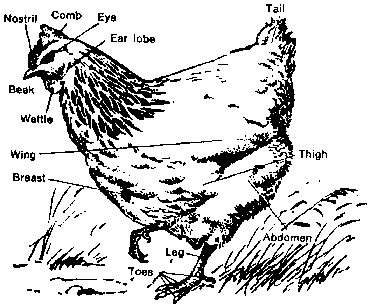
A family poultry unit should not
cost much, but It should yield a
lot
|
| ||||||||||||||||||||||||||||||||||||||||||||||||
Better Farming Series 13 - Keeping Chickens (FAO - INADES, 1977, 48 p.)
How to choose poultry
Traditional types of poultry
21. They do not ask much In the way of looking after.
Often they are quite resistant to dampness, heat, and even to certain diseases: they are called hardy.
But:
22. They are small.
They do not weigh much. They do not yield much meat.
23. They do not grow quickly.
You have to wait at least six months before you can eat or sell them.
24. They do not produce many eggs.
Their eggs are often small.
They produce only 30 to 50 small eggs a year.
So the traditional types of poultry must be improved.
To improve poultry
Good cocks must be selected
25. In several areas animal husbandry centres and services are
carrying out what is called cock distribution. The village cocks are taken away
and replaced by cocks of good breeds.
As you know, the qualities of an
animal's father and mother are passed on to their young.
The qualities of a cock of good breed and the quality oat a hen of local breed are passed on to their chicks.
Thus the chicks born of a cock of good breed and a hen of local breed are Improved poultry.
The male chickens must be sold or eaten.
Then another cock has to be bought next year and mated again to hens of the first cross.
After that the new breed can reproduce itself without further introduction of cocks.
26. Cock distribution is a quick way to get a better product for eating and selling.
It costs the farmer little - the price of the male, the cost of the vaccination and some improvement in the poultry shed, better feeders and drinkers, which he can make from scrap material.
Good hens must be selected
27. The hens of Improved breeds
Those that come from foreign countries make better use of their feed than the local hens do.
They grow quickly, become fat, yield a lot of meat and produce many big eggs.
28. If a farmer decides to feed his local hens well he will not earn much money and will not get much meat.
A local hen grows fat very slowly, uses a lot of feed and uses it badly.
On the other hand, a chicken of improved breed needs only 3 to 5 kilogrammes of feed from its birth to the day when it can be sold or eaten.
29. You get more meat and you earn more money by feeding well a hen of Improved breed than a local breed of hen.
30. The animal husbandry centres and services have selected the improved breeds of hen with good resistance to diseases, and well adapted to the climate.
It is best to buy these hens from the animal husbandry centres and services.
Good chicks must be selected
31. You can buy either day- old chicks, or three- month- old pullets.
Day- old chicks Cost less than three- month- old pullets. But you have to know how to raise them. You have to be able to house them well, for they are very delicate and can die easily.
Three- month- old pullets Cost much more. But they require less looking after. They have been vaccinated and they are more resistant to diseases.
32. When you begin modern poultry keeping it is better to buy three- month- old pullets.
They are easier to raise than the day- old chicks. They need less looking after. They do not die so easily. They are vaccinated.
33. It Is no use selecting cocks, hens and chicks of a modem breed - unless you feed them well
The cocks, hens and chicks bought from the animal husbandry centres have been well fed.
You must go on feeding them well. If you do not, they will not get fat. They will catch diseases and they may die. In a well- run poultry farm with 100 laying birds, not more than 5 or 10 birds should die in the course of one year.
· unless they are vaccinated
All poultry should be vaccinated.
If the birds have not been vaccinated at the animal husbandry centre, you must vaccinate them at once.
· unless you look after them well
If you buy cocks and hens and then do not take good care of them, of their food, their housing and their health, you are wasting all your money.
Traditional poultry raising means little work, costs nothing, but yields little.
Modem poultry raising means work, costs a little money, but can yield a lot.
Improved breeds
34. At the animal husbandry centres you can get Improved breeds of poultry.
For example, here are some of the more successful crosses. In naming the crossed breeds, the breed of the male is always given first.
Rhode Island- Sussex cross
The hen is a light mahogany colour; the cock is white speckled with black.
The hen is a good layer.
In 10 months, that is about 300 days of laying, it will lay 165 to 180 eggs.
Sussex- Rhode Island cross
This cross gives birds that are white speckled with silvery black.
The hen is quite a good layer.
A three- month- old pullet will weigh from 1.5 to 1.7 kilogrammes.
Rhode Island- Wyandotte cross, also called P- 60, is a bird of dark mahogany colour.
Often the hens have a flat curly comb. The hen is a good layer.
But it dislikes damp.
The adult hen weighs between 1.7 and 2
kilogrammes.
New Hampahire- Leghorn and Rhode Island- Leghorn crosses.
These crosses often produce white birds and sometimes birds with mahogany feathers.
They produce white eggs.
There are the Gold- Hen and Harco
crosses.
Other new breeds are being introduced which carry trade names.
The animal husbandry centre can tell you which of them are suitable for your particular conditions.
|
| ||||||||||||||||||||||||
Better Farming Series 13 - Keeping Chickens (FAO - INADES, 1977, 48 p.)
How to feed poultry
To feed poultry well is important and difficult
35. In modern poultry raising you must take a lot of care in feeding the birds.
You want to have birds that grow quickly and yield a lot of meat and eggs.
For that you have to work more and provide most of the feed yourself.
Often you have to buy part of this feed.
36. Poultry are difficult to teed. They need a lot of different types of teed.
For instance, a hen is not like a goat, and cannot feed only on grass.
Poultry need rich feed.
For instance, to produce eggs a hen needs to get in its feed plenty of proteins and calcium.
Poultry need a certain quantity of each type of teed.
For example, if, to build your house, you have 10 kilogrammes too much cement and not enough sheet iron, you cannot use the cement instead of the iron. If, to build its body, a hen has too much protein and not enough calcium, the protein cannot replace the calcium.
It is useless.
You must give poultry the exact quantity of each feed that is needed.
Poultry need good feed
7. To build up their bodies
The muscles
It is the muscles of poultry that yield meat. Poultry are good if they yield a lot of meat in a short time, if the meat is not hard, and is white. The local breeds of hens that are not well fed are thin and their meat is hard.
The hens of improved breeds have well- developed breast and
thigh muscles.
If poultry eat plenty of protein feeds, they develop good
muscles.
The protein feeds are also part of body- building feeds.

Muscles of a hen
The bones
If poultry have well- formed bones, they can walk well. Poultry bones are long and thin. They are light, but hard.
In order to have strong hard bones, poultry must eat mineral salts; if they lack mineral salts their bones are badly formed. Mineral salts are part of the body- building foods.

Skeleton of a hen
38. To make big eggs
A hen has only one ovary. The ovary produces ovules. The ovule consists of a germ and reserves. It is these reserves which make the egg yolk. The ovule passes into the oviduct where the white and the shell of the egg are formed. The egg passes into the cloaca and out of the hen.
39. A hen begins to lay from the age of five months, and can produce an egg nearly every day from the age of seven months.

Reproductive system of a hen

Hen's egg
40. The egg shell is made of mineral salts, especially calcium.
The egg white contains a lot of water, protein substances and mineral salts.
The egg yolk contains a little water, a lot of protein substances, fat and vitamins.
41. To reproduce themselves and have fine chicks
If you want to have chicks the hen must be fertilized by a cock. You will then have fertilized eggs which will produce chicks. To improve the quality of the chicks you will want to take part in a cock distribution scheme. (See paragraph 25.) The cock makes a lot of sperm. So it also needs to be well fed. A cock eats more than a hen.
One cock can fertilize ten hens
On the other hand, you should not keep cocks if you do not want chicks, but only eggs.
42. To be always In good health
In order to grow and produce eggs, poultry need foods that we call body- building foods.
Poultry also need feeds that give strength (energy
feeds).
They need them to live, eat, digest, walk, and to resist cold, heat,
and
diseases.
|
| ||||||||||||||||||||||||||||||||||||||||||||||||||||||
Better Farming Series 13 - Keeping Chickens (FAO - INADES, 1977, 48 p.)
How poultry make use of food and water
43. The digestive system of poultry begins with the beak and ends with the cloak and anus. A hen has no teeth to grind its feed; it swallows down its food at once.
44. The food swallowed passes into the oesophagus and then into three different organs:
· the crop where the food is
moistened,
· the stomach where the food
begins to be digested,
· the gizzard where
the food is ground up.
45. You often see hens swallow little stones. These stones stay in the gizzard; when the feed arrives in the gizzard, it is ground up by the stones.
46. After this the feed is digested. The digested part goes into the blood and feeds the whole body. The remainder passes out through the cloaca; this is the excrement
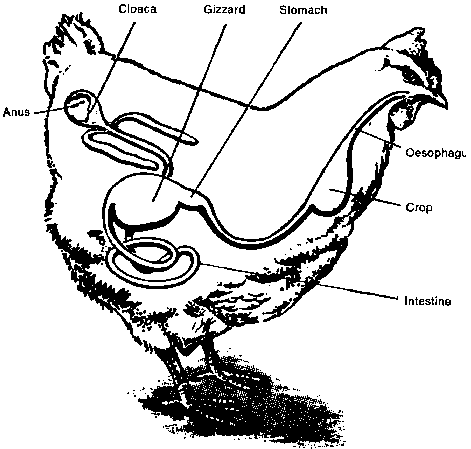
Digestive system of a
hen
Energy feeds
47. Poultry feed must contain above all energy feeds. Often the farmer can himself produce these feeds. The main energy feeds are:
· Maize, sorghum, millet, rice
You can give these in the form of grain or of meal. Poultry like maize; they can eat a lot of it without harm.
· Cassava
You can give it in the form of meal, or boiled. You must not give too much. In 10 kilogrammes of feed there should not be more than 2 kilogrammes of cassava.
· Rice bran
In 10 kilogrammes of feed, there should not be more than 1 kilogramme of rice bran.
· Palm- kemel oil cake
This is both an energy feed which can replace maize, and a body- building feed which can replace groundnut oil cake. In 10 kilogrammes of feed there should not be more than 1.5 kilogrammes of palm- kernel oil cake.
Body- building feeds: proteins
48. Body- building feeds are rich in proteins.
Poultry need proteins that come from animals and also proteins that come from plants.
For instance, if you give poultry 2 kilogrammes of feed containing proteins, there should be:
1.5 kilogrammes of vegetable proteins, 0.5 kilogramme of animal proteins.
49. Proteins that come from plants
Oil cake contains a lot of proteins.
Oil cake is the name for what is left when the oil has been taken from groundnuts, cotton, palm kernels, coconuts.
Groundnut oil cake
Poultry digest it well.
In 10 kilogrammes of feed, 1.5 kilogrammes can be groundnut oil cake.
Cotton oil cake
Poultry cannot digest a big amount of this.
In 10 kilogrammes of feed, not more than 0.5 kilogramme should be cotton oil cake.
Palm- kemel oil cake
This can take the place of maize and groundnut oil cake, but you should not give more than 1.5 kilogrammes of it in 10 kilogrammes of feed.
50. Proteins that come from animals
Boiled blood, meat meal, milk powder or fish meal. You should not give poultry too much protein.
It costs a lot and, if you give too much, it may make the poultry ill.
51. Energy feeds and body- building feeds are not well used by poultry unless you give at the same time:
· mineral salts, vitamins and clean water.
Mineral salts
52. In 10 kilogrammes of feed, there should be 200 grammes of mineral salts.
Bones, oyster and snail shells, and egg shells are rich in mineral salts.
If you do not give mineral salts, poultry cannot grow well; their bones will be small and badly formed.
Vitamins
53. You should mix vitamins in poultry feed if the birds are kept in a yard.
Otherwise the birds get vitamins by eating grass. Vitamins are given in very small quantities.
The farmer cannot produce them.
You have to buy them.
Vitamins can be bought in shops or from the animal husbandry centres.
Clean water
54. It is very important to give poultry plenty of clean water.
Poultry do not make good use of their food if they do not drink enough water.
One hen can drink a quarter of a litre of water a day.
For 20 hens, you need about 5 litres of water a day. If the weather is very hot, the birds will drink more. Each hen will drink about half a litre of water every day.
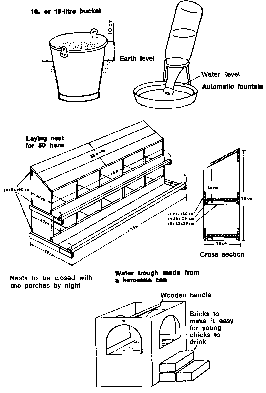
Put the water in fairly big drinking troughs so that several hens can drink at the same time.
Put the drinking troughs in the shade, near the feeding troughs.
Never let drinking troughs be empty. The water must always be clean. II It is dirty, it must be changed. Dirty water gives poultry a lot of diseases.
To make good use of feed poultry must drink a lot.
Special needs of chicks, laying hens, and table poultry
55. In domestic poultry keeping, the farmer produces and prepares most of the poultry feed himself.
In this way he does not spend much money; he uses up what is left over from the family's food and from his harvest.
But he must take care.
He has to give all the birds their complete feed, and this means different feed to birds of different ages.
56. From birth to 8 weeks
Chicks need above all body- building foods.
You should give them water and a feed containing, for instance: in every 10 kg of meal:
7 kg of crushed maize and/or other grains, 2 kg of groundnut oil cake,
1 kg of a mixture consisting of remains of meat, fish or blood, of oil or vegetables, of bones and crushed shells, of termites.
57. From 8 to 14 weeks
The feed should be more plentiful. There should be in every 10 kg of meal:
8 kg of crushed maize and/or other grains, 1.5 kg of groundnut oil cake,
0.5 kg of a mixture consisting of remains of meat, fish, blood, grass, termites, vegetables.
58. After 14 weeks
Give only maize grain or a mixture of maize with other grains.
Remember!
If the poultry are in a yard, you must also give
them feeds that are rich in vitamins: grass vegetables; and rich in proteins:
termites meat scraps fish scraps.
59. Laying hens
To make the shells of their eggs, laying hens need plenty of mineral salts.
To make the reserves in the egg, laying hens need plenty of proteins.
For instance, give in every 10 kg of feed:
8 kg of crushed grains (maize, sorghum), 1.5 kg of groundnut oil cake,
0.5 kg of a mixture consisting of meat or fish, boiled blood, grass and vegetables, and especially 300- 500 grammes of crushed bones, oyster or snail shells or egg shells.
60. During the first three months of life a bird eats about 5 kilogrammes of feed.
61. The food must be well mixed.
You must not make the mixture too long before giving it to the poultry, otherwise the food may go bad.
Feeding and drinking troughs and the drinking founts must always be very clean.
62. If a farmer buys poultry feed
· Either he buys all the teed
That is, a meal containing all the foods that poultry need to live and grow. He should not give any other food. This meal is costly. He must follow the seller's instructions and only give the necessary quantities.
· Or he buys only part of the feed - the concentrates
These are the kinds of meal that contain chiefly proteins, mineral salts and vitamins. If the farmer buys concentrates, he must also give crushed grain oil cake.
63. If you buy poultry feed, you have less work to do, but you may lose a lot of money.
Follow the advice of the animal husbandry centres.
|
| ||||||||||||||||||||||||||||||
Better Farming Series 13 - Keeping Chickens (FAO - INADES, 1977, 48 p.)
How to protect poultry against disease
Preventing poultry from getting ill
64. Buy at the animal husbandry centres day- old chicks or three- month- old pullets
That way you get poultry of a good breed that resist heat, dampness and diseases.
These birds are in good health and have usually been vaccinated.
65. Pay attention to cleanliness
The poultry house, and the feeding and drinking troughs must always be very clean.
You must clean them out often.
66. Do not put too many birds together
If you put too many birds together, they may wound or even kill each other.
The stronger ones peck the weaker.
The grass in the run is soon eaten up by the birds, and cannot grow again.
Diseases are passed more easily from one bird to another.
67. You must not put hens together with ducks, guinea fowls, turkeys.
The diseases of ducks, guinea fowls and turkeys can be given to the hens.
For 50 laying hens, you need an area of about 25 x 20 metres.
68. Take any sick birds out of the run
You must not eat sick poultry.
You must kill them and burn them so that the microbes are not left in the ground to be passed on to the other birds.
It is also better to take out of the run hens that are too thin and do not grow any more.
They do not resist diseases well and can give them to the poultry in good health.
69. Ask the animal husbandry service for advice
When a bird is sick or dead, take it to the animal husbandry service, or to the nearest veterinary assistant. Then you must follow his advice, so that the disease is not passed on to all the poultry in the village.
Often you see all the poultry of a village killed by the same disease. This must be avoided.
70. Get all poultry vaccinated
All poultry bought at animal husbandry centres that have not already been vaccinated, for instance day- old chicks, must be vaccinated.
Vaccination
71. All poultry must be vaccinated when they are very young, before they have begun to lay eggs.
Young birds that have not been vaccinated do not resist diseases, and die.
If you have to vaccinate a hen that is laying, it will not lay any more eggs. Vaccination is generally used against fowl pox, cholera and Newcastle disease.
There are two chief ways of vaccinating:
· mixing the vaccine with the
drinking water;
· by making injections.
The animal husbandry service teaches farmers how and when to give injections. Ask the animal husbandry service for clear instructions and vaccine.
Main diseases of poultry
There are many poultry diseases. Some of them are difficult to recognize. We shall deal only with the main diseases.
72. Bone disease
The birds walk with difficulty; they limp. The leg bones are badly formed.
This disease is chiefly caused by lack of vitamins and mineral salts. So these birds must be given food that contains more vitamins and mineral salts, such as vegetables and crushed bones and shells.
73. Pullorum disease
The chicks are listless, walk with difficulty. They have a very big belly and drag their wings. Their excrement is liquid and turns white. Many of the birds die at the age of 8 days.
The disease is transmitted by the hens' eggs. A hen that has had pullorum, even if it has been cured, always produces infected eggs. All its chicks will be diseased.
Such hens can be kept to eat or to sell the eggs, but should not be kept in order to have chicks. To prevent poultry from catching this disease, do not buy chicks from unknown sources.
The animal husbandry service that sells chicks gives farmers a certificate saying that the chicks are free from this disease.
74. Fowl pest (Newcastle disease)
Fowl pest is a very common disease and very dangerous.
It kills very quickly a large number of poultry. The birds breathe very heavily and very badly. They digest their food badly.
When they have this disease, they cannot be treated: there is no medicine.
But you can prevent the birds from getting this disease.
You must not mix chickens of local breeds with the chickens bought from the animal husbandry service. All poultry must be vaccinated.
75. Coccidiosis
Parasites living in the digestive system are the cause of this disease.
Blood is seen in the excrement of chicks between 10 days and 3 months old.
If the chick is not dead in 30 days, it will always remain thin and will be very late in laying.
To cure diseased poultry, you can mix in the water coccidiostats that stop the disease.
But to prevent poultry from catching this disease, you must:
· not put too many birds
together;
· be very careful about the
cleanliness of drinking troughs and poultry houses;
· put coccidiostats in the drinking water.
There is no vaccine against coccidiosis.
The coccidiostats are provided by the animal husbandry service.
76. Pecking
The birds peck each other. They pull out feathers and make the skin bleed. Then the birds become more and more vicious.
If there are too many poultry in a run, if their house is not shaded from light, if the drinking and feeding troughs are not big enough, the birds are quick to fight, and may even kill one another.
You should:
· take out of the run all the
wounded birds and those which are most vicious;
· treat the wounds with a bad- smelling
medicament;
· sometimes cut off the tip of
the beak.
You can also hang bundles of vegetables or green grass from the roof of the poultry house.
Then in reaching for this food the poultry get tired and become less vicious.
77. There are many other diseases such as fowl pox, spirochetosis and cholera.
There are vaccines and drugs against several of these diseases.
Ask your animal husbandry service for advice.
|
| ||||||||||||||||||||||||||||||||||||||||||||||||||||||||||||||||||
Better Farming Series 13 - Keeping Chickens (FAO - INADES, 1977, 48 p.)
How to house poultry
78. 100 birds at various ages need the following:
|
Age |
Space in the poultry house |
Drinking troughs |
Feeding troughs accessible from both sides | |
|
Weeks |
Square metres |
Number |
Capacity, litres |
Length, metres |
|
1 |
4 |
2 |
4 |
1.2 |
|
2- 4 |
6 | | |
2 |
|
5-11 |
8-15 |
2 |
10 |
4 |
|
12 onward |
20-30 | |
|
5-7 |
|
Adult birds |
30 | | |
7 |
NOTE: 1 metre of perch is sufficient for 5 or 6 adult birds.
How to build a poultry house
You will need:
5 poles, 4 metres
9 poles, 2.5 metres
2 poles, 8
metres
8 poles, 3 metres
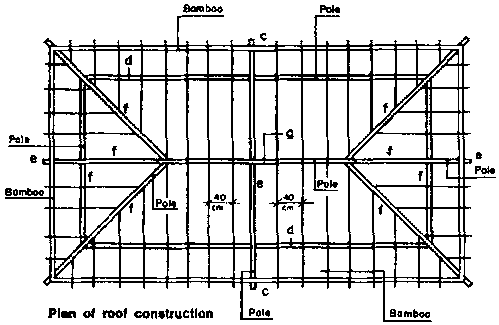
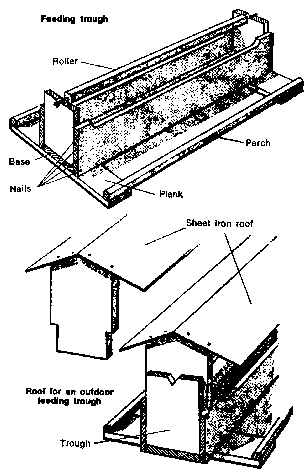
1 pole, 3.5 metres 70 laths for the roof 17 mats Hay or straw for thatching Poultry wire netting, 22 metres One roll of wire Fittings for the door 300 mud bricks Sand Nails, 6 kilogrammes Inside all poultry houses put feeding troughs and drinking founts.
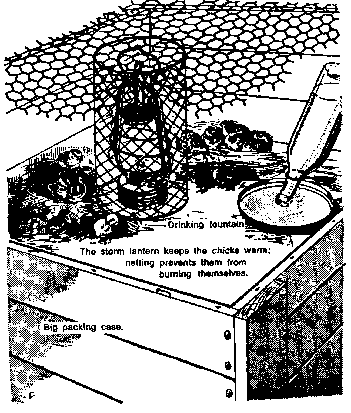
If you want to raise chicks, put in brooders.
If you want to raise laying hens, put in nests.
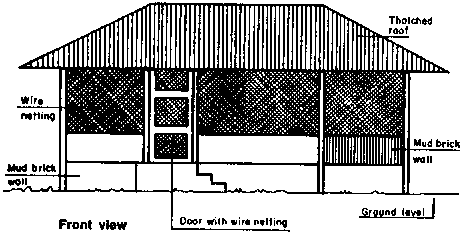
Front view
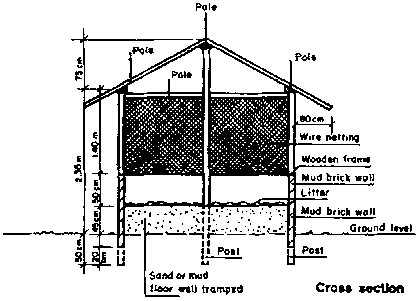
Cross section
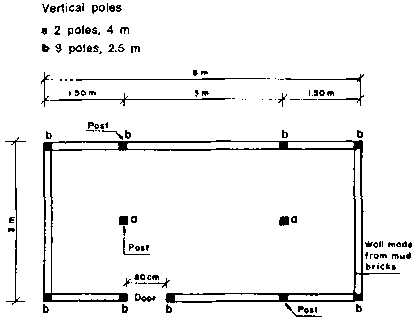
Vertical poles
Floor plan Horizontal poles
|
c 2 poles, 8 m |
f 8 poles, 3 m |
|
d 2 poles, 6 m |
g 1 pole, 3.5 m |